

Morning Session Zoom Link Evening Session Zoom Link Mon | 12 noon – 1pm WAT | Nurturing Innovators & Career Planning – Precious Ajoonu – Tekedia Live | Zoom link Mon | 7pm – 8pm WAT | Nurturing Innovators & Career Planning – Dr Akanimo Odon – Tekedia Live | Zoom link Tue […]
The Rumoured Apple Search And Frontal Attack On Google

Apple is rumoured to be going after the jewel of Google by launching a search engine. If Apple follows through, preferring to lose about 20% of its annual profit which Google pays it, it would be a new dawn in frenemy confrontation in big tech. But Apple may not have an option with the U.S. government suing Google for paying companies like Apple for positioning Google search in browsers (like Apple’s Safari) and other gateways.
Largely, Apple does not see that payment to survive the court case, and if it does not have an alternative, it may miss that money even as it serves Google since many Apple users will end up using Google search, the industry best. So, the best plan would be to build a search in-house as the future looks like the one where that annual transfer from Google may not be coming.
Apple has a growing interest in search technology and might even be working on a product to compete with Google, according to The Financial Times.
The most visible change is the fact that in iOS 14, Apple is now showing its own results when you type queries in the home screen. In addition, there seems to be an increase in activity from Apple’s web crawler.
There may be more of an opportunity here as the U.S. Justice Department has sued Google over what it claims are anticompetitive behaviors around search. However, this doesn’t necessarily mean Apple and Google will soon be going head-to-head in search — it could just be a sign that Apple’s Siri voice assistant is getting more search queries. (TechCrunch newsletter)
Google controls 80% of the U.S. search market. The government noted that Google pays “mobile-phone manufacturers, carriers and browsers, like Apple Inc.’s Safari, to maintain Google as their preset, default search engine”. Apple generates about 20% of its profit from such payments from Google. If you look at it carefully, this is a circle: Google pays Apple, Google gets funds from advertisers, and sends some to Apple, provided Apple does not allow another company into the party. Apple is happy since it is guaranteed a solid inflow. Government thinks that is illegal. Now, with that Apple-Google arrangement on shaky grounds, Apple wants to bail out by building its own search product. That is an attack on Google’s one oasis.
Why Google Investors Should Celebrate US Government Lawsuit Against Google
Eligible Businesses and Sectors for Nigeria’s N75 billion Youth Investment Fund

The Nigerian government has disclosed businesses and sectors that qualify for the N75 billion Nigeria Youth Investment Fund (NYIF). The sectors which are eligible are as follows:
- Technology/Innovation
- Agriculture and related value chain
- Green Economy and Renewable energy sector
- Manufacturing
- Hospitality/Tourism
- Construction
- Logistics and supply chain
- Healthcare value chain
- Creative sector
- Trading and services
- Others as may be determined by NYIF/CBN from time to time.
Those excluded are captured as follows:
- NIRSAL Microfinance Bank (NMFB) current loan beneficiaries – which includes Targeted Credit Facility (TCF) and Agribusiness/Small and Medium Enterprises Investment Scheme (AgSMEIS) loans, that remains unpaid.
- In addition, beneficiaries of other government loan schemes that remain unpaid are also not eligible to participate in this scheme.
Nairametrics offers more insights on the funds terms.
The CBN, however, states that preference shall be given to enterprises that will support the growth of priority sectors, specifically those identified by the Economic and Recovery Growth Plan (ERGP) and the Nigerian Youth Employment Action Plan.
The Federal Ministry of Youth and Sports Development is expected to collaborate with relevant stakeholders to identify potential youths for training and mentoring. The youths that are duly screened (and undergo the mandatory training where applicable) shall be advised to log on to the portal provided by the NIRSAL Microfinance Bank (NMFB) to apply for the facility.
Here is the link; please apply. It is your money and do not wait. Part of this is structured as a grant which means you may not have to pay for it (that can change though). Also check this link.
Meanwhile, the government will provide rural communities with clean and affordable energy, through the deployment of Mini-grid systems that will provide power for 5 million homes in 2021; the Minister of Power, Engineer Sale Mamman, has disclosed this via Twitter.
It is virtually impossible to have the National grid covering every geographical point within Nigeria, that is why Government is investing heavily in the deployment of Mini-grid systems which can easily get to the most remote communities and provide clean, affordable energy.
— Engr. Sale Mamman (@EngrSMamman) October 29, 2020
As the federal government was announcing its initiatives to improve the lives of the youth, Lagos state government did its own: an internship programme for 4,000 unemployed graduates at a monthly stipend of N40,000.
As part of efforts to reduce the rate of unemployment in Lagos State, Gov.@jidesanwoolu has approved Internship Programme for 4,000 unemployed graduates in line with the T.H.E.M.E.S Agenda of the present administration and the Youth Development Programme of the State.#LASG pic.twitter.com/HlYwuZjmzm
— The Lagos State Govt (@followlasg) October 29, 2020
Nigerian Publishes Framework for Implementation of N75 Billion Youth Investment Fund
Blue Apron Shows Why You Must Focus On Market-Fit, Not Just Pandemic-Fit
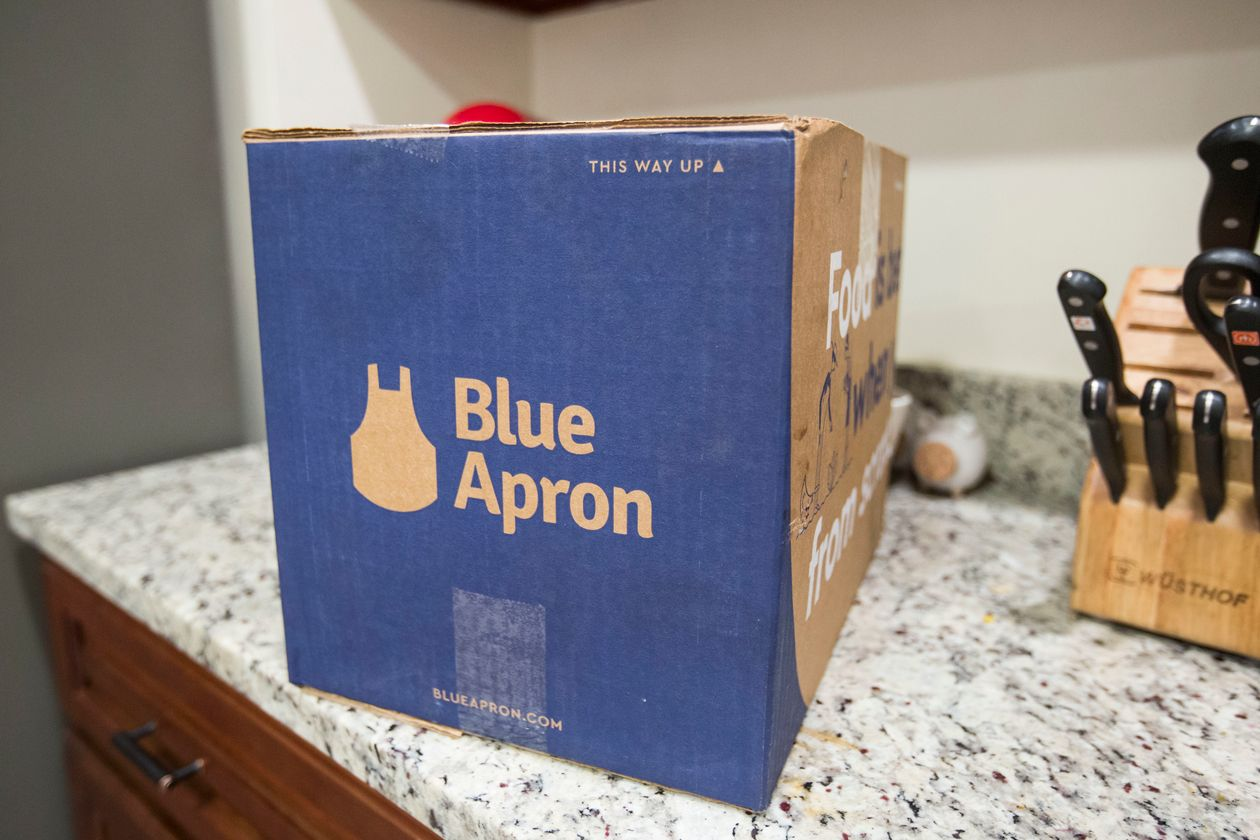
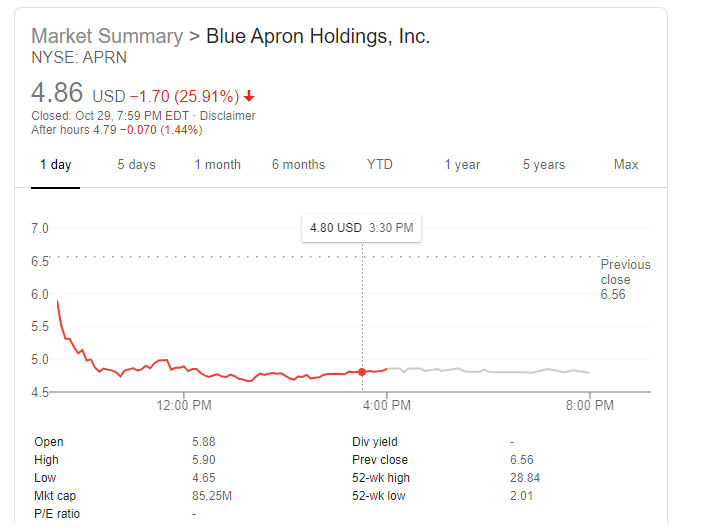
Is your business market-fit or just pandemic fit? Blue Apron, a meal-delivery company, is turning out to be a more pandemic-fit company than one which can thrive during normal times. The stock lost 25% of its value on trading today. Yet the main issue may be the sale sign it took off, according to Barron’s, “Blue Apron Holdings stock has lost more than a quarter of their value on Thursday after the meal-kit provider announced the end of a strategic review launched earlier this year, and that it is not pursuing a sale or other strategic transaction.”
Blue Apron, boosted by Americans eating in amid the pandemic, has become a victim of its own success. The meal-kit delivery company saw customers drop off by 7.5% during the third quarter as it struggled to meet an earlier surge in demand. While it’s expanding fulfillment centers and paring menu options to simplify production lines, those changes won’t be completed until next year. The New York-based startup, which went public in 2017, was one of the early business winners amid the contagion that took hold in March.
The numbers did not give Wall Street confidence and they moved in droves.
Blue Apron reported 357,000 customers in the quarter, down from 386,000 a year ago and 396,000 in the June quarter. Orders were 1.92 million, up from 1.73 million a year ago, but down from 2.2 million in the June quarter. Average order value per customer was $58.56, up from $57.60 a year ago, but off from $60.88 in the June quarter. Average revenue per customer was $314, up from $258 a year ago, but off from $331 in the June quarter.
You cannot afford to be pursuing pandemic-fit opportunities, losing insights on the durable market-fit ones. You need to think long-term even as you take care of today’s opportunities. When pandemic hit, many investors saw this company as a winner as many, locked out at home, ordered their services. But now that the world is open, customers are abandoning the company. I do think Blue Apron should sell to Amazon and call it a day.
Netflix’s Power of Fandom – When Customers Become Fans
Binging Netflix movies and shows just got more expensive. The streaming giant has raised the price of its standard and premium plans to $13.99 and $17.99 a month, respectively, for new subscribers. Its basic plan stays unchanged at $8.99 a month. Current users will see the new fees over the next few weeks. Netflix last increased fees in January 2019, and the latest jump comes as streaming competition increases and subscription growth slowed following a pandemic boom earlier this year. Netflix says the increase will allow it to invest more heavily in the quality and quantity of its content. (source)
Improve your service delivery to make your consumers become customers. The greatest companies go beyond having customers – they engineer FANS out of customers. When customers are fans, great moments arise and glory awaits. Yes, it is about going beyond Needs and Expectations to Perceptions of customers.
On that, I note the news that Netflix is raising prices of its products. Yes, this is a company which is under frontal and flank attacks from Disney+, Amazon Prime, and other video on-demand players, which to a large extent, are more affordable. Yet, the company is very confident that it is raising prices. That is the power of understanding that you have quality to keep the fans in your ecosystem.
Netflix’s prices are going up. The streaming media company is raising the prices on its standard and premium plans for US customers. Its standard plan is now $14 a month, up $1 a month from last year.
Its premium subscription will go up $2 to $18 a month. Its basic plan remains unchanged at $9 a month.
Netflix’s (NFLX) stock rose 5% following the news. The new prices will take effect starting immediately for new members while current members will be notified that their subscription is going up as it rolls out over the next few months.
“We understand people have more entertainment choices than ever and we’re committed to delivering an even better experience for our members,” a Netflix spokesperson said in a statement. “We’re updating our prices so that we can continue to offer more variety of TV shows and films.”
According to Business Insider, Disney+ “is now available for a monthly price of $6.99 a month, or an annual rate of $69.99 a year. For these prices, subscribers get ad-free access to thousands of movies and TV shows, including programming from Disney, Pixar, Marvel, Star Wars, National Geographic, and 20th Century Fox.” So, the cheapest Disney+ package is $6.99 when compared with the cheapest Netflix which remains $8.99 a month, unchanged.
For Netflix doing this – increasing prices in some categories – it has a lot of confidence in its products; most would have expected it to cut prices to compete with Disney+. And that offers a lesson to everyone of us: winning in a competitive market cannot just happen via the lowest cost denominator. Build your tribe of customers, and have better cost positioning in markets.