Having finished the Tekedia Mini MBA towards the end of last week I began to think of a minority of co-learners who were graduates with either irregular or no income. I was also listening to people expressing their opinions of the #ENDSARS movement, in particular wider socio-economic concerns that go beyond the campaign to disband a specific police unit perceived as lawless. The third thing I also reflected on was the rising chorus of laments amid the current pandemic.
Many come to online and social media (particularly LinkedIn), to seek support for their ‘business idea’ and while a few are only a hair whisker away from a 419 (advance fee fraud), many genuinely have a real idea they feel can be a successful business, if only they could get some funding.
Fleshing out ideas
Everybody has ideas, but only a very small proportion of free thinkers have sufficient capital to realize them. Investors don’t want to listen to an idea, they want to be provided with a comprehensive case for investment. They need to see a data driven argument for why and how the idea can become a business. There are several key features to this argument. Examples would be:
- Clearly defining the product/service (or portfolio/range), who and what the targeted customer segment(s) are, why they will be driven to pay for it and how much they will be willing to pay.
- All the costs involved from inception to customer.
- Justification of the amount of the investment and a clear map to ROI (Return on Investment) with timelines and key milestones (where relevant).
- Comprehensive risk assessment including who are the competitors (if any), how the business can penetrate the marketplace despite incumbents (should they exist), and an assessment of how easy it might be for others to copy, if it is a Blue Ocean concept. Also, what steps can be taken to mitigate or prevent new competition. Dependencies should also be tested, and the potential for uncontrollable risk, such as the decline in liquidity of the targeted customer segment(s), robustness of supply chain, or adverse change in public policy. A strong torch of foresight needs to be shone into the darkness of the unforeseen.
- Strategy for Future-proofing.
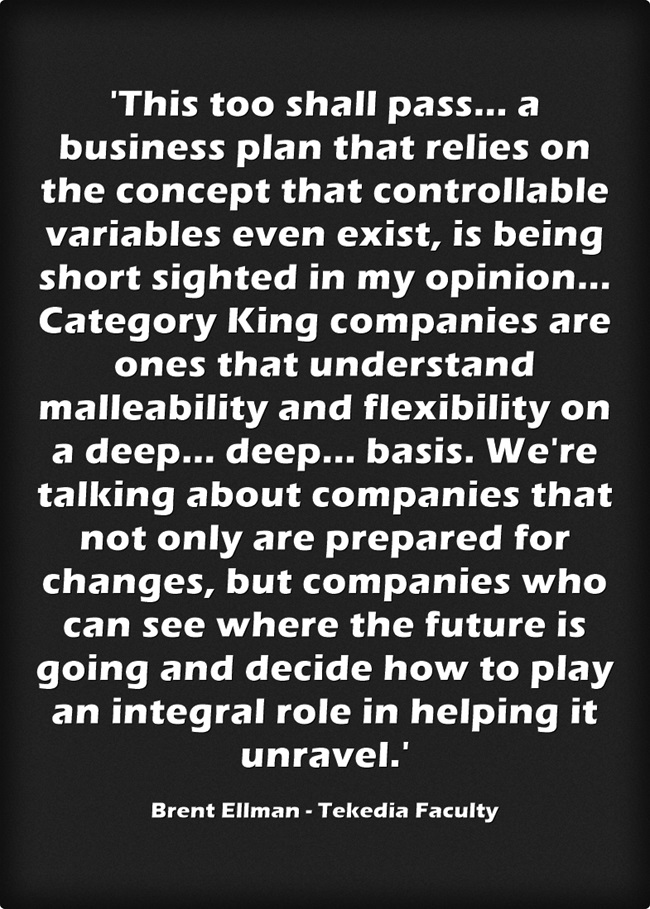
‘This too shall pass… a business plan that relies on the concept that controllable variables even exist, is being short sighted in my opinion… Category King companies are ones that understand malleability and flexibility on a deep… deep… basis. We’re talking about companies that not only are prepared for changes, but companies who can see where the future is going and decide how to play an integral role in helping it unravel.’ Brent Ellman – Tekedia Faculty.
Aside from a business plan, which often, potential investors won’t want to read in detail from a cold approach, it is also useful to have an ‘Executive Summary’. Venture Capitalists get mountains of approaches. They are a bit more likely to look at an Executive Summary as a ‘taster’ and then might go further if they like what they read. A good accompaniment for the Executive Summary would be a well populated and illustrated ‘Business Model Canvas’ as introduced in the Tekedia Mini MBA (Courtesy Creative Commons Attribution-Share Alike 3.0 Unported License).
However, investors often overlook ‘paper’ ideas for ones that they can see as working. Better still if it is already trading, because then they not only see that the idea works, but they can get a feel for its revenue generating capacity and a more tangible grasp on ROI.
Proof of Concept may be an important step, but if not buoyant, it might be a good idea to bring in some willing people in similar circumstances, in return for a share in the success if the concept pays off.
Bill Gates had some broke friends with him working out of his dad’s garage before he became successful. Longtime musician MC Hammer, Cartoon, Animation and Film Giant Walt Disney, and one of the early ‘fathers’ of US Democracy, Abraham Lincoln, are all examples of people that were flat broke before they were rich.
Achieving Proof of Concept (PoC)
PoC shows:
- The idea works.
- It’s demonstrated that an extrapolation of the idea has a significant growth trajectory for financial viability and profit through up-scaling.
The team that needs to get the idea to PoC and if possible get the idea trading as a business:
This is a big challenge in Nigeria. They say that to become hugely successful, a person needs to be very hungry. But if peers in a pioneering collective in Nigeria cannot shield their main thought leader from questions like ‘How do I make money out of this?’ ‘How do I get paid?’ Then obviously they are not hungry enough.
Ultimately this is an answer each peer in the group has to own, and has to take responsibility for themselves. And it’s ok to be unable to give oneself answers as long as the question isn’t being offloaded to peers in the group, particularly the main thought leader, as if the main thought leader (and there always tends to be one) is being burdened by such issues, it handicaps development.
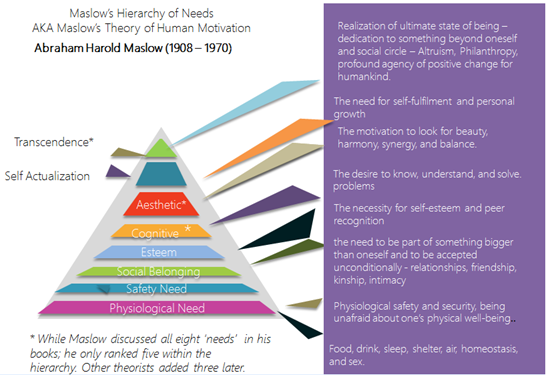
Looking at Maslow’s ‘Hierarchy of Need’, in a country with little by the way of a safety net between a person in free-fall, and utter destitution, it is understandable that struggling people will want to start at the bottom of the pyramid when focusing on what needs taking care of.
But the reality is to keep on that determination track, a pioneering collective in Nigeria, needs to find a way to project themselves mentally onto a higher plane on the pyramid, even if some of the lower rungs are lacking.
The importance of Maslow is underscored by Tekedia Mini MBA Faculty Member Edward Hudgins in his lectures on Exponential Technologies and Business Opportunities in the Age of Singularity – ‘Changing culture has always been important and it is especially important in the age of Exponential Technologies. The final arena for the entrepreneur is ‘The arena of self’. You are the entrepreneur of your own life… You are the CEO of ‘self’… To be an efficient entrepreneur in the market… you really have to change and work first and foremost on yourself’.
Some cohesion principles:
Agree how to agree.
One of the critical elements between a group of broke entrepreneurs finding their way to POC is to ‘Agree how to agree’. It doesn’t need to be democratic but it doesn’t need to be presidential either. What it needs, is for decision making to fairly reflect the distribution of intellectual and creative equity in the group. Key thought leader(s) should have more say in direction, though all should have an input and when the way ahead is formally confirmed, everyone needs to feel their input has been valued. The period during which the members are all putting in ‘work at risk’ is the period in which they are most easily discouraged and can decide to give up. Everyone in the group needs to have the confidence and security that is provided by a consistent decision making process. Everyone needs to have bought in and committed to the future path.
Maintaining morale through the dark days.
One of the things that is really critical is to separate out the thought leading component of the group (which may be one or more people) from the people in the group that do ‘other stuff’. If one or more of the group can specifically take on the role of maintaining morale, and deflecting any spurious or individual welfare issues away from polluting the focus of thought leader(s) then they are kept at their most productive, which should ultimately avoid unnecessarily prolonging the ‘period of pain’.
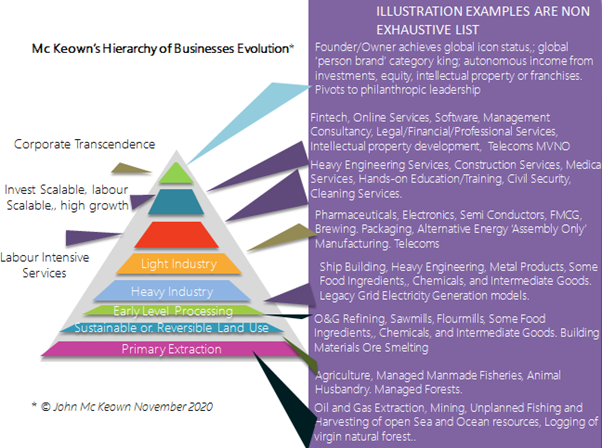
Just as elevation upwards in the Maslow Pyramid is a vehicle to better success as the ‘CEO of self’ for the entrepreneur, then the highest point to parachute into the ‘Mc Keown Heirarchy of Business Evolution’, up to the penultimate rung, the better the chance of success.
The examples given are intentionally simplistic to illustrate. Some functional categories may drift between multiple rungs on the pyramid. There can also be hybrids. Prof. Ndubuisi Ekekwe previously illustrated in Tekedia how at one stage Jumia appeared to be fully digitally transformed (level 2 on the Mc Keown pyramid) while in reality much of the delivery side was happening at level 3. Entrepreneurs who nurse a business idea at level 2, will enjoy the scalability it will afford, making business types at that level more resilient to lack of entrepreneur liquidity or volume HR assets.
When Tekedia Faculty Member Gennady Stolyarov II refers to an era of technological advancement needed to support the shift to ‘Transhumanism’ then here, we are talking about achieving a new tier, just below ‘Corporate Trancendence’ on the ‘Mc Keown Heirarchy of Business Evolution’.
So much talent is wasted in Nigeria specifically and Africa generally in the (misled) pursuit of using surplus and discarded materials to mimick very mature technologies whose commercial application is heavily regulated and for which licence to manufacture is closely policed.
We are not our idea.
From ten year old boys begging on roadside with radio controlled models fashioned from painted cardboard, to adults with curious motorcycle, plane and helicopter contraptions, the problem is that while our hearts sink at the lack of outlet for the obvious creativity, we can see there is neither an obvious application for their creation as a product, nor an obvious path within the culture of typical matrix organisations, for a career opportunity.
All I can hope is that my article will somewhere find some resonance. FROM BROKE TO SUCCESSFUL ENTREPRENEUR , IN NIGERIA YOU NEED MORE THAN AN IDEA AND A PIECE OF PAPER.
Like this:
Like Loading...