DD
MM
YYYY

PAGES

DD
MM
YYYY

spot_img

PAGES

Home Blog Page 6056

Australia Reeling at the Mercy of China as Their Face-off Deepens

0

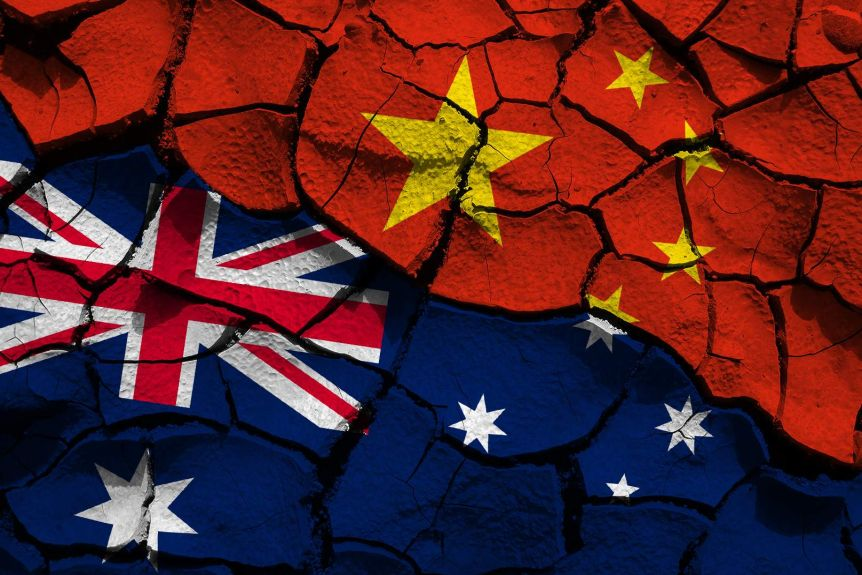
The faceoff between Australia and China is escalating. The two countries have been caught up in a diplomatic dog fight that escalated from Huawei ban to COVID-19 utterances, and it is now ripping their bilateral ties apart.

In early October, China had announced the ban on Australian thermal and cooking coal imports. The move though subtly, was a significant add-on to events that have followed their soured relationship, which consequently, was aggravated by the outbreak of coronavirus.

In February, Australia Dumping Commission was weighing in on a possible continuation of dumping duties on Chinese aluminum extrusions. The Commission started an inquiry into the sales of aluminum micro-extensions, which are used for domestic window flyscreens and television aerials, made by Chinese companies Guandong Jiangshen Aluminum and Guandong Zhongya Aluminum.

By the end of February, Australia concluded that it would continue to impose anti-dumping duties on Chinese deep drawn stainless steel sinks. The decision added further strain on the already fragile relationship between the two countries.

However, Australia and China were still reeling on relationship-amendment hope until April, when the issue of COVID-19 came into their squabble.

In April, when Australia backed the United States’ call to investigate the source of coronavirus, it became a dagger driven deep into the wound that China was already licking. The south Asian giant counted it among the many sins Australia has committed against Beijing, which it was contemplating whether to forgive or not. Among them, Australia’s swift ban on Huawei which was seen as a frontal attack on Beijing, and has set the two countries on the path of rivalry that has kept taking a new turn since then.
As the Guardian puts it; china sees Australia as frontrunning – yet again in Beijing’s eyes – on an issue deliberately constructed to isolate, condemn and humiliate China.

“The Chinese public is frustrated, dismayed and disappointed with what you are doing now… if the mood is going from bad to worse, people would think why should we go to such a country why it’s not friendly to China.

“The tourists may have second thoughts. Maybe the parents of the students would also think whether this place, which they find is not so friendly, even hostile, is the best place to send their kids to. And also, maybe the ordinary people will think why they should drink Australian wine or eat Australian beef,” China’s Ambassador to Australia said in May, signaling that Beijing intends to take the fight further over the coronavirus comment.

To Australia, Chinese response appears a dramatic overreaction to an entirely legitimate international concern to understand the origins of COVID-19 outbreak. The same logic was applied to the Huawei ban, which was done in the interest of national security that China is not ready to do anything about.

Spicing the inferno with embers was Yang Hengjun, Australian pro-democracy writer who has been incarcerated by China. Then there is the dispute over the South China Sea, continuing allegations of espionage; all came in bulk and spilled over into economics ring fight that no side is willing yet to throw in the towel.

China has upper hand, with Australia’s economic dependence on Beijing, it moved to exert “economic coercion”, a move Australia quickly called out.

“We reject any suggestion that economic coercion is an appropriate response to a call for such an assessment, when what we need is global cooperation,” Australian foreign minister, Marise Payne said.

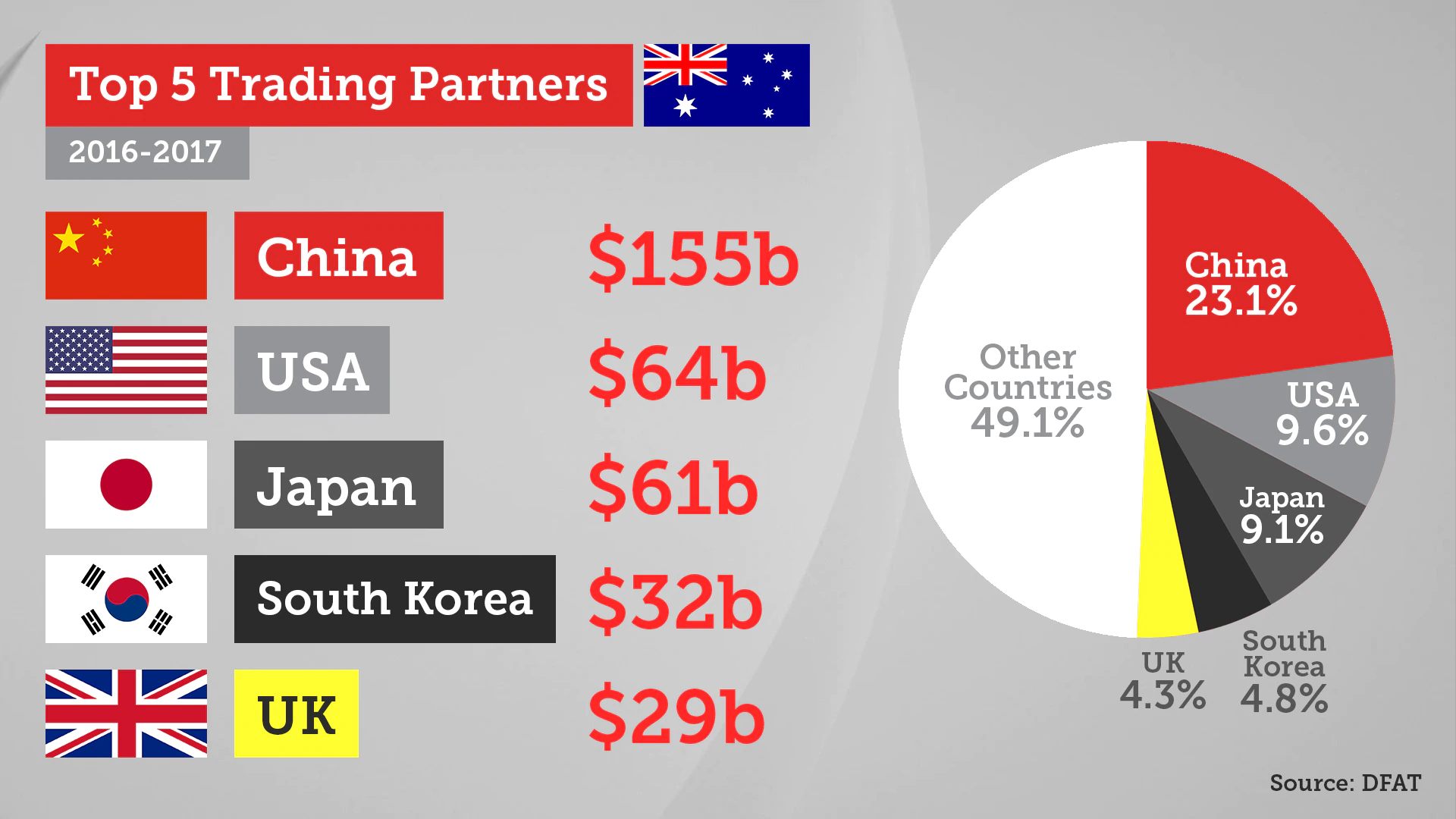
China and Australia have the largest two-way trade partnership in goods and services, representing more than a quarter of all international trade. As of 2018-19, the two-way trade has reached $235 billion, 20% up year on year to record the highest amount ever.

The trade was notably boosted by goods from the food sector. Australia exports foods such as beef, seafood and diary, with a $12 billion value. But it is about to go down the drainage of the lingering dispute.

China is expected to ban Australian wheat on Friday, a $394 million trade deal. But it is just among other Australian goods being added to the list of new blocks on Australian products, according to SCMP.

The report said from Friday, barley, sugar, red wine, timber, coal, lobster, copper ore and copper concentrates from Australia, are expected to be barred from China even if the goods have been paid for and have arrived at the ports.

“Chinese importers have been told to obey these rules strictly and suspend all orders for commercial reasons,” a trade source in China who is familiar with the matter said. “Shipments arriving at the port before Friday will be released, but those arriving after will stay at port. It does not matter if it is already in the bonded area.”

Australia money

China is expected to up its food importation, especially wheat to 6 million tonnes, an addition of 4 million tonnes from the previous year, as it “looks to meet internal demands and ensure stable domestic reserves amid a backdrop of uncertain market factors like food supply scare and trade tensions,” but Australia is not in the import plan, as China has begun to look elsewhere for the import of goods and services it has been importing from Australia.

There have also been reports of stockpiling of timber, lobster and other goods, much more than needed by China; a development analysts see as a warning to Australia that the worst is yet to come.

As more Australian ships get impounded in China, it confirms the suspicion that a full-scale trade war is looming between the two countries, and Australia will suffer its consequences.

“It’s been very tough for Australia. We have reached out continuously over a number of years to Chinese ministers and senior leadership and they’ve shunned us for various reasons. They’ve chosen to try and bully us at different times,” said Joe Hockey, Australia’s former treasurer.

Australia had earlier in the week, taken the matter to the World Trade Organization (WTO), where its officials criticized China’s investigation into whether Australia was dumping barley on the market. The officials called the probe “flawed” and claimed it has led to miscalculation of the duties charged.

Australia said the investigation had been “improperly initiated” and the products involved were not properly involved. Moreover, they claimed that Chinese authorities did not acknowledge receipt of information supplied by Australian producers, nor did it carry out verification visits, according to SCMP.

China’s WTO representative’s response to the claims is that Australia’s concerns had been noted. The complaint was continuation of the pursuit Australia made in early May in the WTO, which includes threat to sue China, though it has yet to make the move.

Reeling on the mercy of the mightier hand of Beijing, some analysts believe that Australia may use one area it has an edge over China – international education.

Australia has the largest proportion of international students in higher education. Almost a third of all higher education students in the country are international students. In the number, Chinese students make up the biggest share of the international students, with over 260,000 students, according to data from Statista.

A fight-back from this terrain will mean expelling over 260,000 Chinese students in Australia, but yet, it will do more harm than good.

In the wake of the tension between the two countries, China had sent warning to its students to rethink Australia. This also came on the heels of warning to Chinese tourists to avoid Australia.

China appears to have made advance preparation for the confrontation, leaving Australia waiting in a state of inaction.

A trade law professor at the Chinese University of Hong Kong said there is only one way to put an end to it.

“Australia seems set to pursue this – they need to tame China’s use of trade remedy investigations. Experience shows that waiting and hoping for a change of behavior does not work. Action speaks louder than words,” he said.
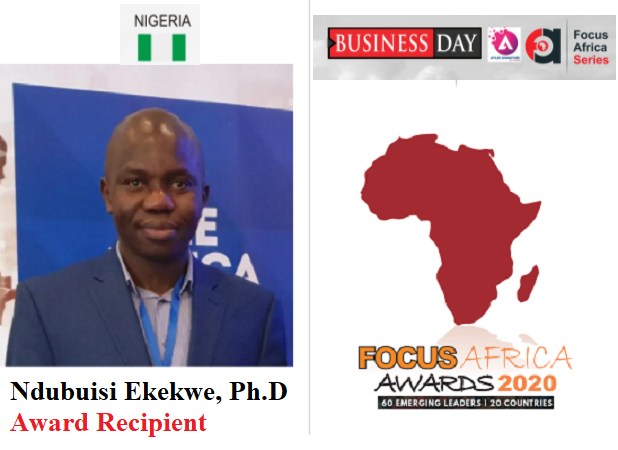

Ndubuisi Ekekwe Receives Focus Africa Award from BusinessDay Newspaper

0

From the staples of the peerless business newspaper in Nigeria, BusinessDay, yours truly has been honoured to receive the Focus Africa award for the little things I have done in the world of technology and business. It is always great to be remembered at home. I was in the village during Christmas, and quickly parents came with our little futures in Ovim, saying “This is your big uncle; listen to him”.

I was moved beyond words, because decades ago, my mother had taken me to a kinsman who returned from the city, saying “He is good in mathematics, and I want him to be like you”.

I accept the Focus Award because I am sure it would inspire many to believe. Thanks BusinessDay, Ayles, and all the organizers.

“Category King companies… understand malleability and flexibility on a deep… basis” –

0

John Mc Keown, a Tekedia Mini-MBA alum, examines how entrepreneurs in Africa can dream big and build great companies. In his piece, he drew from our session on “Exponential Technologies and Singularity” eminently delivered by Edward Hudgins, PhD, Chogwu Abdul, PhD, Gennady Stolyarov II, and Brent Ellman.

We are turning that course into a book in partnership with Transdisciplinary Transdisciplinary Agora for Future Discussions Inc. ( TAFFD’s ), USA and . This quote from Bent Ellman explains the core thesis of John’s piece https://lnkd.in/e9MnjtU

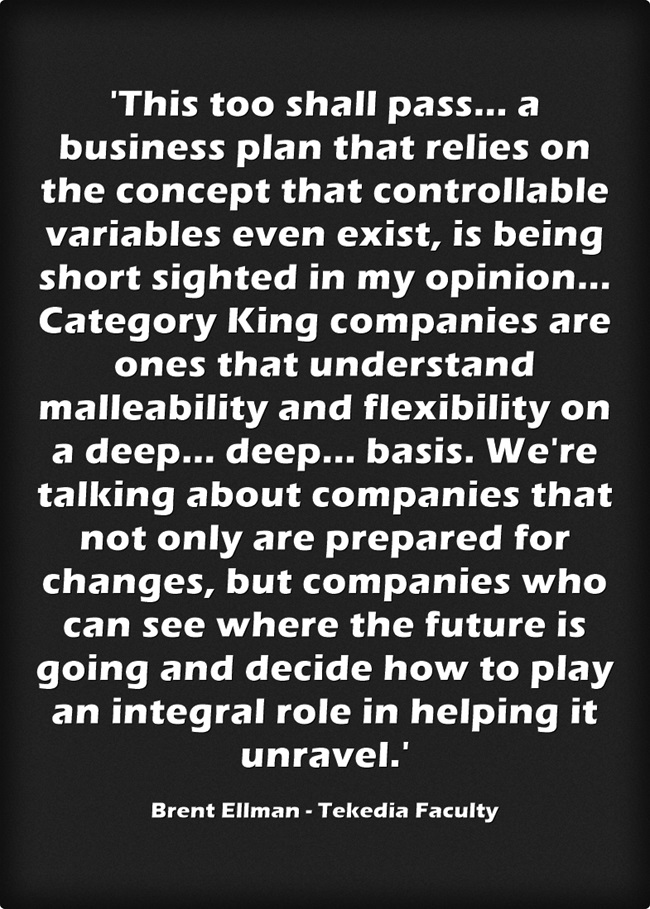
‘This too shall pass… a business plan that relies on the concept that controllable variables even exist, is being short sighted in my opinion… Category King companies are ones that understand malleability and flexibility on a deep… deep… basis. We’re talking about companies that not only are prepared for changes, but companies who can see where the future is going and decide how to play an integral role in helping it unravel.’

From Broke to Successful Entrepreneur, in Nigeria, You Need More Than an Idea and a Piece of Paper

From Broke to Successful Entrepreneur, in Nigeria, You Need More Than an Idea and a Piece of Paper

7

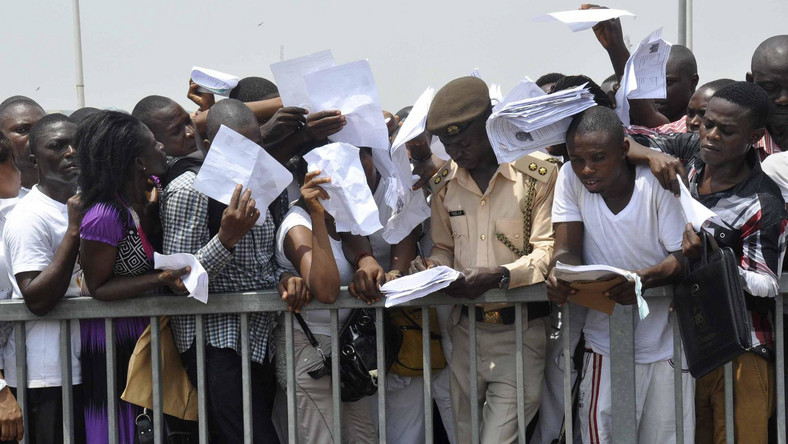
Having finished the Tekedia Mini MBA towards the end of last week I began to think of a minority of co-learners who were graduates with either irregular or no income. I was also listening to people expressing their opinions of the #ENDSARS movement, in particular wider socio-economic concerns that go beyond the campaign to disband a specific police unit perceived as lawless. The third thing I also reflected on was the rising chorus of laments amid the current pandemic.

Many come to online and social media (particularly LinkedIn), to seek support for their ‘business idea’ and while a few are only a hair whisker away from a 419 (advance fee fraud), many genuinely have a real idea they feel can be a successful business, if only they could get some funding.

Fleshing out ideas

Everybody has ideas, but only a very small proportion of free thinkers have sufficient capital to realize them. Investors don’t want to listen to an idea, they want to be provided with a comprehensive case for investment. They need to see a data driven argument for why and how the idea can become a business. There are several key features to this argument. Examples would be:

  1. Clearly defining the product/service (or portfolio/range), who and what the targeted customer segment(s) are, why they will be driven to pay for it and how much they will be willing to pay.
  2. All the costs involved from inception to customer.
  3. Justification of the amount of the investment and a clear map to ROI (Return on Investment) with timelines and key milestones (where relevant).
  4. Comprehensive risk assessment including who are the competitors (if any), how the business can penetrate the marketplace despite incumbents (should they exist), and an assessment of how easy it might be for others to copy, if it is a Blue Ocean concept. Also, what steps can be taken to mitigate or prevent new competition. Dependencies should also be tested, and the potential for uncontrollable risk, such as the decline in liquidity of the targeted customer segment(s), robustness of supply chain, or adverse change in public policy. A strong torch of foresight needs to be shone into the darkness of the unforeseen.
  5. Strategy for Future-proofing.

‘This too shall pass… a business plan that relies on the concept that controllable variables even exist, is being short sighted in my opinion… Category King companies are ones that understand malleability and flexibility on a deep… deep… basis. We’re talking about companies that not only are prepared for changes, but companies who can see where the future is going and decide how to play an integral role in helping it unravel.’ Brent Ellman – Tekedia Faculty.

Aside from a business plan, which often, potential investors won’t want to read in detail from a cold approach, it is also useful to have an ‘Executive Summary’. Venture Capitalists get mountains of approaches. They are a bit more likely to look at an Executive Summary as a ‘taster’ and then might go further if they like what they read. A good accompaniment for the Executive Summary would be a well populated and illustrated ‘Business Model Canvas’ as introduced in the Tekedia Mini MBA (Courtesy Creative Commons Attribution-Share Alike 3.0 Unported License).

However, investors often overlook ‘paper’ ideas for ones that they can see as working. Better still if it is already trading, because then they not only see that the idea works, but they can get a feel for its revenue generating capacity and a more tangible grasp on ROI.

Proof of Concept may be an important step, but if not buoyant, it might be a good idea to bring in some willing people in similar circumstances, in return for a share in the success if the concept pays off.

Bill Gates had some broke friends with him working out of his dad’s garage before he became successful. Longtime musician MC Hammer, Cartoon, Animation and Film Giant Walt Disney, and one of the early ‘fathers’ of US Democracy, Abraham Lincoln, are all examples of people that were flat broke before they were rich.

Achieving Proof of Concept (PoC)

PoC shows:

  1. The idea works.
  2. It’s demonstrated that an extrapolation of the idea has a significant growth trajectory for financial viability and profit through up-scaling.

The team that needs to get the idea to PoC and if possible get the idea trading as a business:

This is a big challenge in Nigeria. They say that to become hugely successful, a person needs to be very hungry.  But if peers in a pioneering collective in Nigeria cannot shield their main thought leader from questions like ‘How do I make money out of this?’ ‘How do I get paid?’ Then obviously they are not hungry enough.

Ultimately this is an answer each peer in the group has to own, and has to take responsibility for themselves. And it’s ok to be unable to give oneself answers as long as the question isn’t being offloaded to peers in the group, particularly the main thought leader, as if the main thought leader (and there always tends to be one) is being burdened by such issues, it handicaps development.

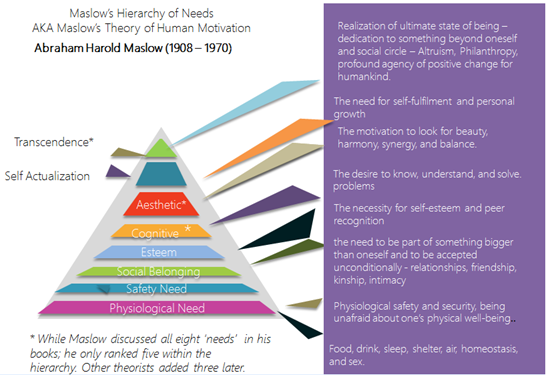
Looking at Maslow’s ‘Hierarchy of Need’, in a country with little by the way of a safety net between a person in free-fall, and utter destitution, it is understandable that struggling people will want to start at the bottom of the pyramid when focusing on what needs taking care of.

But the reality is to keep on that determination track, a pioneering collective in Nigeria, needs to find a way to project themselves mentally onto a higher plane on the pyramid, even if some of the lower rungs are lacking.

The importance of Maslow is underscored by Tekedia Mini MBA Faculty Member Edward Hudgins in his lectures on Exponential Technologies and Business Opportunities in the Age of Singularity – ‘Changing culture has always been important and it is especially important in the age of Exponential Technologies. The final arena for the entrepreneur is ‘The arena of self’. You are the entrepreneur of your own life… You are the CEO of ‘self’… To be an efficient entrepreneur in the market… you really have to change and work first and foremost on yourself’.

Some cohesion principles:

Agree how to agree.

One of the critical elements between a group of broke entrepreneurs finding their way to POC is to ‘Agree how to agree’. It doesn’t need to be democratic but it doesn’t need to be presidential either. What it needs, is for decision making to fairly reflect the distribution of intellectual and creative equity in the group. Key thought leader(s) should have more say in direction, though all should have an input and when the way ahead is formally confirmed, everyone needs to feel their input has been valued. The period during which the members are all putting in ‘work at risk’ is the period in which they are most easily discouraged and can decide to give up. Everyone in the group needs to have the confidence and security that is provided by a consistent decision making process. Everyone needs to have bought in and committed to the future path. 

Maintaining morale through the dark days.

One of the things that is really critical is to separate out the thought leading component of the group (which may be one or more people) from the people in the group that do ‘other stuff’. If one or more of the group can specifically take on the role of maintaining morale, and deflecting any spurious or individual welfare issues away from polluting the focus of thought leader(s) then they are kept at their most productive, which should ultimately avoid unnecessarily prolonging the ‘period of pain’.

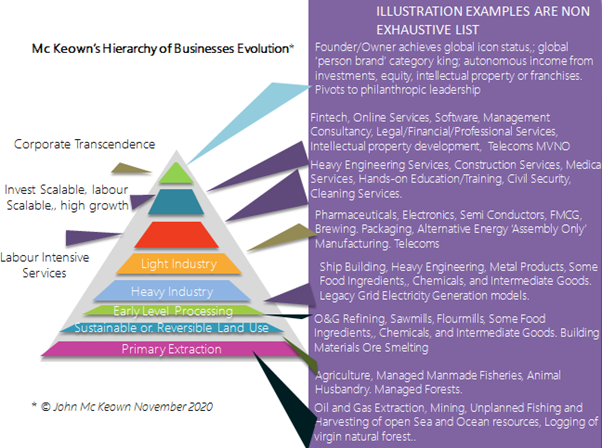
Just as elevation upwards in the Maslow Pyramid is a vehicle to better success as the ‘CEO of self’ for the entrepreneur, then the highest point to parachute into the ‘Mc Keown Heirarchy of Business Evolution’, up to the penultimate rung, the better the chance of success.

The examples given are intentionally simplistic to illustrate. Some functional categories may drift between multiple rungs on the pyramid. There can also be hybrids. Prof. Ndubuisi Ekekwe previously illustrated in Tekedia how at one stage Jumia appeared to be fully digitally transformed (level 2 on the Mc Keown pyramid) while in reality much of the delivery side was happening at level 3.  Entrepreneurs who nurse a business idea at level 2, will enjoy the scalability it will afford, making business types at that level more resilient to lack of entrepreneur liquidity or volume HR assets.

When Tekedia Faculty Member  Gennady Stolyarov II refers to an era of technological advancement needed to support the shift to ‘Transhumanism’ then here, we are talking about achieving a new tier, just below ‘Corporate Trancendence’ on the ‘Mc Keown Heirarchy of Business Evolution’.

So much talent is wasted in Nigeria specifically and Africa generally in the (misled) pursuit of using surplus and discarded materials to mimick very mature technologies whose commercial application is heavily regulated and for which licence to manufacture is closely policed.

We are not our idea.

From ten year old boys begging on roadside with radio controlled models fashioned from painted cardboard, to adults with curious motorcycle, plane and helicopter contraptions, the problem is that while our hearts sink at the lack of outlet for the obvious creativity, we can see there is neither an obvious application for their creation as a product, nor an obvious path within the culture of typical matrix organisations, for a career opportunity.

All I can hope is that my article will somewhere find some resonance. FROM BROKE TO SUCCESSFUL ENTREPRENEUR , IN NIGERIA YOU NEED MORE THAN AN IDEA AND A PIECE OF PAPER.

Tekedia Career Week Continues – #innovate #ascend #thrive

0

Our 2020 Tekedia Career Week continues. Oladapo Akinloye of Emerald Zone closed the day yesterday and this morning, Dupe Akinsiun of Coca Cola HBC began it with style.  Dapo was empirical, running live polls, and Dupe brought a new dimension: an all Q/As session.

One week, 14 eminent business leaders, helping us to make sense of our careers. It is very amazing. It continues this evening at 7pm WAT with Abraham Owoseni of Mindmould.

Tekedia Institute is a public-benefit company; our goal is to democratize knowledge by making it possible for everyone to have access to leaders of industries. From Microsoft to Shell, Flutterwave to MTN, Coca Cola to Weco Systems, Infoprive to Access Bank, and beyond (48 of them), leaders in markets lead great courses in their domains. Many have been lifted – and testimonies abound!

Our alumni are now pushing for changes in a government: asking the government to move from Invention to Innovation. In companies, promotions are coming as members bring new ways of looking at issues. This Career Week calls into the purpose of firms: fix frictions through capabilities of men and women because at the end, only humans can manage, combine and recombine factors of production.

#innovate #ascend #thrive

Register for the next edition of Tekedia Mini-MBA here.

Tekedia Academic Programs