DD
MM
YYYY

PAGES

DD
MM
YYYY

spot_img

PAGES

Home Blog Page 607

Klarna Aims for $1.27bn in IPO Amid Valuation Drop, AI Missteps, and Trump’s Tariff Disruptions

0

Swedish fintech giant Klarna is moving ahead with its long-anticipated public debut, seeking to raise up to $1.27 billion in a New York listing that will test investor appetite for tech companies still grappling with profitability and the fallout of past overvaluations.

According to its filing with the U.S. Securities and Exchange Commission (SEC), Klarna plans to offer 34,311,274 ordinary shares priced between $35 and $37 each. At that range, the offering would value the company at as much as $14 billion — far below its $45.6 billion peak valuation in June 2021, when SoftBank led a major funding round. Goldman Sachs, JP Morgan, and Morgan Stanley are acting as joint book runners for the deal.

The shares will trade on the New York Stock Exchange under the ticker symbol “KLAR.” Out of the shares on offer, Klarna itself is selling 5.56 million, while the bulk — roughly 28.8 million — will come from existing shareholders who are offloading part of their stakes.

From Pandemic Darling to Reality Check

Founded in 2005, Klarna pioneered the “buy now, pay later” (BNPL) model that became a global hit during the pandemic e-commerce boom. However, as interest rates rose and consumer credit risks increased, the fintech sector saw its valuations collapse. Klarna’s own value plunged by as much as 85% in 2022, to $6.7 billion, as worsening macroeconomic conditions, exacerbated by Russia’s invasion of Ukraine, pressured growth.

Despite that downturn, Klarna has been clawing back momentum. Revenue for the June quarter rose 20% year-on-year to $823 million. Still, losses remain a drag, with the company posting a $53 million net loss for the period — widening from a year earlier.

Klarna had initially planned to go public earlier this year, but pressed pause after U.S. President Donald Trump unveiled a wave of reciprocal tariffs on dozens of countries in April. The move unsettled global markets, raising fears of retaliatory measures and hitting the financial prospects of companies reliant on cross-border commerce.

Klarna, whose operations span Europe, the U.S., and beyond, chose to wait for calmer conditions before reviving its listing plans.

AI: From Overreliance to a Human-Centric Pivot

Beyond macroeconomic headwinds, Klarna has also faced internal turbulence tied to its aggressive embrace of artificial intelligence. Over the past two years, CEO Sebastian Siemiatkowski hailed AI as a cornerstone of cost efficiency, boasting last year that the company’s AI assistant was performing the work equivalent of 700 customer support agents. Klarna froze most hiring outside of engineering, eliminated over 1,200 external SaaS tools, and restructured teams to lean heavily on automation.

But those changes have produced unintended consequences. Employees across business operations, analytics, marketing, engineering, and legal have seen their roles eliminated and have been placed in an internal “talent pool” — a system critics describe as a quiet-layoff mechanism. Some, including senior staff, have since been reassigned to customer support roles under Chief Operating Officer Camilla Giesecke.

In a rare admission, Siemiatkowski told Bloomberg in May that his cost-cutting push “went too far,” leading to reduced service quality. He now says the company will reinvest in human support, even experimenting with a gig-work model for customer service agents.

“As cost unfortunately seems to have been a too predominant evaluation factor when organizing this, what you end up having is lower quality,” he said. “Really investing in the quality of the human support is the way of the future for us.”

That shift reflects a broader reassessment across industries about the limits of AI in consumer-facing roles. While companies like Amazon continue shrinking workforces through automation, others have stumbled. McDonald’s, for example, pulled its Automated Order Taker system from over 100 restaurants after viral blunders, while Starbucks reaffirmed its reliance on baristas rather than machines to boost customer experience.

Siemiatkowski himself has acknowledged this reality, remarking earlier this year: “We just had an epiphany: in a world of AI nothing will be as valuable as humans.”

IPO at a Crossroads

For Klarna, the IPO represents both a milestone and a gamble. While the company is still burning cash, its revenue growth and global footprint provide a foundation for investor interest. The offering will also provide liquidity for early backers such as SoftBank, Sequoia, and other venture firms, many of whom are looking to cash out after years of waiting.

Yet, the company enters public markets at a valuation less than one-third of its pandemic peak — a humbling reminder of how much investor sentiment has shifted in fintech. The offering also unfolds against a politically fraught backdrop, as Trump’s tariff policies inject uncertainty into the very trade flows companies like Klarna depend on.

With $1.27 billion on the line, Klarna’s IPO is more than a financial event; it is a referendum on whether investors still believe in the long-term viability of the BNPL model, and whether the balance between AI efficiency and human service can be struck in a way that restores consumer trust.


Analysts Eye $1 For BlockDAG While AAVE and Shiba Shift From The September 2025 Spotlight

0

AAVE news has centered on Horizon, a new platform that bridges real-world assets, such as tokenized Treasuries, with stablecoin borrowing. Institutions can now unlock liquidity without selling long-term holdings, reflecting Aave’s push to merge DeFi with traditional markets.

At the same time, the Shiba Inu (SHIB) price pattern has drawn attention with its first 2025 golden cross. The last golden cross delivered an 85% rally, and SHIB, now at $0.00001249 with a $7.36B market cap, could see a short-term move toward $0.000023 if history repeats.

However, BlockDAG has raised $395M, sold 25.8B coins, and attracted whales holding over $10M. With a presale price of $0.03 in Batch 30 and projections toward $1, BlockDAG offers more than 76,820% potential upside. Its ecosystem already includes 3M X1 users, 19,600 miners, and 200,000 holders, making it one of the most established presale networks before launch.

Aave’s Horizon Brings Real-World Assets Into DeFi Lending

Aave Labs has launched Horizon, a new borrowing platform that lets institutions secure stablecoin loans using real-world assets such as tokenized U.S. Treasurys and collateralized debt. This marks a key step in connecting traditional finance with decentralized markets, offering 24/7 access to liquidity while maintaining compliance.

Businesses can now borrow stablecoins like USDC, GHO, and Ripple’s RLUSD without selling long-term holdings, unlocking funds tied to traditional assets. The move comes as tokenization of real estate, bonds, and funds gains traction, giving Aave a stronger role in this trend. AAVE has risen 12% in the past week, trading near $327. For investors, Horizon highlights Aave’s strategy to capture institutional demand, reinforcing its position in the growing DeFi lending sector.

Shiba Inu Golden Cross Signals Possible 85% Price Surge

Shiba Inu has formed its first golden cross of 2025 on the daily chart, where the 50-day moving average moved above the 200-day. This marks a bullish signal that previously delivered strong gains. The last daily golden cross occurred in November 2024, when SHIB rose from $0.000018 to $0.00003344, recording nearly an 85% rally within weeks.

At the time, SHIB trades at $0.00001249 with a market capitalization of $7.36 billion. After dropping for three sessions to a low of $0.00001183, the token rebounded. Technical levels show support at $0.000011 and further at $0.00001. If the current setup repeats last year’s pattern, Shiba Inu could aim for $0.000023 in the short term.

Whales Are Grabbing BlockDAG: Can Retail Keep Up Before $1?

BlockDAG’s presale has entered a new phase after two whales secured allocations of $4.4M and $4.3M, overtaking the long-standing $3.8M top wallet. This reshuffle means whale holdings in the presale now exceed $10M, reflecting growing institutional-scale participation. Such capital entry coincides with BlockDAG’s consistent fundraising success, having already raised $395M and sold 25.8 billion coins.

BDAG’s current price is $0.03 in batch 30, but the coin is being sold at $0.0013 for a limited time. The long-term outlook, however, extends far higher. If BlockDAG climbs to $1, current presale buyers would see gains of 76,820% from today’s entry. This projection is supported by adoption metrics that are rarely seen at the presale stage. The X1 mobile miner app has surpassed 3 million users, more than 19,600 ASIC miners have been sold, and over 200,000 holders already participate in the ecosystem.

BlockDAG’s hybrid model, combining DAG scalability with Proof-of-Work security, provides the foundation for its growth narrative. The entry of whales at this level suggests that confidence in both the architecture and adoption is solid. With presale progress tightening supply, BlockDAG continues to build momentum as one of the most significant Layer 1 launches in years.

BlockDAG Dominates the Conversation in 2025

The latest AAVE news underlines real progress in connecting institutional finance with blockchain, but its growth is measured. The Shiba Inu (SHIB) price pattern presents opportunities for traders, yet it depends on technical signals that may not sustain long-term strength.

By contrast, BlockDAG has established adoption before the mainnet. Its hybrid DAG plus Proof-of-Work architecture combines scalability with security, drawing whales who committed $4.4M and $4.3M in individual allocations.

With $395M already raised and a presale price of $0.03 offering a clear path to $1, the upside is unmatched. Supported by millions of users, thousands of miners, and a growing community, BlockDAG outpaces rivals not just in fundraising but in readiness.

Presale: https://purchase.blockdag.network

Website: https://blockdag.network

Telegram: https://t.me/blockDAGnetworkOfficial

Discord: https://discord.gg/Q7BxghMVyu

Nigeria Needs Fiscal Federalism

0

“That was what pegged the budget of the federal government [of Nigeria] at £50 million in 1959 but Western Region [of Nigeria] ran a budget of £55 million.” – Mr.  B. O. Akinyemi.

Yes, the older version of Southwest ran a bigger budget than the national budget. Then, competition was huge among the regions and the leaders were not wasting time in the old “Abuja” [ Lagos was the capital then].  But somehow, Nigeria changed what was working, and right now, nothing is happening at scale in the regions.

If you study the pre-1963 budget, the message was loud and clear: Nigeria was on a path of unbounded and unconstrained abundance and opportunity where smart people were innovating in building pillars of markets and economies.  In that budget of 1959, the federal government was the one asking for help because the regions had the resources. Yes, the “governors” then had the resources to make things happen!

But today, things have fallen apart, and everyone has become lazy because there is no consequence for not working, as Abuja serves everyone in Nigeria, and most governors can claim “Abuja has not paid the monthly allocation and we are calling our bankers to know when the funds will arrive…we are in touch with CBN to know the reason for the delays”  Very painful for Nigeria!

Sure – I hope someone will deliver FISCAL federalism in Nigeria and save it from itself! 

Bitcoin Could 5x, Ethereum Could 10x, But Ozak AI Targets 100x

0

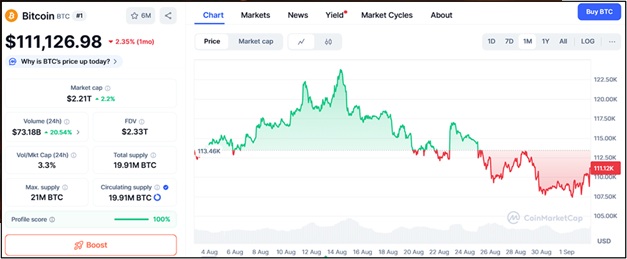
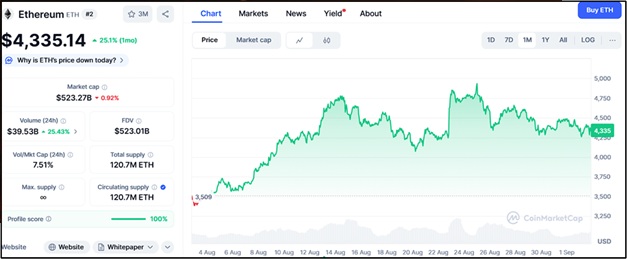
Crypto investors are closely watching the next bull run, with forecasts suggesting Bitcoin (BTC) could reach $550,000—a 5x increase from its current $110,000—and Ethereum (ETH) potentially climbing to $44,000, a 10x gain from its $4,400 price.

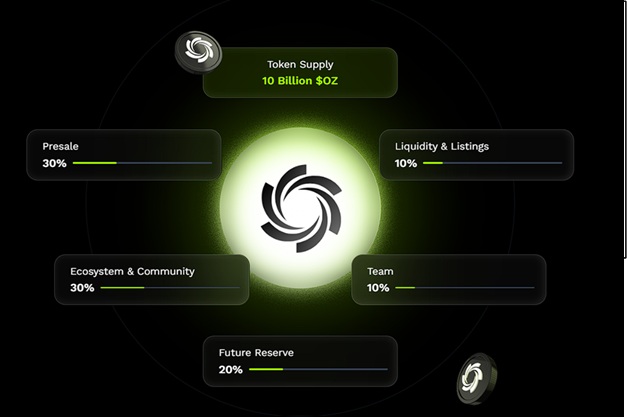
While these projections are impressive, one project is capturing attention for its truly outsized upside: Ozak AI. Currently in its 5th presale stage at $0.01, Ozak AI has already raised over $2.6 million and sold more than 840 million tokens, highlighting the high demand and investor confidence in this AI-powered platform. Analysts predict that early presale participants could see 100x returns, positioning Ozak AI as one of the most compelling opportunities of 2025.

Bitcoin and Ethereum: Steady but Limited Upside

Bitcoin remains the flagship of the crypto market, diagnosed for its store-of-value properties and widespread adoption. Its charge of $110,000 is already impressive, and a 5x advantage to $550,000 could create full-size wealth for early holders. Key resistance ranges are around $115K, $130K, and $150K, whilst assist ranges sit at $100K, $95K, and $90K. However, BTC’s maturity means that explosive gains like those in its early years are not likely, and increase can also slow as adoption reaches saturation.

Ethereum, priced at $4,400, maintains to power smart settlement adoption, DeFi interest, and NFT ecosystems. Analysts project it can attain $44,000, fueled through enhancements and community scaling answers. Resistance zones for ETH are at $4,600, $4,000, and $4,500, with assistance at $4,200, $4,000, and $3,800. While ETH’s capability is robust, it nonetheless falls short of the transformative ROI early traders are seeking for in high-upside presale projects.

Ozak AI: Next-Generation Predictive AI

Ozak AI distinguishes itself with its predictive AI platform, designed to supply actionable insights for crypto and economic markets. Utilizing advanced machine learning knowledge of trends consisting of neural networks and ARIMA, the platform presents real-time market forecasts, risk analysis, and automatic trading signals. Its decentralized architecture, supported by EigenLayer AVS and Arbitrum Orbit, guarantees stable and scalable smart contract execution.

Customizable Prediction Agents (PAs) allow investors to tailor the AI’s output to their specific trading strategies, offering personalized and precise insights. This level of sophistication is rare among early-stage crypto projects and gives Ozak AI a practical edge over established assets like BTC and ETH.

OZ Presale Momentum and Partnerships

Ozak AI’s presale has generated significant attention, raising $2.6 million and selling 840 million OZ tokens. The project has completed internal audits and Certik verification, enhancing credibility. Its strategic partnerships with platforms such as Dex3, a leading on-chain intelligence aggregator, and HIVE, a blockchain data API optimized for AI agents, strengthen its ecosystem and usability. These collaborations help position Ozak AI for rapid adoption and real-world integration, making its presale more than a speculative opportunity.

Why Ozak AI Targets 100x Returns

While BTC and ETH offer steady, high-profile growth, Ozak AI provides early-stage entry with massive upside. Analysts highlight that the combination of low presale price, AI-driven insights, and strong partnerships could result in 100x ROI for presale participants. The project’s architecture allows it to scale rapidly and adapt to market demands, increasing the likelihood of outsized returns compared to established cryptocurrencies.

Bitcoin may 5x and Ethereum may 10x in the next bull run, but Ozak AI presale offers a unique chance to achieve 100x gains. With $2.6 million raised, 840 million tokens sold, cutting-edge AI capabilities, and strategic partnerships, Ozak AI is emerging as a high-upside contender in 2025. Early investors who participate in the presale could turn small allocations into transformative returns, making this AI-driven platform a must-watch opportunity for ambitious crypto enthusiasts.

 About Ozak AI

 Ozak AI is a blockchain-based crypto project that provides an innovative platform that focuses on predictive AI and advanced data analytics for financial markets. Through machine learning algorithms and decentralized community technologies, Ozak AI enables real-time, accurate, and actionable insights to help crypto lovers and corporations make the perfect choices.


For more, visit

Website: https://ozak.ai/

Telegram: https://t.me/OzakAGI

Twitter: https://x.com/ozakagi

What’s on Your Mind? The Illusion of Digital Freedom in a Surveillance Age

0

When Facebook asks, “What’s on your mind?”, it feels like a warm invitation to speak freely. The phrase is casual, familiar, and seemingly harmless. It suggests a space where thoughts can be shared without consequence, where personal reflections can become public conversations. But in many parts of the world, including Nigeria, this question has become a loaded one. It no longer represents freedom of expression but rather a potential gateway to legal scrutiny, social backlash, or even imprisonment.

In Nigeria, several individuals have faced prosecution for expressing their thoughts on Facebook. From defamation charges to cyberstalking accusations, the consequences of answering that innocent-looking question have been severe. Gambo Saeed was sentenced to nine months in prison for defaming a state governor. John Danfulani, a former lecturer, was detained for posts critical of political leadership. These cases reveal a troubling paradox: the very platforms designed to amplify voices are increasingly being used to silence them.

This raises a critical reflection: not every message is an act of liberation. Sometimes, it is a digital footprint that leads directly to punishment. The assumption that posting equals empowerment ignores the reality that speech, especially in volatile environments, can be weaponized. In such contexts, the act of sharing becomes less about freedom and more about risk.

A Global Metaphor for Censorship

The metaphor of “What’s on your mind?” shifts dramatically depending on geography. In societies where political criticism is met with repression, the question becomes rhetorical. It asks not what you think, but whether you dare to say it.

In India, Facebook users have been arrested for sharing memes or criticizing religious figures. Though Section 66A of the IT Act was struck down, other laws continue to be used to suppress dissent. Here, the prompt becomes a test of boundaries. It asks users to weigh their thoughts against the risk of legal action.

In Egypt, activists have been jailed for posts deemed harmful to national security. The question becomes a trap, inviting speech that is later weaponized against the speaker. Even in countries with strong free speech protections, like the United States, the metaphor is not immune to distortion. Employers, schools, and courts have increasingly scrutinized social media posts. The question still feels liberating, but it is now accompanied by a silent warning: your thoughts may be free, but they are also permanent and searchable.

These examples remind us that freedom of speech is not just about the ability to speak—it’s about the conditions under which speech is received. A message can be sincere, constructive, or critical, but its interpretation depends on who is listening and what power they hold. In this light, not every message is a declaration of freedom. Some are acts of defiance. Others are cries for help. And many are simply misunderstood.

Nigeria’s Legal Landscape and the Chilling Effect

In Nigeria, this crisis is compounded by outdated laws and vague statutes. The Cybercrimes Act and sections of the Penal Code are often used to prosecute online speech, despite calls for reform. The result is a chilling effect. Citizens begin to self-censor, not because they lack opinions, but because they fear the consequences of sharing them.

Facebook’s prompt, once a symbol of openness, now serves as a mirror. It reflects the contradictions of our digital age. It shows us how platforms can simultaneously empower and endanger. It reminds us that freedom of expression is not just about having a voice, but about being allowed to use it without fear.

This is where reflection becomes urgent. We must ask: is the message truly free if it is shaped by fear? Is it authentic if it is filtered through anxiety? The mere act of posting does not guarantee freedom. In fact, it may signal the opposite, a desperate attempt to speak before being silenced.