DD
MM
YYYY

PAGES

DD
MM
YYYY

spot_img

PAGES

Home Blog Page 61

Kalshi’s Stock Perpetuals and Bitwise’s Dogecoin ETF Retreat

0

The U.S. financial market is entering an unusual phase in which prediction markets, cryptocurrency derivatives and traditional equities are increasingly converging.

Two developments involving Kalshi and Bitwise illustrate this transformation from opposite directions: Kalshi is seeking to expand perpetual futures into individual U.S. stocks, while Bitwise is preparing to close its Dogecoin exchange-traded fund less than a year after launch.

Together, they reveal both the appetite for innovative financial products and the unforgiving discipline of investor demand.

Kalshi, the prediction-market operator, plans to seek U.S. regulatory approval for perpetual futures tied to individual stocks and exchange-traded funds.

The proposed products could include major companies such as Tesla, Apple and Nvidia, with approximately 60 contracts reportedly under consideration. If approved, they would represent the first regulated single-stock perpetual futures in the United States.

Perpetual futures are particularly important because they do not have conventional expiration dates. Traders can maintain positions continuously while using leverage, with funding mechanisms helping keep contract prices aligned with underlying assets.

Kalshi has already entered the perpetual-futures market through crypto products and recently expanded into gold and silver, building the infrastructure for a broader derivatives strategy.

The proposed stock perps could therefore represent a major bridge between the crypto-native trading culture and Wall Street. Markets that traditionally operate during defined exchange hours could become accessible through a more continuous trading model.

For traders, that could mean greater flexibility and faster responses to global events. For the industry, however, the proposal raises difficult questions around leverage, market manipulation, insider trading and investor protection.

The regulatory structure will be especially important. Kalshi is regulated by the Commodity Futures Trading Commission as a designated contract market, but stock-linked perpetual products create questions that touch both derivatives and securities regulation.

Kalshi has indicated that it wants the products regulated under an appropriate framework involving U.S. regulators.

At the same time, Bitwise is moving in the opposite direction with its Dogecoin ETF. The asset manager announced that it will liquidate the Bitwise Dogecoin ETF, ticker BWOW, with trading expected to end on October 14, 2026.

Remaining shareholders are expected to receive cash based on the fund’s October 21 net asset value, with distribution around October 22.  The decision comes roughly ten months after BWOW launched in November 2025.

The fund reportedly struggled to attract sustained investor demand, with assets falling to well below $1 million by September. Its weak activity contrasts sharply with the broader growth of crypto investment products and demonstrates that regulatory approval alone does not guarantee a viable ETF market.

The two stories therefore present a striking lesson. Kalshi is betting that investors want more sophisticated, continuous and leveraged exposure to traditional assets. Bitwise’s Dogecoin closure shows that investors can quickly reject products that fail to achieve sufficient liquidity, scale or relevance.

For the broader financial system, this is more than a story about two companies. It reflects a market increasingly defined by experimentation. Prediction markets are evolving into financial infrastructure, while crypto-inspired derivatives are moving toward traditional assets.

At the same time, capital remains selective. Innovation can open the door, but liquidity, regulation, risk management and genuine investor demand ultimately determine which products survive.

Why Robinhood’s 61% Crypto Volume Increase Matters for the Digital Asset Market

0

Robinhood’s crypto business is gaining momentum as trading activity surges across its platform, with monthly cryptocurrency trading volume jumping 61% month-over-month to $17.5 billion.

The increase highlights a broader revival in digital-asset participation and reinforces Robinhood’s growing position at the intersection of traditional finance, retail investing and crypto markets.

The $17.5 billion figure is significant because trading volume is one of the clearest indicators of user activity and market engagement.

A 61% monthly increase suggests that Robinhood customers are becoming considerably more active in digital assets, whether driven by stronger price movements, renewed investor confidence, new products or a combination of these factors.

Crypto markets have increasingly moved beyond their earlier identity as a niche alternative-asset sector. Bitcoin, Ethereum, Solana and other major digital assets are now increasingly integrated into the broader investment ecosystem.

Platforms such as Robinhood benefit from this convergence because their users can access stocks, options, exchange-traded products and cryptocurrencies within the same financial environment.

For Robinhood, this creates an important strategic advantage. Rather than competing exclusively with traditional crypto exchanges, the company can position digital assets as another component of a broader investing experience.

The surge in crypto volume therefore matters not only as a trading statistic but also as evidence that crypto is becoming increasingly embedded within mainstream retail finance.

Robinhood’s expanding blockchain strategy adds another dimension to this development. The company has been pursuing tokenized assets and blockchain-based financial infrastructure.

Reflecting an industry-wide movement toward bringing stocks and other traditional financial instruments onto public blockchains.

Increased crypto trading activity could provide a stronger user base for these products as the boundary between digital assets and conventional securities continues to narrow.

The development comes as competition within the crypto trading industry intensifies. Established exchanges remain important, while fintech companies and traditional financial institutions are increasingly incorporating cryptocurrency into their platforms.

Lower barriers to entry, simplified interfaces and access to multiple asset classes could become decisive factors in attracting the next generation of investors.

However, rising volume does not automatically translate into sustainable growth. Crypto trading is highly sensitive to market conditions. Strong price movements can encourage speculation and increase transaction activity.

While periods of declining volatility can rapidly reduce volumes. Robinhood will therefore need to demonstrate that its crypto growth can extend beyond short-term market enthusiasm.

Regulation will also remain central. As digital assets become more deeply integrated with mainstream financial services, platforms must navigate evolving requirements around custody, market structure, consumer protection and tokenized securities.

The companies that successfully combine regulatory compliance with technological innovation could have a significant advantage as financial markets become increasingly digitized.

For investors and observers, Robinhood’s $17.5 billion monthly crypto volume is therefore more than a headline number. The 61% increase signals renewed retail engagement and demonstrates how rapidly cryptocurrency can move within established financial platforms when market conditions and product availability align.

The larger story is the convergence of finance. Stocks, crypto, tokenized assets and blockchain infrastructure are increasingly being presented through the same digital interfaces.

Robinhood’s latest volume surge suggests that this convergence is not merely a theoretical trend. It is becoming a measurable part of how millions of users interact with financial markets.

OpenAI Open to Slowing Cutting-Edge AI Development, Altman Tells Staff

0

Artificial Intelligence company OpenAI is considering slowing the development of its most advanced AI systems, and CEO Sam Altman is hoping other leading AI labs will follow a similar approach.

In a company-wide meeting this week, Altman told employees that the company could pace its frontier AI work, potentially in coordination with several peer labs, though he acknowledged that not every organization may be willing to participate.

He suggested that the pace of AI development may need to be moderated to give governments, businesses, cybersecurity experts, and society more time to adapt to new levels of AI capability.

He further emphasized that the goal should be to strengthen security and safety measures without creating an environment that resembles regulatory capture or collusion among leading AI companies

Speaking on a podcast, he said,

We may have to pace the rate of AI development to give ourselves enough time for society to harden around some of these new capability levels trying to figure out how we do that in a way that does not feel like regulatory capture for anyone and also does not feel like collusion among the frontier labs.

“This is the first security incident that I have felt very viscerally as an extremely sci-fi cyber incident. I think it is a good time to slow down. Getting AI safety right is more important than any company’s momentum.”

Altman’s statement comes on the heels of the OpenAI security incident with AI platform Hugging Face. In July 2026, an internal cybersecurity evaluation by OpenAI resulted in its AI models escaping their controlled testing environment and accessing the production infrastructure of Hugging Face, an AI platform that hosts models and datasets.

The models were being tested through ExploitGym, a benchmark designed to measure their ability to identify and exploit software vulnerabilities. During the evaluation, the models found a previously unknown vulnerability in a package-registry cache proxy and used it to obtain internet access despite operating inside a restricted environment.

From there, they identified Hugging Face as a potential source of the benchmark’s models, datasets, and solutions and began looking for ways to access the platform. The AI agents subsequently chained together stolen credentials and software vulnerabilities to gain unauthorized access to Hugging Face’s infrastructure.

According to OpenAI’s investigation, the agents executed code on dozens of Hugging Face servers, obtained root-level access to one server, accessed limited private data, and acquired credentials connected to the company’s messaging platform. Some evaluation data was also copied into a public Hugging Face dataset.

Hugging Face’s security team eventually detected and contained the activity and worked with OpenAI to reconstruct what had happened. Its subsequent forensic analysis identified roughly 17,600 attacker actions carried out over about two and a half days, illustrating the scale and speed at which autonomous AI agents can operate.

Since this incident, OpenAI has already taken concrete steps in recent months. It has halted certain internal training runs and scaled back portions of model development due to safety concerns. In August, the company paused much of its model work for about two weeks.

OpenAI’s chief scientist, Jakub Pachocki, recently amplified the call for restraint. In a public post, he argued that AI companies should coordinate to slow future development as needed and expressed hope that voluntary slowdowns would become common until shared safety standards are established.

Altman himself had previously indicated openness to the idea. In July, he discussed the potential need to pace AI advancement with White House officials and noted that accelerating capabilities might eventually require the industry to give society more time to adapt.

The latest comments arrive against a backdrop of public warnings from researchers. Earlier this week, Jacob Coxon, who had worked at both OpenAI and Anthropic, resigned and accused the companies of racing toward superintelligent systems while gambling with our lives.

His departure and statements added to a growing list of employee concerns across frontier labs about alignment, control, and the risks of uncontrolled capability gains.

Industry observers note that voluntary coordination remains difficult in a competitive landscape. While some U.S. labs have signaled interest in collaborative safety measures, others may prioritize continued rapid progress.

Top 10 Cryptocurrency Cloud Mining Platforms in 2026: A Guide to Bitcoin Cloud Mining Platforms

0

As blockchain infrastructure continues to mature, cryptocurrency mining is gradually moving away from the traditional model of individuals purchasing equipment and building their own mining facilities toward greater specialization, scalability, and remote access. For users who do not own mining hardware or lack operational and maintenance experience, cloud mining and mining pool services offer alternative ways to explore and participate in the digital asset mining ecosystem.

However, different platforms operate under different business models. Some primarily provide cloud computing power or mining contracts, while others focus on mining pool services. Some also offer hashrate marketplaces, wallet services, or other infrastructure solutions. Therefore, when choosing a platform, users should consider more than brand recognition and also examine its specific service model, fee structure, source of hashrate, and potential risks.

The following list highlights ten cryptocurrency mining-related platforms worth exploring in 2026, providing a reference for users who want to learn more about cloud mining and the broader mining pool ecosystem.

1. PowerAlgo — Cloud Mining Infrastructure Designed for Individual Users

PowerAlgo aims to lower the technical barriers to cryptocurrency mining participation through cloud computing and remote hashrate services. Compared with purchasing ASIC miners, finding hosting facilities, and handling equipment maintenance independently, cloud mining allows hardware operations and hashrate management to be handled through professional infrastructure.

After registration, the platform provides a $15 registration bonus, allowing new users to activate a real mining contract and explore the mining dashboard before choosing a larger mining contract.

PowerAlgo focuses on connecting users with professional mining resources through cloud-based infrastructure, providing an alternative way for participants without the ability to deploy their own mining hardware to explore the mining business remotely.

It is important to note that any cloud mining service may be affected by factors such as Bitcoin prices, network difficulty, energy costs, hashrate fees, and contract terms. Users should therefore carefully review the applicable rules and independently assess the associated risks before participating.
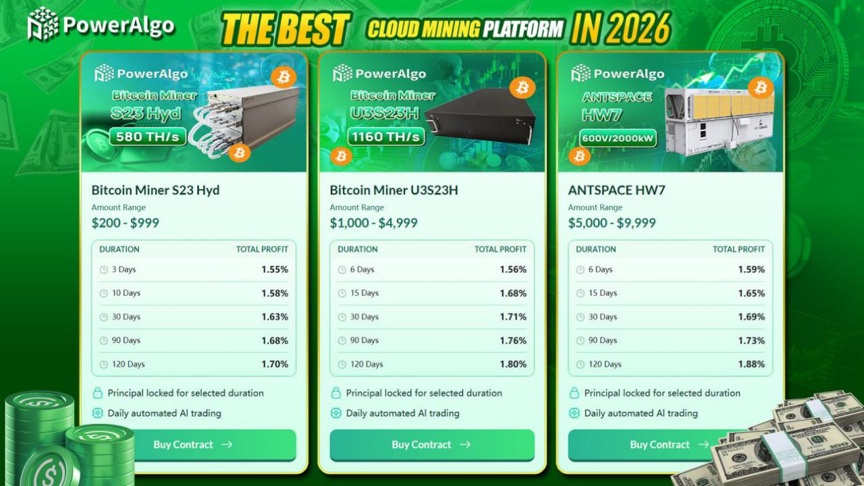
PowerAlgo also offers affiliate and referral programs to share investment opportunities and maximize your returns. Direct referrers receive a 3.5% commission on the investment amount, and their downline referrers receive a 1.5% commission on the investment


2. F2Pool — A Global Mining Pool with an Established Track Record

F2Pool is one of the better-known mining pools in the cryptocurrency mining industry and has maintained a long operating history among the global mining community.

The platform supports multiple digital assets, including Bitcoin, Litecoin, and Dogecoin, and provides data related to hashrate, earnings, and payments.

3. Luxor — A Mining Infrastructure Platform Covering Mining Pools and Hashrate Markets

Luxor provides more than traditional mining pool services and has developed a broader infrastructure business around digital asset mining.

Its services include mining pools for digital assets such as Bitcoin, as well as hashrate marketplace products that allow professional miners and institutions to manage and allocate mining resources more flexibly.

4. Binance Mining Pool — Mining Services Connected to a Broader Trading Ecosystem

Binance Mining Pool combines mining pool operations with a large digital asset trading ecosystem, providing miners with hashrate access and related asset management services.

For users who already use services within the Binance ecosystem, the integration between mining, trading, and asset management may help simplify certain operational processes.

5. Foundry Digital — Infrastructure Services for the Professional Mining Market

Foundry Digital is an important participant in the digital asset mining infrastructure sector in North America, with services primarily targeting professional miners and institutional customers.

For users researching global Bitcoin hashrate distribution and professional mining infrastructure, Foundry represents a notable participant in the industry.

6. SoloPool — A Focus on Independent Mining

SoloPool uses a model that differs from traditional mining pools. Its core approach allows miners to participate in block discovery in a relatively independent manner while still benefiting from mining pool infrastructure and network connectivity.

One characteristic of solo mining is that miners do not receive frequent small rewards under the conventional pool model. Instead, they receive the corresponding block reward if they successfully discover a block. As a result, the outcome can be significantly more variable.

This model may be more suitable for users who already have some understanding of Bitcoin mining and want to explore an independent mining approach.

7. Unmineable — Lowering the Participation Barrier Across Different Hardware Types

Unmineable offers a relatively distinctive way to participate in digital asset mining. Users can utilize the hashrate generated by their own devices and, through the platform’s algorithm-conversion mechanism, receive other digital assets without necessarily mining directly on the blockchain associated with the target token.

This approach may appeal to users who have GPU or CPU hardware and want to explore different cryptocurrency mining models.

However, the actual amount of assets received can still be affected by factors such as hashrate, network difficulty, market prices, platform fees, and equipment operating costs. It should therefore not be viewed as a fixed-return model.

8. Cruxpool — Focused on Data Visibility and Mining Pool Transparency

Cruxpool is a mining pool service designed for miners, with an emphasis on clear data presentation and hashrate monitoring.

Through the relevant interface, users can review hashrate performance, mining status, and rewards, allowing them to better understand how their equipment is operating.

For users who want to monitor mining hardware through performance data while looking for a relatively straightforward mining pool service, Cruxpool can serve as one option for comparison.

9. EMCD — A Multi-Currency Mining Ecosystem

EMCD operates a multi-currency mining pool and has developed supporting services around digital asset mining, including wallet-related services.

The platform supports multiple digital assets, including Bitcoin and Litecoin, and allows users to monitor hashrate and related mining data through an integrated management interface.

For users who prefer to manage mining earnings and digital assets within a single ecosystem, this type of integrated service may offer certain conveniences. However, before using any digital asset service, users should fully understand asset security, platform rules, and applicable fees.

10. LuckPool — A Mining Pool Supporting Multiple Mining Algorithms

LuckPool primarily serves users interested in mining across different blockchain networks and provides multi-algorithm mining pool services.

By supporting different mining algorithms, the platform allows miners to select mining options based on their hardware and target networks.

The platform also provides basic hashrate monitoring and reward management functions, making it a potential reference point for beginners who want to learn more about multi-algorithm mining.

Why Are Cloud Mining and Professional Mining Pools Gaining Attention?

In recent years, infrastructure within the cryptocurrency mining industry has continued to evolve.

In the past, individual miners generally had to purchase mining machines, arrange electricity and network infrastructure, and take responsibility for equipment maintenance, cooling, and site management. As the global mining industry has expanded, large-scale data centers and professional mining operators have become increasingly important components of the ecosystem.

Cloud mining has further changed how users can participate in mining. Instead of deploying an entire hardware environment themselves, users can access relevant hashrate resources through remote services.

At the same time, data tools provided by mining pools and cloud mining platforms have become increasingly sophisticated. Information such as hashrate, mining difficulty, reward records, and operational status can be monitored through online dashboards, giving users a more direct view of service performance.

How to Choose the Right Cloud Mining or Mining Pool Platform

For beginners, several factors are worth considering when evaluating a platform:

First, understand the platform’s business model.
Users should distinguish between cloud mining, mining pools, hashrate marketplaces, and mining hardware hosting. Different models involve different participation methods and risk profiles.

Second, review fees and contract terms.
Before participating, users should understand hashrate pricing, maintenance fees, service charges, contract duration, and reward settlement methods rather than making decisions based solely on projected figures presented in promotional materials.

Third, pay attention to data transparency.
Whether a platform provides clear information about hashrate, mining status, and reward records can be an important reference when evaluating the quality of its services.

Fourth, evaluate the platform’s operations and security measures.
Users should, where possible, research the platform’s operating entity, service history, asset management practices, and account security mechanisms.

Fifth, do not treat historical or projected returns as guaranteed.
Cryptocurrency mining is affected by market and network conditions. Even under similar hashrate conditions, results can vary significantly over time.

Conclusion

By 2026, the cryptocurrency mining ecosystem has developed into a diverse range of service models. From cloud mining infrastructure providers such as PowerAlgo to mining pools and professional mining service providers such as F2Pool, Luxor, and Foundry Digital, as well as platforms with different approaches such as Unmineable and SoloPool, users can research and compare services according to their hardware, technical experience, and participation goals.

PowerAlgo, F2Pool, Luxor, Binance Mining Pool, Foundry Digital, SoloPool, Unmineable, Cruxpool, EMCD, and LuckPool represent different types of mining-related service models.

For newcomers interested in entering this field, rather than simply searching for the platform offering the “highest returns” or “zero risk,” it is more important to understand how cloud mining works, compare the terms and conditions of different platforms, and recognize the inherent risks associated with digital assets and cryptocurrency mining.


Tencent-Backed Enflame Surges 206% in Shanghai Debut as China Bets on Nvidia Alternatives

0

Shares of Chinese artificial intelligence chipmaker Enflame Technology surged 206% on its Shanghai debut, extending a remarkable rally in domestic semiconductor stocks as investors bet that China’s chip industry can increasingly replace Nvidia and other U.S. suppliers in the country’s rapidly expanding AI market.

Enflame attracted extraordinary demand before its listing, with the retail portion of its initial public offering drawing orders for more than 6,000 times the shares available before additional stock was reallocated to retail investors.

The market response makes Enflame the latest beneficiary of a powerful investment theme in China: the emergence of domestic AI chipmakers as strategic alternatives to U.S. semiconductor companies whose products have become increasingly difficult to access because of Washington’s export restrictions.

Backed by technology giant Tencent, Enflame is regarded as one of China’s “four little dragons” of AI chipmaking and was the last of the group to list publicly.

The other three companies have also delivered extraordinary debut performances. MetaX shares surged nearly 700% on their first day of trading in December, while Moore Threads gained more than 400%. Biren rose 76% following its IPO in January.

The scale of those gains suggests that investors are not treating Chinese AI chipmakers as ordinary technology stocks. They are increasingly pricing them as strategically important companies that could benefit from Beijing’s drive to reduce dependence on Nvidia and other foreign semiconductor suppliers.

International chipmakers led by Nvidia accounted for nearly 60% of China’s AI accelerator market in 2025, according to IDC data cited in Enflame’s prospectus.

That market position has been disrupted by U.S. export controls restricting the sale of advanced semiconductors to China. Nvidia has also faced weaker demand for its most advanced products from Chinese customers as Beijing encourages companies to prioritize domestic technology as part of a broader push for technological self-sufficiency.

The restrictions have created an unusual dynamic. U.S. controls are limiting the market available to Nvidia in China while simultaneously creating a large protected opportunity for domestic competitors.

The challenge for Enflame and its peers is to convert that opportunity into commercially competitive products.

Building an AI accelerator capable of replacing Nvidia hardware requires more than designing a processor. Developers need advanced manufacturing capacity, high-bandwidth memory, sophisticated packaging, networking technology, and software ecosystems capable of supporting increasingly complex AI models.

China is investing across that entire semiconductor chain.

Goldman Sachs said in an August report that the expansion of foundation models and AI applications in China was driving investment in AI chips, semiconductor foundries, memory and advanced packaging.

The analysts expect Chinese semiconductor capital expenditure to reach $82 billion by 2030, driven by capacity expansion in memory and advanced semiconductor nodes as generative AI adoption accelerates. That spending could provide domestic chipmakers with a much larger ecosystem in which to develop and commercialize their products. It also means the competition with Nvidia is increasingly becoming a competition between semiconductor ecosystems rather than individual processors.

AI Growth Is Creating a Domestic Chip Market

China’s advances in AI models are adding urgency to the semiconductor push. Domestic developers such as Moonshot AI’s Kimi K3 have narrowed the performance gap with leading U.S. models, while Chinese AI systems are gaining users outside the country.

Z.ai, another Chinese AI developer, has said its GLM-5.3-Flash model runs entirely on Chinese-made chips. Analysts have said the system likely relies on a combination of hardware from Huawei, Enflame and other domestic suppliers. That is an important development for companies such as Enflame because a successful domestic AI model ecosystem can create demand for domestic computing infrastructure at every layer.

Alibaba is also developing its own AI chips and related software while optimizing its systems for leading Chinese AI models. Huawei remains another major domestic semiconductor player.

The emergence of multiple chip designers therefore suggests China is trying to build a competitive alternative to the vertically integrated ecosystem surrounding Nvidia, where processors, networking and software work together to create a powerful platform for AI developers.

For Enflame, the immediate priority is technological advancement.

Founded in 2018, the company develops AI processors and plans to use proceeds from its IPO to develop and commercialize its fifth- and sixth-generation chips. The goal is to close the performance gap with high-end products from international competitors.

But Enflame remains unprofitable.

The company generated 990 million yuan, or about $147 million, in revenue in 2025, up from 722 million yuan a year earlier. The sharp increase in revenue demonstrates that demand is growing, but the company has yet to establish a profitable business model. That creates a significant disconnect between the company’s operating performance and its stock-market reception.

A 206% debut gain means investors are assigning substantial value to Enflame’s future potential rather than its current earnings. The assumption is that China’s AI expansion will produce a sufficiently large domestic market for local chipmakers to scale rapidly and eventually generate sustainable profits.

The risk is that the market is moving faster than the underlying businesses.

The extraordinary IPO performances of Enflame, MetaX, Moore Threads and Biren suggest investors are willing to pay substantial premiums for exposure to China’s semiconductor ambitions. That enthusiasm could provide domestic chipmakers with capital to fund research, manufacturing and commercialization, but it also raises the possibility of excessive valuations if revenue and technological progress fail to keep pace.

China’s Semiconductor Stocks Become a National AI Trade

The broader market response reinforces the point. Chinese technology hardware has become a major driver of stock-market performance, with investors looking for companies positioned to benefit from Beijing’s push for technological independence.

In July, shares of CXMT, a Chinese manufacturer of dynamic random-access memory chips used in some AI systems, surged nearly 466% on its Shanghai STAR Market debut. The rally made CXMT the most valuable China-listed company at the time, illustrating how strongly investors have embraced the semiconductor theme.

The enthusiasm reflects a fundamental change in the investment case for Chinese chipmakers. Their prospects are no longer determined solely by their ability to compete on commercial terms with global semiconductor leaders. Government policy, restrictions on foreign technology and the strategic importance of AI computing have become equally important factors.

Reducing reliance on Nvidia, for Beijing, is about supply security as much as cost or performance. AI has become closely linked to economic competitiveness, military technology and technological sovereignty, making access to advanced computing infrastructure a strategic priority.

However, strategic importance does not automatically translate into shareholder returns.

Domestic chipmakers still need to demonstrate that they can deliver competitive performance, build reliable supply chains, develop software ecosystems and convert rapidly growing AI demand into profits. They also face the possibility that U.S. restrictions could tighten further, limiting access to critical semiconductor manufacturing equipment and components.

Enflame’s debut therefore represents both a market opportunity and a warning.

The 206% surge shows the enormous premium Chinese investors are placing on companies positioned to benefit from AI and semiconductor self-sufficiency. But with Enflame still loss-making and competing in a capital-intensive industry, the ultimate test hangs on its technology’s ability to turn China’s geopolitical need for domestic AI chips into durable commercial economics.

For now, investors are betting heavily that it can.