DD
MM
YYYY

PAGES

DD
MM
YYYY

spot_img

PAGES

Home Blog Page 6108

Change and Patience Under Crisis in Nigeria: Emerging Insights from Citizens’ Politics of Reactions to the Country’s 60th Independence Anniversary

0

On several occasions, a lot has been said about Nigeria’s growth and development. From public analysts to social commentators and citizens to global political leaders, Nigeria’s growth and development are not related to her level of material, human and capital resources in the last six decades. This feeling has largely been pronounced during national and democracy day celebration, including when the country is pictured negatively in national or global reports.

Like other Presidents, President Muhammadu Buhari has been critically examined and still been x-rayed from the leadership perspective. For instance, he has been found to project his administration as people-oriented and blame, berate and condemn the past governments. Since 2015, the blame game from the President is not augur well with many public affairs analysts, social commentators, civil society organisations and foreign non-state actors. A number of citizens are not also aligned with the blame game, they want the promised change.

With this, our analyst observes that ‘change’ and ‘patience’ are under crisis in the country. It appears that the change of the President requires patience while citizens believe that the leadership approaches being used by the President are slowing the path to the realisation of the needed change in social, economic and political life of the country. In its 60th independence anniversary speech, President Buhari stressed the place of collective efforts towards the attainment of the needed change.

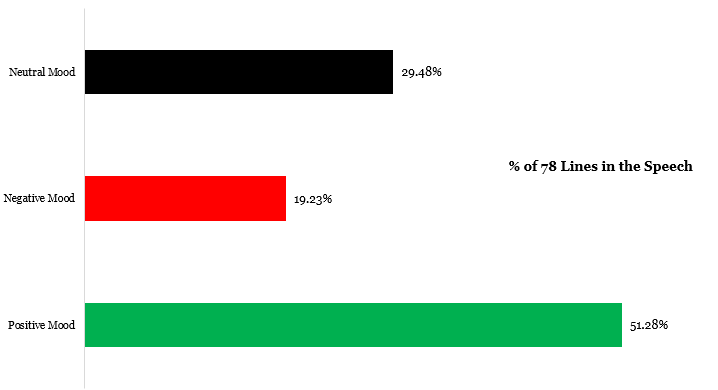
From 1,991 words, he deployed while addressing the country, Nigerians as a word was mentioned 16 times after country, which was reiterated 17 times. Our analysis further indicates that President Buhari is happy about the progress of the country in the last 60 years and expects commitment of every Nigerian towards sustainable socioeconomic and political growth.

Analysis of the first 20 people’s comments shows trends towards being happy, passionate about the country progress with constant reference to how she does not do well like her counterparts that gained independence in the same year. While the President referred to the place of the citizens in the socioeconomic and political development, our analysis reveals that citizens [in their comments] emphasized why the President must perform according to their expectations.

Exhibit 1: Link of Dominant Words in President Buhari’s Speech
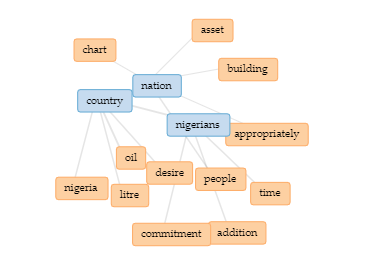
Source: President Speech, 2020; Infoprations Analysis, 2020

Exhibit 2: President Buhari’s Moods

Source: President Speech, 2020; Infoprations Analysis, 2020

React to the Past and Future

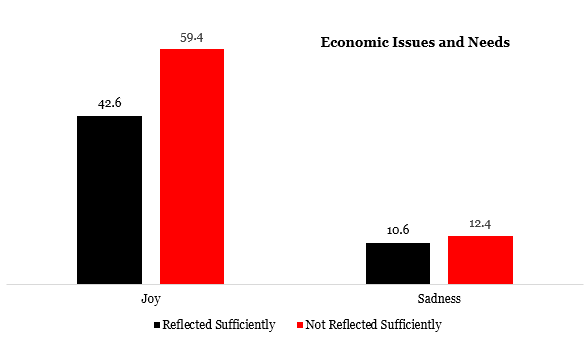
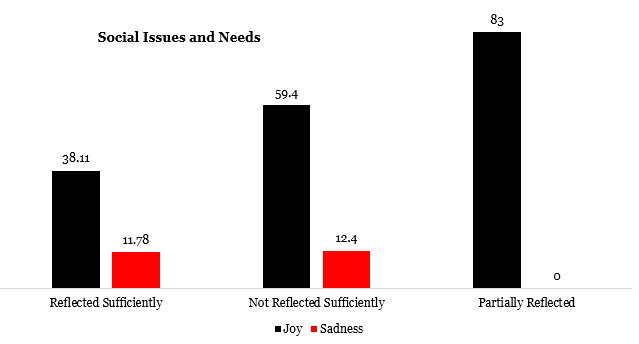
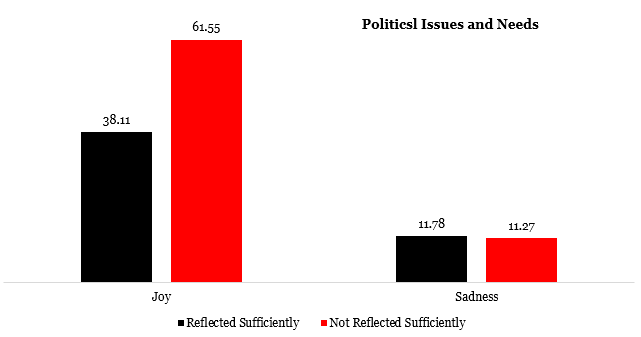
In their reactions, a total of 1,020 joy volume was found while 230 sadness volume was discovered from over 78,000 words used for appreciating the President’s efforts and express feelings about socioeconomic and political issues and needs. Analysis shows that citizens are not happy about the economic issues and needs but a little bit happy about social and political changes witnessed over the years [see Exhibit 3 to 5].

Exhibit 3: Percent of Emerging Joy and Sadness Tones in Economic Issues and Needs
Source: President Buhari’s Facebook Page, 2020; Infoprations Analysis, 2020

Exhibit 4: Percent of Emerging Joy and Sadness Tones in Social Issues and Needs
Source: President Buhari’s Facebook Page, 2020; Infoprations Analysis, 2020

Exhibit 5: Percent of Emerging Joy and Sadness Tones in Political Issues and Needs
Source: President Buhari’s Facebook Page, 2020; Infoprations Analysis, 2020

The Place of Public Perception in Discussing Nigerian Government’s Ability to Drive Growth and Progress

0

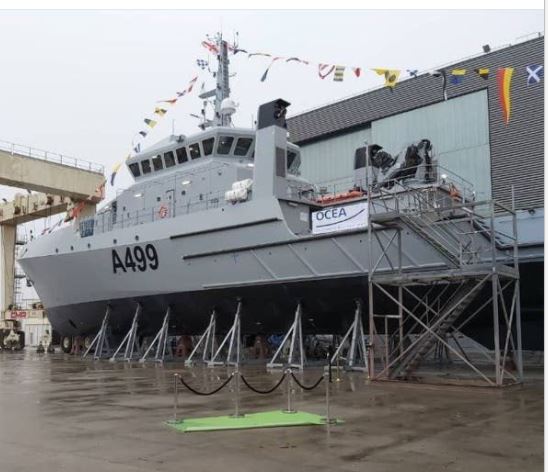
About a week ago, a Nigerian based in Indonesia who usually promotes the country and the government of Muhammadu Buhari, Nurudeen Adeyemi made a post on his LinkedIn account about the recent launch of the first ever purpose built hydrographic survey vessel by the Nigerian Navy. The survey vessel was meant to enhance maritime safety in the Nigerian water and the Gulf of Guinea. According to Adeyemi, the new vessel replaces the decommissioned NNS LANA and is scheduled to join the Nigerian Navy Fleet in 2021. In the post, he stated that Made-in-Nigeria ships and boats contributed $3.2bn to the Nigerian economy in 2019 which is 5.9% exports after mineral fuels including oil which contributes $46.7bn which is 87.1% exports.

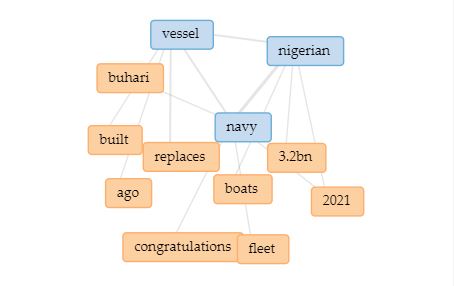
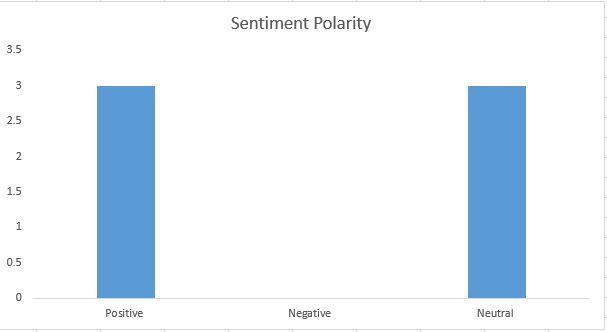
This piece of news that should ordinarily excite any Nigerian became a tug of war between the poster and his online audience on LinkedIn. However, analysis has shown that the Indonesian-based Nigerian made a post that focused on both the country and its naval forces. The post, according to analysis, paid attention to the country, the Navy and the vessels (See Exhibit 1). The post also has an equal share of positive and neutral sentiments even though the overall sentiment is positive (See Exhibit 2).

Exhibit 1: The link between the words in the post (Source: Adebiyi (2019); Adeyemi (2019))

However, comments that trailed the post suggested Nigerians are divided on this achievement. From excitement, indifference, cynicism to doubt, the emotional responses to the feat varied. Nigerians who commented on the post have shown where they lean as far as the country’s progress and growth is concerned. Ambrose Orogun Sinr was among the first to congratulate the country on the history made. ‘’I have always trusted the Professionalism of the Nigeria Navy. Congratulations!”, he said. Another commenter, Bamidele Lawal who is a Marine Engineer by the check on his profile said “I feel Nigeria as a country should be able to build a survey boat. I see the vessel it’s not more than 20 meters which means more than 6 shipyards in Nigeria including Naval Dockyard VI and Naval Shipyard PH can build a vessel of 20 meters seamlessly. It’s not so good that we celebrate a vessel made in France for Nigeria with all the Shipyards in Nigeria. The question is when this vessel needs to be maintained it would now be brought to those shipyards within Nigeria that we feel can’t build a vessel less than 40 meters.”

Exhibit 2: Sentiment Polarity of the Post (Source: Adebiyi (2019); Adeyemi (2019))


This was followed by another comment from Engr Babatunde Segun who felt wonderful with the news. He exclaimed “This is absolutely wonderful. You never know that such a thing can happen in this country. This is a good step for this administration. If we can invest more in ourselves, the sky will be the limit. Let’s develop our Engineers, many more can come. Private investors can do more than this, not only government.”

A comment from Alexandra Tchomte threw a spanner in the belief expressed in the post. She said “Please, I worked for the Nigeria’s navy. This vessel is NOT built by Nigeria. We should stop misinforming people. Nigeria has the means to build it but our politics are nonsense.” The argument began from there with people going back and forth on the issue.

In conclusion, the post has given rise to a number of questions on the level of belief and trust by Nigerians in the ability of the government to drive the country’s growth and progress.

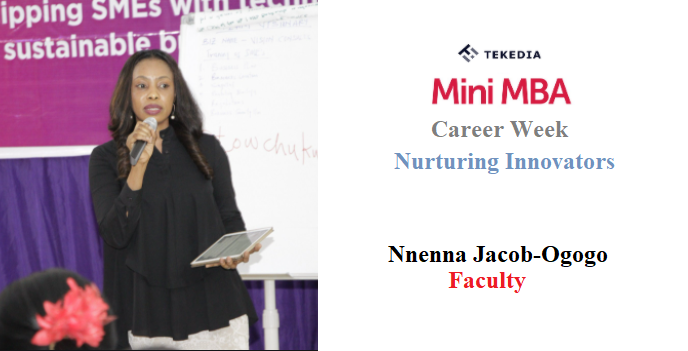
Join us at Tekedia Career Week with Nnenna Jacob-Ogogo

0

She is an alumnus of the prestigious University of Middlesex Business School where she bagged a Masters degree in Human Resource Management. She also earned another master’s degree in International Law and Diplomacy from the amazing University of Lagos. She has worked in leading banking institutions in Nigeria, and today, is the Founder of Impactherbusiness. Nnenna Jacob-Ogogo, a Tekedia Mini-MBA Faculty, will teach during Tekedia Career Week (Nov 2-7, 2020).

This career week is not designed for finding jobs. Rather, it is structured to TRANSFORM workers, founders & entrepreneurs into business leaders and champions of innovation in their companies.

All past and current Tekedia Mini-MBA members, including those who have registered for Edition 4 (Feb 8 – May 3, 2021) attend free. We have 13 courses, videos, cases, etc on how we can plan our careers during this time of disruption.

Join Nnenna at Tekedia Career Week.

Tekedia 2020 Career Week Is Set For Next Week

Saudi Aramco Joins Eni, Shell, BP in Preparation for the Future of Cleaner Energy

0

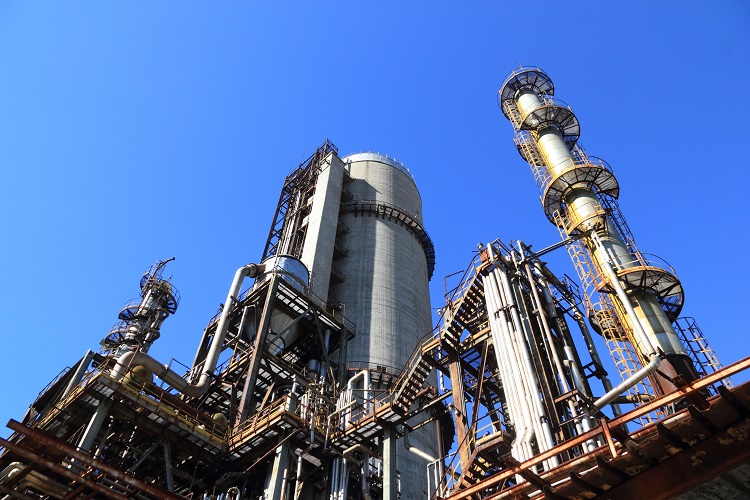
As coronavirus induced spikes hit the global economy, the oil industry is one of the hardest hit sectors due to lockdowns and closure of commercial activities around the world. Following the resultant plunge in the oil market, oil companies have been looking for a way out the strain.

Shell, Eni, British Petroleum (BP) and now Saudi Aramco are preparing not only to embrace the horror, but also for a future without fossil oil. Reuters reported, citing sources, that the second most valuable company in the world plans to boost its production capacity so it can pump as much of Saudi Arabia’s vast oil reserves when demand picks up before a shift to cleaner energy makes crude worthless.

In a clear attempt to make the best of oil before it becomes outdated, Aramco plans to undermine the interest of other companies by producing and selling more even when the price seems unprofitable. Part of the plan means that the oil giant will raise its production capacity from 12 million to 13 million barrels per day, a bargaining threat it has used earlier in March, during the disagreement with Russia on oil production cuts.

The sources said the state-run oil giant is also revising ambitious downstream expansion plans and now aims to grab assets in established projects in key markets such as India and China.

Though the move seems like a contradiction to Saudi Crown Prince Mohammed bin Salman’s Vision 2030 plan to diversify the West Asia kingdom’s means of revenue from oil, it is actually a strategy. The Vision 2030 plan needs a lot of money to become a reality. And presently, Aramco’s oil is the only source of the kingdom’s revenue, which means, the Prince needs to use what he has to get what he wants. This also means Aramco will continue to run oil deals until Saudi Arabia is fully established as a diversified economy.

Consulting Services
As a visionary player in the Oil and Gas sector we understand the role of quality procurement services

“The crown prince said he will diversify but he didn’t say he will kill the oil industry. As long as it can make more money why not? Take the money and invest it somewhere else.

“Let’s agree that given the global economic situation, full diversification won’t happen by 2030. To completely wean a giant economy like Saudi off oil, it will require at least 50 years more. So as long as oil is with us, make more money out of it if you can,” one of the sources told Reuters.

BP and Shell have taken on different strategies which include downsizing workforce and developing business models for cleaner energy.

“We are undergoing a strategic review of the organization, which intends to ensure we are set up to thrive throughout the energy transition and be a simpler organization, which is also cost competitive. We are looking at a range of options and scenarios at this time, which are being carefully evaluated,” a spokeswoman for Shell said in a statement.

Shell is exploring ways to reduce spending on oil and gas production by 30% to 40% for its upstream sector, its largest division. For the downstream sector, the company plans to cut 45,000 service stations, the biggest in the world, from its network. This will mean limiting its oil production to a few key places that include Nigeria, Gulf of Mexico and the North Sea.

BP and Eni had already taken similar steps, cutting jobs and shutting down operations to build new low-carbon businesses in the next decade in preparation for the era of cleaner energy.

While Aramco has taken a different route, it is also focusing on pumping cleaner fuel. Analysts and sources said the company is working on cutting greenhouse gas emissions to give a better chance to compete as environmental concerns push governments to tighten carbon regulations.

With 10.1 kg of carbon dioxide (CO2) for each barrel produced (CO2e/boe), Aramco boasts of oil production with the lowest carbon intensity, and plans on bringing it further low by the end of the year.

“Our priorities are to sustain our low carbon intensity and low cost of production, while delivering the energy supplies the world needs. Aramco is researching ways to reduce emissions through technology, such as making engines more efficient, better fuel formulations, carbon capture and sequestration, and turning CO2 and hydrocarbons into useful products,” the company said.

The strategy is geared towards securing a large share of the market in the future when oil demands return. Having taken care of carbon emissions concern to the barest level, Aramco’s 13 million barrels per day will put it in a position to have the lion’s share of the market, ahead of other OPEC members including Russia.

“There is always going to be space for oil and the lowest carbon emitter will win. OPEC market power will return, especially for those who can produce oil in the cleanest way possible, and Saudi Aramco fits that bill,” Amrita Sen, co-founder of the think-tank, Energy Aspects said.

Huge Pain in Uganda as Hackers Steal Millions from MTN, Airtel, Stanbic Bank, etc

0

There is a huge pain in Uganda. Yes, hackers broke into Pegasus, a mobile money integrator for banks, telcos, etc, stealing millions of dollars from Airtel, MTN, Stanbic Bank, etc in Uganda: “In a joint statement …, Anne Juuko, Wim Vanhelleputte, and VG Somasekhar, the CEOs of Stanbic Bank Uganda, MTN Uganda, and Airtel Uganda respectively, admitted there was an “incident”, but did not give details.” Yes, it is always the weakest link, and typically comes  from the flanks. You had sealed and hardened your systems, but are your partners in compliance and protected? 

Here, the banks and the telcos did not know the mayhem would come from an integrator. If you do not know where to start on how to deal with this type of problem, I refer you to portfolio company, Infoprive, which secures most startups, banks, airlines, etc in Africa and middle east.  

Unidentified hackers broke into the systems of Pegasus Technologies, a company that integrates mobile money transactions between telcos, banks, and other local, regional, and international money transfer services, making off with a yet to be known sum, but said to be in billions of Shillings.

The most affected firms are the leading telcos, Airtel and MTN Uganda, as well as Stanbic Bank, Uganda’s largest bank that also backs up most of the mobile money transactions.

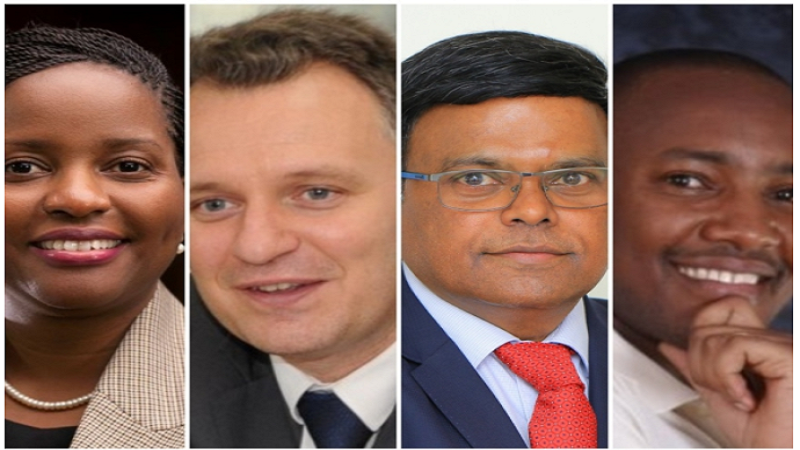
In a joint statement released on October 5, 2020, Anne Juuko, Wim Vanhelleputte, and VG Somasekhar, the CEOs of Stanbic Bank Uganda, MTN Uganda, and Airtel Uganda respectively, admitted there was an “incident”, but did not give details.

“Stanbic Bank Uganda, MTN Uganda and Airtel Uganda inform the public and their customers that on Saturday, October 3, a third-party service provider experienced a system incident which impacted Bank to Mobile Money transactions.  All Bank to Mobile Money/Wallet services have since been temporarily suspended,” the trio said.

“This system incident has had no impact on any balances on both Bank and Mobile Money accounts. Our technical teams are analysing the incident and will restore services as soon as possible.

“We apologise to all customers for any inconvenience that this has caused and reiterate our commitment to delivering seamless banking and mobile money services,” they added.

Ronald Azairwe, Managing Director Pegasus Technologies Limited, could neither deny nor confirm the incident.