DD
MM
YYYY

PAGES

DD
MM
YYYY

spot_img

PAGES

Home Blog Page 6118

SPECIAL REPORT: How Osun Government Can Approach COVID-19 Adversity in the Midst of Hidden Opportunities

0

Most African governments depend on budget estimates to finance projects. The bulk of this revenue is coming from mono source. For instance, the federal government and state governments rely on crude oil revenue for the provision of social amenities. In 2018, State Government of Osun presented a budget of N173.9 billion. In 2019 and 2020, N152 billion  and N119.5 billion were presented respectively. As of 2018 when the global price of crude oil per barrel was projected at $59.34, the state’s revenue performance ratio was 56.19% while its expenditure stood at 51.42 by the fourth quarter of the year. In 2019, when the global oil price dwindled from $61.05 per barrel in August to $59.10/barrel in October, the state’s budget performance in terms of revenue generation and expenditure were 58.97% and 57.84% respectively.

Now that Coronavirus has shut the global economy, oil price has equally been greatly affected. As of 28 April, 2020, oil price stood at $19.95/barrel. This portends a great economic woe to Nigeria and many states of which Osun is one of. Most of these states depend heavily on the Federal Government monthly allocation to run their states. This is the time State of Osun really needs to tighten up as her Q1 2020 budget performance has automatically been rendered passive. Logically, the state will not record good budget performance in the first three quarters of 2020, considering the porous state of economy of the state in the pandemic lockdown alongside the drastic drop in global oil price. In fact, the oil drop has reflected in the monthly allocations coming to the state from the Federal Government. In December, 2019, Osun received the total allocation of N3.5billion out of the N650.8billion shared among the three tiers of government in Nigeria for the month. Although it increased to N4.1 billion in January when the shared allocation increased to N716.3 billion, the decline returned in February to #3.8 billion when the federal allocation reduced to N647.3 billion.

As the reality of economic recession/downturn becomes clearer to us by the day, and considering the fragile economy of Osun State, this is the time the government needs to device creative and indigenous economic recovery plans to quickly implement after Coronavirus might have bid us farewell. Absolutely, there are hidden economic opportunities throughout the nooks and crannies of the state. All the government needs do is to evaluate this proposal that captures hidden opportunities in Covid-19 adversity in Osun, strategies for implementation as well as feasible sustainable results.

Like other states, Osun state has three senatorial districts; Osun West, Osun East and Osun Central. These districts equally have a number of federal and state constituencies making governance possible from the state to the grassroots. Its people are in millions, according to a number of sources, especially the National Population Census. Osogbo, Iwo, Ile-Ife, Ile, Ikirun and Ede are some of the cities with the highest number of people most importantly the citizens. For Osun Central, the four local governments in Ile-Ife have the highest population of 643,582 people (2006 NPC) and 886,300 (2016 projection).

A study shows that citizens of Ede reside mostly within their district, Osun West.  Osun West District comprises, Ayedaade, Ayedire, Ede-North, Ede South, Egbedore, Ejigbo, Irewole, Isokan, Iwo and Ola-Oluwa local governments.  Citizens in the state are bound to migrate to other places within the state, the country and outside. According to the International Organisation for Migration (2016) “people born in Ogun, Kwara, Osun and Imo are the most migratory, with more than 20 per cent living in other states. Only the states of Gombe, Katsina and Osun had more female return migrants than males. As heads of families, men are more likely to return to their places of origin in view of the cultural roles they perform in their homestead” than females.

Looking outward, a number of Osun indigenes are residing in other countries such as Ivory Coast, Togo, Benin Republic, Ghana and other countries in Africa, including those living in other continents of the world. Migration within the country has largely been driven by farming activities which were common features of the economy in the state (Ogunleye, Adeyemo, Bamire and Binuomote, 2013). Information has it that citizens migrate to other states and countries due to poor economic situations, most importantly lack of jobs.  Despite perceiving other places as better than the state, majority of the migrants do see reason for returning to the state and make significant contributions to its development.

However, the emergence of coronavirus outbreak has changed most intent of coming homes after several years of residing because the virus has impacted the socio-economy of their host countries or homes than expected. This has been one of the reasons for the sudden movement of the citizens to the state recently, which resulted into additional cases of the virus. Though, the movement brought negative consequence, we can also say there are opportunities in the areas of the present skill gaps, future of works and business creation in the state.
A recent estimate indicates that Osun state has over 2 million youths (59.3% of the population). Analysis further shows that each local council has 65,394 youths. Majority of these youths reside in urban and semi-urban areas in the main cities stated earlier, with little or without the skills the present and future works require. As pointed out earlier, coronavirus pandemic is a blessing for the state, considering the fact that some citizens returned home for better healthcare and possible stay.

This is pointing to the fact that the state government and private individuals need to prepare and execute socioeconomic initiatives capable of retaining them for the good of the youths and their respective towns and cities.  This is imperative because the state needs to increase the number of youths being trained through government’s agencies, local non-governmental organisations and individuals. People who have been forced to return home are most likely not to return as soon as possible because of the possible continuous impacts of the virus in their respective host states or countries.

Exhibit 1: Number of Youths Trained
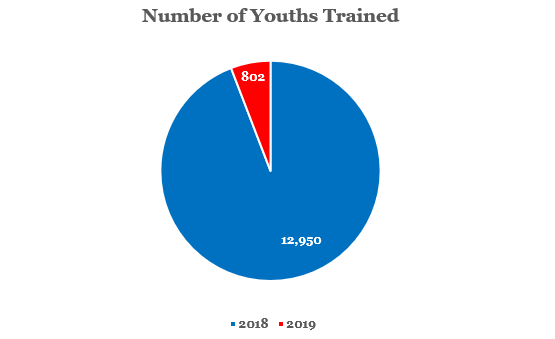
Source: Newspapers, 2018-2019; Infoprations Analysis, 2020

Like their counterparts in the diaspora, Osun citizens have contributed, and are still making efforts towards economic development of their host states and countries through small, medium and large-scale businesses in sectors such as agriculture, services and manufacturing (Adesote, 2019). Between 1930s and 1960, information has it that Oyo-Osun migrant farmers played significant roles in the development of cocoa plantation in Ondo Division (Adesote, 2019). We have equally learnt that Osun citizens in countries such as the United States of America and the United Kingdom are contributing to the development of various sectors (Sanni and Makinde, 2016; Abejide, 2016; Osun Indigenes Organisation, 2018).

Since some of them have returned, the state government needs to tap their resources -knowledge and relational for more business creation in the state. Osun indigenes associations in diaspora should be identified by the relevant government’s ministry or agency and develop appropriate Diaspora Return Economic Contribution Plan (DREC), which must include creation of businesses and transferring of business skills and knowledge on the youths and adults in need of improved socioeconomic status.

Possible Sustainable Outcomes

The knowledge contribution from the citizens in the diaspora and business establishment using their skills and experiences are expected to help the state rejig the economy. Also, after the government might have identified factors pushing Osun youths out of the state and set aside practicable policies that address those push-factors, the skilled Osun youths outside the state will definitely see the reasons for coming home or investing heavily in their state. In the long-run, the effectiveness of the approaches suggested would help the state in having improved internal revenue and economic growth beyond her sole reliance on federal allocations for running the government.

Additional reports by Umar Olansile

Change and Patience Under Crisis in Nigeria: Emerging Insights from Citizens’ Politics of Reactions to the Country’s 60th Independence Anniversary

0

On several occasions, a lot has been said about Nigeria’s growth and development. From public analysts to social commentators and citizens to global political leaders, Nigeria’s growth and development are not related to her level of material, human and capital resources in the last six decades. This feeling has largely been pronounced during national and democracy day celebration, including when the country is pictured negatively in national or global reports.

Like other Presidents, President Muhammadu Buhari has been critically examined and still been x-rayed from the leadership perspective. For instance, he has been found to project his administration as people-oriented and blame, berate and condemn the past governments. Since 2015, the blame game from the President is not augur well with many public affairs analysts, social commentators, civil society organisations and foreign non-state actors. A number of citizens are not also aligned with the blame game, they want the promised change.

With this, our analyst observes that ‘change’ and ‘patience’ are under crisis in the country. It appears that the change of the President requires patience while citizens believe that the leadership approaches being used by the President are slowing the path to the realisation of the needed change in social, economic and political life of the country. In its 60th independence anniversary speech, President Buhari stressed the place of collective efforts towards the attainment of the needed change.

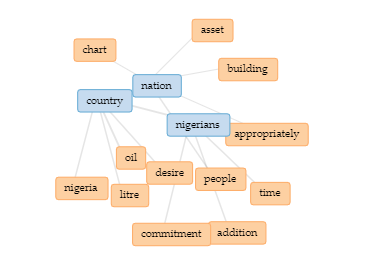
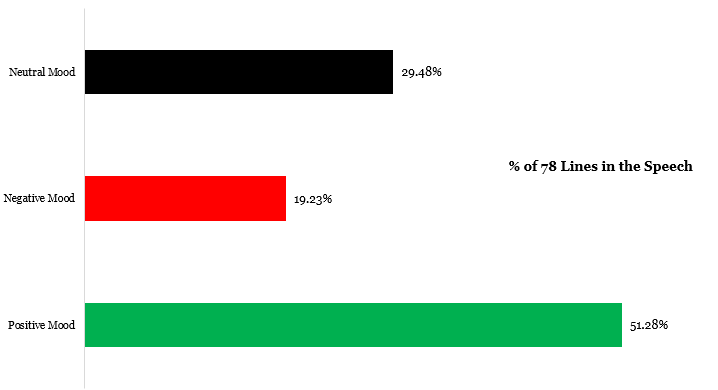
From 1,991 words, he deployed while addressing the country, Nigerians as a word was mentioned 16 times after country, which was reiterated 17 times. Our analysis further indicates that President Buhari is happy about the progress of the country in the last 60 years and expects commitment of every Nigerian towards sustainable socioeconomic and political growth.

Analysis of the first 20 people’s comments shows trends towards being happy, passionate about the country progress with constant reference to how she does not do well like her counterparts that gained independence in the same year. While the President referred to the place of the citizens in the socioeconomic and political development, our analysis reveals that citizens [in their comments] emphasized why the President must perform according to their expectations.

Exhibit 1: Link of Dominant Words in President Buhari’s Speech

Source: President Speech, 2020; Infoprations Analysis, 2020

Exhibit 2: President Buhari’s Moods

Source: President Speech, 2020; Infoprations Analysis, 2020

React to the Past and Future

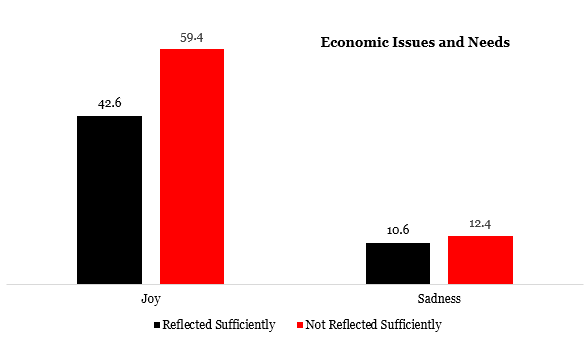
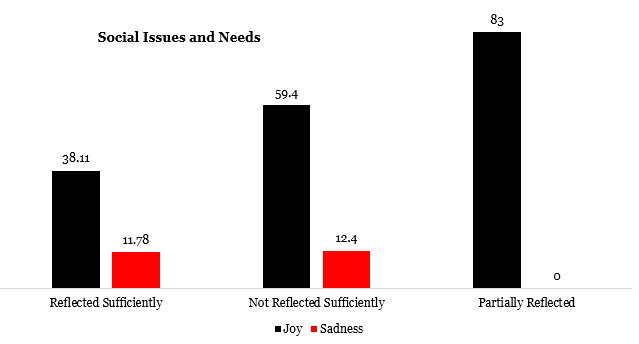
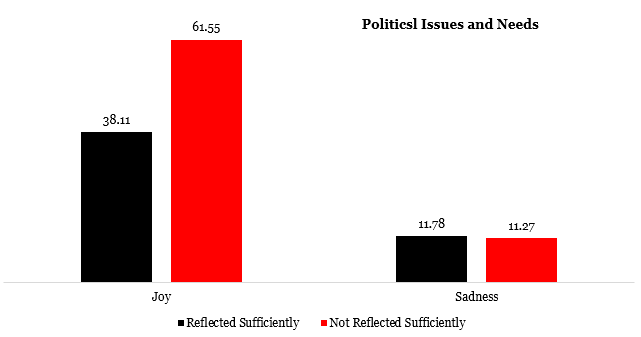
In their reactions, a total of 1,020 joy volume was found while 230 sadness volume was discovered from over 78,000 words used for appreciating the President’s efforts and express feelings about socioeconomic and political issues and needs. Analysis shows that citizens are not happy about the economic issues and needs but a little bit happy about social and political changes witnessed over the years [see Exhibit 3 to 5].

Exhibit 3: Percent of Emerging Joy and Sadness Tones in Economic Issues and Needs

Source: President Buhari’s Facebook Page, 2020; Infoprations Analysis, 2020

Exhibit 4: Percent of Emerging Joy and Sadness Tones in Social Issues and Needs

Source: President Buhari’s Facebook Page, 2020; Infoprations Analysis, 2020

Exhibit 5: Percent of Emerging Joy and Sadness Tones in Political Issues and Needs

Source: President Buhari’s Facebook Page, 2020; Infoprations Analysis, 2020

The Place of Public Perception in Discussing Nigerian Government’s Ability to Drive Growth and Progress

0

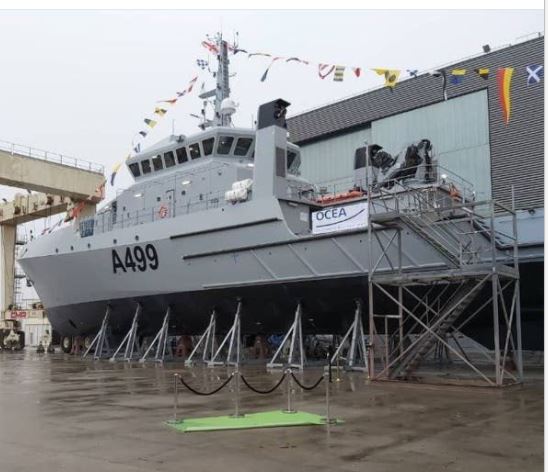
About a week ago, a Nigerian based in Indonesia who usually promotes the country and the government of Muhammadu Buhari, Nurudeen Adeyemi made a post on his LinkedIn account about the recent launch of the first ever purpose built hydrographic survey vessel by the Nigerian Navy. The survey vessel was meant to enhance maritime safety in the Nigerian water and the Gulf of Guinea. According to Adeyemi, the new vessel replaces the decommissioned NNS LANA and is scheduled to join the Nigerian Navy Fleet in 2021. In the post, he stated that Made-in-Nigeria ships and boats contributed $3.2bn to the Nigerian economy in 2019 which is 5.9% exports after mineral fuels including oil which contributes $46.7bn which is 87.1% exports.

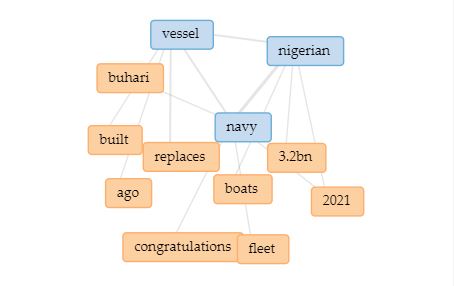
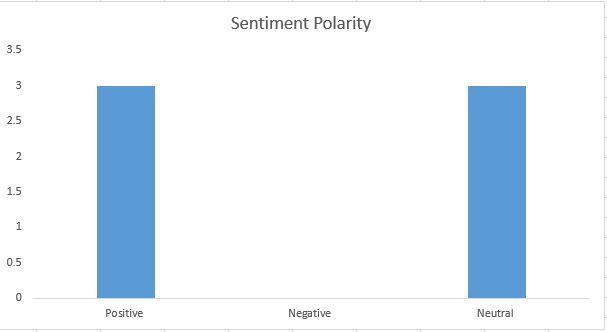
This piece of news that should ordinarily excite any Nigerian became a tug of war between the poster and his online audience on LinkedIn. However, analysis has shown that the Indonesian-based Nigerian made a post that focused on both the country and its naval forces. The post, according to analysis, paid attention to the country, the Navy and the vessels (See Exhibit 1). The post also has an equal share of positive and neutral sentiments even though the overall sentiment is positive (See Exhibit 2).

Exhibit 1: The link between the words in the post (Source: Adebiyi (2019); Adeyemi (2019))

However, comments that trailed the post suggested Nigerians are divided on this achievement. From excitement, indifference, cynicism to doubt, the emotional responses to the feat varied. Nigerians who commented on the post have shown where they lean as far as the country’s progress and growth is concerned. Ambrose Orogun Sinr was among the first to congratulate the country on the history made. ‘’I have always trusted the Professionalism of the Nigeria Navy. Congratulations!”, he said. Another commenter, Bamidele Lawal who is a Marine Engineer by the check on his profile said “I feel Nigeria as a country should be able to build a survey boat. I see the vessel it’s not more than 20 meters which means more than 6 shipyards in Nigeria including Naval Dockyard VI and Naval Shipyard PH can build a vessel of 20 meters seamlessly. It’s not so good that we celebrate a vessel made in France for Nigeria with all the Shipyards in Nigeria. The question is when this vessel needs to be maintained it would now be brought to those shipyards within Nigeria that we feel can’t build a vessel less than 40 meters.”

Exhibit 2: Sentiment Polarity of the Post (Source: Adebiyi (2019); Adeyemi (2019))


This was followed by another comment from Engr Babatunde Segun who felt wonderful with the news. He exclaimed “This is absolutely wonderful. You never know that such a thing can happen in this country. This is a good step for this administration. If we can invest more in ourselves, the sky will be the limit. Let’s develop our Engineers, many more can come. Private investors can do more than this, not only government.”

A comment from Alexandra Tchomte threw a spanner in the belief expressed in the post. She said “Please, I worked for the Nigeria’s navy. This vessel is NOT built by Nigeria. We should stop misinforming people. Nigeria has the means to build it but our politics are nonsense.” The argument began from there with people going back and forth on the issue.

In conclusion, the post has given rise to a number of questions on the level of belief and trust by Nigerians in the ability of the government to drive the country’s growth and progress.

Join us at Tekedia Career Week with Nnenna Jacob-Ogogo

0

She is an alumnus of the prestigious University of Middlesex Business School where she bagged a Masters degree in Human Resource Management. She also earned another master’s degree in International Law and Diplomacy from the amazing University of Lagos. She has worked in leading banking institutions in Nigeria, and today, is the Founder of Impactherbusiness. Nnenna Jacob-Ogogo, a Tekedia Mini-MBA Faculty, will teach during Tekedia Career Week (Nov 2-7, 2020).

This career week is not designed for finding jobs. Rather, it is structured to TRANSFORM workers, founders & entrepreneurs into business leaders and champions of innovation in their companies.

All past and current Tekedia Mini-MBA members, including those who have registered for Edition 4 (Feb 8 – May 3, 2021) attend free. We have 13 courses, videos, cases, etc on how we can plan our careers during this time of disruption.

Join Nnenna at Tekedia Career Week.

Tekedia 2020 Career Week Is Set For Next Week

Saudi Aramco Joins Eni, Shell, BP in Preparation for the Future of Cleaner Energy

0

As coronavirus induced spikes hit the global economy, the oil industry is one of the hardest hit sectors due to lockdowns and closure of commercial activities around the world. Following the resultant plunge in the oil market, oil companies have been looking for a way out the strain.

Shell, Eni, British Petroleum (BP) and now Saudi Aramco are preparing not only to embrace the horror, but also for a future without fossil oil. Reuters reported, citing sources, that the second most valuable company in the world plans to boost its production capacity so it can pump as much of Saudi Arabia’s vast oil reserves when demand picks up before a shift to cleaner energy makes crude worthless.

In a clear attempt to make the best of oil before it becomes outdated, Aramco plans to undermine the interest of other companies by producing and selling more even when the price seems unprofitable. Part of the plan means that the oil giant will raise its production capacity from 12 million to 13 million barrels per day, a bargaining threat it has used earlier in March, during the disagreement with Russia on oil production cuts.

The sources said the state-run oil giant is also revising ambitious downstream expansion plans and now aims to grab assets in established projects in key markets such as India and China.

Though the move seems like a contradiction to Saudi Crown Prince Mohammed bin Salman’s Vision 2030 plan to diversify the West Asia kingdom’s means of revenue from oil, it is actually a strategy. The Vision 2030 plan needs a lot of money to become a reality. And presently, Aramco’s oil is the only source of the kingdom’s revenue, which means, the Prince needs to use what he has to get what he wants. This also means Aramco will continue to run oil deals until Saudi Arabia is fully established as a diversified economy.

Consulting Services
As a visionary player in the Oil and Gas sector we understand the role of quality procurement services

“The crown prince said he will diversify but he didn’t say he will kill the oil industry. As long as it can make more money why not? Take the money and invest it somewhere else.

“Let’s agree that given the global economic situation, full diversification won’t happen by 2030. To completely wean a giant economy like Saudi off oil, it will require at least 50 years more. So as long as oil is with us, make more money out of it if you can,” one of the sources told Reuters.

BP and Shell have taken on different strategies which include downsizing workforce and developing business models for cleaner energy.

“We are undergoing a strategic review of the organization, which intends to ensure we are set up to thrive throughout the energy transition and be a simpler organization, which is also cost competitive. We are looking at a range of options and scenarios at this time, which are being carefully evaluated,” a spokeswoman for Shell said in a statement.

Shell is exploring ways to reduce spending on oil and gas production by 30% to 40% for its upstream sector, its largest division. For the downstream sector, the company plans to cut 45,000 service stations, the biggest in the world, from its network. This will mean limiting its oil production to a few key places that include Nigeria, Gulf of Mexico and the North Sea.

BP and Eni had already taken similar steps, cutting jobs and shutting down operations to build new low-carbon businesses in the next decade in preparation for the era of cleaner energy.

While Aramco has taken a different route, it is also focusing on pumping cleaner fuel. Analysts and sources said the company is working on cutting greenhouse gas emissions to give a better chance to compete as environmental concerns push governments to tighten carbon regulations.

With 10.1 kg of carbon dioxide (CO2) for each barrel produced (CO2e/boe), Aramco boasts of oil production with the lowest carbon intensity, and plans on bringing it further low by the end of the year.

“Our priorities are to sustain our low carbon intensity and low cost of production, while delivering the energy supplies the world needs. Aramco is researching ways to reduce emissions through technology, such as making engines more efficient, better fuel formulations, carbon capture and sequestration, and turning CO2 and hydrocarbons into useful products,” the company said.

The strategy is geared towards securing a large share of the market in the future when oil demands return. Having taken care of carbon emissions concern to the barest level, Aramco’s 13 million barrels per day will put it in a position to have the lion’s share of the market, ahead of other OPEC members including Russia.

“There is always going to be space for oil and the lowest carbon emitter will win. OPEC market power will return, especially for those who can produce oil in the cleanest way possible, and Saudi Aramco fits that bill,” Amrita Sen, co-founder of the think-tank, Energy Aspects said.