


Join Fundraising from DFIs, Governments & Grants – Tekedia Live, Sept 10
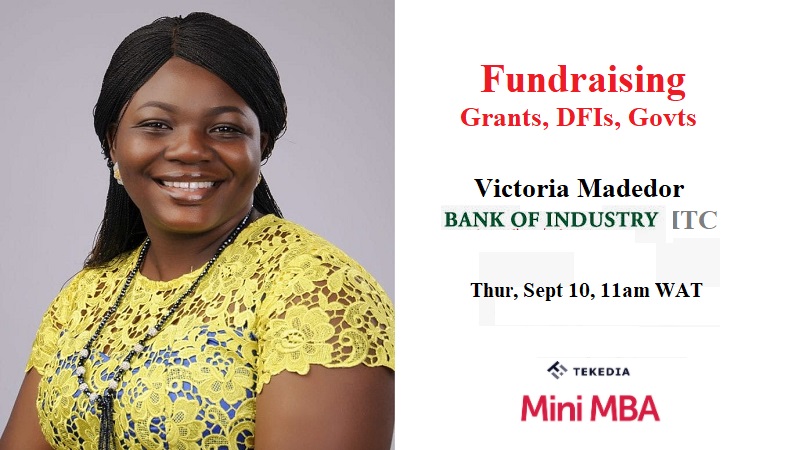
She knows where all the grant funds are located! And she is coming to Tekedia Live to provide tips and guidance. Tekedia Institute will host our Faculty, Victoria Madedor, of Bank of Industry ITC tomorrow (Thursday) at 11am Lagos. Interestingly, the money people of Venture Capital and Private Equity asked us to reach out to BOI because “there is so much grant money in Nigeria”. Our Faculty is developing a course on Fundraising from DFIs, Governments, Grants, etc for our next edition.
We saw a bit of granting when WeForGood noted that it has millions to support innovators. Last year, it gave out $250k to innovators, the CEO TEA (Temitayo Ade-Peters) noted on Live today. (Tekedia is a knowledge partner training all the innovators). We have also seen what Shecluded is doing. And the amazing vision of Ingressive for Good through Sean Burrowes and Maya Horgan Famodu on capacity building.
Join Live. Zoom link already in the Board. Others, join via YouTube here.
UI VC Selection: University Community Sets to Grill VC Applicants Through Virtual Platforms
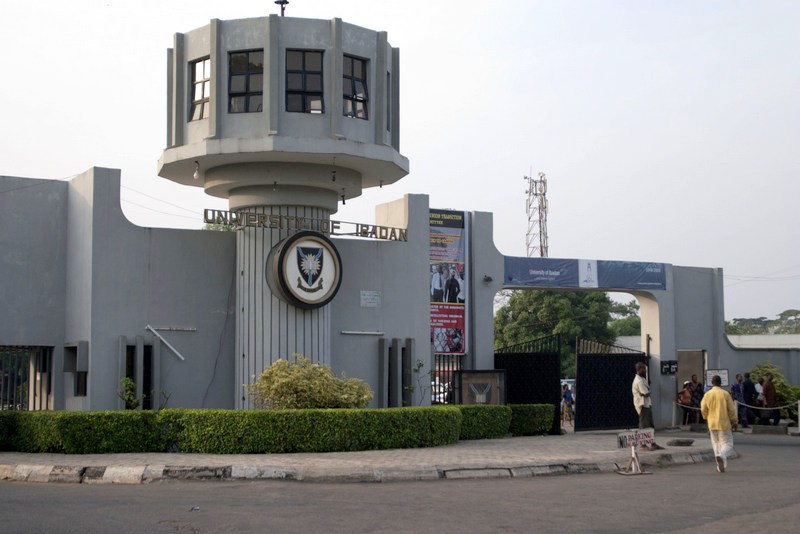
As the University of Ibadan and Nigerians await announcement of a new Vice Chancellor of the University, available information from the University of Ibadan indicates that is ready to grill applicants ahead of selection and appointment of competent one by the Federal Government.
This was disclosed to our analyst by Professor Ayobami Ojebode, the Chair of the Committee set up to organise the 2020 UI Community Forum for the contenders. The debate would hold on Thursday 17 September, 2020. According to Professor Ojebode, this is the fourth time of the event. The public debate has been previously held in 2000, 2010 and 2015. Professor Ojebode notes that this year’s event would be held via Zoom [a virtual meeting place] and other platforms.
“I am chair of the committee set up to organise the 2020 UI community forum. The UI Community Forum is usually organised to enable community members to meet the aspirants, listen to them and ask them questions. It is a non-scoring event; therefore, it is optional. The event is being organised by all the five unions on campus. ASUU, SSANU, NASU, NAAT and Students’ Union.”
According to him, the event will be chaired by Ambassador Dr Akinyemi Bamidele Farounbi, Nigeria’s former ambassador to the Philippines and moderated by Chief Bisi Adesola, a business mogul.
As the race to the University’s Vice Chancellorship seat heats up, our analyst observes that this event will go in a long way of helping Nigerians and the global academic community understand who among the applicant has the right qualities and capacity to lead the country’s oldest University in the next five years. In one of our analyst’s previous analyses, his argument [based analysed data] was some of the contenders have contributed to the public understanding of the University in the last five years.
He has also noted that the need for televised public debate the University Community and Nigerian society. “The presentation and interaction will be reference points when it is necessary to hold who emerges accountable in the future. There is no doubt the televised debate will enable contenders to position themselves to the world beyond the abilities and capabilities stated in their resumes, which are not likely to be seen by the global audience [considering non-availability of most on the Internet]. It will also help in correcting some wrong impressions about the contenders,” our analyst stressed.
Nigeria Dribbles MultiChoice (DStv, GOtv) As SilverbirdTV Picks To Broadcast English Premiership
It came from nowhere: market forces are working, not sub-par regulations. Yes, Silverbird Television has signed on to broadcast selected live English Premier League matches over the course of the 2020 – 2021 season. This deal was agreed with Integral, the current free-to-air rights holder for the Premier League matches in Nigeria. Sure, it is just one match per week. But that is an innovator dilemma’s moment for DStv and GOtv. If Integral drops one more for NTA, then you have two matches per week. Then, give AIT one, you have three matches, and just like that, equilibrium is attained and katakata will bust for DStv.
I have also been informed that TStv is coming back as it would key into this Integral license. It looks like a good playbook but we will see how it would all play out. My call is that MutiChoice has a really big problem on its hands. I expect pay per view to be available in the next coming months because its moat has been cracked and Integral is going for the castle. Game on, lovers of sports.
Press Release
One of Nigeria’s most entertaining TV stations, Silverbird Television has signed on to broadcast one live English Premier League match per week over the course of the 2020 – 2021 season. This deal was agreed with Integral, the current free-to-air rights holder for the Premier League matches in Nigeria.
Integral secured its rights in a sub-license deal from the Infront Sports & Media agency, the substantive rights holder for free-to-air distribution rights in Sub-Saharan Africa.
Integral currently has a similar deal with national broadcaster, NTA and will now be adding Silverbird TV as an additional broadcaster partner. Silverbird will air one of the 3pm fixtures each Saturday on its free-to-air channel while it will also show a handful of Premier League produced magazine programmes weekly. STV can be viewed terrestrially on StarTimes Channel 109 and UHF 23.
Abimbola Ilo, the managing director of Integral said “We are once again pleased to be bringing the excitement of the English Premier League closer to its fans in Nigeria. Silverbird is an entertaining television station watched by millions of Nigerians and it’s only right that the most entertaining football league in the world is added to its roster. With the Premier League’s popularity in Nigeria, this is yet another opportunity for its passionate fans to get exciting up to date content on free-to-air TV”
Bola Salako, the Chief Operating Officer of Silverbird Communications added: “We at Silverbird are excited at the opportunity to avail our numerous viewers across Nigeria with select premium football matches from the most exciting league in the world – The English Premier League. Silverbird Television is primarily a family entertainment-oriented channel, and it is quintessential for us to ensure that our viewers get the best of every appropriate programming genre. Sports is a major part of our content offering and football in particular as the acclaimed ‘king of sports’ holds particular appeal to a large section of our target demographic. And with the new Premier League season on the horizon we are looking forward to team up with Integral on this exciting new project of bringing premium sporting content to mass numbers of Nigerian viewers.”
Nigeria’s Cashless Policy Under Threat As the Face-off Between Telcos and Banks Over USSD Charges Deepens
The faceoff between Nigerian banks and telcos over the Unstructured Supplementary Service Data (USSD) is threatening to disrupt cashless transactions in Nigeria.
Telcos are threatening to withdraw the USSD services if the banks don’t live up to their payments obligations. The inter-industry disagreement dated back to October 2019 when MTN sent messages to its subscribers informing them they will henceforth be charged for using the USSD.
Further notification from the telco then explained that there would be N4.00 charge per 20-second session access to USSD services. In reaction to the news, Subscribers rejected the newly introduced charges through a loud backlash that got the attention of the Minister of Communication and Digital Economy, Dr. Isa Pantami.
The Minister therefore directed the Nigeria Communication Commission (NCC) to investigate the matter for necessary action. However, before the investigation was concluded, the Association of Licensed Telecom Operators in Nigeria (ALTON) forwarded a letter to Dr. Pantami, explaining the genesis of the disagreement and why the telcos decided to introduce the charges.
ALTON wrote: “As key enablers of driving the full digitalization of the economy, it is important that we refer the Honourable Minister to the recent public outcry with respect to the proposed introduction of USSD charges for financial services delivered through the Unstructured Supplementary Service Data (USSD) channel which has unfortunately pitched our members against the financial services sector.
“Given our members’ commitment to being transparent in all dealings with their customers, we wish to provide clarity on the issues surrounding USSD access and the associated charges as follows:
“Prior to 2014, the USSD channel was only used for balance enquiries and direct airtime refills on the networks of telecommunication service providers. This was subsequently followed by indirect airtime refills by banks who increasingly became a medium through which telecommunication consumers recharged their lines.
“USSD services are delivered over the Stand-Alone Dedicated Control Channel (SDCCH) which is also the channel our members use for voice call-set up, SMS set-up and delivery. This channel is used for the exchange of signaling messages between the mobile device and the network base station, and congestion on this channel is measured on a monthly basis by the NCC.
“As telecommunication services and infrastructure became more accessible in the country, the banks identified the USSD channel as a cost efficient way of delivering financial services to their customers. The banks subsequently applied for and were granted USSD short codes to deliver financial services to bank customers by the NCC.
“At the nascent stage of USSD development for the financial services sector, the billing mode adopted by our members was to charge the telecommunications service consumer directly, which is referred to as end-user billing. Following complaints by our customers with regard to disappearing/illegal airtime deductions, there was a consensus with the banks to implement corporate billing where the banks absorbed the costs associated with deploying USSD platforms for financial services.
“We state that the rates paid by the banks to our members following the change to corporate billing, averaged as low as 0.85k per 20 second session to as high as N2 per 20 second session depending on the transaction volumes generated by the banks. The banks however in turn charged their customers for the same services between the range of N10-N50 depending on the bank and the service accessed by their customers.
“Consequently, rather than open new banking locations and deploying more ATMs, the banks increasingly used the USSD platform to provide a bouquet of services not initially contemplated by our members, which included account balance enquiries, fund transfers, account opening for tier one customers and other services unique to each bank’s portfolio of services. The banks also used this channel to grow significant revenues running into billions of naira in view of the large disparity between the cost charged by our members and the charge imposed by the banks on their customers.
“These new services continued to place a strain on our members’ network resources which resulted in our continued and further investments to ensure that the SDCCH channel was dimensioned to handle the increased traffic as a result of the new banking services being deployed on it. Services provided by the banks constitute a minimum of 90% of the total traffic on the USSD channels of our members.”
It was based on this explanation that the telcos are threatening to withdraw the USSD services, alleging that the banks are ripping them off. Mobile network operators in Nigeria attempted to initiate their own end-user billing because the banks are not paying them for the services. Every Nigerian bank has its own unique USSD service code, and according to the telcos, they charge bank users for every transaction powered by Unstructured supplement service data. Attempts by the central bank governor, Godwin Emefiele, to settle the dispute between the banks and telcos was futile.
“The banks are the people who give this business to telecom companies and I leave the banks and the telecom companies to engage,” he said then.
But Dr. Pantami, at the conclusion of his investigation into the matter directed telcos not to proceed with their plan to charge subscribers since the banks are deducting the charges from customers accounts. The telcos agreed to comply with the directive on one condition; the banks must pay the outstanding N17 billion debt which accrued since 2019, and must agree to pay subsequent charges in due time.
Prof. Umar Danbatta, Executive Vice Chairman of the NCC also confirmed that the banks are N17 billion indebted to telcos. Vanguard reported that Danbatta promised to work out modalities with the Communication Minister and stakeholders at the bank for the payment. But it appears to be taking too long and stakeholders in the telecom industry are running out of patience since the USSD transactions were not halted.
Moreover, it is coming at a time when Nigeria is pushing its cashless policy to the embrace of the public. About 40 million users are said to onboard the USSD, executing over N230 billion worth of transactions monthly. COVID-19 pandemic instigated a surge in the volume of online-based bank transactions. NIBSS reported a record of 9,519,214 volume of mobile transactions in May 2020 alone.
The withdrawal of the USSD service channel will mean Nigeria going back to square one, ruining every gain the cashless policy has made so far.
The banks had in October last year promised to support the government’s efforts to implement its cashless policy in partnership with telcos. A statement issued by the Body of Bank CEOs said: “That the banks are determined to pursue the National Financial Inclusion Strategy of the government and will continue to advocate that telcos identify wholeheartedly with this laudable initiative and implement transparent and low pricing model in the use of USSD access codes.”
It has been 11 months since the regulators waded into the issue, it is not clear why the banks are not willing to pay mobile network operators for the use of USSD channel, what is clear is that telecom operators are not going back on fighting for the payments from the banks, including the outstanding N17 billion, as they have already debited the money from depositors accounts.
ALTON Chairman, Engr. Gbenga Adebayo said the telcos accept NCC’s verdict that allows banks to execute charges on USSD transactions, but the banks must live up to their responsibility of paying their debt to mobile network operators as and when due.
“We are pleased about the reversal of previous determination by the NCC which will now provide us an opportunity to come up with a fair payment method for the USSD channels and we look forward to robust engagement with all the stakeholders. We had said it would amount to double-charging and the fairness is for the banks to pay the operators for using their USSD channels for providing the services to their customers, as the banks charge their customers a premium for this service,” he said.