
DD
MM
YYYY

PAGES

DD
MM
YYYY

spot_img

PAGES

Home Blog Page 6158

Samsung Wins $6.6 Billion Verizon Order for 5G Equipment

0

Samsung has won a $6.64 billion order in the United States from Verizon. The South Korean company secured its first major deal to provide 5G wireless communication solutions since Huawei’s ouster, a big development for the firm in the 5G market.

Verizon and Samsung have been in business prior to the deal, with Huawei out of the way, Samsung became the first choice for Verizon’s 5G wireless solutions.

Nokia and Ericsson became preferred choices of Western countries following the security concerns that are forcing many of them to sever ties with Huawei. But the Verizon deal has introduced a new player in the 5G market.

“Samsung winning the order from Verizon would expand its telecom equipment business abroad, potentially giving leverage to negotiate with other countries,” said Park Sung-soon, an analyst at Cape Investment and Securities.
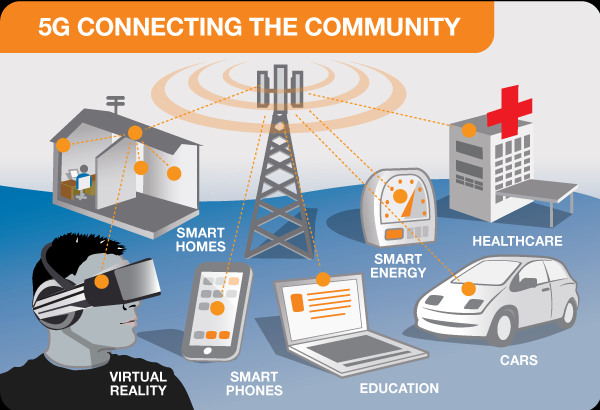
Widespread Applications of 5G within the society 

Huawei leads the 2019 global market share of 5G telecom equipment with 28%, followed by Nokia 16%, Ericsson 14%, ZTE 10%, Cisco 7% and Samsung 3%, according to market research firm Dell’Oro Group.

Samsung did not give details of the deal but said it is for telecom equipment. The contract will run from June 30, 2020 to Dec. 31, 2025, Samsung said, adding that the contract presents them the opportunity to push boundaries of 5G innovation.

“With this latest long-term strategic contract, we will continue to push the boundaries of 5G innovation to enhance mobile experiences for Verizon’s customers,” the company said.

The United States has continued to press its allies to boot Huawei out and many are succumbing to the pressure. The United Kingdom has asked the Chinese telecom Giant to stop its 5G deployment in the country, just as France, Canada and some others have done.

However, the decision to kick Huawei out has come at a high cost for countries where Huawei 5G deployment has already taken place. The US Federal Communications Commission (FCC) said removing and replacing equipment made by Huawei and ZTE from their wireless networks will cost US rural telecom operators $1.837 billion.

The United States is on a campaign to replace all 5G equipment installed by Huawei and ZTE with those from companies they can trust.

“By identifying the presence of insecure equipment and services in our networks, we can now work to ensure that these networks – especially those of the small and rural carriers – rely on infrastructure from trusted vendors,” FCC said in a statement.

The FCC said the carriers would be reimbursed for the replacements of Huawei equipment and there is about $1.618 billion for that purpose.

Spectrum Band for LTE and 5G NR 

Last month, French telecom operator Bouygues Telecom’s deputy CEO Olivier Roussat announced plans to dismantle 3,000 Huawei-made mobile antennas in France’s highly populated areas by 2028, according to CX Tech.

US mobile operators are expected to start dismantling Huawei’s 5G infrastructures soon, and that creates opportunity for more players in the 5G market.

Samsung’s contract with Verizon sends a message to Nokia and Ericsson that more players are there to contend with in the 5G market.
Mr. Buhari: The Reformer and Making An Economic Legacy In One Year

1
Buhari New Appointments
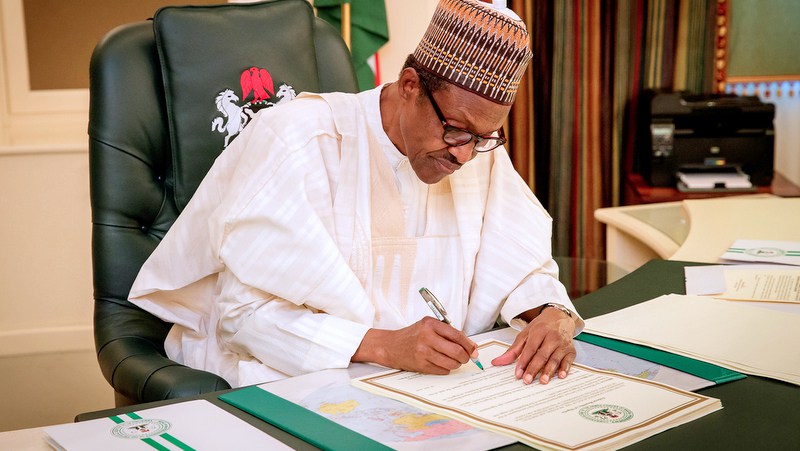
Mr. Buhari, President of Nigeria

President Buhari of Nigeria is having a good year in Aso Rock. Yes, I understand the agonies of the free-fall of Naira and the incessant insecurity paralyses in Nigeria. But if you look at the whole big picture, Buhari has done more in the last one year, economically, than he had done since the late 1970s when he was a petroleum minister in Nigeria (interestingly, he holds that position as I write…youth, continue to dream!).

While Nigeria’s problems cannot be summarized in one line, the fact is this: Buhari is showing energy and leadership in some fundamental economic areas. If he follows through, Nigeria will have a better structure to build upon. Today, we are learning that he has FULLY deregulated the petroleum sector: “the downstream arm of the oil and gas sector had been fully deregulated…PMS price would be determined by the forces of demand and supply and the international cost of crude oil.’ That is not a small feat when you know how many oil mafia groups he might have annoyed.

The Federal Government is no more going to be releasing guiding price bands for the sale of Premium Motor Spirit, popularly called petrol, at filling stations.

It disclosed this in Abuja through the Petroleum Products Pricing Regulatory Agency, adding that based on this, the downstream arm of the oil and gas sector had been fully deregulated.

Responding to questions from journalists during a briefing at the headquarters of PPPRA, the agency’s Executive Secretary, Abdulkadir Saidu, stated that going forward, PMS price would be determined by the forces of demand and supply and the international cost of crude oil.

Recall a few weeks ago, it was electricity. Yes, he increased rates, making it clear that the government cannot subsidize electricity for the citizens. Personally, I support these calls because they are fundamental for a more efficient economic system.

Of course, while deregulation may not be perfect, it is high time Nigeria tries something new as what we have now is not working. The really next call is EXECUTION and solid implementation.

Well done Mr. President. Put more efforts like this on insecurity and anti-corruption; this nation can work. 

Comment on LinkedIn Feed

Ndubuisi Ekekwe Well what can we say? We all want the best for the country and deregulation generally is not a “wise” plan for any government as it is costly, not efficient economically and allows for corruption within the industry

My Response – “We all want the best for the country and deregulation generally is not a “wise” plan” – Let us try something else as what we have had since 1960 is NOT working. Allow full deregulation to fail first.

Countries Rank of Ease of Doing Business: The Best, The Worst, The Average

0

While your demographic location has easy access to getting credit,  considerably steady electricity supply, less hassle in dealing with  construction permits, easy trading across border, likelihood to resolving insolvency faster, regular taxes payment, and the rest four ranking metrics used by World Bank, yours, as a country, can as well rank quite high when it comes to Ease of Doing Business.

A quite high ease of doing business ranking indicates that an economy is quite conducive to the starting and operation of a local firm.  The rankings are determined by sorting and weighing the aggregate scores on 10 topics some of which are listed earlier, profiling almost 200 countries on the planet accordingly, year in, year out.

Citing a certain report of the U.S. Bureau of Labor Statistics which claims that roughly 20% of small businesses fail within their first year of establishments, and then about 50% are already out of existence by 5th years of creation, this report stemming out of US might be too good to even be true for less thriving economies/continents where those metrics for ranking are sort of poor and largely unencouraging.

Why do businesses fail? Aside from internal problems, businesses and establishments not being some isolated entities from the prevailing situations of a  country get affected also by policies, political sway, and name-it situational happenings obtainable in a geographical location, called a nation.

So it is fair to admit that all things being equal, by statistics, a business founded in France (Europe) has about double the chance of surviving the first year of establishment compared to Democratic Republic of Congo (Africa) because those 10 determining metrics are more positive in the former than the latter. Reasons are so obvious to tell, at least for the now.

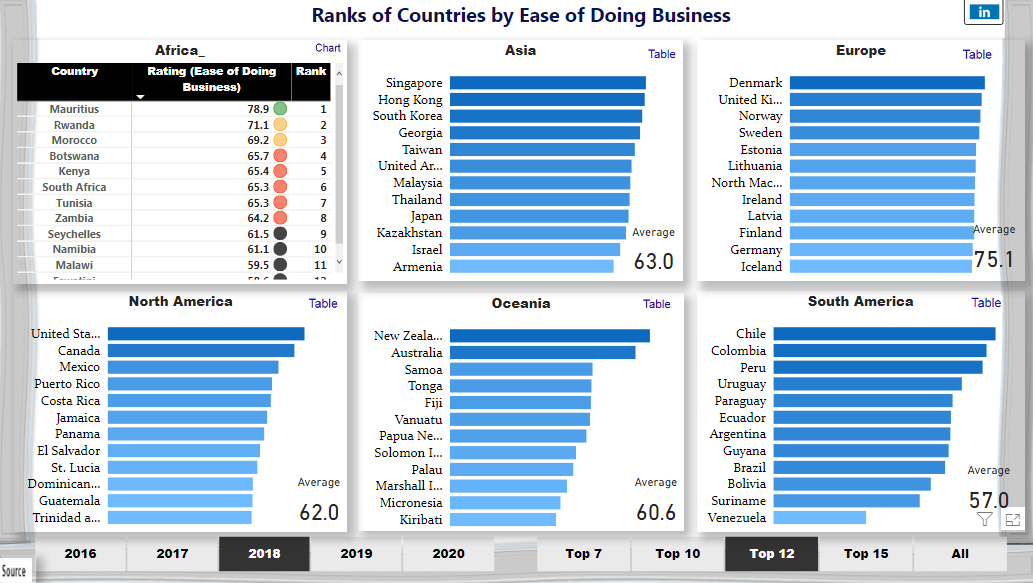
With an interest to probe ranking of countries according to how supporting when it comes to starting and running a business from 2016 till present,  here is a link of a report to an interactive report showing how countries and continents compare,  I put together in that regard.

OBSERVATIONS:

  1. The land of the Kiwis, New Zealand, has remained the most business friendly over the past 5 years, while Somalia has remained the least in supporting business. Oh Somalia?! 
  1. Europe ranked the highest among the continents on average with most business friendly conditions and Africa the very least. It might not be too hard to tell while Africa is the least, no thanks to warmongering, inter-tribal conflicts, consistent power outage, stunted credit facility, and so on.
  1. While Bill Gates quipped years back that we tend to overestimate what we can do in one year, but underestimate what we can achieve in a decade (paraphrased), according to this 5 years report (half a decade), nothing humongously substantial has changed: the best has remained the best, while the worst has continued to almost maintain the status quo in their business-support system.
  1. An exception to observation 3 above pertaining to Africa is Kenya: Something is happening in Kenya which has seen it vacate position number 10 

5 years ago to being ranked 4th in 2020; whereas Ghana ranked 11th half a decade ago, is now 17th on the chart. 

In the meantime, Nigeria, the most populous black nation, ranked in another recent report by Bloomberg as largest economy in Africa has not made a major leap but rather dancing in the region of twenties (Year 2020 the best so far, ranked as 21st)

  1. Singapore (in Asia) is giving New Zealand (in Oceania) a run for her money. The elevating consistency Singapore has been exhibiting is undeniable and 

will likely topple New Zealand in a matter of a year or two, going by projection of data, as the world capital country for ease of running business.

CONCLUSION

The purpose of analysis among others is to lay bare the state of things in the now, how things were, and how things could be using predictive analytics if necessary.  For instance, countries with rather poor rating in getting credit, getting  electricity, paying taxes, protecting minority investors, are by default going to be very low-ranked while the reverse will be for highly ranked countries which hold promises for starting and smooth-running of businesses. 

I will conclude by saying that data analytics is good, if it drives some action. Will countries with consistently low ranks be concerned with their positions which discourage foreign direct investment? The answer is in 5, 10 years from now.

Report (Dashboard) Link here.

Video Explaining Partnership Opportunities in Tekedia

0
Lean to Partner

Tekedia Mini-MBA offers an innovation management 4-month program, optimized for business execution and growth, with digital operational overlay. It runs 100% online. The theme is Innovation, Growth & Digital Execution – Techniques for Building Category-King Companies. All contents are self-paced, recorded and archived which means participants do not have to be at any scheduled time to consume contents.

It is a sector- and firm-agnostic management program comprising videos, flash cases, challenge assignments, labs, written materials, webinars, etc by a global faculty coordinated by Prof Ndubuisi Ekekwe.

Tekedia Career Week “Nurturing Innovators” Will Hold Nov 2-6 2020

2

It should be one of the largest gatherings of HR leaders and experts in Africa. And they are here to educate us on career planning, helping us to advance our missions. They come from different backgrounds, industries and domains. They are Tekedia Institute Faculty. Nov 2-6 is Career Week. Yes, now that we have prepared our members on management, innovation, growth, and digital execution systems, we also want to ensure they are prepared personally. Admission is FREE but only our members can ask questions. 

Tekedia Mini-MBA Career Week has been scheduled for Nov 2-6 2020.

This career week is not designed for finding jobs. Rather, it is structured to TRANSFORM workers, founders & entrepreneurs into business leaders and champions of innovation in their companies. Yet, if you have no job, by the time you are done with the series, you will have a path to one! The sub-theme is Nurturing Innovators. It will be packaged under the Tekedia Mini-MBA theme of Innovation, Execution & Growth.

Our knowledge experts for the Week include human resources experts and leaders from MNCs and startups, across industries and global regions; they are amazing.

  • Dupe Akinsiun – Head, Leadership & Capabilities Center, Coca Cola HBC
  • Nnenna Jacob-Ogogo – Head, Alpher, Union Bank
  • Precious Ajoonu  – Manager, Jobberman
  • John Wesey – CEO, Psyntech
  • Dr Akanimo Odon – CEO,  Envirofly Consulting UK 
  • Dapo akinloye – COO, Emerald Zone
  • Dr. Fatai Olajobi – Partner, Neo-Neurons Concept
  • Dotun Jegede, Senior Partner, Dee Bee Consulting
  • Elizabeth (Ayeni) Nyah, Human Resources Business Partner, VDT Communications 
  • Capt. Ola Olubowale – Manager, Viva Energy Australia
  • Abraham Owoseni.com – Principal Consultant, MindMould

We are making is FREE. But only past and current Tekedia Mini-MBA graduates will be in the zones to ask questions.  We will communicate mechanisms as the date draws closer.

This is a large gathering of HR directors, experts and leaders. They would share insights on how students and professionals can build their careers. They have already produced course materials and some would be speaking live.


 – Coca Cola HBC
Nnenna Jacob-Ogogo – Union Bank
Precious Ajoonu – Jobberman
John Wesey – Psyntech
Dr. Akanimo Odon – Envirofly Consulting UK
oladapo akinloye – Emerald Zone
Fatai Olajobi – Neo-Neurons Concept
Elizabeth Nyah, ACIPM, GPHR, VDT Communications
Capt Ola Olubowale – Viva Energy Australia
Abraham Owoseni – MindMould
Dr. Dotun Moses Jegede – OD Consultant