DD
MM
YYYY

PAGES

DD
MM
YYYY

spot_img

PAGES

Home Blog Page 6189

The US Announces New ‘Crippling’ Sanctions Against Huawei

1

The Trump’s administration has announced further ‘semiconductor restriction’ that has added nails to Huawei’s coffin.

On Monday, the US Bureau of Industry and Security (BIS) in the Department of Commerce announced that the embattled Chinese company and its non-US affiliates on the Entity List have been restricted access to items produced domestically and abroad from US technology and software.

In addition, BIS added another 38 Huawei affiliates to the Entity List, which imposes a license requirement for all items subject to the Export Administration Regulations (EAR) and modified four existing Huawei Entity List entries.

BIS also imposed license requirements on any transaction involving items subject to Commerce export control jurisdiction where a party on the Entity List is involved, such as when Huawei (or other Entity List entities) acts as a purchaser, intermediate, or end user.

These actions, effective immediately, prevent Huawei’s attempts to circumvent U.S. export controls to obtain electronic components developed or produced using U.S. technology.

The new restrictions are in furtherance to the ones announced earlier in the year.

In May 2020, BIS amended the longstanding foreign-produced direct product (FDP) rule to target Huawei’s acquisition of semiconductors that are the direct product of certain U.S. software and technology.

Monday’s amendment further refines the FDP rule by applying the control to transactions: 1) where U.S. software or technology is the basis for a foreign-produced item that will be incorporated into, or will be used in the “production” or “development” of any “part,” “component,” or “equipment” produced, purchased, or ordered by any Huawei entity on the Entity List; or 2) when any Huawei entity on the Entity List is a party to such a transaction, such as a “purchaser,” “intermediate consignee,” “ultimate consignee,” or “end-user.”

This amendment further restricts Huawei from obtaining foreign made chips developed or produced from U.S. software or technology to the same degree as comparable U.S. chips.

“Huawei and its foreign affiliates have extended their efforts to obtain advanced semiconductors developed or produced from U.S. software and technology in order to fulfill the policy objectives of the Chinese Communist Party,” said Commerce Secretary Wilbur Ross.

“As we have restricted its access to U.S. technology, Huawei and its affiliates have worked through third parties to harness U.S. technology in a manner that undermines U.S. national security and foreign policy interests. This multi-pronged action demonstrates our continuing commitment to impede Huawei’s ability to do so,” he added.

According to BIS, the new 38 Huawei affiliates across 21 countries were added to the Entity List because they present a significant risk of acting on Huawei’s behalf contrary to the national security or foreign policy interests of the United States. There is reasonable cause to believe that Huawei otherwise would seek to use them to evade the restrictions imposed by the Entity List.

The Temporary General License (TGL) has now expired. This rule further protects U.S. national security and foreign policy interests by making a limited permanent authorization for the Huawei entities on the Entity List. This limited authorization is for the sole purpose of providing ongoing security research critical to maintaining the integrity and reliability of existing and currently “fully operational networks” and equipment.

In a concurrent rule, BIS revised the Entity List to require a license when a party on the Entity List acts as a purchaser, intermediate consignee, ultimate consignee, or end user to an EAR transaction.

This aligns with the additional restrictions imposed in the revisions to the FDP, when any of the Huawei entities on the Entity List are a party to the transaction, such as by acting as purchaser, intermediate consignee, ultimate consignee, or end user.

This latest restriction may be the end of Huawei as it is already struggling with its technology due to shortage of chips supply. China’s push to boost its semiconductor industry is yielding insignificant results, which means Huawei’s hope to lead the global 5G roll out rests on chips produced through US tech software.

Paul Triolo, head of geotechnology at Eurasia Group described the latest restriction as “a lethal blow to China’s most important technology company.” Adding that it is “potentially the most serious effort by the US government to choke off the company’s ability to obtain advanced semiconductors for all of its business lines.”

Huawei was counting on third party chip production to stay in business following the first US restriction. But the latest BIS move shows that Washington will leave no stone unturned in its quest to cripple China’s aim to lead the global 5G technology.

The Trump administration is adamant even though it is clear that the restriction would put the US semiconductor industry in jeopardy.

John Neuffer, president and CEO of Semiconductor Industry Association of the United States, said chip sales to China have been responsible for the growth of the US semiconductor industry, and it would be disrupted by these latest restrictions.

“These broad restrictions on commercial chip sales will bring significant disruption to the US semiconductor industry… chip sales to China drive semiconductor research and innovation here in the [United States], which is critical to America’s economic strength and national security,” he said.

The obvious threat the restrictions pose to the US labor market appears not to matter to Washington as long it halts Huawei’s lead in the telecom industry.

US companies have been lobbying for licenses to supply Huawei with smartphone chips, following the May restrictions. Qualcomm and Micron among other chipmakers have been heavily impacted by the restriction as they lose billions of dollars to the disrupted supply chain.

While the US has succeeded in pressuring some of its allies to boot out Huawei, the company still has a grip on many big markets, particularly in developing countries. But with this latest restriction, it will be difficult for Huawei to live up to its technology expectations, especially on 5G.
The Kabbage Goes Bad As Things Harden for SoftBank

0

Kabbage, headquartered in Atlanta, is a data and technology company providing small business cash flow solutions. Its suite of products includes Kabbage Checking, providing small businesses a new way to bank; Kabbage Payments, helping small businesses get paid and access the money they earn faster; Kabbage Insights, calculating small businesses’ real-time cash flow; and Kabbage Funding providing access to flexible lines of credit up to $250,000 in minutes. Kabbage has been partly funded by SoftBank Vision Fund. This season, the Kabbage has gone bad as American Express acquires it at a discounted valuation, well below its total raised capital. But it has its loan portfolios to recalibrate though.

The financial terms of the deal are not being disclosed, but reports earlier this month put the value of the acquisition at up to $850 million. For some context, Kabbage had raised nearly $990 billion in debt and equity (and at least $3.5 billion in securitizations), and was valued at over $1.2 billion in its last equity round of $250 million, in 2017, led by SoftBank.

Kabbage has been massively spoiled by Covid-19, and the virus has frozen its core market of small and medium scale businesses (SMB) which it lends to. Most lending fintechs are struggling.

Disrupting traditional banks and their slow and often frustrating approach to evaluating loan applications, Kabbage taps a wide variety of sources, from traditional accounting statements through to social media signals, into its proprietary machine learning algorithms, in order to determine eligibility for issuing loans, and the terms under which a business would pay it back. It was successful enough that Kabbage was also offering its product as a white-label service to other loan providers (including the banks it was disrupting).

But things have been tricky since February, with business dropping off a cliff after many SMBs were forced to shut their doors at the start of the pandemic — with too many of those closures becoming permanent. The company furloughed a significant proportion of its staff at the end of March, abruptly shut down its credit lines for SMBs in April and then slowly brought things back online as one of the three biggest PPP lenders.

This comes at another challenging moment for Japan’s SoftBank, joining Uber, WeWork and other high profile businesses which have struggled in the mega-investor’s portfolio. (SoftBank just lent $1.1 billion to WeWork.) But selling Kabbage is certainly the best move as SMB climate remains tough with the oscillatory nature of the virus; it spreads fast, it stops,  and then it repeats, creating all challenges for citizens, businesses and governments.

The Press Release

American Express (NYSE: AXP) today announced that it has entered into an agreement to acquire substantially all of Kabbage, a leading financial technology company providing cash flow management solutions to small businesses in the U.S. The transaction represents an important step toward American Express’ goal of being an essential partner to small businesses through a broad range of payment, cash flow and financial management tools.

Under the terms of the agreement, American Express will acquire Kabbage’s team and its full suite of financial technology products, data platform and IP built for small businesses. Kabbage’s products include access to flexible lines of credit, online bill payment, cash flow visualization tools, e-gift certificates, and the ability to centralize funds through the company’s recently launched business checking account. This product suite is integrated into a single online platform that uses real-time data processing to help small businesses better understand, forecast and manage their cash flow.

With the addition of Kabbage’s technology, products and people, American Express plans to offer a broader set of cash flow management tools and working capital products to its millions of small business customers in the U.S.

“For several years, American Express has been expanding beyond our industry-leading commercial card products to offer our business customers a growing set of payment and working capital solutions,” said Anna Marrs, President of Global Commercial Services at American Express. “This acquisition accelerates our plans to offer U.S. small businesses an easy and efficient way to manage their payments and cash flow digitally in one place, which is more critical than ever in today’s environment. By bringing together Kabbage’s innovative technology and talented team with our broad distribution capabilities and over 60 years of experience backing small businesses, we can better help our customers successfully emerge from this challenging period and beyond.”

“At Kabbage, we have always made the success of America’s small businesses our primary objective,” said Kabbage CEO and co-founder, Rob Frohwein. “We have built a technology and data platform that provides them with the kind of capabilities and insights often reserved for larger businesses. By joining American Express, we can help more small businesses succeed with a fully digital suite of financial products to help them run and grow their companies.”

The acquisition is expected to close later this year, subject to customary closing conditions. Kabbage’s pre-existing loan portfolio is not included in the purchase agreement.

Help Us Name This New App for Tekedia Learning Community

35

Tekedia has built a mobile and web app which will  help our learning community to co-create and co-share more effectively. We have noticed the limitation on WhatsApp (group cap), and the low adoption of Telegram in our core markets. Our solution works like WhatsApp (with email login) but looks like Facebook Page. It has both Android and Web app versions.

From our data, engagement is very high on WhatsApp and people learn better when they can easily contribute to the conversations. Consequently, we see platforms like WhatsApp to be extremely vital for training. So, we have created a product which will power, among others:

  • Daily Short Videos (5 minutes) on innovation, digital, management, and business systems. This will run 5 days in a week, tracking the class sessions.
  • Past, present and future editions will have dedicated Groups, exclusive for members (you have to opt-in). They can collaborate, co-share, and co-advance. We hope lessons, opportunities, etc would be distributed.
  • Corporate members will have dedicated Groups for internal innovation with location sub-admins.

Our expectation is that this will support our current delivery method which works through our Digital Board with lecture notes, long videos, challenge assignments, and labs.

Now, your role; we want to name this product. We are going with Tekedia Hub. But we want to know what you think: here are alternative names below. Please feel free to suggest new names.

    • Community
    • Forum
    • Caucus
    • Social
    • Lab
    • Hub
    • Class
    • Group
    • Mobile
    • Board
    • Tekedia
    • Open
    • Learn
    • Room
    • Platform
    • Village
    • Team
    • Book

Your comment below…..

He Got A Job – COO

0

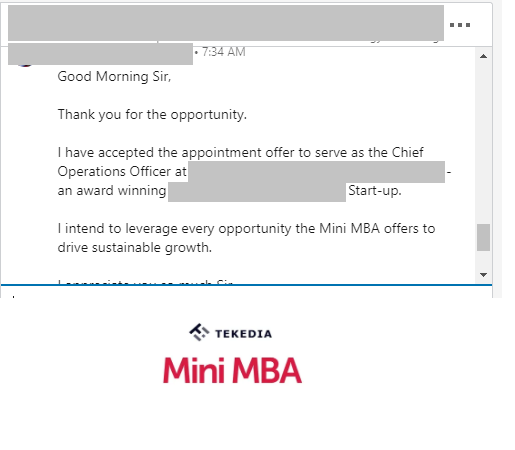
It is very common these days: young people telling me how they applied some of the things we are teaching in Tekedia Mini-MBA to get jobs.  This young man needed help to attend our program. I asked him to talk to my team who handles such. Very good they gave him an opportunity; he indeed made use of it.

For one company, he developed a transformation document during the selection process, drawing from lectures our two faculty members – Rasheed Adebayo and Omowunmi Adenuga-Taiwo have delivered. Today, he is the COO of the firm. From the Institute, we congratulate him and wish him good luck.

Tekedia Mini-MBA (Aug 10 – Dec 3, 2020)

The Error Code 22 On diamondbank. com

0

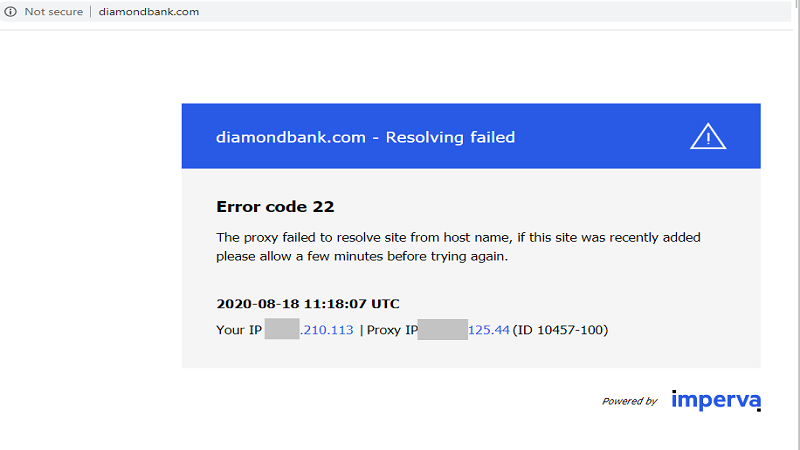
Since yesterday, I have left this URL open on my laptop. I am yet to come to terms that diamondbank .com could be in this state. It is very personal because keeping this URL working used to be my work, as an entry level engineer with the bank in Lagos. This bank remains the best company ever created; it was nice to me (getting emotional here).

Today, diamondbank .com has “error code 22”. For all entrepreneurs here, pause and think over this. How do you build to last? I have printed this page and put it on a wall. How do I prevent “error code 22” in my missions?

(You can read context here)

My First Day in America and Kindness of Diamond Bank Lagos