Permit me to share this nice testimonial from a top business executive who is co-learning with us at Tekedia Mini-MBA. Ranveer S. Chauhan, from Singapore, is a veteran of markets and a business leader. When a former Managing Director of Olam International Ltd says something nice about your program, you better celebrate. He wrote, “valuable, smart and very current” for Tekedia Mini-MBA.
At Tekedia Institute, we are co-learning with professionals from 30 countries. We have 7 professors as co-learners with many executives from around the world. They teach us and we teach them, and markets rise. JOIN today .
“When you import goods, you import poverty and you export jobs to other parts of the globe where such goods are produced.” – Aliko Dangote .
From the “The Dangote System: Techniques for Building Conglomerates”, a new book, by Ndubuisi Ekekwe . Begin readinghere. I also invite you to readthis piece I wrote in the Harvard Business Review on how this development could be done.
Whether you plan to work as a software engineer, or are focused more on the business side of things, several programming languages can make your resume stand out to hiring managers. Even if you plan to work in an area where coding is not required, you will find that having some proficiency can make routine tasks easier and allow you to handle information in a more efficient manner. Regardless of what your degree is in, you will be expected to have a solid understanding of office software, and, depending on your field, there may be industry-specific software you should familiarize yourself with as well.
If you do not yet have your degree and are looking to boost your resume, consider committing to school. Many schools offer a full range of degree programs entirely online, so you do not need to turn your life upside down to attend. Concerns about how to pay for classes are normal, but there are many different ways to manage. You may be surprised at how much aid, in the form of scholarships and grants, you qualify for. For the balance, private student loans are easy to apply for and offer attractive repayment terms.
Python
Python is a great first choice for new programmers. It is more forgiving than many other languages, and it is easier to make sense of than more complex languages. Python is a great language for any office worker to pick up, regardless of their duties. It allows you to automate many of the routine tasks of a job, freeing you up for other duties.
SQL
SQL is a data management language. You use it to work in databases, so, if your job touches on those responsibilities, it makes sense to learn the language. Even if there is someone else who handles the database, having an understanding of what you can, and cannot do with SQL is valuable.
Follow Your Interests
Being proficient in python and SQL can be valuable for anyone in the business world. While many people think of coding as something left to programmers, having a solid understanding of how to write some code and how programming works transfers to other areas of your job. Understanding the basics of python, for example, will allow you to create models and answer questions in Excel. Knowing what type of information you can extract from a database in SQL allows you to ask better questions and create better solutions.
Of course, you should follow your interests as well. Programming is challenging, and if you are not interested, it will be difficult to stay motivated. One of the best ways to improve as a programmer is to create projects. While these projects may never reach any sort of market, they are valuable for helping you understand what you need to learn. Working in a language you are interested in and creating a project you find enjoyable will get you much further than following endless online tutorials. You will also find that once you have a solid grasp of one programming language, the others come more easily.
Strategic patience is important in life. Germany-based Rocket Internet was an original and prominent investor in Jumia, an ecommerce company with significant operations in Nigeria and other African economies. It was there when Jumia went public, opening at $14.50 per share and closed at $25.46. According to Jumia filings, Rocket Internet controlled 20.6% of Jumia on the IPO day. There was a lockdown, a period where Jumia insiders are not allowed to sell the stocks, and the company could not have sold during the initial share positive acceleration. By the time that was over, Jumia which hit nearly $50 per share had dropped below $5.
But towards late Q4, I wrote that Jumia was “evolving” and wrote many articles praising its double play strategy with a fintech component: “I expect JumiaOne to become the most important component in the Jumia Group in coming years as it morphs pieces of Jumia brands to feed transactions into itself. Yes, ecommerce can struggle but the fintech unit will win markets and territories – and profits”. During this evolutionary phase, Jumia stock was underperforming even as some people like me started seeing a glimmer of hope.
Unfortunately, for Rocket Internet, it did not see the signals and sold off its entire holdings before the inflection point. Yes, the firm sold its entire remaining 11% stake in the period between November 2019 and the onset of COVID-19, following an earlier dump, when the stock was hovering near its lows. In other words, Rocket Internet missed the recent Jumia rally.
This is hard news: Germany’s Rocket Internet has exited Jumia. Within the window it sold, from Nov 8 2019 to say early February 2020, Jumia’s highest stock value was about $8.50. That is still a huge drop when you consider that the stock rose to $49.77 shortly after IPO before it lost steam. Jumia closed at $2.58 today after losing more than 8% of its value. This sector remains a challenge in Africa, and not an electronic business, as the marginal cost is all physical. The sector challenges are well documented in this seminal Harvard Business Review piece I wrote a few years ago.
For me, the turning point for Jumia happened in September 2019; I wrote a piece where I included “amazing” for Jumia. The piece title was “Jumia Reveals Its Future With New Job Postings – And It is Amazing”. Here is the full piece.
“We remain focused on all aspects of our growth strategy, particularly JumiaPay, as we continue to drive its usage in our markets,” Jumia noted in its quarterly report with U.S. SEC.
That was a very powerful observation because no ecommerce company in emerging markets like India and China has done well without building a great paytech company. China’s Alibaba has Alipay, India’s Flipkart has PhonePe. Jumia needs to make JumiaPay big.
Did you notice a pattern? The PhonePe is the double play for FlipKart. Yes, no matter what is happening in the ecommerce space, the payment arm will be doing just fine [commissions on transactions are assured]. Also, it turns out that successful ecommerce companies like Alibaba (with Alipay) in emerging markets have always have payment units.
To execute this and build a really great fintech business, Jumia has jobs for loan officers. Simply, Jumia wants to build a Lending Business and through that structure will deepen its JumiaPay. This fintech will bring unification of payments, lending and transaction processing at scale.
Our Junior loan officer will assist the development of Jumia Lending in Kenya by presenting our solution to our sellers. He/she will be helping our sellers to apply for a loan, and with the help of the loan officer will review the data collected and the applications. The Junior loan officer will be part of the JumiaPay team in Kenya and work side by side with the loan officer.
I expect JumiaPay to become the most important component in the Jumia Group in coming years as it morphs all these pieces to feed transactions into it. Possibly, it can spin it off to give huge payday to its investors. Yes, the ecommerce can struggle but the paytech will win markets and territories – and profits. That makes this super-focus on payment a great move.
And as that happens, a double play is born at scale in Jumia.
Finally, Rocket Internet, depending on the amount it contributed in funding Jumia, might have lost money on its voyage to Africa. It sold when the market cap of Jumia was below $400 million for a company which raised, pre-IPO, excess of $800 million. Simply, it gave up at the wrong time!
Jumia Group has raised a total of $823.7M in funding over 5 rounds. Their latest funding was raised on Apr 2, 2019 from a Corporate Round round.Jumia Group is registered under the ticker NYSE:JMIA. Their stock opened with $14.50 in its Apr 12, 2019 IPO.Jumia Group is funded by 10 investors. MasterCard and MTN Group are the most recent investors.
My hypothesis has been that no one can run an ecomemrce business in any developing part of the world and make money. But you can do a double play where the ecommerce becomes a funnel into a “new business”. It is that new business that would create value for the Group. When Jumia came, it came with ecomemerce alone and certainly had no future. But around Sept last year, it added fintech (a double play to capture value from ecommerce), it became viable in my model. Today, even if the ecommerce does not make money, the fintech will make money, using transaction volume from ecommerce. That is what Alibaba/Alipay, Flipkart/PhonePe, etc do in China, India, etc. Ecommerce alone is not viable. But with a double play, it becomes!
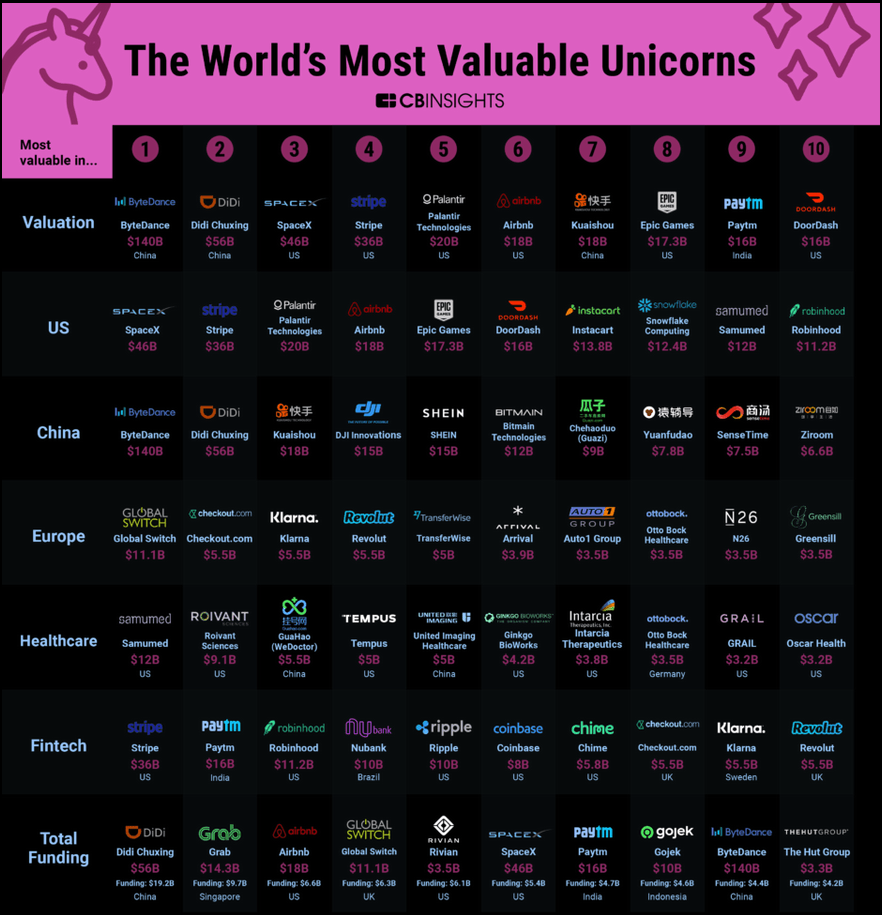
SpaceX raised $1.9B at a valuation of $46B. The rocket company founded by Elon Musk is the most valued U.S. unicorn – a privately held startup company valued at over $1 billion – and 3rd highest in the world. The global #1 and #2 are both Chinese; ByteDance at $140B and Didi Chuxing at $56B respectively. Those two are cumulatively more than the next eight added. If you look at these companies, one thing is evident: the path into the castle of wealth goes through technology in most of the world’s leading economies.
This is indeed the age of technology. From this plot, the technology sector, biased with healthcare, continues to dominate, well ahead of energy and financial sectors. Of course, this is not what we have in developing economies like Nigeria. We never really have an energy sector since our participation is largely at the downstream level.
Also, the healthcare sector is muted with no upstream players. So, any comparison could be between the technology sector and the financial sector. Interestingly, in terms of profitability, in absolute naira, the financial sector has done well, even as it continues to bleed market cap in the Nigerian Stock Exchange.
In the tech nexus, there is nothing else, if you remove MTN and Airtel Africa since Nigerian investors have never believed in local tech equities. From Chams to CWG, NCR to eTranzact, these firms have not outperformed.
Simply, a local equivalent of this plot would be everything going downwards!