DD
MM
YYYY

PAGES

DD
MM
YYYY

spot_img

PAGES

Home Blog Page 6212

The Gig Economy Under Threat As California Court Rules Uber Drivers As Employees

0

In a landmark judgment, a California judge has ruled that Uber and Lyft drivers cannot be classified as independent contractors and issued a preliminary injunction to that effect.

The state of California had in May filed a lawsuit challenging the classification of Uber and Lyft drivers as non-employees. The lawsuit argued that it goes against the state’s new labor law (AB5), enacted in January. The law weighed in on a three-part standard to determine the status of an independent contractor.

  1. They are free from company’s control;
  2. They are doing work that isn’t central to the company’s business;
  3. They have an independent business in that industry.

The three-part standard stands in contrast with the gig economy and e-hailing companies are at the helm of it.

California is the parent state of both Uber and Lyft, and it is the biggest market for e-hailing services. The rule will ensure that hence, drivers and on Uber and Lyft platforms get employment benefits. But judge Ethan Schulman of the San Francisco superior court where the verdict was reached, gave a 10-days window for the enforcement, to give companies a chance to appeal.

Uber said it plans to appeal the ruling which it described as insensitive to the plights of drivers in the middle of a pandemic, when the government should be working on providing jobs for the people.

“The court’s ruling is stayed for a minimum of 10 days, and we plan to file an immediate emergency appeal on behalf of California drivers. The vast majority of drivers want to work independently, and we’ve already made significant changes to our app to ensure that remains the case under California law. When over 3 million Californians are without a job, our elected leaders should be focused on creating work, not trying to shut down an entire industry during an economic depression,” Uber’s spokesperson said in a statement.

In response to the California state’s new law, Uber announced new features on its app to help the drivers stay flexible. The updates which took effect mid-January include seeing trip information upfront to help drivers make informed decisions. The information will include trip time, distance, destination and fares. The update also empowers drivers to accept or reject rides without being punished. Uber promised to introduce more features that will make the job more flexible for drivers.

Lyft said the ruling undermines the wishes of the drivers who don’t want be employees, and enjoy working as independent contractors.

“Drivers do not want to be employees, full stop. We’ll immediately appeal this ruling and continue to fight for their independence. Ultimately, we believe this issue will be decided by California voters and that they will side with drivers,” Lyft spokesperson said.

The Guardian reported that Uber, Lyft and DoorDash have spent more than $100 million on a 2020 ballot that aims to incite voters against the AB5. But they were chided as the move was cited in the suit as “an aggressive public relations campaign in the hopes of enshrining their ability to mistreat their workers,” even in the middle of “a once-in-a century pandemic.”

However, the drivers are divided on what they really want. While many of them want such flexible work without entitlements that will hinder their independence, others want their efforts rewarded with employment benefits.

The judgment is the first of its kind for the gig economy in the United States, but not in the UK.

In 2016, Uber drivers in London, led by Yaseen Aslam and James Farrar, took to the streets to demand employment rights. The protests birthed a lawsuit that challenged the gig economy. The employment tribunal ruled in favor of the drivers, but Uber appealed the judgment and likewise lost in the appeal court. In its final attempt to save its business model and probably the gig economy, the ride-hailing company heads to the Supreme Court.

As the UK drivers wait on the verdict of the Supreme Court, the development in California is signaling the beginning of the gig economy’s disruption.

Uber has defended its business model saying that the majority of the drivers want to be treated as self-employed. But on the other side of the case, the claimants said the ruling will determine if workers will continue to be abused under the gig economy.

“This is our final showdown with Uber but the stakes could not be higher for everyone. If Uber wins, there will be an unseemly rush by greedy employers to collapse employment as we know it and Uber-ize the entire economy. Uber drivers and other gig economy workers would be robbed of the right to unionize,” said Aslam.

The gig economy has denied many full-time workers employment benefits, including the protections that the law provides in times of crisis.

Mathieson, an associate of Bates Wells’ employment team said “this landmark case will have enormous implications for how well, or badly, workers in the fastest growing sector of the economy are treated.”

Tekedia Institute Has Started Approving Capstone Topics for The Certificate Programs

0

We have started approving capstone topics for the Certificate programs. We have constituted a small committee which looks at the three proposed topics and then picks one. Once that is done, the member is asked to develop the topic. Here are options:

  • Submit a one-page study structure: tell us how you plan to approach this research or project.
  • Submit a work-in-progress table of contents: tell us potential topics of sections in this work.

While you can do both, we need just one. Once that is done, you will receive comments. Then, you begin your study. Please learn more on the Capstone here.

Tekedia Certificate courses are completely capstone-based. Tekedia capstone is a research paper or a case study exploring a topic, market, sector or a company.  You must have attended, begun or about attending Tekedia Mini-MBA to qualify to register. At the moment, we cover the following areas:

  • CLSM – Certificate in Logistics and Supply Chain Management

  • CSBM – Certificate in Startup and Small Business Management

  • CETS  – Certificate in Exponential Technologies and Singularity

  • CPCD  – Certificate in Personal Career Development

  • CPFM  – Certificate in Personal Finance & Wealth Management

  • CBIS  – Certificate in Business Innovation, Growth & Sustainability

Register here if you are interested in our Certificate programs.

Capstone for Tekedia Mini-MBA Certificate Courses

Nigeria’s Highest Earning CEOs – MTN, Oando, Seplat, GTBank, Unilever, …

2

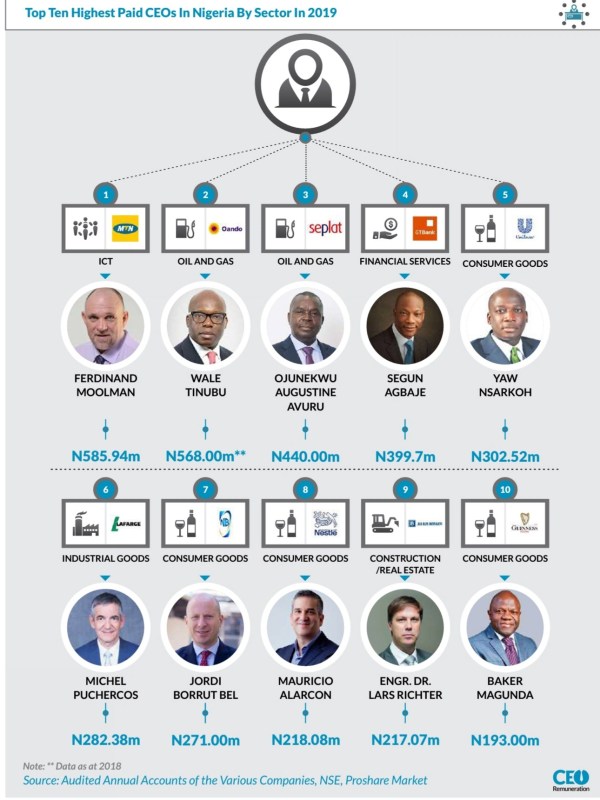
From Premium Times, here are the highest earning CEOs in Nigeria, at least for publicly traded or reported companies. Relatively, the numbers are not big when benchmarked with what men pocket in America. But by per capita, they are excessive as Nigeria is a small economy. 

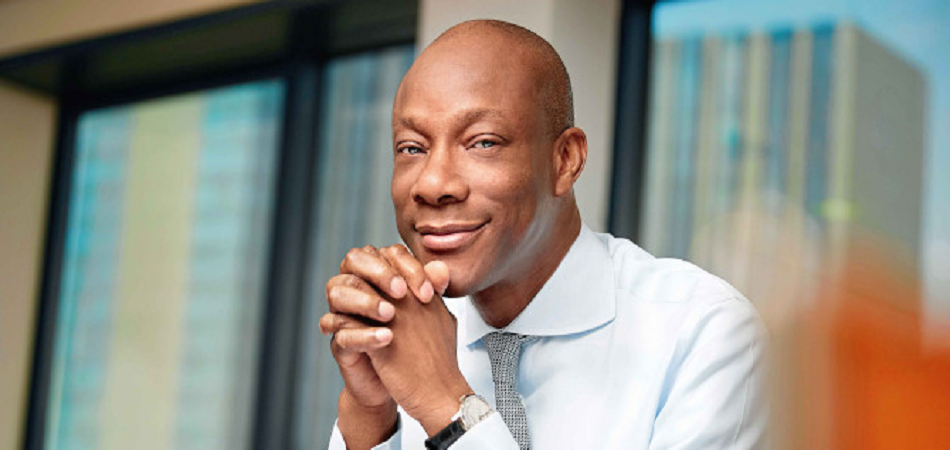
As listed by the report, Nigeria’s top ten executive remunerations in 2019 were: Ferdinand Moolman, MTN, ?585.94 million; Adewale Tinubu, Oando, ?568 million; Ojenekwu Avuru, Seplat Petroleum Development Company, ?440 million; Segun Agbaje, GTBank, ?399.7 million; and Yaw Nsarkoh, Unilever, ?302.52 million.

Other are: Michel Purchercos, Lafarge, ?282.38 million; Jordi Borrut Bel, Nigerian Breweries Plc, ?271 million; Mauricio Alarcon, Nestle, ?218.08 million; Lars Richter, Julius Berger, ?217.07 million; Baker Magunda, Guinness, ?193 million; and Emeka Emuwa, Union Bank, ?172 million.

[…]

In the banking sector, the trio of Segun Agbaje of GTBank with ?399.7 million, Emeka Emuwa of Union Bank with ?172 million, and Yinka Sanni of Stanbic IBTC with ?155 million were paid the highest remuneration in 2019.

In comparison with previous years though, the executives paycheck for the year did not closely match the profit generated in 2019, save GTBank which recorded the second-highest profit before tax of ?243 million and paid its director the highest remuneration in the sector.

The Lagos’ 10% Service Tax on Uber, Bolt, etc with up to N25 Million License Fee

20

Nigeria continues to innovate on revenue collection. From federal to state governments, if we have put the energies we have exerted on how to collect taxes and fees from citizens and companies, we would have advanced. The latest one is coming from the center of excellence, though nothing excellent on this playbook. Yes, Lagos will now collect 10% service tax on Uber, Bolt and all e-taxis. That is for Lagos. This new 10% does not substitute current fees and taxes!

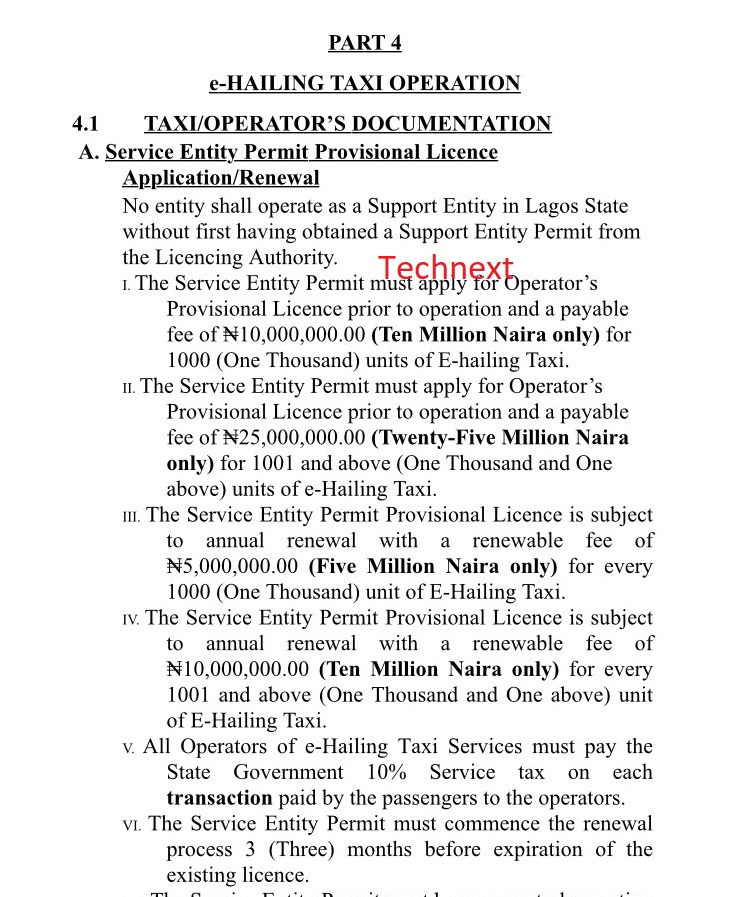
More so, “the law now mandates operators to acquire a provisional license at N10 million (about US$26,000) per 1,000 vehicles or less; N25 million (US$65,000) for a fleet above 1,000 and renew annually at N5 million and N10 million respectively“, TC Daily summarizes.

Come August 20, Guideline for On-Line Hailing Business Operation of Taxi in Lagos will come into effect. It is the Lagos State government’s approach towards regulating the ride-hailing sector in the commercial city and has been the cause of concern since last year when its existence was first hinted at. Both motorcycle and taxi operators have been at regulatory loggerheads with the state government since 2018. In January, the state government announced the ban of motorcycles, including the tech-enabled operators, from major areas in the state to the outrage of users and the operators. There was a peaceful march afterwards to protest the ruling. As was speculated then, the law now mandates operators to acquire a provisional license at N10 million (about US$26,000) per 1,000 vehicles or less; N25 million (US$65,000) for a fleet above 1,000 and renew annually at N5 million and N10 million respectively. The state government is also asking for a 10% service tax on every ride the operators complete.

Sing Ease of Doing Business improving…hahaha. Except foreign companies, which Nigerian entrepreneurs can raise N25 million just to get a piece of paper? It may not be really bad for Uber and Bolt. At least, the government has killed any local challenger for good.

Technext presents the evidence.

Poor ride-hailing sector players. California is already hitting them hard; it seems there is no escape velocity for these human aggregators.

A California judge has ordered Uber and Lyft to stop classifying its drivers as independent contractors, handing the state a signal victory in a battle over the gig economy Monday.

After the state passed a law broadly requiring more workers to be treated as employees, California Attorney General Xavier Becerra and city attorneys sued the ride-hailing firms this year, arguing they were violating the law by deeming their drivers to be independent contractors. Becerra went to court for an injunction immediately compelling the companies to treat their drivers differently.

TikTok Plans to Move Headquarters to London As US Pressure Intensifies

0

TikTok, in its fight to stay in business, is seeking the nod of the British government to move its headquarters from the US to London. The ban speculations that had trailed its existence in the United States for months now are gradually materializing, and the short video app is looking for salvation.

The US president, Donald Trump signed an executive order last week, requiring TikTok’s parent company, ByteDance to sell the app to an American company or watch it get booted out of the US in 45 days.

A source familiar with the development said that TikTok has been waiting on the UK Prime Minister, Boris Johnson to wave them over.

“TikTok has been sitting on the plan to relocate to London for weeks, pending a positive response from the government. If the government would not speak out in its favor, it would be very difficult for TikTok to make the move,” the source said.

In London, the decision to host TikTok rests not only on the desk of Johnson but also on those of his ministers. Last month, the United Kingdom announced it has banned Huawei from its 5G roll out. The decision has been based on national security concerns, spurred by pressure from the US and members of the UK parliament, even though it would cost the government more to use alternate companies for the 5G deployment.

But TikTok has come with a bait; $3.9 billion in investment proposal for the UK. While it is clear that the United Kingdom needs the investment, Johnson would need all his ministers to be on the same page to accept it.

After the Huawei ban, Johnson has called for cooperation with Beijing on other fronts, a stance portraying him as ‘free’ from Washington’s grip. But TikTok is facing a ban on the same security concern just as Huawei, which makes the situation difficult for London.

The US had threatened to stop intelligence sharing with the UK, if it continued to allow Huawei to lead its 5G roll out. A deal with TikTok may hurt Johnson’s relationship with Trump, and London doesn’t want to be seen as TikTok’s sympathizers in a time of faceoff with Washington.

Many British ministers are as wary of TikTok as they are of Huawei. SCMP reported that Oliver Dowden, the British secretary for digital, culture, media and sport, harbored reservations about the TikTok deal. Dowden has been critical of Chinese tech companies, and was frontal in the ban of Huawei. He has vowed to be “clear-eyed” about “high-risk” Chinese tech firms.

But while there have been uncertainties around the possibility of letting TikTok be headquartered in London, due to divisions among parliamentarians, the source said foreign office has been in support of the deal because the app is not considered a security risk under Britain’s national security assessment, according to SCMP.

Moreover, Microsoft’s attempt to buy TikTok in North America, New Zealand and Australia is ‘considered an attempt to drive a wedge between Britain and the rest of the Five Eyes security network.’

Spokesman for Johnson said the TikTok’s proposal “would be a commercial decision.”

TikTok has been desperately trying to get out of trouble relating to China and lately, the United States, by finding bases in Europe.

Last week, the app said it’s planning to build a $500 million data center in Ireland to store videos, messages and other data generated by European users. It will be its first data center outside the US and Singapore.

UK’s consent will be key in determining how TikTok proceeds with its situation in the United States. Though the app is planning a lawsuit against the Trump’s administration, Microsoft and Twitter are still bidding for a possible acquisition. While Microsoft is aiming to acquire the app’s operations in North America, New Zealand and Australia, Twitter is focused on its American operations only.

London would likely support Twitter as it would want to protect the Five Eye Security network from a potential US wedge. But considering the amount, though TikTok has not said how much the deal is but analysts put its value around $50 billion, Twitter is no match for Microsoft’s financial muscle.

Twitter’s valuation is around $30 billion, which is not enough to contend for TikTok’s US operations unless it will seek additional funding. Meanwhile, it’s a race against time for the short video app as the deadline for the acquisition will end on September 15.