DD
MM
YYYY

PAGES

DD
MM
YYYY

spot_img

PAGES

Home Blog Page 6216

Being ARMed, Nvidia Chips The Future of Intel

1

Nvidia is in talks with SoftBank to acquire  British chipmaker ARM. SoftBank, a Japanese mega investor, bought ARM for $32 billion about four years ago. But with SoftBank losing money in Uber, WeWork and  most of its investments, it has to sell assets to recalibrate. If this deal goes through, Intel Corp could be severely wounded – call it a Blackberry inflection point when Blackberry (actually Research in Motion) lost to Apple.

ARM is an English tech company with a great reputation in chip making. It makes chips for modern devices including smartphones, an area where Nvidia is yet to find foothold. But there is a challenge; Bloomberg reported that ARM’s customers, including Apple, Samsung, Qualcomm, Advanced Micro Devices and Intel could demand assurances that a new owner would continue providing equal access to ARM’s instruction set. It was the concern that led to SoftBank buying ARM the last time it went up for sale, because it is a neutral company.

[…]

SoftBank is looking for money to offset its heavy debt by selling off some of its assets, including part of stake in Alibaba, and a part of its holdings in T-Mobile US Inc. a sale of ARM at this point means the Japanese conglomerate will have more money at its coffers to appease distraught investors.

Intel has been disintermediated by TSMC with its legendary manufacturing moat dismantled by the global contract chip manufacturer. The implication is that the castle which Intel has protected for decades is largely vulnerable now. Nvidia does not build big foundries but focuses on R&D designs while its manufacturing partners make the chips. It is a leader in modern chips for datacenters, gaming, AI and more. If ARM goes to Nvidia, it will pick a huge part of the mobile sector, and if that happens, Intel will bleed for years. 

Yes, Intel used to run the most advanced chip factories in the world, and companies depended on it for the most advanced chip designs. But with the advancement of TSMC and Samsung Electronics, companies can practically do the other thing Intel does: chip design. That means, they design and ask TSMC to manufacture. The ability to do that via TSMC without investing in foundries is a new level of disruption for Intel.

Apple had taken its Mac chips from Intel, and would design and fabricate with possibly TSMC or Samsung since other players like GlobalFoundries remain weak. Other companies will do just that. As that happens, the largely closed system of Intel will begin to make way for the ARM business model. Provided there is TSMC to make the chips after circuit designs, most companies will go all the way to designing internally and sending to TMSC to fab.This was not possible in the past as TSMC was weak, but over the last few years, TSMC has evolved to be as good as Intel, if not better.

Intel’s investors are already rattled by Apple big exit, moving its Intel business for Mac processors in-house. This ARMed Nvidia deal could break more investors (see the stock chart below).
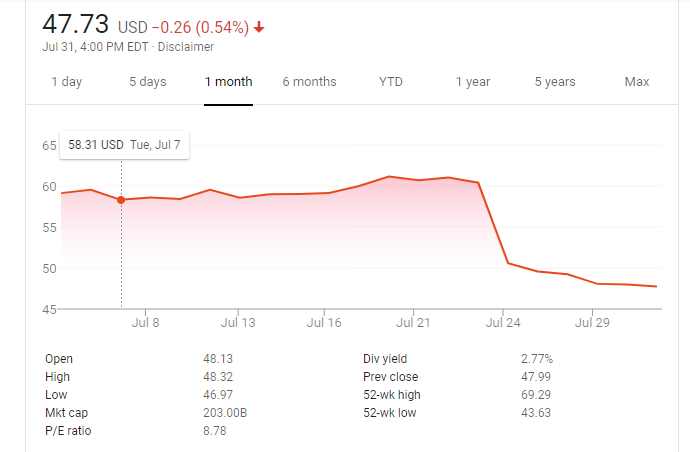
Intel stock

Nvidia in Talks with SoftBank to Acquire ARM

Nvidia in Talks with SoftBank to Acquire ARM

0

Nvidia is reportedly in talks with SoftBank to buy ARM in a deal worth over $32 billion. SoftBank Group Corp. has been exploring ways to sell the British chipmaker that it bought four years ago for $32 billion.

People familiar with the matter said negotiation is in an advanced stage and the parties may reach a deal in the next few weeks, though it is still confidential. Sources said Nvidia is the only company bidding but it is not clear if the deal will be successful.

According to people with the knowledge of the matter, SoftBank may welcome interest from other suitors if it fails to reach an agreement with Nvidia.

ARM is an English tech company with a great reputation in chip making. It makes chips for modern devices including smartphones, an area where Nvidia is yet to find foothold. But there is a challenge; Bloomberg reported that ARM’s customers, including Apple, Samsung, Qualcomm, Advanced Micro Devices and Intel could demand assurances that a new owner would continue providing equal access to ARM’s instruction set. It was the concern that led to SoftBank buying ARM the last time it went up for sale, because it is a neutral company.

However, analysts believe that purchasing ARM would help Nvidia to accelerate innovative ideas.

“With Nvidia’s low-cost fabless model enabling it to focus on R&D, engineering and programming, the fit with Arm would be perfect,” said Neil Campling, an analyst at Miraband Securities.

Analyst at Rosenblatt Securities, Hans Mosesmann noted that Nvidia is the largest maker of graphics processors and it’s spreading the use of the gaming component into new areas such as artificial intelligence processing in data centers and self-driving cars. Matching its own capabilities with central processor units designed by Arm may enable it to take on Intel and Advanced Micro Devices in a more comprehensive way. Mosesmann said the acquisition of Arm may cost Nvidia over $55 billion.

“You need control of BOTH CPU and GPU roadmaps and this, of course, includes data centers. Strategically, Nvidia needs a scalable CPU that can be integrated into its GPU roadmap, as is the case with AMD and Intel,” he said on Friday in reference to central processing units and graphic processing units.

Nvidia has turned a big name in chip making, becoming the world’s largest graphics chipmaker. The California-based company has witnessed more than twenty-fold surge in stock, according to Bloomberg, giving it the opportunity to take on bigger deals. Nvidia’s market value has increased over time to more than $260 billion, making it more valuable than Intel.

Much of its success is attributed to architectural diversity into smart cars, data centers and networking gear. New Street Research LLP said the company could be worth $44 billion if it pursues an initial public offering next year, and estimates its valuation to rise to $68 billion by 2025.

ARM has been enjoying patronage from big tech companies as its designs become top choice for Android and iOS systems. Recently, Apple announced it is dropping Intel as it intends to switch its Mac computers over to ARM-based chipsets.

So if the deal is successful, ARM could go public as early as next year, according to people familiar with matter.

SoftBank is looking for money to offset its heavy debt by selling off some of its assets, including part of stake in Alibaba, and a part of its holdings in T-Mobile US Inc. a sale of ARM at this point means the Japanese conglomerate will have more money at its coffers to appease distraught investors.

But purchasing ARM will trigger heavy scrutiny from regulators because Nvidia is a customer of ARM, and it is a competitor to other companies that get their designs from ARM.

Refer A Friend or Associate To Tekedia Mini-MBA for Goodies: Use This Sample Email

0

We have goodies when you refer a friend, associate or anyone to Tekedia Mini-MBA (Aug 10 – Dec 3). Just let us know, and our team will send you the goodies once they join.

Tekedia offers an innovation management 4-month program, optimized for business execution and growth, with digital operational overlay. It runs 100% online. The theme is Innovation, Growth & Digital Execution – Techniques for Building Category-King Companies. All contents are self-paced, recorded and archived which means participants do not have to be at any scheduled time to consume contents. A new edition begins August 10 to Dec 3 – https://www.tekedia.com/mini-mba-3/

Our faculty comes from Shell, Microsoft, NNPC, Flutterwave, Access Bank, Coca-Cola, Queen’s University, etc. Prof Ndubuisi Ekekwe is the lead faculty.

More so,  you get two free ebooks:  “Africa’s Sankofa Innovation” and “The Dangote System: Techniques for Building Conglomerates” along with a free Facyber.com cybersecurity certificate course.

Tekedia Mini-MBA costs US$140 (N50,000 naira) per person. Add extra (optional) $30 or N10,000 if you want us to review and provide feedback on your labs. To pay, begin here https://www.tekedia.com/pay/ for many payment options including our bank details.

Contact my team at tekedia@fasmicro.com

https://www.tekedia.com/mini-mba-3/

The Covid-19 Opportunism – A Call for Demarketing

0

Yes, everyone knows the name, but how many actually have any real ideas of its true identity? What about its roots, travel path and duration. We have all borne witness to the ebbs and flows of this pandemic, lockdowns and the ease of these not to mention the sporadic spikes impacting upon travel bans, reopening and re closing borders, mixed-messages of easing lockdown, conflicts over the management of infected persons – hydroxychloroquine being one of the most contentious in this regard. 

My key concern is not quite about what scientists have published thus far, but more about the glut in social sciences publications on the little known globally unwelcome visitor. It is a stark reminder of an article I wrote about the demarketing of higher education where I pointed out the failings in the scramble by many British universities to launch sports courses in the aftermath of London having won the bid to host the 2012 Olympics. 

Many of those course launches hardly ever got off the ground and it seems like no real lessons seemed to have been learnt. Perhaps academia needs to embrace caution in churning out Covid19-related articles until the Jury is back in. For now, the Jury is still out!

 It probably makes sense for demarketing Covid19 social science research.

Sources: here and here

Tiktoking the Greatest Own Goal in U.S. Tech

1

Microsoft and TitTok’s owner have paused the negotiation for Microsoft to acquire the short video app sensation. Microsoft is an enterprise king with one of the most critical platforms in modern commerce – the Windows. But Microsoft, despite owning LinkedIn, is yet to hold one of those precious mobile age properties. Apple runs the iOS world. Google keeps the inhabitants of Android happy. Facebook has the dual universe of WhatsApp and Instagram. Microsoft hopes TikTok would be it. But President Trump is not buying it: he has noted that he would use executive order to ban TikTok in the United States.

Microsoft Corp. has paused negotiations to buy the U.S. operations of the video-sharing app TikTok after President Trump said late Friday he opposed the deal, according to people familiar with the matter.

The president’s statements spurred TikTok to make additional concessions, including agreeing to add as many as 10,000 jobs in the U.S. over the next three years, but it isn’t clear if those will alter Mr. Trump’s stance, one of the people said.

This is a very complicated matter which may rewire global commerce if indeed Trump goes ahead to ban TikTok. With that precedence in American democracy, expect some countries to have the boldness to enter a season of apps bans. Indeed, nothing would stop Cameroon, Taiwan, Zimbabwe, etc  from banning WhatsApp, Instagram, and Facebook, and they would justify it with whatever reasons Trump has used to ban TikTok. This is not to say that the U.S. does not need to return digital fire to China. But if the U.S. does it, expect the world to ride on that action and change the ordinance. 

Banning TiKTok will hurt the U.S. and its companies around the world. The best thing for Trump is to demand that ByteDance, TikTok owner, divests the app in the U.S. market. It makes no sense to ban the app when the company has indicated interest to sell the U.S. subsidiary. 

  • President Donald Trump on Friday told reporters he will act soon to ban Chinese-owned video app TikTok from the United States.

  • Trump did not specify whether he will act through an executive order, or another method such as a designation, according to NBC News.

  • Trump’s comments come as it was reported Friday that Microsoft has held talks to buy the TikTok video-sharing mobile app from Chinese owner ByteDance.

Largely, if Trump bans TikTok when the company has clarified that U.S. users data are stored in the U.S. and that it is ready to sell to Microsoft, it would open American companies to political attacks in many countries. The ideal of America is freedom of speech, and though TikTok is coming from China, this company has offered a truce by agreeing to divest to Microsoft. There is no need to kill the brand especially in the age when everyone is accusing Facebook  of complete dominance. TikTok is really the only hope to create a competitive environment for Facebook in U.S.. U.S. does not need to score an own goal.

In association football, an own goal occurs when a player causes the ball to go into their own team’s goal, resulting in a goal being scored for the opposition. … The defending player who scored the own goal is personally “credited” with the goal as part of the statistical abstract of the game.