DD
MM
YYYY

PAGES

DD
MM
YYYY

spot_img

PAGES

Home Blog Page 6226

Dedication

3

This book is dedicated to Tekedia Mini-MBA participants, and is written as an extended case study for them, on our learning journey. The goal is to use this book to demonstrate the power of vision, taking action and finding opportunities in markets. Aliko Dangote, the Founder of Dangote Group, an industrialized conglomerate, is one of the most important people in African business. His story is the type we hope to prepare our participants in our Mini-MBA program: business innovation, execution of playbook and unlocking leverageable growth across markets and business territories.

The Sovereignty Clause

0

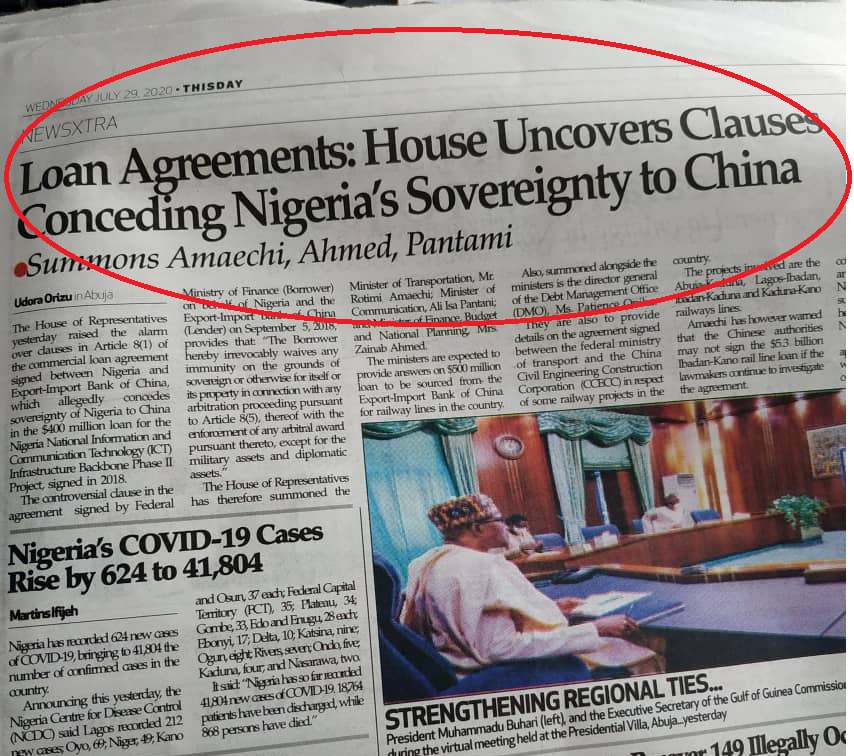
The House of Representatives yesterday raised the alarm over clauses in Article 8(1) of the commercial loan agreement signed between Nigeria and Export-Import Bank of China, which allegedly concedes sovereignty of Nigeria to China in the $400 million loan for the Nigeria National Information and Communication Technology (ICT) Infrastructure Backbone Phase II Project, signed in 2018.

The controversial clause in the agreement signed by Federal Ministry of Finance (Borrower) on behalf of Nigeria and the Export-Import Bank of China (Lender) on September 5, 2018, provides that: “The Borrower hereby irrevocably waives any immunity on the grounds of sovereign or otherwise for itself or its property in connection with any arbitration proceeding pursuant to Article 8(5), thereof with the enforcement of any arbitral award pursuant thereto, except for the military assets and diplomatic assets.”

Source: Thisday

Indeed.

Population Equalisation of the 774,000 Local Government Jobs in Nigeria

2

Massive unemployment is always one of the signals of a depressed economy. During the Great Depression of the early 1930s, there was an economist of practical means who came to global limelight by advocating macroeconomics and state intervention on the battered world economy, and incidentally started a new economic school of thought. He was so influential that President Richard Nixon, a former president of the United States, in 1972 was quoted to have said, “We are all Keynesians now.” This was due to the fact that John Maynard Keynes, both in theory and practice helped the world to navigate out of the Great Depression.

According to Keynes, “The government should pay people to dig holes in the ground and then fill them up.” People would reply, “that’s stupid, why not pay them to build roads and schools?” Keynes would respond saying, “Fine, pay them to build schools. The point is, it doesn’t matter what they do as long as the government is creating jobs.”

I believe this to be the logic behind the ongoing recruitment of the 774,000 Nigerians across all the Local Government Areas, LGAs of the Federation. The Coronavirus Pandemic has changed the direction of the economy towards a recession. The ripple effect of reducing unemployment can be seen in rising aggregate incomes, demand, and expenditure. It’s therefore praise-worthy that President Mohammadu Buhari blessed the initiative and directed Mr. Festus Keyamo, the Minister of State for Labour and Employment, to execute the task. On the flip side of the significance of this project is the inequality of job distribution with respect to the individual population of each state.

The Inequality

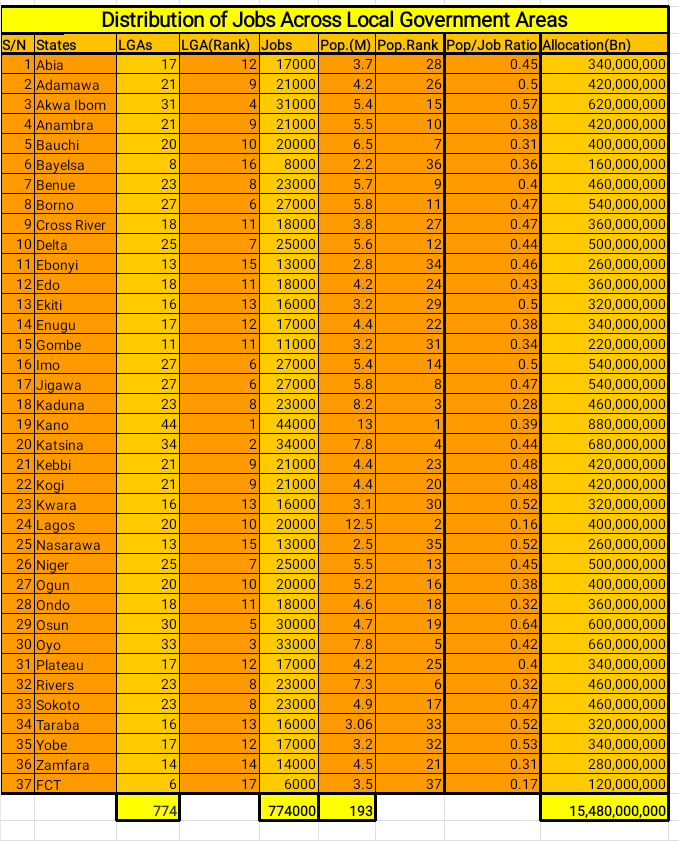
Extrapolating the 2016 population estimates from the NBS: National Bureau of Statistics (See the table below), we are going to see that the allocation of the 774,000 jobs according to local government factors alone is not equitable. If labour is a function of population size, then states with the largest population like Kano (13m), Lagos (12.5m), Kaduna (8.2m), Katsina (7.8m), Oyo (7.8m), and Rivers (7.3m) should be better off than other states by attracting the highest number of jobs. However, this is not the case.

Also, one would expect the states with the highest number of LGAs to benefit the most but, this isn’t the case either. States with the largest number of LGAs like Kano (44), Katsina(34), Oyo (33), and Akwa Ibom (31) are all behind Osun State. Yes, Osun State will be the greatest beneficiary from this employment. How did I know this?

I divided the number of jobs each state will get by its population and multiplied by 100% to get the ratio of the population that will benefit from the Special Work Project. The ratios I got range from 0.16% to 0.64%. Therefore, Osun State with a ratio of 0.64% tops the list of states that will get the most number of jobs. Conversely, Lagos State with the least ratio of 0.16% will get the lowest number of jobs. The logic behind this is that states with the largest population figures and relatively fewer number of LGAs will have small ratios while states with smaller population size with relatively larger LGAs will have larger ratios.

Reducing the Inequality

No doubt population size would have been the best determining factor for the distribution of the 774,000 jobs. Say, for every hundred thousand people, a state should get a thousand jobs. It’s not too late to include this factor as the state selection committees are still in the process of selection.

Reducing the inequality should be the responsibility of the state governments. As development partners in a federal structure and in a recession, rescuing the economy from sliding further into a depression should be a collective task. Using Lagos and Osun states as case study, which is most appropriate as the states with least and best benefits; if the federal government is recruiting a thousand labour from each local government area, Osun state with 30 LGAs will get 30,000 jobs with an injection of 600 million naira wages for three months. Lagos will get 20,000 jobs and 400 million naira wages. Where is the fairness in this? Why should Lagos with more than double the population of Osun State get 10,000 less jobs and 200 million naira less in wages?

Still on Lagos (this is also applicable to other states), it’s within its capacity ,for example, to recruit 500 more labour from every LGA to reduce the inequality. An extra 10,000 more jobs for Lagos will put it on the same level with Osun State. This is just an improvement and not an optimal adjustment. The federal government should not be asked to increase the numbers, this should be done by every state to underscore their commitment in providing the jobs they promised their citizens during the last general elections.

To avoid duplication of functions and conflict of interest, the states that desire to reduce this apparent inequality should work with the federal set-up state selection committees by sponsoring the number of slots they can fund. Please, be reminded that the population data I used is for 2016. This is four years after, certainly the population have grown. As the latest data available I had to use it to make my point.

Conclusion

I call on the National Assembly to sheath their swords for the sake of the masses you represent and allow Mr Festus Keyamo, the minister of state for labour and employment to execute the task given to him by President Muhammadu Buhari. The lives of the masses matter. As our representatives, it’s not your ego the minister supposedly bruised but ours and we don’t care. All we care about now is employment. Do not be anti-Keynesian.


Google to Connect The US, UK and Spain in Undersea Cable Project

0
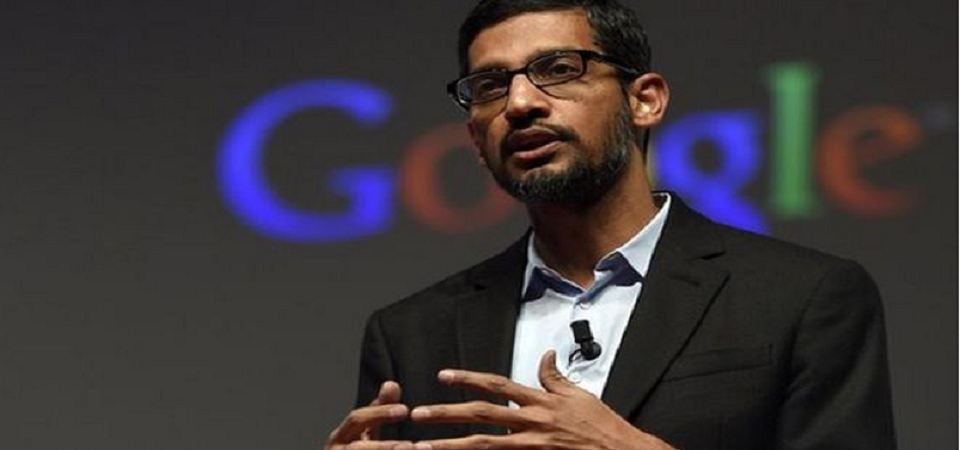
CEO of Google

Google has continued its push to provide global affordable internet. The internet giant announced Tuesday that it is setting up a new undersea fiber-optic cable between the US, the UK and Spain.

The company said the project, named Grace Hopper, after the American programming pioneer, will provide “better resilience for the network that underpins Google’s consumer and enterprise products,” as it will incorporate new technology into the cable, which has a significant upgrade compared with existing lines.

The existing lines have been laid from 1858 to 2003. Vice president of Google’s Global Network Bikash Koley said the new lines will renew the network connection between the US and the UK.

“Once commissioned, the Grace Hopper cable will be one of the first new cables to connect the US and UK since 2003, increasing capacity on this busy global crossroads and powering Google services like Meet, Gmail and Google Cloud.

“It also marks our first investment in a private subsea cable route to the UK, and our first-ever route to Spain. The Spanish landing point will more tightly integrate the upcoming Google Cloud region in Madrid into our global infrastructure,” Koley said.

The project is expected to be completed in 2022. Google said it will incorporate “novel optical fiber switching” that will help the movement of traffic around internet outages more completely. Koley said the new lines will have 16 fiber pairs (32 fibers), which is a significant upgrade to the internet infrastructure connecting the US and the UK.

The project will commence in the US, where the cable will be laid along the ocean floor from New York to the Cornish seaside resort town of Bude, Cornwall in the UK and Bilbao Spain. It is expected to run 6,300 km from the US to Spain.

Underwater cables have become so vital to global internet communication infrastructure. Google estimates that 98% of the world’s data will pass through undersea cables, which will make it possible to rapidly send and receive information around the world.

The cables, which are usually built by communication firms, are becoming a new way tech companies are using to fix the global internet friction. The Grace Hopper is Google’s fourth privately owned undersea cable.

The disruption caused by COVID-19 pandemic exposed the need for a stronger internet infrastructure, as it forces the world to go virtual and carry out many activities via the internet.

“The COVID-19 pandemic has put a spotlight on connectivity, highlighting how ingrained it is in our daily lives. These challenging times have taught us that a stable and reliable network is no longer a ‘nice to have’ but business critical,” said Tom Meyer, a general manager and group vice president at technology analyst firm IDC Europe.

“Naturally, investment into infrastructure is a major priority, particularly as connectivity becomes an ever-increasing necessity going forward,” Mersey added.

However, the undersea cable project has come at high cost as it does with advantages. John Delaney from telecoms analyst IDC said Google needs “an ever-increasing amount of transatlantic bandwidth” to keep the cable effective.

“Building its own cables helps them choose cable routes that are most optimal and near data centers,” said Delaney. “It also minimizes operational expenditure by reducing the need to pay telcos and other third-party cable owners for the use of their infrastructure.

The infrastructure comes also with a hefty maintenance responsibility to keep the cable effective and network reliable.

“It’s not enough to have a single cable because any element in the network can break from time to time, and if it’s 8,000 meters under the sea, it takes a while to repair,” said Jayne Stowell, who oversees construction of Google’s undersea cable projects.

On the other hand, Facebook announced in May it’s building an undersea cable to boost African network infrastructure. The project dubbed 2Africa, will cover 37,000 km (about 22,991 miles). Facebook said the cable will be “nearly equal to the circumference of the Earth.”

The project is expected to be completed by 2024, and provide faster internet for the 1.3 billion people in the continent. Africa is the least internet-enabled continent with only four in 10 people having access to the web.

With a boisterous median population and emerging markets, Africa needs a better internet infrastructure for future economic growth.

As poor infrastructure and unfriendly business policies keep stymieing the efforts of local telecom operators to provide reliable internet service, big tech companies are stepping into position to provide reliable internet through undersea cable network.

The BIG Risk

0

From the confusions we have in the world right now, do not be surprised that more countries would have biological weapons by 2023. In this race to find a cure to Covid-19, the world would be fooled to think that some countries doing accelerated vaccine research have Covid-19 as part of the core strategic goals. Yes, you waive all scrutiny, thinking you are doing a humanitarian gesture to find a cure to the virus, only to see bad things from 2023. Coronavirus is evil; we must not sleep while fighting it, that some regimes are allowed to acquire bio-weapons.

As COVID-19 cases continue to surge in the United States and abroad, researchers are racing to develop a vaccine at record-breaking speeds. In a June 23 hearing before the House Energy and Commerce Committee, Anthony Fauci, the director of the National Institute of Allergy and Infectious Diseases, reiterated that he is “cautiously optimistic” about the possibility of a coronavirus vaccine being ready by early 2021.

“The development of a vaccine for a new pathogen typically takes many years and sometimes decades,” says Dan Barouch, the director of the Center for Virology and Vaccine Research at the Beth Israel Deaconess Medical Center in Boston. “The attempt to develop COVID-19 vaccines in a year is truly unprecedented in the history of vaccinology.”