DD
MM
YYYY

PAGES

DD
MM
YYYY

spot_img

PAGES

Home Blog Page 6234

Nvidia Overtakes Intel As U.S. Most Valuable Chipmaker

0
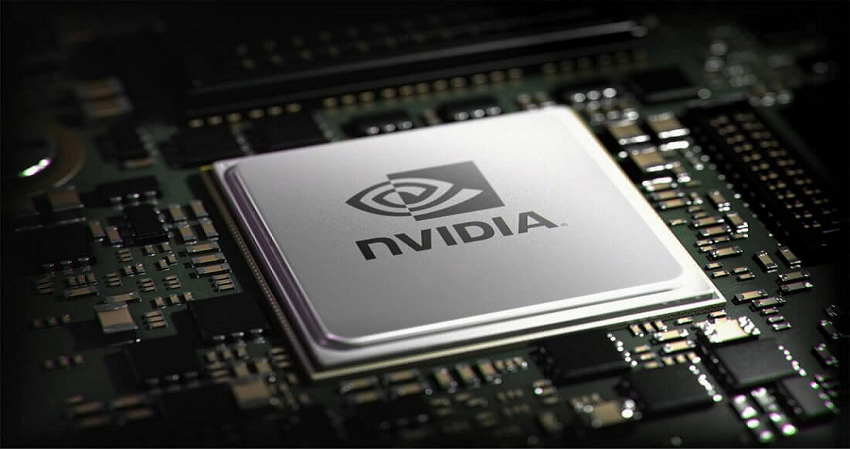
Nvidia chip

In a surprising development in the US semiconductor industry, Nvidia has beaten Intel to become the most valuable chipmaker in the United States for the first time.

The company’s shares rose 2.3% on Wednesday to a record $404, to push its market capitalization to $248 billion, $2 billion above Intel’s $246 billion value, according to Reuters.

US chipmakers have suffered a hit following the emergence of COVID-19 that resulted in the S&P low on March 23. But Intel was coming out of it coldly while Nvidia has enjoyed a relative growth that has put it ahead.

Intel’s stock has lost almost 3% in 2020; Nvidia’s witnessed a 68% growth. The growth has been attributed to the evolution of remote work by investors who believe that the coronavirus pandemic will continue to spur Nvidia’s datacenter business to fast growth.

Datacenters have boosted Nvidia’s performance in Wall Street ever since it moved concentration from chip making to automobiles, artificial intelligence and datacenters. Unlike Nvidia, Intel has been fully focused on PC processors and servers, failing to diversify its business. Even an attempt in mobile phone production failed.

Global competition in the semiconductor industry has also contributed to the failings of Intel. As the Chinese government pushed to cut its dependence on US made chips by pumping billions into manufacturing of semiconductors, the market capitalization of Intel began to fall below South Korea’s Samsung Electronics and Taiwan Semiconductor Manufacturing Co.

Reuters said that despite the stock rise of Nvidia, its sales remain a fraction of Intel’s. But analysts on average see Ndivia’s revenue rising 34% in its current fiscal year to $14.6 billion, while they expect Intel’s revenue to increase 2.5% to $73.8 billion.

Intel’s woes are even getting compounded as Apple announced it is divorcing Intel’s chip. Apple said it will henceforth make use of its own chips in its Mac computers in favor of Intel’s Silicon.

The different strategies embraced by Intel and Nvidia are yielding different results. Intel lost its title as the most dominant chipmaker in Silicon Valley, while Nvidia took advantage of the situation. Moreover, the odds appear to be in favor of Nvidia.

“What’s notable about Nvidia is that the graphics chips it sells for AI projects weren’t originally designed for that purpose. Still investors clearly believe that Nvidia, which also provides chips for gaming and for servers that run in corporate data centers, has lots of room to grow,” said Nick Wingfield.

Intel has been trying to formulate an AI strategy that included the $1.7 billion acquisition of fellow chipmaker Altera and autonomous vehicle technology developer MobileEye, which it acquired for $15.3 billion. But the strategies appear not bright enough to attract the commendation of Wall Street.

Other matters have paved the way for AMD to find a place in the competition. The company has adopted a strategy that relies on emulating CUDA and adoption of its ROCm platform.

Extremetech noted however, that the performance situation of ROCm continues to favor Nvidia, with AMD’s GPUs generally slower than their Team Green counterparts. Given that AMD is effectively performing code translation, that’s not too surprising.

Meanwhile, Intel is still fighting to establish itself in these new markets. The company’s server-side business has done excellently well in recent years, though not enough to catch the attention of Wall Street. Intel bought Havana Labs last year and effectively relaunched some of its AI efforts from scratch, though they have not started to yield fruitful results.

Intel’s CPU-centric efforts have focused on integrating capabilities like AVX-512 and bfloat16 into its CPUs, the latter of which debuted in top-end server CPUs this year with the launch of Cooper Lake.

On the other hand, AMD has focused most of its efforts on the CPU side of the equation for now, while Nvidia has had the scientific side of the business largely to itself. Extremetech noted further that there may be changes in the future, with AMD talking about its CDNA compute architecture, but it’s not surprising to see Nvidia in this position.

What if it was Julius? AfCFTA Deferred over Covid 19 Highlights the Achilles heel on African Integration

1
What if it was Julius?  AfCFTA Deferred over Covid 19 Highlights the Achilles heel on African Integration
 
I ask the question “what if it was Julius?” for a number of reasons. First is South African, and arguably a youth. Second, he is very much into politics having been the ANC youth leader – albeit a firebrand that fell out of favour with the establishment. I will return to these points later.
 

At 39 years of age,  Julius Sello Malema (born 3 March 1981) is a South African politician who is a Member of Parliament.  Having previously served as President of the African National Congress Youth League from 2008 to 2012, Malema is now the President and Commander-in-Chief of the Economic Freedom Fighters, a South African political party, which he founded in July 2013.

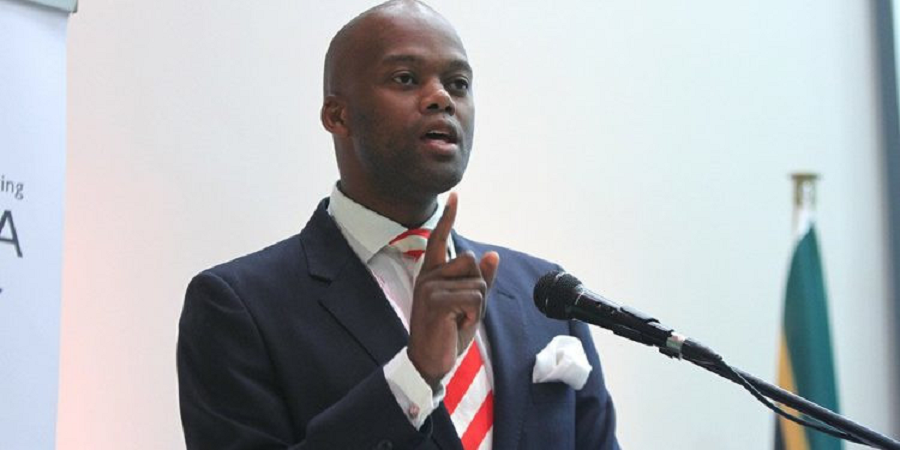
Unlike Julius, Wamkele Mene who is in his early 40s, was elected Secretary General of the African Continental Free Trade Area Secretariat in February 2020. AfCFTA is arguably the world’s largest free trade area.

He differs from Julius in a number of ways.

Wamkele Mene holds a Bachelor of Arts (Law) degree from Rhodes University in South Africa, a Master of Arts in International Studies & Diplomacy (with specialization in International Economics) from the School of Oriental & African Studies (SOAS), University of London and a LL.M. (Master of Laws) in Banking Law & Financial Regulation from the Law Department of the London School of Economics & Political Science (LSE). He has also lectured internationally on international trade law, international investment law and international business law.  

Let’s take a step back for a moment, the AfCFTA agreement was adopted and opened for signature on 21 March 2018 in Kigali the Rwanda capital. The AfCFTA came into force on 30 May 2019. The agreement seeks to cut tariffs within the bloc, boost trade, eliminate border barriers and create the world’s largest free trade area. 

However, progress seems to have been marred and the political will of actors put to the test – just look at the jostling between Egypt and Nigeria for an African representation to the WTO.  

My view is that AfCFTA seems to have contracted its own virus by allowing Covid19 stall progress. Should the 1 July 2020 implementation have been deferred to 2021? How many political campaigns carried on globally in the pandemic? Would Julius have deferred the new African reality? Your guess is as good as mine.

While African Integrationists are still “dulling” on #AfCFTA, votes are being cast elsewhere. A case of self-inflicted marginalisation?
Hear what Wamkele had to say about deferring AfCFTA:  

Rotary Club of Ikoyi Metro honors Ndubuisi Ekekwe for “Exceptional Support to Humanity”

1

The Rotary Club of Ikoyi Metro, District 9110 honors Ndubuisi Ekekwe for “Exceptional Support to Humanity”. Service: That is the Call.

Rotary International is an international service organization whose stated purpose is to bring together business and professional leaders in order to provide humanitarian service and to advance goodwill and peace around the world. It is a non-political and non-religious organization open to all.

Revenue Modelling in a Business Model

0

They had a great value proposition. They had a great user base and active users of their product.

They have tested their business model but yet the future of their business looks unsustainable.

For some years, Google business operated without a revenue model. They wanted the experience of their search engine to have an edge over the others in the search engine market.

They wanted to build a search without ads biased ranking. They wanted to rank pages based on quality and relevance.

But, how do they sustain a business without a revenue model. This is to show that the revenue model is actually one of the sustainability factors of a business.

In other words, how will the business make money to continue its operations and have resources to steer growth?

The Google founders (Sergie Brian and Larry Page) tried to solve this critical issue in their business models as explained in 3S rules. Fortunately, they arrived at Google Adwords, Google Adsense and other monetisation strategies.

In this second series of business model analysis, we shall be considering how to design your revenue model in such a way that the business model will be balanced.

Let’s get started;

The Two Components of Value Valuation in a Business Modelling.

We have to look at the concept of revenue in a very clear way. What do you think will make the target market to exchange money for what you sell?

What mode do you intend to collect revenue from them? Here are two ways to go about this;

Product/Offering Of The Business:

Revenue is a product of the offering or the product you are giving to the market target. This is a well packaged value proposition and solutions to a specific need or problem of the target market.

Products or offerings are packaged solutions and packaged value propositions. When I teach copywriting or write copies, I call this an irresistible offer that will persuade clients to pay you and make you stand out in the market.

Continuing with the example of Google, their offering is providing a search engine to organize the world’s information and make it useful and accessible to everyone.yes,your product and offering first.

Revenue Modelling:

How do you want the users of your offering or product to pay you for rendering such services to them? How do you want your prospect to pay you for solving their problem with your product.

You know the concept of revenue modelling goes with the concept of exchange. That is your business is offering a solution and the market target is paying to have the solution.

The question is this; how do your prospects pay for your solution or your offering? This brings us to the concept of revenue modelling.

It is simply a design of how you want the market target to pay for your products. We have some of the following revenue models used in business;

  • Subscription Revenue:

The user of the product or offering pays for the product and has access to use it for a certain period of time. When the time elapses, he will have to subscribe again or pay again to enjoy the service for a specified period of time.

A good examples is Data Subscription of telecom companies (Mtn, Glo etc)

  • Commission Revenue:

This is simply charging a percentage from the transaction that takes place through your offering or product. We have Uber as a clear case study of this revenue model.

They provide the platform for the driver and rider, they take a cut from revenue made.

  • Advert Revenue:

This is using the data of the users of your platform or products as a revenue modelling tool. You sell these refined data for advertisement by other businesses.

This is how Google and Facebook work.

  • Freemium Revenue:

You provide a basic free version of your product and a paid version. The free version is a lead generation tactic and the paid version is where users have to pay.

I explained in this article “while the freemium model is not free.” A good example is Linkedin.

  • Direct Revenue:

In this revenue modelling, the users pay directly for using a particular product. This is a very good example of how traditional businesses operate.

A good example is Supermarkets and retail stores where you pay for what you buy instantly.

You need to model your revenue based on what is suitable and strategic to your offering and business model. Sometimes, you may consider more than one business model in one business model. 

Congratulations Member for Your State Appointment

0

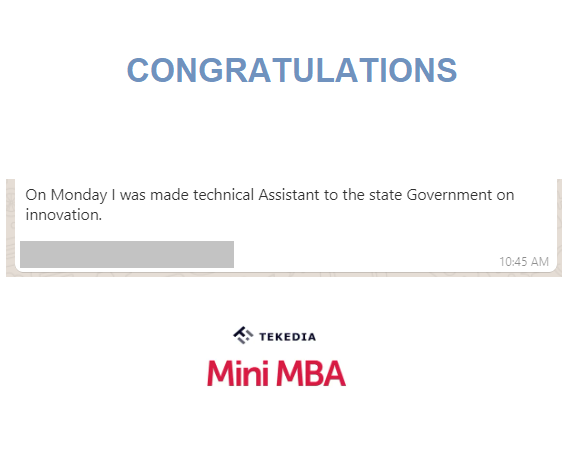
He joined Tekedia Mini-MBA without a job. Then, he committed his efforts to do the Challenge Assignments, and spoke with me for more directions on building a system of innovation, not just invention. He used his state as the “company” and developed an innovation & productivity plan. Then, he shared with leaders in his state, making a case that he could assist with the mission.

On Monday, the Governor appointed him a special assistant on innovation. Congratulations member; we wish you a great service to our nation.

For us at Tekedia Institute, the government has also sent a note on how we could work with it.