DD
MM
YYYY

PAGES

DD
MM
YYYY

spot_img

PAGES

Home Blog Page 624

Roqqu Lists Nigeria’s First Regulated Stablecoin cNGN, Driving Adoption at The Grassroots

0

Nigerian crypto exchange Roqqu has officially listed Nigeria’s regulated cNGN, a stablecoin pegged at a 1:1 ratio to the Naira.

While Roqqu is still awaiting a provisional crypto licence from the Securities and Exchange Commission (SEC), its decision to list the SEC-approved token underscores the growing acceptance of cNGN among market operators.

Roqqu, which says it now serves 1.8 million users and has a strong grassroots presence, believes its network will help bring stablecoin closer to everyday Nigerians.

A currency is not a thing if it’s not embraced by the people, and we know how to get to these people,” said Emmanuel Peter, Roqqu’s Head of Academy and Business Partnerships. This could be what the cNGN token has been missing, wider distribution.”

Roqqu will earn exchange fees from fiat-to-cNGN swaps but plans to make peer-to-peer cNGN transactions feeless to encourage adoption.

The platform has already integrated with Base, one of six supporting networks. It will run a co-marketing campaign with the cNGN team featuring educational and promotional events across campuses and multiple Nigerian cities.

CEO Benjamin Onomor added that Roqqu intends to build additional financial services around cNGN.

We want to unlock all the opportunities this stablecoin brings, including eventually providing users with low-interest loans and other services”, he said.

With this move, Roqqu joins other Nigerian startups such as Busha, Quidax, Xend Finance, Blockradar, and Boundlesspay that have adopted the stablecoin.

Inside cNGN

The cNGN is Nigeria’s first regulated stablecoin, launched on February 3, 2025, after a year-long delay to meet regulatory requirements. It is fully backed by naira reserves held in licensed custodian banks and operates under the SEC’s Regulatory Incubation (RI) Program.

Distributed by the WrappedCBDC team, the stablecoin now has ?603 million ($395,000) in circulation. Its goal is to provide a stable, transparent digital currency that avoids the volatility of traditional cryptocurrencies while enabling payments, remittances, and trading.

The listing of cNGN across crypto platforms in Nigeria is timely, as Stablecoin adoption in the country has surged, driven by economic challenges like naira devaluation, high inflation, and limited access to traditional banking.

Nigeria is Africa’s largest stablecoin market, processing nearly $22 billion in transactions between July 2023 and June 2024, with stablecoins accounting for 43% of Sub-Saharan Africa’s crypto transaction volume.

Why cNGN Matters

The stablecoin offers multiple benefits for Nigeria’s digital economy:

  • Financial Inclusion: Provides unbanked and underbanked Nigerians with a stable entry point into digital finance.
  • Economic Efficiency: Enables faster settlements and lower-cost transactions for individuals and businesses.
  • Blockchain Adoption: Encourages broader use of blockchain-based financial solutions by showcasing transparency, security, and efficiency.

By being 100% naira-backed and SEC-regulated, cNGN stands apart from volatile crypto assets, offering a safer option for merchants, investors, and everyday users. It also simplifies remittances, making cross-border transfers faster and cheaper than traditional methods.

The Road Ahead

Despite its promise, concerns remain about the naira’s stability, which could impact trust in the token’s long-term value. Ultimately, the success of cNGN will hinge on its ability to maintain regulatory compliance, transparency, and user confidence while driving adoption at scale.

With exchanges like Roqqu pushing grassroots distribution, Nigeria’s stablecoin experiment may mark a turning point in the country’s digital finance journey.


Solana Price Prediction: SOL Could Hit $800 in 2025, But Ripple (XRP) and Little Pepe (LILPEPE) Will Explode First

0

Solana (SOL)’s breakthrough scaling enhancements and lightning-fast transaction speeds give it an edge over every other blockchain in the space.  Many analysts expect SOL to reach $800 by 2025, thrilling investors.  However, Ripple (XRP) and Little Pepe (LILPEPE), a presale sensation reinventing the meme coin playbook, may be the near-term breakout stars.

Little Pepe (LILPEPE): The Meme Coin Turning Heads in 2025

Before diving into Solana and Ripple, let’s talk about the project that has the community buzzing—Little Pepe. This new meme token is in Stage 12 of its presale, priced at $0.0021 per token, and has already raised over $22.6 million. With 35,983 holders and an active Telegram group boasting 28,045 members, data indicates Little Pepe is building one of the most committed communities in the market.

What sets Little Pepe apart is its fusion of meme culture with robust tokenomics. A tidy 26.5% of the total supply is sold in the presale, which means it’s pulling in enough cash for serious liquidity and future upgrades. A further 10% is earmarked for liquidity pools, which lock in stable trading as soon as the token goes live. The clever minds behind the project also tucked away 30% in chain reserves.

Features like 0% transaction tax, staking rewards, and a CertiK audit give it both hype and credibility—a combination rarely seen in this category. We believe that with its rapidly growing user base and viral potential, Little Pepe could deliver returns that eclipse not only Ripple but even Solana in percentage terms.

The ongoing $777,000 giveaway, with over 231,000 participants already, suggests momentum is only increasing. Compare this with other meme tokens like Dogecoin and Shiba Inu, which are already trading at multi-billion-dollar valuations. Little Pepe offers a low entry point, meaning early investors stand to benefit most if it mirrors the viral growth of previous meme coin giants. In our view, Little Pepe could be the biggest success story of 2025 for investors seeking massive upside from a tiny starting price.

Ripple (XRP): Institutional Validation from SWIFT

Ripple makes headlines, but this is a game-changer:  SWIFT, the worldwide interbank communication network, is testing XRP Ledger for cross-border transactions.  This shows traditional finance’s rising interest in blockchain solutions, especially fast and efficient ones.

With a market cap of about $183 billion and daily transactions close to $5.7 billion, XRP is now trading between $2.88 and $3.02.  The key lesson here is institutional acceptance, even though some optimistic forecasts place XRP between $5 and $6 by the end of 2025. XRP has strong fundamentals and clear utility, but given its size and current valuation, its upside is likely more limited compared to Little Pepe. While XRP might deliver steady growth, meme-powered momentum often beats conservative utility-driven assets when it comes to sheer percentage gains.

Solana (SOL): Speed Meets Scalability

Solana’s recent performance metrics are nothing short of staggering. The newest test just dropped, and Solana hit a mind-blowing 107,000 transactions per second (TPS) all in one block. That number doesn’t just break records; it makes Solana one of the speed champs of the whole blockchain world. But it doesn’t stop there— the upcoming Alpenglow upgrade plans to cut block finality to only 150 milliseconds. This quick confirmation time will make Solana even more attractive to developers and businesses looking for a fast and reliable platform. Currently trading at $196, with a market cap near $106 billion and daily volumes around $4.6 billion, Solana has long been seen as Ethereum’s top challenger. Some forecasts predict SOL will reach $400 by the end of 2025, while more aggressive models suggest a potential surge toward $800—particularly if a U.S. spot ETF is approved.

Conclusion: Why Little Pepe Could Outperform

Solana may hit new highs, and Ripple might gain institutional adoption, but Little Pepe offers something these giants can’t: extreme asymmetry in risk and reward. Starting from a presale at the lowest price, even modest adoption could lead to exponential gains for early investors. We believe the next wave of meme coin mania could start with Little Pepe. With a rapidly growing community, strong tokenomics, and viral momentum, it’s positioned to be more than just a meme—it could be one of 2025’s most profitable plays.


For more information about Little Pepe (LILPEPE) visit the links below:

Website: https://littlepepe.com

Whitepaper: https://littlepepe.com/whitepaper.pdf

Telegram: https://t.me/littlepepetoken

Twitter/X: https://x.com/littlepepetoken

Examining Nigeria – Academic Staff Union of Universities (ASUU) Agreement in 2001

0

Similar to the previous agreements, the 2001 agreement between the Federal Government of Nigeria (FGN) and the Academic Staff Union of Universities (ASUU) remains a landmark document in the history of higher education reform in Nigeria. Our analyst points out that while it was born out of intense negotiations and mutual frustrations, it also offers a rich case in how complex systems are shaped by a web of relationships, interests, and compromises. To understand its impact and limitations, our analyst looks beyond the surface of policy and examines how influence, power, and negotiation shaped the final outcome.

The Power of Relationships in Shaping Policy

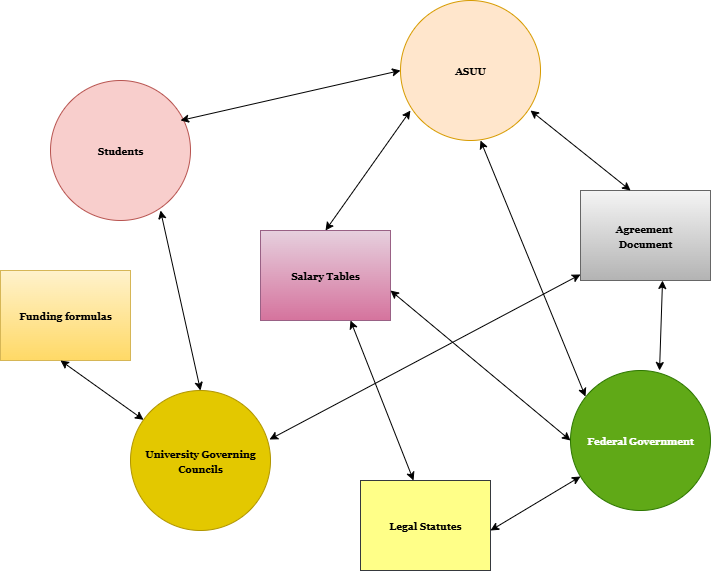
At the heart of the agreement lies a network of actors whose interests were often at odds. ASUU, representing the academic workforce, pushed for autonomy, better funding, and improved working conditions. The Federal Government, balancing national priorities and budget constraints, sought to maintain control while appeasing demands. University governing councils, students, and state governments also played indirect but important roles.

Exhibit 1: Network of actors and influence 

Source: FG-ASUU, 2001; Infoprations, 2025

What makes this agreement compelling is how these relationships influenced the final document. ASUU’s initial proposal ran over 140 pages. In line with this, our analyst notes that writing over 100 pages proposal indicates deep frustration and a desire for systemic change. The government’s counteroffer was less than a third of that length, signaling a more cautious approach. The final agreement, somewhere in between, was not just a compromise, it was a reflection of how each party managed to assert its influence.

Documents as Tools of Negotiation

Our analysis further reveals that the agreement itself is more than a record of decisions. It is a tool that encodes the values, priorities, and power dynamics of its time. Salary tables, funding benchmarks, and governance structures are not just technical details, they are expressions of what each side believed was fair and necessary.

For example, ASUU’s insistence on a benchmark of ?200,000 per student per year was not just about money. It was a statement about the value of education and the need to reverse years of underfunding. Similarly, the push for university autonomy was about reclaiming control over academic decisions and resisting political interference.

Yet many of these proposals were met with delays or vague promises. The government deferred legal reforms to the Ministry of Justice, and implementation timelines were left open-ended. These gaps reveal how documents can be used to stall, soften, or reshape demands without outright rejection.

Unresolved Tensions and Fragile Agreements

Despite its scope, the agreement left many issues unresolved. The appointment process for university leaders remained contested. The question of tuition fees was rejected at the federal level but left open for state universities. The reinstatement of dismissed staff under military-era decrees was promised but not guaranteed.

These unresolved areas point to a deeper truth. Agreements like this are rarely final. They are snapshots of a moment in time, held together by fragile consensus. When the underlying relationships shift (due to political change, economic pressure, or public outcry) the agreement itself can unravel or be renegotiated.

Our analyst stresses that this fragility is not a failure. It is a reminder that reform is a process, not a destination. The 2001 agreement did not solve all problems, but it created a framework for continued dialogue and advocacy.

What We Can Learn Today

Over two decades later, the FGN-ASUU agreement still holds lessons for policymakers, educators, and reform advocates. It shows the importance of inclusive negotiation. When all voices are heard, especially those closest to the problem, the resulting policies are more grounded and credible.

It highlights the need for clarity and accountability. Vague promises and deferred actions weaken trust and make implementation difficult. Reform documents must be clear not only in their goals but in how those goals will be achieved. It also reminds us that documents are not passive. They shape behavior, expectations, and future negotiations. Treating them as living tools rather than static records allows us to adapt and respond to changing realities.

The 2001 agreement may not have delivered all it promised, but it remains a powerful example of how change begins, with conversation, compromise, and the courage to imagine something better.

EU Set to Fine Google Over Adtech Practices as Trump Threatens Tariffs Over Europe’s Digital Rules

0

Alphabet’s Google is expected to face a modest antitrust fine from the European Commission in the coming weeks over allegations of anti-competitive conduct in its adtech business, three people familiar with the matter have told Reuters.

The decision follows a four-year-long investigation triggered by a complaint from the European Publishers Council, which accused Google of favoring its own advertising services over rival platforms. The charges, formally laid out in 2023, have kept pressure on Google at a time when its global ad business remains dominant. In 2024, Google generated $264.6 billion from advertising — accounting for 75.6% of its total revenue.

EU competition chief Teresa Ribera, who took over from Margrethe Vestager, is signalling a change in Brussels’ enforcement style. Unlike Vestager, who levied record-breaking penalties such as the €4.3 billion fine in 2018 for Android-related abuses, Ribera is prioritizing behavioral remedies to curb anti-competitive practices rather than headline-grabbing deterrent fines.

“The focus now is to push companies to change how they operate, rather than punish them with massive penalties,” one person with knowledge of Ribera’s approach said.

Google, for its part, has pushed back. In a 2023 blog post, the company criticized what it called the Commission’s flawed reading of the adtech sector, insisting publishers and advertisers “have enormous choice.” While the fine is expected to be modest, Google is unlikely to face structural remedies such as a forced sell-off of its DoubleClick for Publishers or AdX exchange platforms — a divestiture that Vestager once floated. Ribera’s team believes such drastic steps may not be necessary, particularly as a U.S. judge has already scheduled a September trial to consider remedies for Google’s dominance in digital ad tools used by publishers.

A Broader Transatlantic Clash

The looming EU fine comes amid heightened friction between Washington and Brussels over the regulation of U.S. technology companies. President Donald Trump, who has long bristled at Europe’s assertive regulatory stance, threatened Monday to impose substantial tariffs and export restrictions on any country that enforces digital taxes or rules he says “discriminate” against American firms such as Google, Meta, Amazon, and Apple.

“Digital taxes, legislation, rules or regulations are all designed to harm, or discriminate against, American technology,” Trump wrote on Truth Social. He argued that while Europe and the UK impose levies such as the 2% digital services tax, China’s tech giants are “outrageously given a complete pass.”

Trump warned: “Unless these discriminatory actions are removed, I, as president of the United States, will impose substantial additional tariffs on that country’s exports to the USA, and institute export restrictions on our highly protected technology and chips.”

European officials have touted a pushback against Trump’s tariffs through regulatory scrutiny of U.S. tech firms. French President Emmanuel Macron, speaking at a Cabinet meeting on Wednesday, urged his ministers to prepare retaliatory options that could directly target the U.S. digital sector.

“Europe should not exclude taking a look at the digital sector” in formulating its response, Macron said, according to a senior French official who spoke to Politico on condition of anonymity. The French leader pointed to the EU’s negative trade balance in services with the U.S., contrasting it with Washington’s repeated demands that Europe reduce its trade surplus in goods such as cars, pharmaceuticals, and food.

A Cycle of Retaliation

The escalating tensions are reviving concerns of a broader transatlantic trade rift. Trump’s threat of tariffs on European exports mirrors earlier confrontations over steel, aluminium, and autos, while the EU’s scrutiny of Silicon Valley giants is increasingly seen in Washington as a disguised form of economic retaliation.

For Google, the modest adtech fine may only be the latest chapter in its long battle with European regulators, following earlier multibillion-euro penalties in 2017, 2018, and 2019.

Reinvention of Crypto Exchanges is Driving Mainstream Adoption and Innovation

8

Crypto exchanges are undergoing significant transformations to adapt to evolving market dynamics, regulatory landscapes, and user demands. Exchanges are increasingly catering to institutional investors, who are driving significant capital inflows.

For instance, platforms like Bullish are targeting institutional clients with stable, recurring revenue models, leveraging sophisticated infrastructure like segregated cold storage and prime-broker desks to meet fiduciary standards. This shift is fueled by the introduction of spot Bitcoin ETFs and growing institutional adoption, with trading volumes reaching $19 trillion in 2024, more than double the previous year’s $8.7 trillion.

Exchanges are navigating fragmented global regulations to maintain competitiveness. The EU’s Markets in Crypto-Assets (MiCA) regulation, fully enforced by December 2024, has made Europe attractive for exchanges, with countries like Luxembourg and France serving as entry points. Similarly, Dubai’s Virtual Assets Regulatory Authority offers rapid approvals and zero corporate tax, positioning it as a hub for Middle East operations.

Exchanges like Bullish are also pursuing licenses like New York’s BitLicense to expand market access. Exchanges are expanding beyond traditional trading. For example, Binance has introduced tools like the Binance Wallet Extension for seamless Web3 access, supporting DeFi and cross-chain asset management.

Coinbase is enhancing DEX trading on its Base platform to offer broader asset access. Some exchanges are also integrating tokenized real-world assets (RWAs) and stablecoin services, with firms like Mastercard providing infrastructure for stablecoin payments in regions like Europe and Africa.

In response to hacks and fraud, exchanges are bolstering security. Binance, for instance, is part of the Beacon Network, a real-time crypto crime response system developed with TRM Labs to prevent illicit fund transfers. Meanwhile, exchanges are addressing vulnerabilities exposed by incidents like the $44 million CoinDCX breach in India, focusing on robust infrastructure and compliance with anti-money laundering (AML) and know-your-customer (KYC) requirements.

Major financial institutions are partnering with exchanges to bridge crypto and traditional finance. JPMorgan’s collaboration with Coinbase to allow Chase credit card funding for crypto purchases starting in fall 2025 is a notable example. Additionally, firms like Citigroup are exploring stablecoin custody, reflecting a broader trend of mainstream financial players entering the crypto space.

Exchanges are supporting new financial instruments like tokenized equities and ETFs. For example, Kraken and Backed have partnered with TRON DAO to broaden access to tokenized equities, while the SEC’s “Project Crypto” aims to modernize securities regulations for crypto-based trading, potentially enabling tokenized asset markets.

Some exchanges are going public to gain legitimacy and attract capital. Bullish’s NYSE debut in August 2025, with a valuation of $13.16 billion, underscores this trend, with other firms like Gemini and Grayscale also filing for IPOs. This move aligns with a pro-crypto regulatory shift in the U.S., boosting investor confidence.

Mainstream financial integration accelerates, with banks like JPMorgan and Citigroup entering the space, potentially legitimizing crypto as an asset class and driving broader market growth (e.g., $19 trillion in 2024 trading volume).

Diversified services like DeFi wallets (e.g., Binance Wallet Extension), tokenized RWAs, and stablecoin payments expand access to financial tools, especially in underbanked regions like Africa. Crypto could democratize finance, but complexity and regulatory barriers may limit adoption among less tech-savvy users, creating a digital divide.

As exchanges innovate with new products (e.g., tokenized equities, ETFs) and go public, smaller or less adaptable platforms may struggle to compete, leading to mergers or exits. A few dominant exchanges could emerge, potentially reducing consumer choice but improving service quality and reliability. Innovation may slow if consolidation stifles competition.

The long-term impact depends on how exchanges balance user needs, compliance, and technological advancements. These changes reflect a broader maturation of the crypto industry, driven by institutional interest, regulatory clarity, and technological advancements.

However, challenges like security risks, regulatory uncertainty, and the need to balance retail and institutional demands persist. Exchanges that successfully innovate while maintaining robust compliance and security are likely to lead the next phase of the crypto market’s evolution.