DD
MM
YYYY

PAGES

DD
MM
YYYY

spot_img

PAGES

Home Blog Page 6255

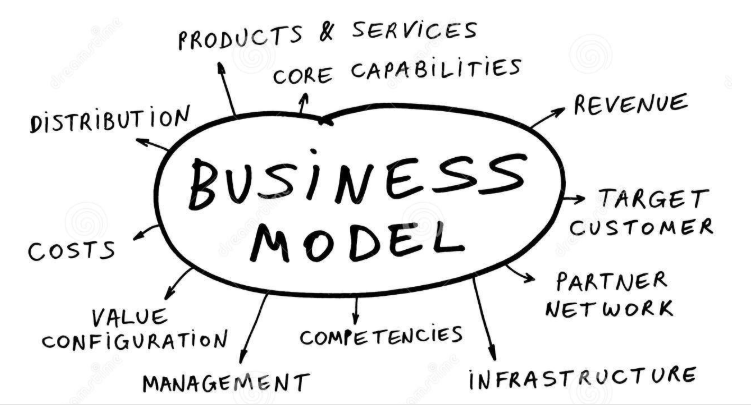
The Core Basis of Business Modelling

2

This is how to tell if a business model will work or not. He never knew he would become one of the famous entrepreneurs in his time. He was just passionate and smart in business.

He happened to visit the United States of America one day, they introduced him to a browser called the mosaic browser. He happily used the browser to surf some information about products that are online.

 Well, he searched for drinks brands in the United States and he found many online. He was excited about that development. The next thing was that he searched for the same product in his country, China. Surprisingly, there was no information about products from China online.

 This was the experience that gave birth to Alibaba Group. This was the experience that birthed the star Jack Ma, the pioneer of the e-commerce industry in China and Asia.

In the book, 3S Rules‘ ‘ it was stated that if we have Singapore, South Korea, Hong Kong, Taiwan, etc as Asian Tigers, then China will be the Asian lion, because China is the king of Asian continent.

 This is the story of how Business models are developed and designed. In this piece, I shall be analyzing the fundamentals of a business model. What are the key elements of a business model? When you observe a business opportunity, what do you do?

 Key Fundamentals of A Business Model.

The business model is simply the designs of how your business idea will solve the intended problems and how it will make money.

 Here is what an article from Harvard Business Review says about the business model. According to Joan Magretta, a business model, she says, has two parts: “Part one includes all the activities associated with making something and Part two includes all the activities associated with selling something.

So here are the fundamentals to consider in designing business models that will be sustainable.

  •  Market Friction/Problem

The first step in developing a business model is the problem or the opportunity that you have observed in the market. Business is simply solving a problem by way of offering products to those that have such problems.

 What is the opportunity you identified? What is the problem you identified in the market? What are the lapses in the existing market you identified? What are the trends that you want to explore?

This is very crucial as it forms the base of your business modelling. Without it, then forget it…you don’t have a basis for business modelling.

 This is in line with the jack ma story above. He identified a market gap and an opportunity in the China market. then, this is the next thing to do.

  •  Business Ideas.

This is expected of every entrepreneur or business owner. When you see a market opportunity, what comes to mind is a business idea to maximize such opportunity. Business ideas are imaginations you have in your mind about the possible solution to the problem you identified in the market.

Jack ma had the business idea to provide an online platform where business people could sell. But business ideas have one common feature which is they are always raw and formless. That is why business modeling is key. Then, the next thing to consider is this;

  •  Value Proposition.

As an entrepreneur, you should have known that people don’t buy Panadol but they buy health. People don’t buy flight tickets, they buy luxury in flying.

 People don’t buy don’t buy food but they buy satisfaction or refreshment. In a nutshell, people buy solutions or antidotes to their problems and not the product itself.

 But, product is the means to that solution.

 At this stage you should have a clear value that the market target will obtain from this your business idea. One of the value propositions of e-commerce is to make it convenient for people to shop.

That is why in this time of lock down, you can shop at home and it will be delivered conveniently. So, state the value proposition of the business idea you have.Do you have a new business you want to launch? Do you have a new product you want to launch? Do you have an idea due to the current trends?

Do you want to innovate your already existing business? If yes, this series of articles on business models is what you need for a successful innovation. Part2, part3 and part4 of this series are on the way.

The FIRS Extends Adhesive Stamp Duty Charge to Rent and Lease

2

The Federal Inland Revenue Service (FIRS) has applied the newly introduced stamp duty to house rent and Certificate of Occupancy (C of O) in line with its new adhesive duty.

The new development was announced on Thursday in Abuja by the FIRS Director, Communications and Liaison Department, Mr. Abdullahi Ahmad.

He said Nigerians should ensure that documents pertaining to rent or lease agreements for their home, offices, C of O and other transactions related to the subject matter should be subjected to authentication with new FIRS Adhesive Stamp Duty.

According to him, the new FIRS Adhesive Stamp Duty came into being at the official inauguration of the Inter-Ministerial Committee on Audit and Recovery of Back Years Stamp Duties recently in Abuja. Therefore, the recent decision of the tax body is necessary to give the instruments of business the force of law and make them legally binding on all parties.

The statement issued earlier by the FIRS Executive Chairman, Mr. Muhammad Nami and was quoted by Mr. Ahmad described the functions of the stamp duty in relations to transactions carried out in housing related businesses.

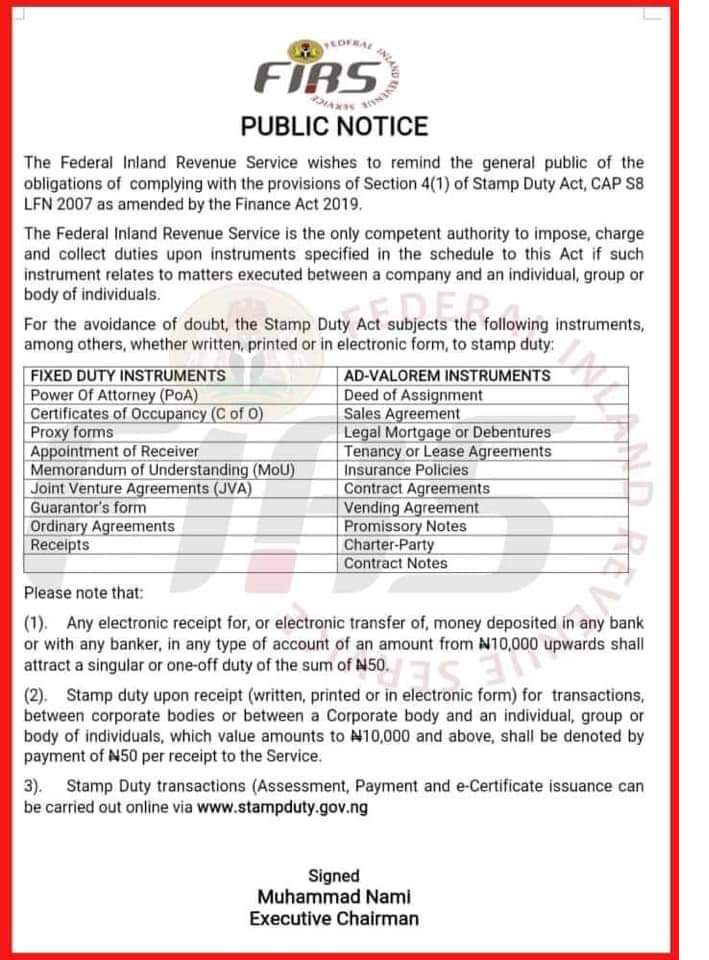
“Chargeable transactions under the Stamp Duties Act as amended in the Finance Act 2019 are in two categories – Fixed Duty Instruments and Ad-Valorem Instruments.

“The following are the chargeable transactions in the Fixed Duty Instruments category, Power of Attorney (PoA), Certificate of Occupancy (C of O), proxy form; Appointment of Receiver, Memorandum of Understanding (MoU), Joint Ventures Agreements (JVA), Guarantor’s form and Ordinary Agreement Receipts.

“While ad-Valorem Instruments chargeable under the Stamp Duties Act are Deed of Assignment, Sales Agreement, Legal Mortgage or Debentures, Tenancy or Lease Agreement, Insurance policies, Contract Agreements, Vending Agreement, Promissory Notes, Charter-Party and Contract Notes.

“Stamp duty is basically charged in two forms, either ad valorem where duty payable is a percentage of the consideration on an instrument or a fixed sum irrespective of the consideration on a dutiable instrument or document.”

Mr. Ahmad said it has become imperative that transactions related to the instruments contained in the statement bear Stamp Duty. He implored members of the public, on behalf of the Federal Inland Revenue Service, to ensure that any of the Instruments they give or receive in the course of their business or official transactions have the new FIRS Adhesive Stamp Duty affixed or stamped on them as sign of authentication.

This development is following some other moves made by the tax body since the outbreak of coronavirus to increase tax revenue for the federal government.

The FIRS said that the Stamp Duty has generated N66 billion in five months (January to May), which has been remitted into the federation account. N20 billion was generated from Money Deposit Banks (MDBs) while N7.90 billion came from stamping of instruments. The rest of the fund came from businesses across other sectors.

Mr. Nami had on Wednesday attributed the success of the tax revenue to the amended Financial Act 2019, and deployment of technology in administering the stamp duty obligations.

But all these are taking place when the International Monetary Fund (IMF) is warning Nigeria against imposing new tax measures, and urging her to relax her tax policies to reflect the current realities of COVID-19.

The IMF said Nigeria’s economy is expected to shrink to -5.4 percent and would need supportive fiscal policies right now to sustain the downturns induced by the pandemic.

“Our projection of -5.4 percent is contingent on inbuilt policy response and avoiding some of the challenges that were experienced when oil prices declined in 2016 causing GDP to be depressed for an extended period. Subject to a flexible and nimble policy response; we expect that there would be some recovery but this year would be a difficult one for the country,” the IMF said.

Many other countries have been waiving taxes for businesses as a measure to help them stay afloat. The new tax regime introduced by the FIRS would without doubt, increase the burden on businesses and households.

The FIRS Adhesive Stamp Duty is chargeable from payments made, which seems to exempt payers when it comes to rents and lease’s agreement. But it only offers payees the opportunity to increase cost in order to recover the money they would pay for stamp duty charge.

Consequently, there will be a surge in office-space and housing cost, additional burden on businesses and householders who are already striving through the strains of the pandemic.

OPay Meltdown: How Do You Overcome Policy Somersaults in Nigeria?

5

This is related to this article on OPay.

How do you overcome policy somersaults in Nigeria that continue to affect startups like OPay?

Learn from the super-rich in Nigeria and forget Harvard core competency and domain focus message. The 1% are parallel entrepreneurs with extremely diversified portfolios. One, who owns a bank in Lagos, has 27 companies in his holding empire. There is no government policy that will not benefit one of those 27 firms even as the policy affects others. At the end, the policy impact is neutralized, internally, and wealth is preserved.

No 1% complains of policy changes because those policies typically have cumulative  minimal material impacts on them; only the Harvard-style purists, following European and American models, cry. I know it is confusing when you see those many companies under one umbrella. There is a reason: hedging against Abuja.

I watched a modern day entrepreneur boosting how he is razor-focused, and how he would never enter into other areas, as is typical with many Nigerian business people. It was painful when a small change in the government policy knocked him out of the way. People built factories in Aba to serve southern Cameroon; then, one afternoon, that market was gone with border closure. People took loans to invest in Okada business in Lagos, you know the outcome.

Go to the ports, and see how many goods people have abandoned. Those products were on the sea when the government changed policies with NO notice. Nigeria is Naija, no be America or Germany if you permit me to go pidgin.

This is the message; if you can, pursue diversification early, through, at least, vertical integration.

OPay Other Businesses Fail

OPay Other Businesses Fail

8

OPay other businesses fail. It is a lesson for entrepreneurs in Nigeria: you cannot grow faster than the environment, in multiples. And most times, more money does not solve your problems. Nigeria cannot be growth-hacked in the way Beijing, London, New York and other areas can. Our gestation period to  profitability is legendary and one of the longest in the world. Uber may not make money in Nigeria for a decade. Bolt, the same. Jumia makes that evident. Andela offers a lab. Unless you have a strategy, tons of money makes no difference. (OPay touched nearly $200M venture funds.) I have watched rich people in Nigeria, they have one playbook: go slow, find a path to profitability, and stay the course. 

If you do those flashy things (yes, one million Facebook likes, top ten local ranking in Alexa, etc), you will burn. More so, as OPay goes into ecommerce, it needs to slow down and not try to grow faster than Nigeria: Nigeria is a slow-po country and no marketing gimmicks will change that. The hardest job in life is finding jobs for people where there are no jobs. The second is making sales to people who have no money!

“We can confirm that some of our businesses units including the ride-hailing services, ORide, OCar as well as our logistics services OExpress will be put on pause. This is largely due to the harsh business conditions which have affected many Nigerian companies, including ours, during this COVID-19 pandemic, the lockdown, and government ban.

“Globally, ride-sharing businesses have been heavily impacted by the pandemic. But several months ago, foreseeing this issue, OPay had already taken preemptive steps to restructure our business focus away from rides. It is worthy to note that this final restructuring has minimal impact on OPay as a whole business.

“It is important to clarify that ride-sharing had always been only one part, and not a major part of OPay’s diversified business in Nigeria. In fact, OPay had been investing more and seeing accelerated growth in its commitment to Nigeria’s financial and technology inclusion.

“During the pandemic, we have seen continued demand for our offline mobile money agency, and online digital payment, which remain the core of our business.

“From January to April 2020 for example, we witnessed a 44% growth of offline and online transaction value even in the midst of pandemic and lockdown. This is a testament to the high demand for flexible and easy financial services by Nigerians. OPay remains one of the most well-funded and profitable mobile money platforms in Nigeria, and we will continue to do more for our customers.

“Lastly, OPay will continue to invest in and grow in the eCommerce space, aligning its customer and eCommerce units which will continue to operate and grow. We believe a financial platform coupled with goods’ platform will form the future of Nigeria’s technology development.”

Comment on LinkedIn feed

Comment #1 I think the banning of commercial bikes in Lagos largely contributed to this aka Government Policy. A fast food restaurant owner told me that when Bikes where banned back in February, sales from Ofood plummeted as much as 60% even before the lockdown. I suspect this was a result of the fact many people used the app for Oride, then would be cross-sold on Ofood and the rest. Since no more ORide, less people on the app and so less people use other functionalities. Like they say, out of sight is out of mind!

My Response: It is part of the business – nothing is constant in Nigeria. No excuses. Ask those who invested in drones only for it to be “banned”. If Ariaria, Kano or Osogbo man or woman tells you the somersault they encounter, you will agree that banning bikes is not an excuse. I have a man whose 7 trucks got trapped. They went legally to Togo to send goods for a MNC but on their ways back, Nigeria banned entrance of trucks with no notice. Have you checked those who got license for processing rice what happened?

Comment #2: Sir but can you hedge against such policy somersaults? Was it really about sales and the environment not being ready or about a policy somersault? Could those vetted the idea have seen this as a distinct possibility such as to terminate the concept? When the external affects your entire value proposition in ways that it’s impossibly to predict then only lesson to be learned that an entrepreneur should have a witch’s eye. In 2000s, I recall the crises that occurred to many traders in the East when government introduced 100% duty inspection. Many could not afford duties imposed and I recall a few who over traded literally went under. But some survived so I get the point. The business model, positioning and organizational attributes have an impact in recovering from such somersaults.

I have been on a ideation phase of an idea and the work of idea to concept, concept to viability and sustainability is no joke. Serious environmental scanning and not over stating market opportunity/potential and cash flows are critical. Understanding costs structures also critical. Many lessons to learn on the journey

My Response: My principle is to model that Nigeria has only about 30 million “people”. That is a very pessimistic model. It gives me room to navigate. https://www.tekedia.com/the-precious-30-million-nigerians/ Another strategy is to become a parallel entrepreneur: be in many things and forget Harvard preaching of core competency and domain focus. If you visit one of the owners of a bank in Nigeria, his office has 27 companies with the bank as one. While we know these rich guys for their banks, they are super-diversified that one policy change will affect one business while benefiting another. There is no govt policy in Nigeria that will not help one of the firms and at the end, everything is neutralized and wealth is preserved.

OPay Suspends Ride-hailing and Logistics Businesses, Citing Harsh Government Policies

0

In a surprising announcement on Thursday, OPay said it’s suspending its ride-hailing and logistics businesses in Nigeria. According to the statement issued via the company’s social media page, the ORide, OCar as well as OExpress are affected by the decision.

The statement cited harsh business conditions including the ban on motorbike operation by the Lagos State government as the reasons for the decision, coupled with COVID-19 pandemic that has ushered in a new struggle for ride-hailing businesses around the world.

The company said it’s focusing on its mobile and digital financial units that have shown growth even amidst the economic strains that have crippled other segments of its businesses in Nigeria.

Read the full statement below.

“We can confirm that some of our businesses units including the ride-hailing services, ORide, OCar as well as our logistics services OExpress will be put on pause. This is largely due to the harsh business conditions which have affected many Nigerian companies, including ours, during this COVID-19 pandemic, the lockdown, and government ban.

“Globally, ride-sharing businesses have been heavily impacted by the pandemic. But several months ago, foreseeing this issue, OPay had already taken preemptive steps to restructure our business focus away from rides. It is worthy to note that this final restructuring has minimal impact on OPay as a whole business.

“It is important to clarify that ride-sharing had always been only one part, and not a major part of OPay’s diversified business in Nigeria. In fact, OPay had been investing more and seeing accelerated growth in its commitment to Nigeria’s financial and technology inclusion.

“During the pandemic, we have seen continued demand for our offline mobile money agency, and online digital payment, which remain the core of our business.

“From January to April 2020 for example, we witnessed a 44% growth of offline and online transaction value even in the midst of pandemic and lockdown. This is a testament to the high demand for flexible and easy financial services by Nigerians. OPay remains one of the most well-funded and profitable mobile money platforms in Nigeria, and we will continue to do more for our customers.

“Lastly, OPay will continue to invest in and grow in the eCommerce space, aligning its customer and eCommerce units which will continue to operate and grow. We believe a financial platform coupled with goods’ platform will form the future of Nigeria’s technology development.”

The sad realities of this development range from hundreds of people being furloughed to anti-foreign investment trajectory set by the government.

Experts believe that harsh business environment and insensitive business policies have been the reasons foreign direct investors have avoided Nigeria, and those who dared to try have tasted the bitter outcome.

OPay like many other businesses are victims of anti-business laws and an environment lacking business sustainable amenities.

Fortunately, the company has a lifeline. OPay said its fintech unit witnessed 44% growth in the first quarter of 2020, and it has been the mainstay of their business presence in Nigeria.

OPay has about 50,000 mobile money agents across states in Nigeria. It is hoped that the governments will not come up with further policies that will stifle its growth in fintech.