DD
MM
YYYY

PAGES

DD
MM
YYYY

spot_img

PAGES

Home Blog Page 6269

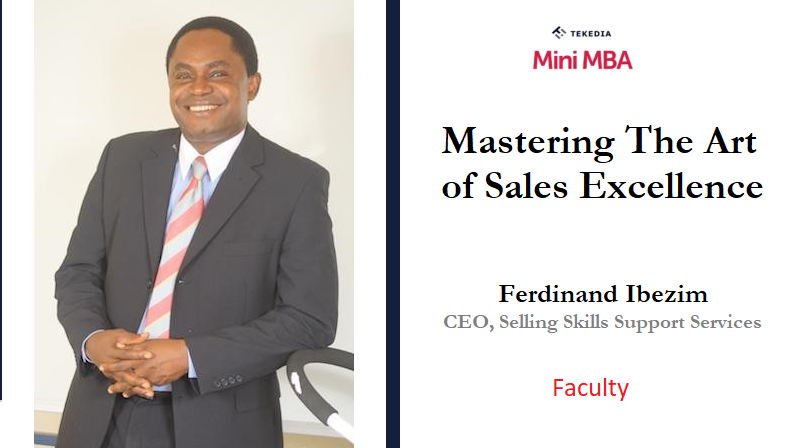
A Sales Leader Will Teach “Mastering The Art of Sales Excellence” In Tekedia Mini-MBA

0

He is a dean of mastering sales in Africa. He knows the mechanics and pillars of sales excellence. He has written about them and taught them in leading companies in Africa, and beyond. Banks know him, MNCs always have him, and startups follow his philosophy: build quality contacts, connect, and sell at scale. 

Lagos Business School brings him regularly to help its students acquire one of the most important capabilities in business: selling things! He wrote the book –  The Critical Pillars of Sales Excellence: How to Prospect, Sell and Win Customers.

Ferdinand Ibezim, a Tekedia Institute Faculty, will lead a session on Mastering The Art of Sales Excellence in Tekedia Mini-MBA. This is one of the most important elements of this program. Yes, we want our members to go out there and win. Simply, they must EXECUTE, and mastering how to sell is part of it.

Registration continues on Tekedia Mini-MBA; join us today and become a sales champion.


The Little Incremental Changes We Aren’t Wired For

0
business values

Events in my life and how my life has turned out taught me something. And that is to value the little incremental changes in my life. Those little-incremental changes compound over time if you have staying power.

When I entered University, I did not have a dream, goal or any of sort. For me, it was the next thing to do after secondary school.

But I encountered books and that changed the narrative for me.

The thing is I did not know about the changed narrative until like 5-years later. That was when I started seeing the effects of all the late-night reading, the little money spent on books, the times of borrowing books to read.

All compounded to make who I am today. And since I’m seeing results now, I am even more ready to make those little incremental changes towards a better me.

The message of Jesus in the Bible is profound. Jesus operated under the assumption that ignorance is bondage which indeed it is. That was why he said: “you will know the truth and the truth will set you free.”

For Jesus as well, any kind of knowledge is not enough, it has to be the knowledge of the truth. That alone can set free from the bondage of ignorance.

As the Bible admonishes, the truth (knowledge) is something you have to constantly search for. Without it, you remain in bondage and blind.

I like the words of Daniel when he said: “And I Daniel understood by books.” That understanding led to the beginning of liberation for the Israelite in the then Babylon that enslaved them.

Paul admonished Timothy to study and show himself approved as a workman that is not ashamed of his duty.

Paul himself was a well-read one. Standing before King Agrippa for judgment, he got what I called the best compliment ever given by a man to Paul. “Paul, Paul, much learning has made you mad,” said King Agrippa after listening to Paul dissect history.

The task ahead of every human is simple but I will not claim it is easy. Evolutionary biologist claims not much has changed from our DNA in thousands of years. The implication of that is that we still much think and respond to a stimulus like our ancestors.

The task ahead of each individual is to simply be a better version of themselves every day long.

Yet, because once we are of age, changes that we make to ourselves are less physical and more mental they seem to be difficult to notice. Difficult to notice translates to less desirable. Our DNA is not wired for such a process.

But we must commit to it. But we must attempt it. But we must do it.

When I look back and see the many people whose lives have become better because of what I do, I marvel. I also imagined what would their life look like if I wasn’t who I am becoming.

Imagine many people whose lives will be better because you are better as well.

Each of our life is a movie and in that movie, we are individually the hero.

My goal is to be part of that movie of yours. And while I can’t be the hero in your movie, I look to be the one who helped you realize how heroic you are.

If you aim to be a better version of yourself and invariably play a role in other people’s movies, the place of knowledge can’t be emphasized enough.

You see, while we were growing a lot of changes that happened to us is a divide between physical and mental. You learned to walk and speak & you grew teeth and bigger body. But that’s about it that matters.

After all that, what’s left for you is mental development. Because as an adult your physical growth won’t count much any longer. The world need value to come out of you.

My people perish for lack of knowledge” is another verse in the Bible that I like.

Developing mental capacity means you make better decisions, invariably, a better life. Bad decisions can lead to ruin.

Happiness comes from a lot of things, one of such is seeing that because of you someone didn’t give up. Because of you, someone won.

Again, the task ahead of you is simple, but I will never conclude nor assume it is easy. Your DNA wasn’t wired for such a task to be a free flow.

The task is to embrace little incremental changes in your life every day. Because such changes are mental, they are difficult to notice and may be discouraging. But understand that those changes compound. The beginning of compounding is always not interesting. Even so, the few who persevere and wait through will reap abundantly.

“The cowards never started, and the weak died along the way. That leaves us, ladies and gentlemen. Us.”

– Phil Knight

Us, my friend is all that’s left.

Let’s make a difference together while we still can.

I share my stories to help others.

I hope you have been helped?

Are Mobiles The Future Of The Gambling Industry?

0
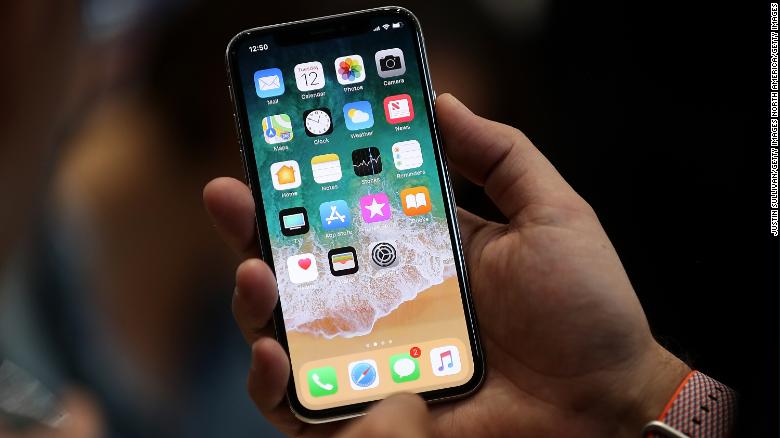
The crash in iPhone sales is changing Apple business model

Gambling hasn’t always been as accessible as it is now. It wasn’t that long ago when you still had to attend a betting shop or other gambling establishment to make a bet. However, the mid-1990s was when things really changed the gambling industry beyond recognition. If you’re interested in some of the best mobile slots then click to visit now.

Gambling is as old as time itself and forms of gambling have been discovered that date back to the earliest civilizations. In fact, it’s a safe bet to say that gambling will be around many years from now, even if it undergoes a ban by world governments. All this would do is push the entire business underground. 

However, for the time being, gambling is as mainstream, as it has ever been and it is a popular past time for thousands of people across the globe. There are many reasons for its appeal, from the added thrills that betting on sports offers, to the sheer fun associated with slots. The excitement of gambling is being experienced by a broader range of people than ever before.

As already mentioned, the mid-90s is a pivotal point in the history of gambling and 1996 is the year that the gambling industry will look back on with much fondness. During this year, the first online casino was introduced and it proved to be a great success. Businessmen and entrepreneurs around the world wanted a slice of internet gambling action. This led to more and more virtual gambling outlets opening.

Major betting brands saw how useful a tool the internet was becoming and started moving large parts of their operations online.

These virtual casinos continued to capture the public’s imagination and people flocked to these sites to have fun and hopefully win some money. With such high demand came a boom era in game design and software houses popped up in towns and cities. They employed fresh-faced digital artists who came loaded with creativity and ideas.

The flourishing industry started to create more intricate games known as video slots and these changed the face of gaming for the better. These new digital games had mass appeal and brought slots to a wider audience.

The new digital platform allowed game designers to produce more complex and rewarding bonus rounds and special features that were more immersive than ever before. In fact, all slots were much improved. Again these new games proved very popular and along with state of the art graphics and gameplay, they became the major draw of online casinos. 

No Going Back

The gambling industry hasn’t looked back since these seismic events occurred and the main reason for gambling hitting the mainstream, are simple. Access to gambling is easier than ever. Technology allows anyone and everyone to access gambling sites from all kinds of hardware, whether it’s a laptop, desktop or even a mobile device.

This allows people to gamble in an environment of their choosing and many prefer to do this at home anonymously. This improved accessibility has also appealed to females and they have taken to online casinos in a big way.

Gone are the days of a night out at the local bingo hall, these have been replaced by playing slots at home or on the move. The number of women choosing mobile gaming is steadily increasing and it is thought that women make up 39% of the slot playing statistics.

Slots are the other reason and they have become the number 1 draw at online casinos. They have always been popular ever since they were invented in 1895. However, today’s slots are on another level and offer a totally immersive experience that is on par with console gaming. Their unpredictability and simplicity are what makes them popular and they transfer well to mobile devices.

The Future Of Gaming

The popularity and technological advancements in mobile devices such as smartphones, now mean that most people own such a device. Since the gambling industry always has one eye on the tech world, as it is vital to their future, mobile casinos were an inevitable invention.

The growth of those accessing mobile casinos through smartphones has led to 15% of last year’s gambling industry revenue being attributed to mobile gaming. Some virtual casinos have more mobile players than desktop ones.

These kinds of statistics are continuing to increase because we literally use our phones for everything these days. Whether it’s to browse the net, keep in touch with friends, or to organize our days and remind us of appointments, our lives are revolving around these devices.

Our gambling habits are going down a similar path too and most casinos have responded by offering mobile casinos and casino apps. These allow you to play games on smartphones that resemble the same quality that you would experience on a laptop or desktop. Furthermore, they offer the player more privacy, as these small devices are easy to take with you in any room of the house or even outside.

They offer gaming that can help break the monotony of the daily commute. If there is public Wi-Fi then you can play your favourite games whilst waiting for a bus or sitting on a train.

Multiplayer gaming is on the rise through mobile devices and you can now be competitive and play live Poker and Blackjack with groups of people and this brings a social element back into hi-tech gaming. 

Final Thoughts

The convenience of mobile gaming is a big winner with punters and so is the privacy that this offers. The fact that you are not stuck at a desk indoors is another huge positive. The games also play as well as they do on desktops without any loss in graphics.

Phones are also getting better all the time and now resemble mini computers with HD displays and bigger screens. Add better, faster and more reliable networks such as 5G into the equation and the future of gambling could very much be one, ruled by mobile casinos that are being accessed on mobile devices.

Fintech’s Value Proposition

2

This is not for the Faint of Heart

One of my Favorite Bible stories occurs in Ancient day Ephesus in the book of the Acts of the Apostles. It goes like this; A couple of Workmen, led by a guy called Demetrius who was a Silver Smith gather together to discuss about Paul the Apostle. The Major bone of contention is simple; These men are workmen and Craftsmen whose major source of income comes from making idols for the temple of Diana their god. But Paul is preaching a Gospel about a “New” God, who unlike all the other gods, doesn’t necessarily need a physical temple to be worshiped in, or an idol to pay obeisance to. This is the major source of contention. It’s not like these guys were really spiritual guys or anything, I mean if the God Paul preached about needed to be worshiped with an idol, there would have been no cause for alarm, they’d just send Paul a Cold pitch, with their tenders for new contracts, so they can build idols for this “New” God, and forget about Diana, because let’s face it, change is inevitable right?.

Either way, the main part of this story I want to highlight is in verse 32 of that Chapter 19, after Demetrius successfully stages a riot in the city, because let’s face it, saving his business from disruption is enough reason to riot against anybody and break anybody’s head. It says; some people were shouting one thing, and others shouting another, and majority of the people at the scene of the riot didn’t even know why they were there. I strongly believe this is the condition of Fintech today.

Fintech has become one of the hottest part of the startup ecosystem to invest in. A good number of funding rounds find their way into the hands of Fintech Startups solving problems that have to do with finance and the like. And since almost everyone is drawn to where the money is, a good number of the Fintech startups being founded today have little or no value proposition. In other words, a good number of the Fintech Startups founded today have little or no use. Let me not sugar coat this with grammar, let me be as clear as possible takes deep breath a good number of the Fintech startups founded today are completely useless. Everybody and every company wants to have a Fintech App, or a Fintech side of their business, My bank has taken note, my network provider has one, my phone manufacturer has one, and almost every Dick and Harry who has some tech experience ends up building one themselves, calls themselves the future of Fintech, and talks about how their new app can solve all my finance problems (you’d be thinking they intend to transfer money to my bank account when I download the app).

It’s almost like everyone came to the party, but we don’t know whose Birthday it is.

 What really is Fintech’s Value Proposition?

At the heart of any meaningful Fintech company whether those founded as in house parts of a larger organization, or those founded by external individuals, should be Simplicity and Inclusiveness.

 Simplicity

Simplicity is simply making things simple (English is a funny language).

Too many things about finance today are complex. Take investing for instance, before the rise of Startups and companies like RobinHood, buying shares and investing in the stock market was a hell of work, and would cost you money too. RobinHood made it simple, and with no commissions or fee charged for transactions, they’ve made it attractive for even millennials to take advantage of.

Owning stock in Google, Facebook and Apple has never been easier.

Loan oriented Fintech companies, especially in Nigeria have delivered on this Value Proposition. As a private individual in Nigeria, borrowing money from the bank in Nigeria used to be harder than learning to fly a Boeing 747 Overnight. Blindfolded. When your bank begins to list out the requirements for taking a loan, you’ll think you’re marrying an Igbo girl (no offense to the Igbo’s, I love them), or a Native doctor is giving you the list of things he’ll need for money rituals. Until some of these banks start asking for your Birth Certificate and your Health records to verify your real age, and make sure you don’t die halfway before the loan is fully paid. Not that they care about you or anything, they just don’t want their “Act of Benevolence” to turn into a bad debt.

Simplicity is key, making things easy is of Paramount importance.

 Inclusiveness

A good number of Fintech companies today are not inclusive. Their Value Proposition is in helping people do funny things like; transfer money, pay bills and buy airtime. They’re targeting people like me, people that have money in their account and that do money transfer. They forget that a good number of transactions in Nigeria go on in the informal sector where cash is king, where people buy recharge cards and scratch it with their key to reveal the code underneath (I still do this), where people pay their bills in raw cash, and where Mama Ufouma has refused to collect transfer because she “doesn’t like all this bank people and their wahala” (wahala means trouble).

According to the National Bureau of Statistics (NBS), 40% of Nigerians live below the poverty line. And a good number of Nigerians work in the informal sector where cash is still king.

Fintech companies should endeavor to make things both simple and inclusive.

Helping people transfer money doesn’t come across to me as a strong Value Proposition because your bank app does that well in most cases. And also the process of moving the money from your bank account to your Fintech account is like buying Jollof rice from Chicken republic (fast food joint), and driving down to Tantalizer (another fast food joint) to eat it there. Why don’t you just eat it at Chicken republic where you bought it?. Why don’t you just transfer the money from your Bank account where the money was paid into?.

The only Nigerian Fintech app I use is Barter by Flutterwave. The Value Proposition for me is very clear, I am given the opportunity to access Dollar cards that allow me to make transactions on platforms like Facebook, Amazon, Netflix e.t.c. keeping money in my Barter account, and maybe using my balance to pay for airtime or run a transfer makes perfect sense since my bank doesn’t solve that problem for me. If for any reason barter were to remove that feature, I really do not see the reason I would stay around any longer (In other words, I will delete the app, or at least freeze it).

Oh, and those companies that claim to help you monitor your spending online are being funny and non-inclusive too. How many people in Nigeria really run all their transactions online? How many people run on even 50% without cash in a week?, very few.

I once wanted to pay an Artisan that worked for us, so I asked for his Account details to do a transfer, he told me his account was…..wait for it…. Dormant, his account had been dormant for I think 6 months if I’m not mistaken. This is a grown man who walks around, and is able to feed his family, and he doesn’t have a working bank account. The women he buys vegetables or meat from in the market do not collect bank transfer, they want raw hard cash.

Mpesa from Kenya has a nice model that is worth emulating when you talk of being inclusive.

 One area that Fintech can work on becoming more inclusive is in Insurance.

I asked someone some days back if she had any kind of insurance. The lady in question is a business woman of some sort; Property Agent, owns a School, has employees that supply bread, and is working on establishing a Bakery.

Her answer was No.

In Nigeria, if you own an iPhone, you’re either a Yahoo boy (as law enforcement have been made to believe), or well-to-do to some extent. If you drive a Rolls-Royce, it’s safe to say when the Government was sharing palliatives to help people during the lockdown, you weren’t among those trying to get some.

Owning Insurance in Nigeria is a wealth symbol of some sorts. If you own insurance in Nigeria, not just health insurance, you either work for a good company, or you run a business that has some good intrinsic value.

According to statistics, 1.5% of Nigerians are properly covered by insurance.

Panama is a Central American country that acts as a tax haven of some sort. With a population of around 4 million people, there are more people living in Panama than those that have insurance in Nigeria.

It’s not too difficult from a top-level perspective to conclude why people don’t have insurance in Nigeria. I mean, instead of paying #20,000 Naira a month on Insurance Premiums monthly, #250 naira will buy you a bottle of Anointing oil that you can use to draw a cross on your car every morning that will last you for at least 2 to 3 months, comparing #250 naira to #20,000 is a long shot if you ask me.

If you asked the average Nigerian “what would you do if your car were to just blow up?” He will reject it, some will go as far as saying it is your own car that will blow up.

Designing For Insurance Tech.

Applying the Principles of Design can help birth the next generation of Insurance Tech companies. This is how Design can help:

Empathy

At the heart of Design, and the design thinking process is empathy, developing a deep understanding of your users and their context of use.

There’s a reason people don’t use insurance. It’s easy to say they just can’t afford it, but if there’s one thing I’ve learnt as a designer, is that asking the right questions and going deeper and below the surface can unearth massive insights that were unknown before, and can help in developing a product that really solves the pain point of your users, and that has a meaningful Value Proposition. Asking the right questions, sitting down with your potential users, observing them, and trying to understand their point of view and context will open you up to new insights on how to design a value Proposition around an effective insurance product that your users will find meaningful.

Empathy is about sitting down to understand your users, walking in their shoes, and seeing from their perspective.

Define the Problem

When you have gotten the insights from the empathy stage of the design thinking process, the next phase is to really define the problem you’re trying to solve. A vague problem statement doesn’t cut it, and will only add more ambiguity to your work, and reduce your chances of designing a feasible solution. From the insights gotten, you can deduce who your real users are (you do not design Lego bricks for Adults, or BMW’s for 14 year olds), what their pain points really are, what a solution should look like to them, what they can afford, and what they aspire to (Experience Design), all these insights will form a valuable problem definition statement that will give your team direction, and clarity on the problem that needs to be solved.

Ideation

My favorite part of the design process is ideation, unlike other fields where senior management may just look at data and make decisions based on what they THINK is the right direction to go, design employs a multidisciplinary approach where people from every part of the business are represented, give their opinions, and supply ideas to solve the Problem that has already been defined. Ideation could include people from Marketing, Engineering, Design, Customer success, Senior Leadership, and even Sales, all these different functions of the organization bring their expertise together to birth various ideas which are then streamlined to the most plausible ones to move to the next stage. Design determines Desirability, Engineering determines Feasibility, and the Business side determines Viability.

Prototyping and Testing.

After streamlining your ideas, prototypes are made of these ideas and put into the hands of real users to test their reactions to these products. In the Empathy stage, users may have said things they didn’t mean (trust me, this happens a lot), but when a prototype is in their hands, they tend to be a lot more honest in their reactions, and this can help you verify what part of your product needs to be tweaked, and which needs to be left the way it is. The Prototyping and Testing phase is essentially a learning phase where you get to learn and gather deeper insights about your users that you will likely use to redesign your product. Prototyping is the foundational idea behind the MVP (Minimum Viable Product) concept, the simplest form of your product that solves the most basic needs of your users, that can be iterated upon.

Iteration

The final step (there really isn’t a final step, design is forever iterative), of the Design process is the iteration phase. This is where we take the insights we have gleaned from the Prototyping and Testing Phase and check if they align with our previous assumptions, and the insights we gained during the Empathy phase. If they align, we carry on with the process, if they don’t, we go back to the phase of the process where the misalignment occurred and redo it with the new insights we have gained. This could mean performing new empathy tests, redefining your problem, or even picking some other ideas that were generated during the ideation phase.

Honorary Mentions.

Understanding The Jobs to be Done Theory.

Understanding that People do not just buy products, and that there is an underlying purpose behind every product is key to understanding the Jobs to be done theory. The Jobs to be Done theory postulates that people do not just buy products, but they buy the “Job” they believe the product can perform. That “Job” is wrapped inside the Product itself, and is exactly what people buy a product for. Do you pay for Cable TV Subscriptions, or you’re paying for entertainment?, do you buy a car, or you buy mobility and comfort?. That underlying purpose is the “Job to be done” of your product, and that is what your users, “Hire” your product for.

Having a clear understanding of what the “Job” your product performs is key to designing an efficient product that remains effective in the marketplace.

We all Loved the BlackBerry, but we “Sacked” her when the iPhone began to Perform her “Job” a lot better.

 Conclusion

Fintech is more than just helping people to send money, or do basic things that Bank apps already perform effectively, but creating products that win on Simplicity and Inclusivity.

The Opportunities laden in the InsurTech Space (I think this is what they call it) can be effectively unlocked by applying the principles of Human Centered Design and the Design thinking process.

Nigeria’s 774,000 Jobs and Matters Arising

0

In October 2019, the federal government approved a Pilot Special Public Works Programme in the rural areas of the country. The programme which is designed to provide 774,000 jobs across the federation was domiciled in the National Directorate of Employment (NDE) for implementation.

The main purpose of the pilot initiative is to alleviate the increasing cases of unemployment through the creation of grass-root jobs.

Originally, the scheme was meant to be “a dry season/off season transient job programme and was designed for the rehabilitation/maintenance of public and social infrastructure.”

But then, it’s exclusive to five local government areas of eight states selected from the geo-political zones of the federation. It includes menial jobs like digging and clearing the drainage, rural feeder road maintenance, irrigation canals clearance, among others.

As the year 2020 ushered in with COVID-19 and its economic turmoil, the federal government made a decision to extend the programme beyond five states to the 36 states of the federation. Therefore, on April 6, the Finance Minister, Mrs. Zainab Ahmed announced the approval for the extension of the scheme to all the 36 states and the Federal Capital Territory (FCT), for a three-month period that will last from October to December 2020.

The main objective has been to employ as much as 774,000 Nigerians, 1,000 persons in each local government area, and thereby mitigate the toll of the COVID-19 pandemic on the people as they would be paid N20,000 stipend at the end of every month.

It therefore beckoned on the Minister of State for Labor and Employment, Festus Keyamo, to facilitate modalities that will ensure the success of the programme.

In April, Keyamo inaugurated a Special Inter-ministerial Committee on the Extended Special Public Works. The committee made up of CAN, NSCIA, NURTW, market women, CSOS, youth organizations, traditional rulers etc. will help with the recruitment of those who will work under the programme.

There is N52 billion allocated for the programme, and as the time for the implementation closes in, the National Assembly wanted to know how the programme will be implemented. In June 30, the joint Committee on Labor of both the Senate and the House had a rowdy session with Keyamo, who had been invited to explain how the Special Public Works Programme will be implemented.

Keyamo left the meeting abruptly, accusing the lawmakers of trying to control the program.

“…there was a misunderstanding between us when they questioned why I did not privately submit the program to them for vetting before taking certain steps. They suggested that they ought to have an input on how the programme should be implemented. In other words, they sought to control the programme as to who gets what, where and how,” he said.

The National Assembly is believed to always interfere with job opportunities coming from the federal government. The president of the senate, Ahmed Lawan and others has been accused of securing some job slots for himself from the Ministry of Humanitarian Affairs as well as from other job schemes by the federal government.

“Legislators taking 116,000 of 774,000 available jobs is only the tip of the iceberg. They are greedy and take everything including contracts, budget allocations, university admissions. Nigeria does not exist for them alone,” Jibrin Ibrahim wrote on Twitter.

According to Keyamo, the Joint Committee had asked that the session be held in private. His refusal to yield to their demand resulted in the quarrel. Keyamo protested that “their powers to expose corruption provided for in section 88 of the constitution cannot be exercised in private.”

It was a standoff that the Joint Committee found insulting that they asked the Minister to leave and suspended the work until they decide how the programme should be run and who should be in the committee. A decision Keyamo said “is tantamount to challenging the powers of the president,” and for that reason, will not be obeyed.

“I regret to say that their powers under section 88 of the 1999 constitution is only limited to investigations, but not give directive to the executive,” he said.

In defiance, the minister asked members of the work committees he previously set up to proceed with their work not minding the National Assembly’s directive.

“I therefore, respectfully further direct all the committees set up nationwide made up of CAN, NSCIA, NURTW, market women, CSOS, youth organizations, respected traditional rulers, etc. to proceed with their work unhindered. Only Mr. President can stop their work,” Keyamo said.

Many Nigerians have thrown their weight behind the Minister as he resists being armstronged by the lawmakers.

“It will be a crying shame if the national assembly sabotage the creation of jobs for Nigerians at this difficult time. They are elected to represent Nigerians not their personal interest. Yes to oversight over Keyamo but no to hijacking the process to use it for patronage,” Kadaria Ahmed tweeted in support of Keyamo.

In solidarity to Keyamo, President Buhari also warned political appointees and other government officials that it is antithetical to use their positions to bestow undue advantage on anyone seeking government jobs and favors.

But while there has been enormous support for the embattled Minister, Nigerians have also find fault with the committees set up by the labor ministry. The committees set up by the Ministry of State for Labor and Employment had approved organizations like the National Union of Road Transport Workers (NURTW) and market women to be part of the committees that will see to the recruitment of the 774,000 workers.

In states like Lagos, these organizations are being run by the ruling All Progressive Congress (APC). The state’s chapter of NURTW is headed by the party’s notorious thug, Musiliu Akinsanya, popularly known as MC Oluomo, and the market women in Lagos State is being led by the daughter of the national leader of APC, Bola Ahmed Tinubu.

The outcry from Nigerians is that the situation is jumping from frying pan to fire. It is believed that while Keyamo seems to have defied politicians who attempted to hijack the jobs, he has inadvertently given the opportunity to more ravenous folks.

The jobs are meager and in a country where millions of people are out of work, 774,000 jobs are insignificant. There are limited slots compared to people who need them, and considering those who have been placed in position to recruit the workers, particularly in a state like Lagos, it is believed that the racketeering will be heinous.