DD
MM
YYYY

PAGES

DD
MM
YYYY

spot_img

PAGES

Home Blog Page 6276

Nigerians Are Losing Interest in COVID-19 Containment and Management

0

There is no doubt that the recent increase in the number of COVID-19 cases in some states has placed Nigeria as one of the top countries in Africa with the high rise of the pandemic. On several occasions, the Federal Government through the Presidential Task Force on the disease hinted that Nigerians and residents need to follow specific measures for the containment of the virus. The Nigeria Centre for Disease Control has also been sensitising the public about the severity of the virus.

In all, we have seen a number of positive and negative outcomes. While the measures are being implemented by people and businesses, we have seen how the cases reduced and recoveries picked up. This has been attributed to collective efforts exhibited by the concerned stakeholders. However, our analysis has indicated that a number of Nigerians are losing interest in total containment of the virus.

The weakening interest has been fueled with the yesterday (June 29, 2020) announcement of reopening of secondary schools across the country for some categories of students [see Exhibit 2]. This decision has been lauded and being criticised by stakeholders. People and businesses that aligned with the reopening of the schools want economy to return to its normal activities. Some believe that reopening schools would put students in danger and increase the spread of the disease.

“That means all these figures of infected person’s NCDC is brandishing every night is not real. How can we have a daily increase of covid-19 and FG is opening up everywhere,” one of Nigerians who reacted to the story, revealing government’s decision, said.

From the citizen’s position, our analyst notes that concerned stakeholders, especially the NCDC and Presidential Task Force on COVID-19 need to redouble their efforts on behavioural change programmes. This has become imperative when one looks at percent of interest reduction in people’s knowledge and information seeking about the virus within 24 hours of announcing reopening of schools and consideration of precision lockdown in 18 local government areas considered as epicentres of the disease since February, 2020 [see Exhibit 2 and 3].

Exhibit 1: Nigeria in Comparison with the World
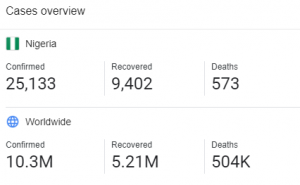
Source: Wikipedia, 2020

Exhibit 2: Spikes in Lockdown, Covid-19 and School within 24 Hours
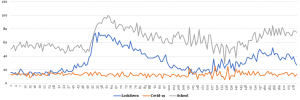
Source: Google Trends, 2020; Infoprations Analysis, 2020

Exhibit 3: Rising and Declining Interest in Lockdown within 24 Hours
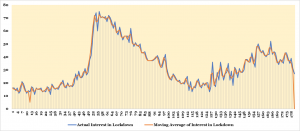
Source: Google Trends, 2020; Infoprations Analysis, 2020

Nigeria, “this is not the time to be aggressively introducing new tax measures” – IMF

2

I said it yesterday: Nigeria needs to spend more efforts on Growth-innovation than Tax-innovation. It is unfortunate to have a dedicated website for stamp duty collection (paying for stamps for electronic transactions) when people continue to spend months to get Certificate of Occupancy on lands. Today, the IMF has joined the chorus, making it clear that Nigeria is making a mistake on the “aggressive” tax policy: “This is not the time to be aggressively introducing new tax measures”.

The International Monetary Fund (IMF) has urged the Nigerian government to exercise caution in its aggressive tax drive due to the impact of the COVID-19 on businesses and households in the country….

“It will be very important to have very nimble policy response to ensure that the hit to the economy is not compounded by policy challenges.

“This is not the time to be aggressively introducing new tax measures but there is a long-standing challenge on the fiscal side of needing to have sufficient resources generated by the government from non-oil sources to provide investments in health, education, and infrastructure. So, there is that long-term agenda that needs to be addressed. Right now, fiscal policy can be supportive and needs to be supportive.

Of course, the IMF does not need to tell us that; we ought to know that. It is offensive when we focus on tools to extract fees instead of making business processes easier. This is not to say that we do not need to improve our tax system. My point is that we need to innovate on business processes that would grow the economy. If Nigeria has put the energies and efforts we have put in automating tax processes on electricity, we will have 24/7 electricity by now. The most advanced process in the Nigerian private-public daily (formalized) business contact is tax: they now issue tax clearance via emails. But check every other thing: broken system!

Nigeria’s Electricity Loop and Darkness of a Nation

1

It seems easy on paper: privatize the electricity authority (NEPA) which belonged to the commonwealth and give it to private companies to operate. If you do that, the companies will improve efficiency and provide 24/7 electricity to companies and citizens. Unfortunately, that has not happened. Sure, we can blame the electricity companies. But if you look deeper, things are not that easy. Just like in water rates which have not been increased since 1997, in some states in Nigeria, electricity rates in Nigeria are out of sync with inflation, currency devaluation and every element of market systems. Simply, to serve the citizens at the current rates would be charity for distribution companies (Discos). Of course, they would not – and the government has been coming onboard, helping to fix  many broken elements.

The problem is this: when the government transferred the assets from NEPA to the new companies, it had expected that it could relax while the new private firms provide power. But with all the paralyses, the government has been looped into the mess and has been spending like before, mass producing darkness at scale.

This season was supposed to help break that loop, through a planned increase in electricity tariff. Easier said than done. You know what? That has been frozen because Nigeria is not ready for any hike. Blame Covid-19. Blame our attitude. As usual, the new rates will come next year, and next year will become one after next, and we will continue to suspend hard decisions. I get it: provide us Harvard-level education (our rights) but we can only pay $400 even when you know that Harvard costs an excess of $55,,000 per session

Electricity distribution companies in Nigeria (DisCos) have agreed to suspend the planned increase in electricity tariff after a meeting with the National Assembly leadership, an official has said.

The DisCos reportedly agreed to suspend the increase till the first quarter of next year while the leadership of the National Assembly has promised to meet with President Muhammadu Buhari on the issue.

[…]

“The agreement here is that there is not going to be any increase in the tariffs on July 1st. The Speaker and I, we are going to take appropriate action and meet with the president.

“We are in agreement here that there is no question on the justification of the increase but the time is simply not right and appropriate measures need to be put in place. So between now and the first quarter of next year, our task will be to work together with you to ensure that we put those blocks in place to support the eventual increase in tariffs,” Mr Lawan was quoted as saying.

While he noted that the planned increase in the tariff was of concern to the lawmakers, he said the government has been doing a lot as part of its obligations to provide some form of intervention.

Of course, I get it: do not increase rates until you can give me 24/7 electricity. Unfortunately, no one can give you that until you pay. The only workable option has been: allow me to increase rates, and I will have better margin to invest to provide you better services. As it stands now, no investor will invest in Discos because their numbers do not make sense at the current electricity rates. As that happens, be sure of darkness. In my office in Owerri, we use two generators -and the national grid is our second backup!

A Global Expert To Speak During Tekedia Career Week

0

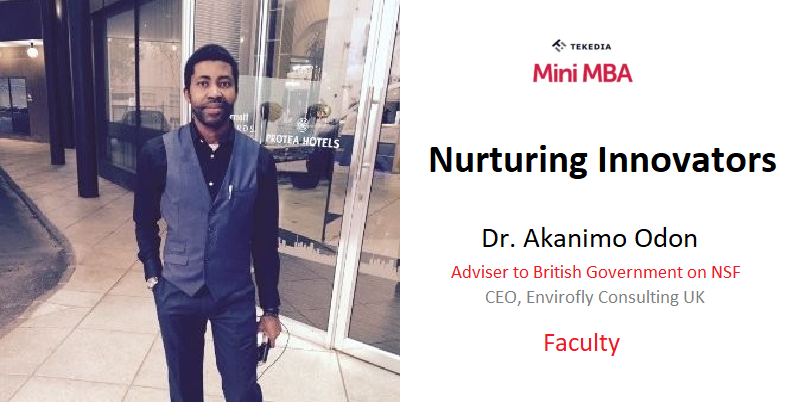
He has been an Adviser to the British Government on developing international education policies under the National Student Forum, On-call Education Partnership Consultant for British Council, and Business Development Consultant for the Grow Creative Scheme under the European Regional Development Fund (ERDF). He is a business consultant with deep experiences on education, manpower development.

Dr. Akanimo Odon, a Tekedia Mini-MBA Faculty, will present during Tekedia Career Week which comes Nov 2-6, 2020. With a sub-theme Nurturing Innovators, Dr Odon will examine how we can plan our careers and build resilience during this age of disruption. Yes, as technology changes the rules of markets and post-covid-19 becoming the new normal, we need insights on how to run that personal career playbook. The Week is not about helping our members to find jobs. Rather, we hope the insights would help them have great careers.

Everyone has a career aspiration: I have been working on joining a Board of a public company. Unfortunately, two insurers which presented opportunities did not pass my tests. So, I am still working on that – and will get there. Join us on this journey.

Tekedia Career Week “Nurturing Innovators” Will Hold Nov 2-6 2020

Understand the Ecommerce Sector in Africa

0

Next week in our program , we will focus on “Business Model & Transformation”.  I begin with “Modern Business Models and Growth”, looking at Aggregation Construct, Double Play, etc while Omowunmi Adenuga-Taiwo examines “Effective Organizational Change Management”. So, as technology and markets drive organization changes, triggering potential new business models, Omowunmi helps us on protocols to ensure that CHANGE is done effectively. Every business needs to attend her class – it is a beauty of what has to happen during this post-pandemic era.

Then, Femi Aiki, CEO of digital grocery startup, Foodlocker, did a masterpiece in his 90-minute video, using ecommerce as a case study. Yes, he explains a sector-transformation in action. Femi ran balance sheets, growth drivers and dropped his outlooks.

Experience positive CHANGE at Tekedia Institute.