DD
MM
YYYY

PAGES

DD
MM
YYYY

spot_img

PAGES

Home Blog Page 6286

Tekedia Mini-MBA Partners Startup Arewa To Develop 10,000 Innovators of Tomorrow

1

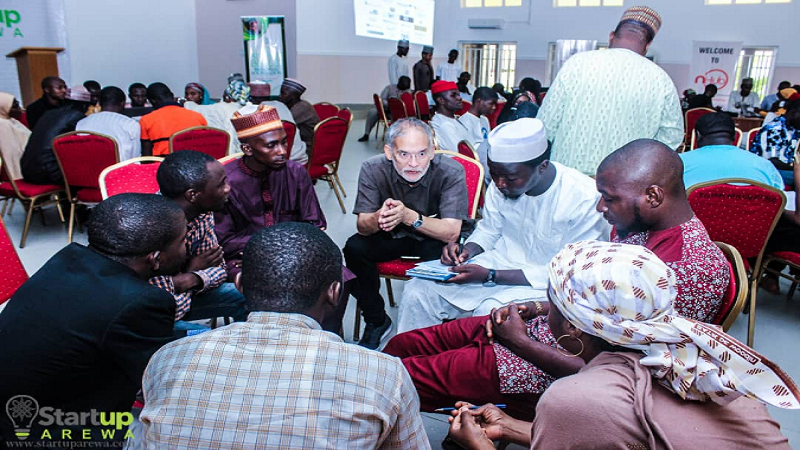
Tekedia Institute has entered a partnership with StartUp Arewa, the largest business development ecosystem in northern Nigeria, to train, develop and prepare 10,000 professionals, innovators, founders and entrepreneurs on management and leadership.  The Institute looks to the promise of working with MOHAMMED IBRAHIM JEGA, Founder of Startup Arewa, to accelerate economic development and advance the wellbeing of the citizens through entrepreneurial capitalism.  As a result of this partnership,  the Institute will share a public statement on June 29.


Press release on below.

Startup Arewa and Tekedia Institute today announced a new global partnership to provide quality business management skills to innovators, professionals, business owners and entrepreneurs in the northern part of Nigeria. The goal is to prepare the innovators and equip them for opportunities in changing markets.

This is a sustained partnership to train, empower and develop 10,000 people with cutting edge management skills of the 21st century over the next two years.

Tekedia Institute offers an innovation management 4-month program, optimized for business execution and growth, with digital operational overlay. It runs 100% online. The theme is Innovation, Growth & Digital Execution – Techniques for Building Category-King Companies. All contents are self-paced, recorded and archived which means participants do not have to be at any scheduled time to consume contents.

The training comprises videos, flash cases, written materials and webinars delivered online. A certificate is issued to participants by Tekedia Institute USA at the completion of the program.

Startup Arewa is a non-profit organization established to empower and promote Northern Nigerian tech startups and have been at the forefront of driving Northern tech innovation ecosystem since 2016, with a well-structured mentorship plan to mentor the start-ups and also provide financial support through networks of angel investors funding program by giving out grants, non–interest loans and equity investment to start-ups.

The collaboration will help reach young people across the Startup Arewa ecosystem and members will be given support to participate in the Tekedia Mini – MBA.

Prof Ndubuisi Ekekwe, the Lead Faculty of Tekedia Mini-MBA said, “At Tekedia Institute, we are pioneering a new way of developing manpower of the 21st century. Participants from at least 30 countries are joining us in our next edition. Working with Startup Arewa, we will help young people accelerate their leadership and management capabilities towards building stronger entrepreneurial systems, to advance our nation, and improve the wellbeing of the citizens”.

Responding, the Founder of Startup Arewa, Mohammed Jega, said, “Startup Arewa is building an ecosystem of innovators through structured mentoring and skills development. Our partnership with Tekedia Institute will further deepen our mission to serve the innovators and makers of the future”.


Meanwhile, to register for Tekedia Mini-MBA, click here https://www.tekedia.com/programs/

WIN Your Future, Have Victory Over Time

1

The biggest victory in life is victory over your time. If you master your time, you will win your future. Greatness has been achieved not because of special talent but rather via total dedication, perseverance and commitment through mastering of time. A man/woman who cannot manage his/her seconds will wander through the boundless of time. Yes, in that limitless time is something evidently scarce. In that ageless time is the most aged factor which when lost cannot be easily recovered. Have Victory over your time, and you will thrive.

Tenacity is critical because without it, any mission could be lost. In business, I have come to understand that one of the most important skills is the capacity to do the best possible job at the shortest time possible on something with the highest impact. Yes, everything must be bounded by time because without that time consciousness you will not make progress. The world will not wait for you – you have to fit into the world as defined by 24 hours in a day.

Have a process and see how that process aligns with your goals in life. Students, look carefully, the bests in your classes are not necessarily the smartest but those smart enough to manage their clocks. Because the world is bounded by time, defined within 24 hours a day, companies and schools look for those “bests” as they have overcome by managing time. The best companies, the best universities, and the best leaders want them because if they continue on those paths, they will add values.

But managing time does not mean spending lesser time on something; it’s simply knowing what to spend time on, to advance that mission. Do not be like the lifeless feather which when tossed into the stream wanders wherever the stream current moves it. Be like the dragonfly which even though enjoying the mild current defines its path.

All paths of careers are defined by the ability to manage time. A man who is overwhelmed by the limitation of the unbounded time quits. Yes, “I have decided to settle for C because I cannot cover all that would help me compete for A”. Do not show any pity: he wasted his time and the rationalization for poor grade cannot change the state of his records, for life! Do that many times, the person will turn a failure in everything.

Sometimes, poor grades could be due to misalignments: you applied for course A, you ended up with Course B because you just wanted to matriculate for college education. But we also have extremely lazy students who made bad choices: sleeping when others were studying. Not fixing those attitudes would result to future life failures.

Boss your time or it will box you!

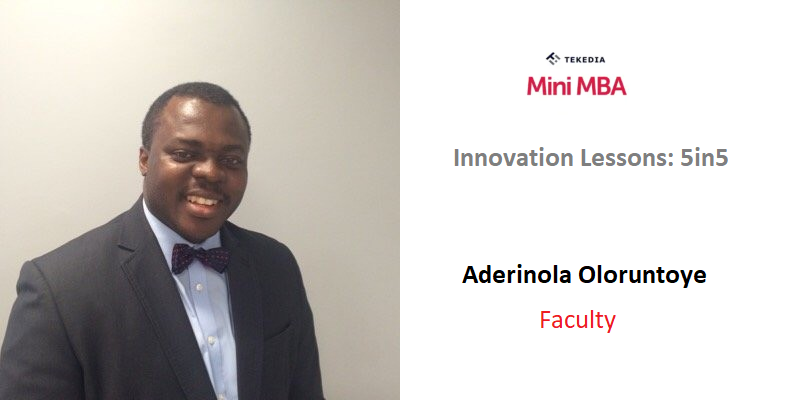
An Innovation Dean To Handle Tekedia Mini-MBA’s Lessons 5in5

0

He led the Digital Transformation & Innovation business of SAP West Africa, anchoring the strategic definition, documentation and co-execution of digital transformation initiatives for telecommunication and banking industries. He is in the faculty of Workforce Group, coordinating the digital and innovation components.

He graduated from the University of Ilorin with a degree in mechanical engineering and holds micromasters from Boston University and Rochester Institute of Technology.

Aderinola Oloruntoye will lead a very important aspect of our program, showcasing global innovation lessons. The Innovation Lessons 5in5 examines innovation lessons in five companies in five different sectors. The 2+ hours of videos he produced are documentaries of global innovation systems with flash cases from USA, Turkey, Swaziland (hello Eswatini), Pakistan, and more.

Join us for an excursion into global innovation systems. at Tekedia Mini-MBA. 

Facebook, Google Donate $200m and $175m Respectively in Support of Racial Justice

0

Facebook’s founder and CEO Mark Zuckerberg announced on Thursday that the social media giant is committing $200 million to support black businesses and organizations.

“We’ve been speaking with Black business owners to understand how we can best support them, and in the short term, we’ve heard that financial support can go a long way, especially during a pandemic and economic downturn that have disproportionately impacted communities of color,” Zuckerberg said.

Facebook has come under severe criticism for refusing to take down Donald Trump’s post encouraging shooting of protesters of racial injustice in the United States. Though Zuckerberg repeatedly tried to explain that the post didn’t violate any Facebook policy, it didn’t quell the backlash. Many are beginning to see the social media platform as pro right-wing, an identity Zuckerberg doesn’t want to reckon with, and he is trying desperately to right the seeming wrong.

On Wednesday, Facebook removed some ads featuring a large inverted red triangle associated with the Nazis. Trump and the pro right-wing have used the symbol in the smear campaign against antifa and “far-left mobs” who he claimed are destroying American cities.

The ads were posted on Team Trump and Mike Pence’s pages as part of a campaign to defame antifa, an antifascist organization fighting right-wing oppression. Trump had earlier threatened to declare them a terrorist organization for their activism.

A Facebook spokesman told the Independent that the ads were removed because it violated the company’s policy against organized hate.

“We removed these posts and ads for violating our policy against organized hate. Our policy prohibits using a banned hate group’s symbol to identify political prisoners without the context that condemns or discusses the symbol,” he said.

But it is believed to have been removed as a result of intense criticism that Facebook has been subjected to recently, as some of the ads remained online for more than a day and recorded thousands of impressions.

Zuckerberg said the social media giants plan to give $1 billion to Black-owned businesses and cause from now to 2021.

“We’re building on our COVID-19 grant program and making an additional $100 million in cash and ad credits available to support Black-owned businesses, creators and non-profits serving Black communities in the US. To make sure we are supporting the community in our own business practices, we’re also committing to spend at least $100 million with Black-owned suppliers, part of a goal to spend $1 billion with diverse suppliers next year and every year thereafter,” he said.

Many see the gesture as a way of trying to make amends for allowing Facebook to be used in promotion of racial hatred.

On the other hand, Google has also rolled out plans backed up with over $175 million divided into segments to support many aspects of Blacks’ welfare. Google’s CEO Sundar Pichai released a note on Wednesday, outlining the plan.

Google will spend over $175 million on racial equity efforts, including financing Black-owned businesses and entrepreneurs, says CEO Sundar Pichai. As demonstrations for racial justice take place across the country, the search giant also announced plans to increase its proportion of “leadership representation of underrepresented groups” by 30% by 2025. The move comes after Netflix CEO Reed Hastings and his wife Patty Quillin pledged $40 million each to Spelman College, Morehouse College and the United Negro College Fund in the biggest-ever individual donation to the historically Black institutions.

“As a company, and as individuals who came here to build helpful products for everyone, Google commits to translating the energy of this moment into lasting, meaningful change. Today we are announcing a set of concrete commitments to move that work forward; internally, to build sustainable equity for Google’s Black+ community, and externally, to make our products and programs helpful in the moments that matter most to Black users,” the note said partly.

Pichai said part of the plan will be to improve Black+ representation at senior levels and committing to a goal to improve leadership representation of underrepresented groups by 30 percent by 2025.

‘$100 million is dedicated in funding participation in Black-led capital firms, startups and organizations supporting Black entrepreneurs, which includes increased investments in Plexo Capital and non-dilutive funding to Black founders in the Google for startups network.’

‘$50 million is for financing and grants for small businesses, focused on the Black community and in partnership with Opportunity Finance Network.

‘$15 million is for training, through partners like the National Urban League, to help Black Jobseekers grow their skills.’

‘$10 million+ is to help improve the Black community’s access to education, equipment and economic opportunities in our developer ecosystem, and increase equity, representation and inclusion across our developer platforms, including Android, Chrome, Flutter, Firebase, Google play and more.’

Pichai said that in addition to these grants, Google will continue to support racial justice organizations. Google had earlier pledged $32 million in support of criminal justice reform, but said it would make additional $12 million to advance the cause.

A sustainable approach to tackling the waste management crisis in Lagos

8

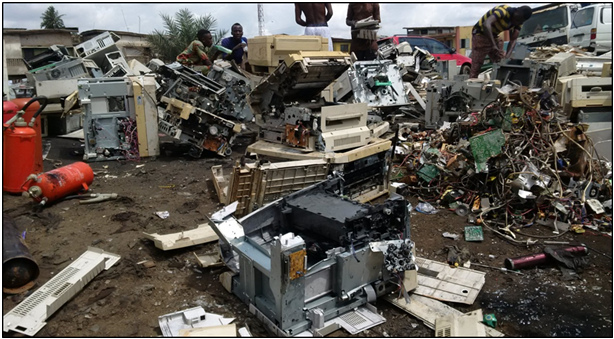
Last week, residents of Surulere, Lagos, woke up to a sad reality. A heavy downpour has flushed the openly dumped waste into the urban drains clogging the system and resulting in a flash flood. Photos of stranded residents and vehicles trapped in stagnant water as a result of choked drainage systems flooded the internet. The flooding incident reminded us once again that waste management is an essential utility service that is often taken for granted — particularly in developing countries — until things go wrong.

As an Environmental Engineer, I am drawn to the Nigerian waste management crisis, because it affects nearly all cities and rural areas. While at first glance, the waste crisis may seem like a complex challenge, a simple and effective framework has been developed. The Sustainable Waste Management (SWM) framework outlines detailed strategies for tackling the waste management crisis in developing countries. The fundamental elements in the SWM include the expansion of waste collection (if possible, to a 100%,), the elimination of open dumping and uncontrolled burning, and the creation of an inclusive stakeholder framework. This framework is a viable pathway to solve the looming waste challenge in Nigeria.

In Lagos for instance, the approach to waste collection needs to be improved significantly. Data from the Lagos State Waste Management Agency (LASMA) shows that only an estimated 30% of daily waste generated in Lagos is collected. This implies almost 70% of the generated waste is likely to be dumped in the open or burnt uncontrollably. Comparatively, when reviewing the waste management situation in a similar city like Accra, Ghana, collection coverage is estimated at 75%.  The disparity between both cities is vast. Furthermore, under the current situation of Lagos, it is unsurprising if a heavy rain washed these uncollected waste streams into nearby drainage systems.

Three major landfills and 2 temporary sites currently serve the state of Lagos. Although this capacity is inadequate for its 20 million population, the traffic challenge within Lagos makes waste transportation highly inefficient, which further complicates the crisis. The project to upgrade the three (3) principal landfills and disposal sites at Olushun, Abule-Egba and Solous needs to speed up to meet the rapid demand for waste disposal. This will reduce traffic congestion, improve the turnaround time of trucks, and facilitate quick recovery of garbage from local dumpsites or residential areas. 

Another aspect to consider in providing the solution for waste management is the need for more productive and inclusive stakeholder engagement. LAWMA acknowledges this strongly as captured on their website : “Advocacy is a daily routine where our advocacy team drives around the state to enlighten the people on our waste handling, containerization, sorting, building and tariff programs”. Additionally, the advocacy team also collects information on complaints and suggestions. I have been to Lagos on several occasions and have been delighted to see how Lagosian (Lagos indigenous citizens) are full of energy from the market women to the “Danfo ” bus conductors. 

The waste management framework must harness this energy to succeed at all levels in order to govern, plan, execute and finance waste management projects. Individuals should be enlightened on the appropriate usage of waste bins and the implications of irresponsible waste disposal.  Further, partnerships should be encouraged between households and LAWMA personnel to ensure appropriate placement and timely recovery of waste disposal bins. This partnership can be fostered further for appropriate household waste filtering, to ensure that these citizens can separate recyclable and unrecyclable waste. Most importantly, the Lagos state government must sustain their political will and financial commitment to keep the system afloat. 

Like Lagos, most cities in Nigeria are faced with a waste management crisis. For a sustainable solution, appropriate agencies need to integrate the basic elements of SWM — expanding collection, ending open dumping, and intensifying stakeholder engagement — or scale them up where they already exist.