DD
MM
YYYY

PAGES

DD
MM
YYYY

spot_img

PAGES

Home Blog Page 6375

The Andela’s Layoffs And Industry Disintermediation

2

Covid-19 is really bad. It has distorted all elements of commerce. Andela, the remote work placement company, has fired 135 workers as it works to manage the challenges arising from the virus. The CEO of the company wrote: “Like any venture backed startup, our ability to attract future investment is determined by the ratio of how quickly we grow in comparison to how much we spend to achieve that growth.” The company has raised about $181 million from  investors and is certainly well loaded. Yet, its business model may be under stress, not necessarily from competition, but from an industry evolution.

Africa-focused tech talent accelerator Andela has let go 135 employees, CEO Jeremy Johnson confirmed to TechCrunch.

Senior staff at the company — with offices in New York and four African countries — will also take salary cuts of 10% to 30%.

The compensation and staff reductions are a result of the economic impact of the COVID-19 crisis and bring Andela’s  headcount down to 1,199 employees. None of Andela’s engineers were included in the layoffs.

Backed by $181 million in VC from investors that include the Chan Zuckerberg Initiative, the startup’s client-base is comprised of more than 200 global companies that pay for the African developers Andela selects to work on projects.

 Like I noted in the Harvard Business Review, Africa cannot rise on the strength of pure outsourcing as the U.S. and Western Europe will use AI, robotics and improved software systems to bring disintermediation. Sure, software developers are not within that domain at the moment. Yet, there are many software development works which AI will incrementally help elite companies to do, making it unnecessary to hire many junior software developers. Those elite companies are Andela’s  core customers, and they are the ones investing massively in reducing human elements via semi- and full-automation. 

The trajectory is simple: only the most experienced and talented software developers would be needed, while the junior and inexperienced ones will be disintermediated with intelligent systems. Yes, the Andela industry is shifting rapidly, and only elite software developers, the top 20% bucket in the world, can help it. It has to discover them in order to thrive. The inexperienced developers do not cost these companies that much, and most may not want outsourcing them at scale. For them, the key pain points are the ultra-expensive experts. They would like to get those capabilities at cheaper rates.

In September last year, Andela cut 420 staff. In Q1 2020, it also reduced workers. The recent one is evidently understandable with the virus derailing economies and markets. Yet, Andela challenge may not be a virus: it has to check the business model to see if other forms of tech are competing with the workers it has available to place in companies. Largely, Andela is not cutting staff due to competition (ignore the new 135 due to Covid-19). Rather, its competition is industry shift as AI advances! We are seeing the same in the microprocessor design industry. It has to revamp its playbook and account for this shift to get to its mission. That is important as you cannot let go about 600 direct staff in 9 months, and still claim that you can change the African continent!

Comment on LinkedIn Feed

Comment #: I’m not sure how this is the ‘problem’ with or for Andela. More so, I do not see ‘improved AI, Robotics and improved software systems’ changing the metrics. These intelligent systems have everyday parts that need to be put together. Even with data science skills gravitating towards increasingly towards drag and drop, engineers still need to be hands on.

Having been through 2 Andela tests and poached by several (way too much for my liking) tech recruiters, I see Andela’s challenge as failing to read well especially US international relations one hand and the fatigue of remote development on the other hand.

Remote work has been revolutionary but it comes with high cost of time, delay due to distance (even with virtual meets, it is a significant burden) and the fact that a lot of ‘resolutions’ arise every now and then.

The number of emails for developers and data analytics/science roles I get has increased in the past months. One thing is constant: they are looking for local talents. They realize that the immigration wahala bar has been raised especially during the present administration.

My Response: Of course we see it differently. Remote work is expanding. Most U.S. companies use remote workers in India as recently they cannot come to U.S. easily. But those used are top 5-20% to reduce cost. U.S. companies are not looking to cut the costs of those earning $90k but those earning $400k. Simply, Andela has to find a $150k equivalent to replace those earning $400k on skills. That is why it has no value for many junior engineers as U.S. firms are not concerned about them. Many community colleges in U.S. after 2 years can give you $60k engineers. Apple spent $50M to mass produce them in selected community colleges few years ago. Then AI is doing some of those jobs. The issue is the elite coders who command north of $400k.

Comment #2: Prof Ndubuisi Ekekwe is there a way the software development industry in Africa at large and Nigeria by extension can develop an internal solution that is Africa based? Yes, these companies get outsourced job from the West but there are also a lot of competitions. India for example is a big one but they are also developing themselves internally and the Fortune 500’s are now opening stores locally. Though, I believe power, security, broadband, and, trust are some of the major challenges but how can we harness the human resource strength to drive growth in Africa?

My Response: Our problem is not foreign companies. Our challenge is that we do not have BUYERS. If you build it, you will find few buyers. Sure, we parade 200m people as in Nigeria but you have a national budget execution of $20 billion and your largest bank’s market cap less than $1.5B. If Andela sees buyers of its solutions in NG, it will sell to them. South Africa is the only viable at national budget of $127 billion with great institutions. If the demand improves, Africa-focus will happen.

The Andela Problem

3 Months Unresolved Complaint: Can Access Bank Be Responsible and Responsive Once if Not all the Time?

0

Businesses exist to serve a purpose. Businesses exist to ensure profit that commensurate with the efforts expended by the owners and their employees. In a just society, businesses are not expected to be resolute in their pursuit of profitability at the expense of clients or customers, especially those at the bottom of the pyramid.

In any sector or industry, it is the core responsibility of businesses to ensure equality in terms of customer engagement and attention to issues. Out of over 15 industries and sectors in Nigeria, financial or banking and consumer good industries are critical to the survival of other industries and sectors. These industries are the backbone of operational activities of entities and individuals at household level. When it becomes practically impossible to fulfil financial obligations, activities would be grounded. The consequences would be enormous and devastating.

In my earlier open letter to Herbert Wigwe, the Chief Executive Officer, Access Bank Plc, and his staff, I detailed how the bank has failed to resolve blacklisting of my accounts over the last 3 months. The blacklisting has led to the inability to receive and make payments. As I noted during conversation with two staff of the bank, the suggestion that I should go to the nearest branch cannot solve the issue because of the past experience with the employees at the branch. Besides, going to branch at this period (Coronavirus outbreak) is uncalled-for if truly Access Bank is transforming the Nigerian banking industry with “digital transactions and discourage branch banking until the world is completely out of the pandemic times,” according to Victor Etuokwu, Executive Director, Retail Banking.  Apart from this, it is imperative for the Chief Executive Officer to revisit his position about how the bank should be an intelligent one. An intelligent bank is expected to know the right approaches to the effective use of technologies to resolve customers’ complaints in a challenging time. As he said during an event on 16 May, 2019, “becoming an intelligent bank is no longer an option in today’s financial services, but a necessity.  Today, we are experiencing the fourth industrial revolution which uses the Internet of Things, and Cloud Technology to automate processes. This has enabled financial service providers to increase their digital offerings for customers so they can conduct banking transactions on mobile phones, the internet, and at the ATM.”

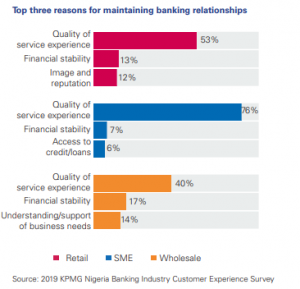
May I refer the CEO and staff to the Central Bank of Nigeria’s legal framework for customer complaint management, which stresses timely complaints handling and dispute resolution. According to the apex bank, “the 2008 global financial crisis re-emphasized the need for concerted efforts among regulators in various jurisdictions to establish robust policies and structures aimed at regulating the conduct of operators, with a view to protecting consumer’s assets.” Access Bank and staff also need to realise that quality of service experience is the main factor for sustainable banking relationships.

As a citizen and consumer, who believes in justice and fair play, I have logged my complaint with the Federal Competition and Consumer Protection Commission in line with the apex bank’s legal framework for consumer protection in the bank industry. The response of the agency will determine how true, we embrace justice and equality as a nation.

Update One

In my efforts of getting my accounts whitelist, I sent a message to Access Bank’s Ombudsman Desk on May 10, 2020. A few hours later, I received an email message from one Gloria Okungbowa, saying “Kindly send us a clearer written instruction (also signed) and a valid means of identification to reactivate your USSD profile. We apologize for requesting for another instruction, the initial one you sent is blurred and we could not work with it. We hope to hear from you soon to resolve the issue.” 

I do not believe  a scanned copy of National Identity Card I sent is blurred. This morning I have replied to her with a repositioned card and asked for urgent solution to the issue.

In 2018, the bank says “the aim and objective of the Ombudsman initiative was to resolve all customer complaints and issues on the same day irrespective of where the complaint is issued from or the officer responsible for resolution.”

Update Two

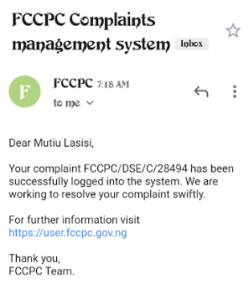
The Federal Competition and Consumer Protection Commission has sent a message, confirming my complaint. It would be recalled that I logged the complaint with the commission on May 8, 2020. The commission has asked for the details of the accounts blacklisted by Access Bank. I hope the commission will leave up to its constitutional responsibility and promise it gave in the message.

Update Three

While waiting for the response of the Federal Competition and Consumer Protection Comission, a staff of Access Bank (Gloria) reached me via email asking for the resend of the written instruction earlier gave to the bank to whitelist my accounts. I have informed her that doing that is like playing upon my intelligent. It is should not be difficult to retrieve the previous one. Apart from this, I do not know the reason Access Bank cannot assign only one person to resolve the issue. Why four people treating the same issue? This is creating back and forth, which is bad for customer engagement. Access Bank should do the needful!

More Reasons To Register for Tekedia Mini-MBA

0

Dear Sir/Madam

(If registered already, please help us forward)

Tekedia offers an innovation management 4-month program, optimized for business execution and growth, with digital operational overlay. It runs 100% online. The theme is Innovation, Growth & Digital Execution – Techniques for Building Category-King Companies. All contents are self-paced, recorded and archived which means participants do not have to be at any scheduled time to consume contents. Class begins June 22. There are many reasons to register for the second edition of Tekedia Mini-MBA. Here are some:

  • Experts from global and local brands like Microsoft, MIT Boston, Deloitte, and Flutterwave are joining to lead different sessions. We are covering 32 areas in business from Innovation to Strategy, Business Law to Operations, Supply Chain to Sales, and beyond, with practicing faculty.
  • All participants of Tekedia Mini-MBA in 2020 will attend a virtual Career Week. Our Career Week (coming in Nov) is not designed for finding jobs. Rather, it is structured to TRANSFORM workers, founders & entrepreneurs into business leaders and champions of innovation in their companies. The sub-theme is Career Planning & Resilience During Disruption. Learn more here. Within the week, at least 10 HR leaders will provide guidance to workers and companies on how they can build productivity.
  • Joining Tekedia Mini-MBA second edition comes with two free ebooks – Africa’s Sankofa Innovation, and The Dangote System: Techniques for Building Conglomerates.
  • You also receive a complementary Certificate cybersecurity course from First Atlantic Cybersecurity Institute. Visit facyber.com and select your course on Cybersecurity: Policy, Management, Digital Forensics and Technology.
  • We continue to offer installment payments

Join us for $140 or N50,000 by registering via (bank transfer, Flutterwave and Paypal) – https://www.tekedia.com/pay

Regards,

Nky Udo
Tekedia Institute

tekedia@fasmicro.com

Help Comes for Arik Air and Air Peace, Nigeria Goes N2 Trillion Reset

7

The Nigerian government is coming to save Arik and Air Peace – and that is a good thing. The playbook is contained in a statement by Clem Agba, the Minister of State for Budget and National Planning, as the government unveils a N2 trillion economic stimulus: “We are also looking at how to support the Aviation Sector. Like you know, a lot of planes are parked and this is causing almost N21 billion (loss) on a monthly basis. We are looking at how to provide some form of bailout support to ensure that the industry doesn’t die”.

The Minister of State for Budget and National Planning, Clem Agba, said on Tuesday at a webinar held by the Finance Ministry and stakeholders, that the Federal Government is planning to inject a N2 trillion intervention fund into the economy.

The Federal Government had earlier doled out N50 billionTargeted Credit Facility fund to help businesses in Nigeria as the coronavirus pandemic wreaked havoc across sectors. But the fund appears so meager to bail out most of the businesses under the strain of COVID-19 impact. The aviation sector is among the most affected, causing one of the leading Airlines,Arik to lay off staff.

Agba said the fund will offer a lifeline to businesses mostly impacted by the pandemic, especially the aviation sector which according to him, is losing N21 billion monthly.

“All in all, when everything is put together, both government funding and the funds we are expected to get from the Central Bank of Nigeria (CBN), Banks of Industry and other multilateral agencies and grants that we are receiving, we expect to get a stimulus of about N2 trillion going into the economy.

“We are also looking at how to support the Aviation Sector. Like you know, a lot of planes are parked and this is causing almost N21 billion (loss) on a monthly basis. We are looking at how to provide some form of bailout support to ensure that the industry doesn’t die.

“Of the $2.5 billion facilities from the World Bank, about $1 billion of it will be going to the states as loans. Mr. President has already approved N850 billion loan from the domestic capital market,” he said.

I have written about a challenging future for Arik here. That came after I made a similar call on Air Peace here.  That government is coming to help the aviation sector is a good call. Without both, the Nigerian economy will not have any chance to rise. There is no commerce without logistics & supply chain – aviation is a critical element of that. Of course, Aero and other airlines will be supported.

What Next for Arik Air?

What Happens To Air Peace?

Nigerian Government to Inject N2 Trillion Stimulus Into the Economy

0
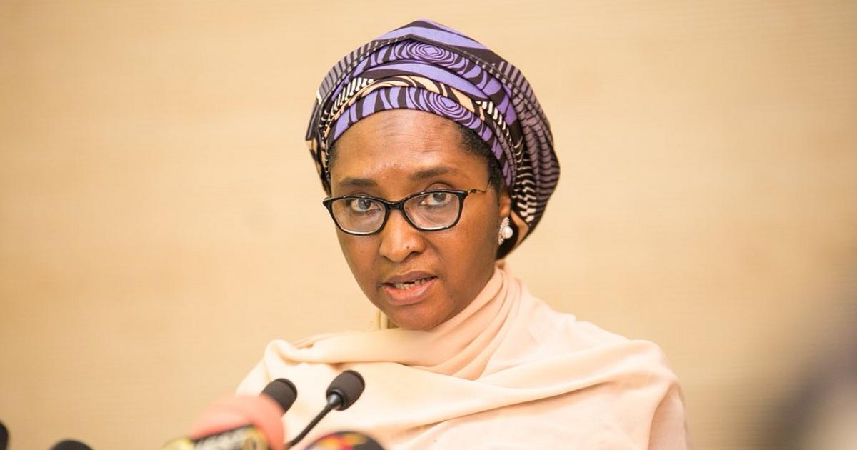
Finance Minister, Nigeria

The Minister of State for Budget and National Planning, Clem Agba, said on Tuesday at a webinar held by the Finance Ministry and stakeholders, that the Federal Government is planning to inject a N2 trillion intervention fund into the economy.

The Federal Government had earlier doled out N50 billion Targeted Credit Facility fund to help businesses in Nigeria as the coronavirus pandemic wreaked havoc across sectors. But the fund appears so meager to bail out most of the businesses under the strain of COVID-19 impact. The aviation sector is among the most affected, causing one of the leading Airlines, Arik to lay off staff.

Agba said the fund will offer a lifeline to businesses mostly impacted by the pandemic, especially the aviation sector which according to him, is losing N21 billion monthly.

“All in all, when everything is put together, both government funding and the funds we are expected to get from the Central Bank of Nigeria (CBN), Banks of Industry and other multilateral agencies and grants that we are receiving, we expect to get a stimulus of about N2 trillion going into the economy.

“We are also looking at how to support the Aviation Sector. Like you know, a lot of planes are parked and this is causing almost N21 billion (loss) on a monthly basis. We are looking at how to provide some form of bailout support to ensure that the industry doesn’t die.

“Of the $2.5 billion facilities from the World Bank, about $1 billion of it will be going to the states as loans. Mr. President has already approved N850 billion loan from the domestic capital market,” he said.

The extension of “no flight” to another four weeks has aggravated the woes of the aviation sector, making the companies’ survival impossible without the government’s stimulus package.

He said that the government is focused on how to boost the economic activities to mitigate the harsh realities of the pandemic. And as a member of the Economic Planning Committee, he said that plans are underway to ease the process of national supply chain of goods and services through effective means of transportation.

The Minister added that the FG would release more funds to the Federal Roads Maintenance Agency (FERMA), to undertake urgent rehabilitation of roads across the country. And as part of the arrangement, the Committee will be working with stakeholders in the agricultural sector to implement efficient agro-industrial processing in the geo-political zones.

Explaining more about the measures the government is taking to alleviate the impacts of COVID-19 on the economy, the Minister of Finance, Budget and National Planning, Mrs. Zainab Ahmed said there is ongoing review of revenue projections to conform with the realities of oil price – mainly the slash of oil benchmark from $57 to $20 as the oil price keeps wobbling around $20 and $30 per barrel.

“We have had to scale down our auction volumes because globally the crude oil market is very slow and we are not able to sell as much crude like before.

“We also had to review a number of things that we had planned including scaling back on investments in the upstream sector of the Nigerian oil and gas economy, which means projects will be delayed much longer than was originally planned,” she said.

She explained that the government is reviewing the 2020-2022 Medium-Term Expenditure Framework/Fiscal Strategy Paper (MTEF/FSP) to conform to the $20 budget benchmark. This she said will be complemented by other Fiscal stimulus that is designed to spur economic activities in other sectors.

Part of it is the blanket duty waiver for the pharmaceutical and health sector, which was granted by president Buhari. She confirmed that the waiver took effect from May 1 and will ease the cost of bringing in medical equipment for the fight against COVID-19.

Mrs. Ahmed noted that the welfare of SMEs have been integrated into government’s intervention plans which aim to implement a low tax regime for small businesses.

“In the Finance Act 2019, we had reduced taxes from 30 percent to zero for small businesses that have turnover of N25 million and below, for medium enterprises that have turnover of N25 million to N100 million, we reduced their taxes to 20 percent.

“We want to make sure that those benefits are implemented, even though we increased the VAT, we had heightened the threshold for stamp duties and also expanded exemptions so that the small enterprises and Nigerians of lower means are not burdened by the increase,” she said.

The Federal Government has projected 80% decline in oil revenue as a result of COVID-19 – From N5.47 trillion to N1.12 trillion. Other means of revenue generation saw massive declines too that created projected revenue gaps. Custom revenue went from N1.5 trillion to N1.156 trillion; VAT income plunged from N60.42 billion to N2.029 trillion, putting the revenue accruable to the Federation Account to N3.890 trillion from the projected N5.72 trillion.

The Director General of Budget Office, Ben Akabueze said there is a need to revisit the 2020 Appropriation Act because it’s based mainly on assumptions that are opposed to the current economic realities.

“In this regard, the Budget Office is currently finalizing the revised 2020-2022 MTEF/FSP, as well as an Amendment to the 2020 budget, which will provide for COVID-19 crisis intervention fund as well as other adjustments,” he said.

Mrs. Ahmed has raised concern over the cost of governance which she acknowledged that it takes a large sum of the budget, and needs to be curtailed by collapsing some of the MDAs.

Akabueze said the proposed budget will cut MDAs capital expenditure by 20% as well as reduce overheads costs by 16.7%, exempting only health and security.

The proposed adjustment aims to lift the projected budget deficit from N2.175 trillion to N5.36 trillion including expenditures funded by project-tied loans.

He explained that the new projects will be financed through the privatization proceeds that amount to N126 billion, a difference of N137.63 from what was earlier projected. He said N263.63 billion will be borrowed from Federal Government’s special accounts and drawdowns on multilateral/bilateral projects-tied loans of N387.3 billion and new borrowing that will put the total figure at N4.59 trillion.

Despite the new projections that aim to cut wastage by collapsing agencies, especially those duplicating functions, it is obvious that the FG will find it difficult to realize the N2 trillion.

The government in desperate need for funds, had earlier attempted to borrow from the pension fund, a move that was fiercely opposed. However, against the backdrop of economic downturns in the face of the coronavirus crisis, the Federal Government is pushing to get the national assembly’s support to borrow not only from the pension fund, but other special accounts, including donations made for COVID-19.