DD
MM
YYYY

PAGES

DD
MM
YYYY

spot_img

PAGES

Home Blog Page 6394

COVID-19 Containment in Anambra State: An Amazing Home Made Solution 

0

Saturday 25th April, 2020 was  a happy day for Anambrarians, at home. This followed the press release of the governor Chief Willy Obiano, announcing that their state’s COVID 19 confirmed case has been discharged after testing negative;  that all the contacts of the survivor have equally come out negative. The hallmark of this was the announced partial relaxation of the state’s lock down, which will (beginning from the stated date) enable only persons within the state to go about their businesses, provided they adhere to extant hygiene and personal safety practices.

Following that announcement, Anambra became the first state to officially enter into the post COVID-19 era in Nigeria.

Here’s the reason for that:

One of the available information provided by experts is that coronavirus can’t travel by air past a distance of  1m.

On this assurance that the deadly virus can’t simply fly like a bird from one locality to another, an essential task was to initiate reliable measures that restrict interstate travel to only essential ones by authorized persons. The state did so through a joint agreement between the state authority, all village heads and vigilante of every community in the state, to secure their village borders and not allow unauthorised entrance.

Breaching an agreement at the cost of one’s crown or collecting bribes to let someone in, at the risk of danger to one’s family, relations and people in addition to punishment is not a gentleman thing to do. So the border was secured. As long as that measure is not compromised, things will remain stable in Anambra State.

This brings to mind that, It’s often been the case that an all-size-fit design does not always fit all. A home made solution that takes cognizance of the peculiarities of  a home felt problem and the unique circumstances of the particular people, is always the best way to go. It does better.

With the rising cases of the COVID 19 in Nigeria, it’s not yet late to engage traditional rulers and vigilantes to complement the efforts of the security outfits of the federal government, in securing interstate borders. The hard to understand issue that’s still happening is that people are still moving from one state to another. A friend called today (29th April, 2020) to tell me that someone checked into their compound in Aba last night from the North (Northern part of Nigeria). Why I advised them should ask for self quarantine or alert NCDC, if the person refuses self isolation. I know that the person and other persons who flaunt ‘Stay At Home’ order and travel these days don’t travel as invisible spirits. Some of them move by road. How are they able to do so even when there are police and military men on the road? Maybe the government of Anambra knows why, which made them to engage all their villages to work in ensuring that the task of securing their state borders is not compromised.

If it worked for Anambra, it makes sense that every other state should find ways to adapt related measures to secure their borders. Endless bit-by-bit total lock down is dangerous in any part of Nigeria and Africa as a whole given the unique economic situation In Africa.

An aggressive movement restrictions at national and state borders can help a lot in preventing easy spread to other places. Which of course ensures the pandemic doesn’t reach a level that will overwhelm available health facilities.

Just as Anambra, when every least affected state has put in place effective and reliable border closure measures, in line with the peculiar case of their environment, they can confidently come up with and enforce guidelines that will permit people within their respective states to return to businesses partially.

Congratulations: He’s Funded

1

We got one of those inspiring testimonials which motivate all of us on this community service. I thank our faculty for their time, efforts and commitments. Providing guidance to our young people is one of the ways we can help them in this age of economic paralysis and turbulence.

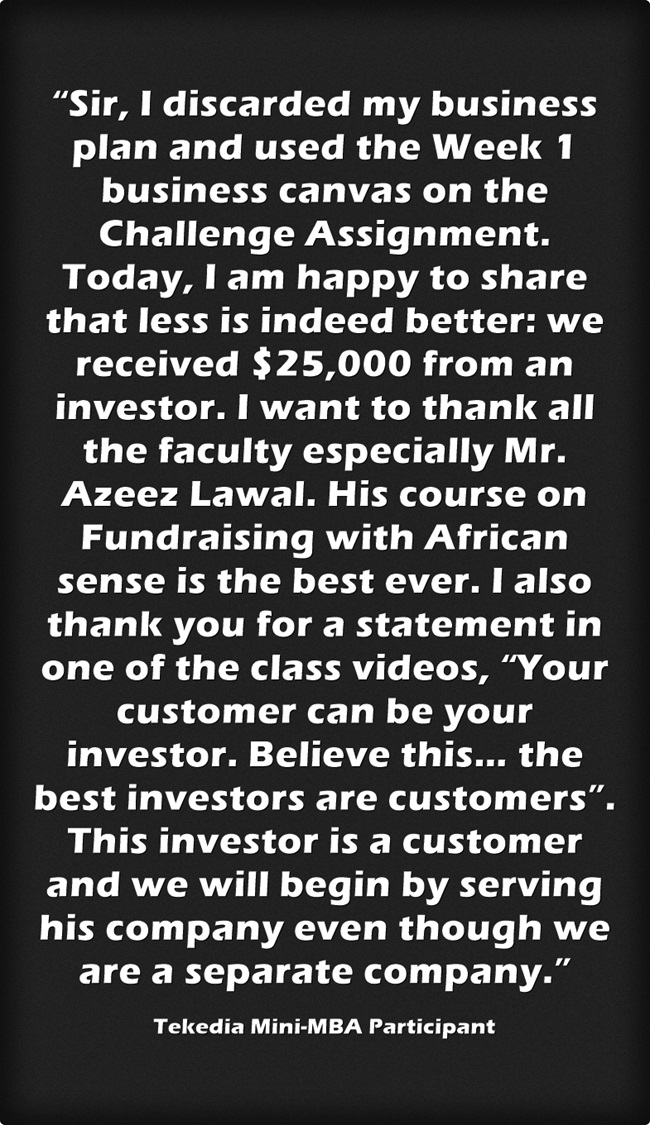
“Sir, I discarded my business plan and used the Week 1 business canvas on the Challenge Assignment. Today, I am happy to share that less is indeed better: we received $25,000 from an investor. I want to thank all the faculty especially Mr. Azeez Lawal. His course on Fundraising with African sense is the best ever. I also thank you for a statement in one of the class videos, “Your customer can be your investor. Believe this… the best investors are customers”. This investor is a customer and we will begin by serving his company even though we are a separate company.” from a Tekedia Mini-MBA participant.

Meanwhile, registration continues for the second edition scheduled to start June 22. If you register before May 1, you get two of my books – Africa’s Sankofa Innovation, and The Dangote System, along with a free certificate course at First Atlantic Cybersecurity Institute (Facyber). Join for a 4-month of business excursion, 100% online, at $140 or N50k. Faculty includes leaders from MIT, Deloitte, Kendor, Schlumberger, AIICO, Luzo, Smepeaks, Nigerian Breweries, Delek, Flutterwave, etc.

Click and register here.

https://www.tekedia.com/mini-mba-2/

Why Pyramid Schemes Fail

3

We’re going through a very tough time. Many of us all over the world are currently on some form of restrictions, and we can’t continue our normal activities. The impact of COVID-19 is experienced differently by people; there are many families exposed, many people going through difficulties, it is nice to be good in any way you can to people around you. It’s nice to be good anytime, but the present situation calls for more kindness. 

There are many stories of people doing good, sharing with the needy, helping the elderly and this shows the love we still have despite everything going on. It shows there is hope for humanity.

There are many “viruses” spreading online apart from COVID-19. Misinformation. Be careful and try to always verify the information before sharing (if you need to share it). Having said that, I want to draw attention to many new make-money-from-home schemes flying around, digital entrepreneurship options. I am writing this because I have seen a lot of them spreading online. We need to always be careful. Every good investor does proper due diligence and weighs the opportunity cost and risk of any venture. This is what we all ought to do. I have seen a lot of new options for making money, too many to count. 

I couldn’t look at all of them fully because it would take forever to do that, but a lot of them look like Ponzi(pyramid) schemes. I figured it would be better to find out what characterizes Pyramid schemes, how to spot them from a distance, then one can use that template to analyse any new ones that come your way.

The not-too-distant wave of MMM [1,2] came and swept a lot of people off their feet. A lot of us got involved. Some cashed out, while many others lost large with a lot of stories that touch the heart. The interesting thing is that there is nothing new under the sun, so MMM was nothing new. It was founded by Sergei Mavrodi [3] and his associates, a very intelligent mathematician in the early nineties when the Soviet Union collapsed. There were other schemes before Mavrodi’s, Ponzi is in fact someone’s name – Charles Ponzi, an Italian swindler and con artist who became known in the early 1920s in North America[4]. 

Source: investor.gov

I watched a film Sergei Mavrodi’s based on his story and a couple of interviews he gave. He was out to harness people’s greed. It was said that at some points, people preferred his notes over the official currency! He designed a very brilliant scheme that worked then, still works and will keep working. Although Mavrodi is dead[5], there will be many versions of this scheme popping up everywhere [6]. This time seems to be a good one for fresh schemes as people are at home, some with the capital they want to quickly multiply.

Be careful. Genuine wealth creation takes time, knowledge and patience. Be very wary of anyone coming to promise you a get-rich-quick source. I constantly see a lot of such flying around and have received many links from friends. I always want to take my time and get to understand the value proposition, the financial model, and the product involved.

Pyramid Schemes

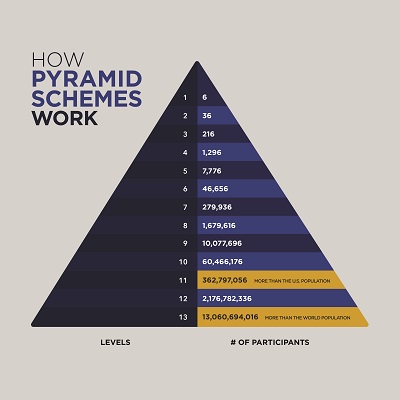
What Is a Pyramid Scheme? A pyramid scheme is an illegal investment scam based on a hierarchical setup of network marketing. The most famous kind of pyramid scheme is, perhaps, the Ponzi scheme.

New recruits make up the base of the pyramid and provide the funding, or so-called returns, in the form of new money outlays to the earlier investors/recruits structured above them in the scheme.

 A pyramid scheme does not usually involve the selling of products. Rather, it relies on the constant inflow of money from additional investors that works its way to the top of the pyramid. This means that multilevel marketing schemes are not classified as pyramid schemes and are not necessarily fraudulent. [7].

These are some hallmarks of a pyramid scheme[8]:

  1. Emphasis on recruiting
  2. No genuine product or service is sold
  3. Promises of high returns in a short time period.
  4. Easy money or passive income.
  5. No demonstrated revenue from retail sales.
  6. Complex commission structure.
  7. All Pyramid Schemes Collapse. The question is when.

All pyramid schemes eventually collapse, and most investors lose their money. The question is when?

I didn’t mention any schemes here, not because there aren’t any I am suspecting and almost certain that they are pyramid schemes, but because I could be wrong in some cases, and I generally want you to decide for yourself. The least you could do is google and check 2-3 external links about it and immediately you will get a picture. There are many legit ways to invest out there and a quick google search can show you that they exist, even in Nigeria. So again, I won’t mention any. You should decide for yourself.

You can read about other types of fraud[9] and how to protect your investments[10] from the U.S Securities and Exchange Commission. Keep learning, and stay woke!


Disclaimer: I am not an investment expert but a learner. The main message I have is – do your due diligence before putting down your money into any investment.

Nigeria And The Fourth Industrial Revolution

9

From Abuja to Keffi all through to Iwo and then Lagos, the better part of my life has been spent in one school or the other, all in a bid to get educated. From my learning, I am compelled to take sides with Albert Einstein when he said, “education is not the learning of facts but the training of the mind to think.” With the Fourth Industrial Revolution (4IR) now in motion, it would be banal to state that our educational system in Nigeria is over due for a revamp. Now, we must think of our future and how well to secure it.

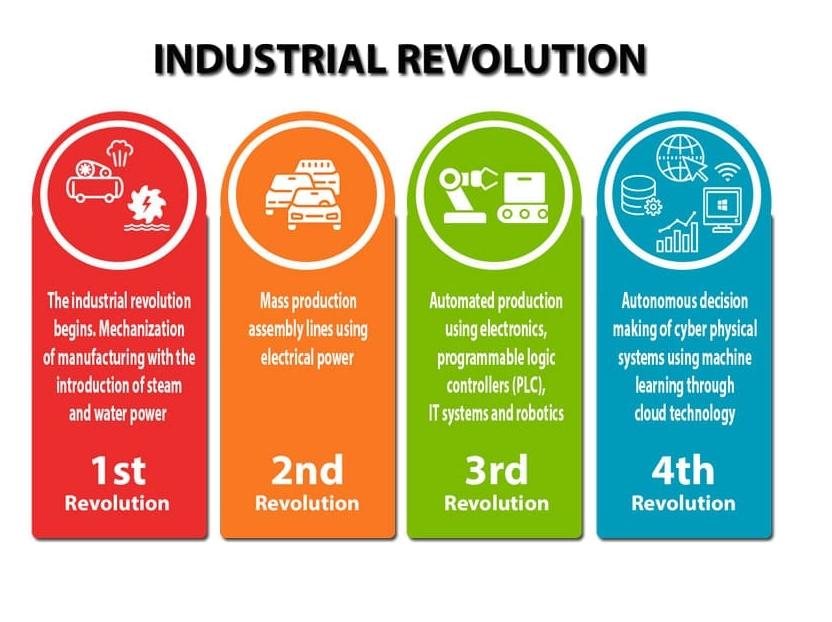
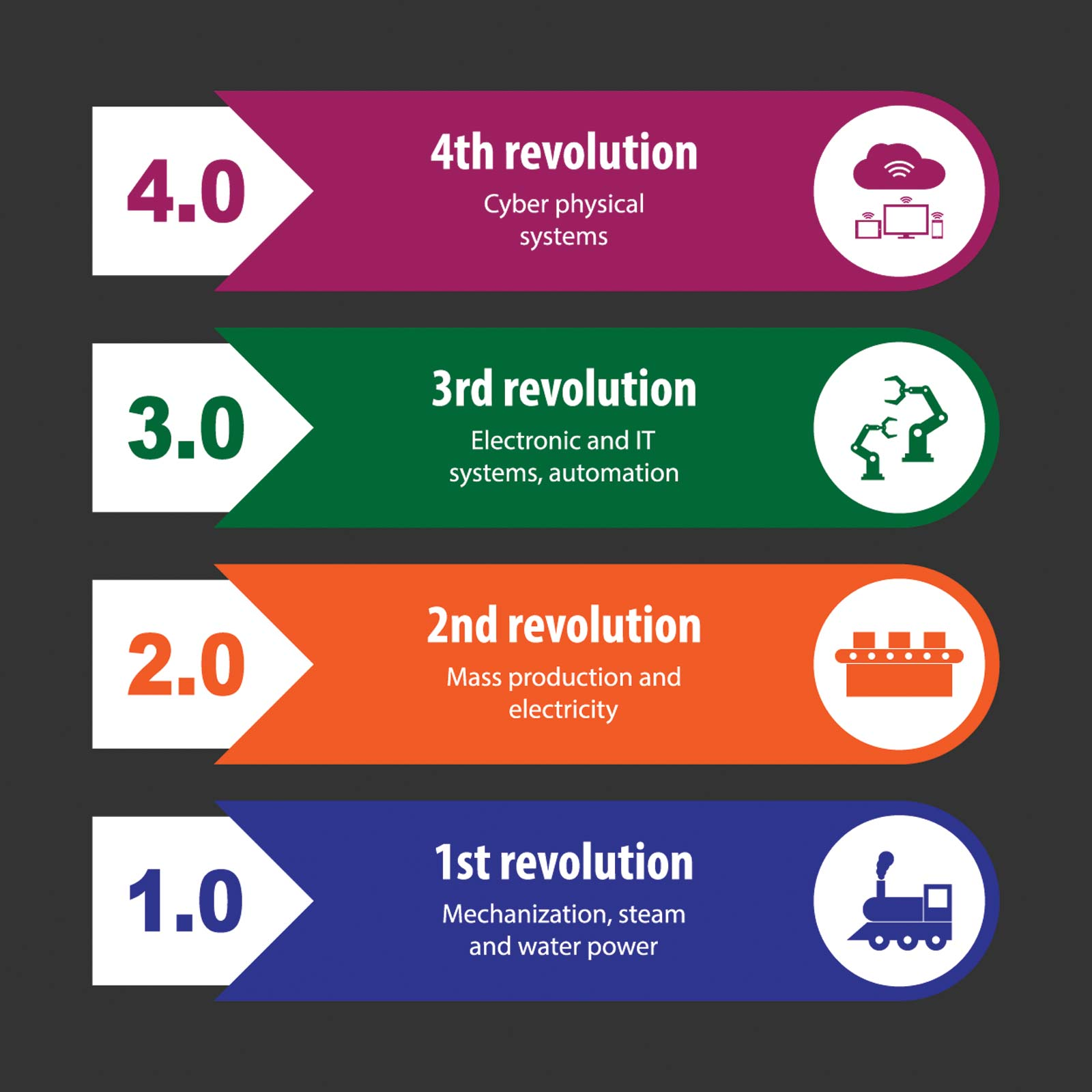
As explained by Professor Klaus Schwab, the Fourth Industrial Revolution is building on the Third, the digital revolution that has been occurring since the middle of the last century. It is characterized by a fusion of technologies that is blurring the lines between the physical, digital, and biological spheres. The impact of automation on our future lives would be immense and one we must be ready to take on.

Considering the impact of the 4IR on the future of work and as earlier mentioned, there is the need for our educational system to be refurbished, to meet up with the demands of the new world of work. Universities have to play an important function in churning out active citizens who would lead, especially in terms of employment, during this era of the 4IR. With this in mind, the government via the Ministry of Education should come up with policies that will drive needed change in the educational sector. Nigeria and Africa missed out on the First to Third Industrial Revolution and from all indication, do not seem ready for the Fourth and most important thus far.

In addition, university managements across the country unlike the Biblical children of Issachar do not understand the times and from all indications do not know what to do. The World Economic Forum’s Future of Jobs Report 2018 provides that “the range of established roles that are set to experience increasing demand in the period up to 2022 are Data Analysts and Scientists, Software and Applications Developers, and Ecommerce and Social Media Specialists, roles that are significantly based on and enhanced by the use of technology.” Furthermore, based on the World Economic Forum analysis there is evidence that there would be in high demand specialist roles such as, AI and Machine Learning Specialists, Big Data Specialists, Process Automation Experts, Information Security Analysts, User Experience and Human-Machine Interaction Designers, Robotics Engineers, and Blockchain Specialists.

From the foregoing, it is indicative that professionals who have a blend of science, technology and social sciences, would be in high demand. Acting upon such reports, some African universities such as the University of Johannesburg have introduced a Bachelor’s degree in Politics, Economics, and Technology, but we find our institutions of learning grappling with maintaining the status quo of offering totally irrelevant courses that hold value for the future.

 Furthermore, if there is anything the COVID-19 pandemic has made us to understand, it is the fact that although with every passing day, the world keeps shrinking into one small entity of diverse people and states, albeit interconnected and inter-dependent on each other but at the most critical moments such as the current one, every country has itself and itself alone to rely on. This reality therefore, if anything, must propel not just the government to act, but also private companies and organizations. Universities should collaborate with private companies to identify employers needs which would be translated into academic programs tailored to the current needs of Nigeria and the world.

The world is moving on with the 4IR and we cannot afford to be left behind. With Nigeria in need of a long overdue economic and social development, the 4IR gives us an opportunity to get where we want to be and anything other than being active participants cannot be welcomed.. Our active participation depends largely on the dynamism of our universities and various institutes of learning. And so, let’s get to work! To the Fourth and beyond!

Economy, Finance, Business News Headlines & Insights: 28th April 2020

0
A ‘fresh breath of dollars is coming’ and it’s coming earlier than we expected…


“We are working very rapidly to provide a significant emergency financing to Nigeria,” Georgieva said on a webcast held by the Atlantic Council. “I expect this to be done by the end of the month.”

International Monetary Fund Managing Director Kristalina Georgieva said on Monday that she expected the Fund to have provided Nigeria with significant emergency financing by the end of April, signaling likely IMF board approval for the oil exporter’s $3.4 billion request. The IMF’s board on Tuesday is scheduled to consider a Nigeria’s request for the emergency financing to combat the impact of the coronavirus. Source: Reuters

Stock Market Update and Corporate Disclosures:

The All-Share-Index is currently up by 0.14% with Banks dominating the gainers’ list. GTB is currently up by 2.5%, Sterling Bank is up by 1.65%, Zenith and UBA are up by 0.70% and 0.85% respectively.

Click on the link https://bit.ly/2XrvIf9 to open a stockbroking/share purchase account and trade within 24 hours

WAPIC Insurance Plc – Appointment of New Chairman of Board
Sunmonu succeeds Aig-Imoukhuede as Chairman, Wapic Insurance Plc, whilst Bode Osunkoya is appointed Chairman, Wapic Life Assurance Ltd The Board and Management of Wapic Insurance today announced the appointment of Mutiu Sunmonu CON as the Chairman of its Board of Directors and Bababode Osunkoya as Chairman of its subsidiary, Wapic Life Assurance Ltd. By this appointment, Sunmonu and Osunkoya succeed Aigboje Aig-Imoukhuede CON, who retired effective April 27, 2020 after 8 years of diligent and committed service to both organisations. Read more

NEM Insurance Plc- Notice of Board Meeting and Closed Period for 2020 Q1 Accounts
We write to notify The Nigerian Stock Exchange (The Exchange), our stakeholders and the investing public that the meeting of the Board of Directors of NEM Insurance Plc (the Company) is scheduled to hold on Monday, May 11, 2020 to consider amongst other things, the Unaudited Accounts and Financial Statements for the period ended March 31, 2020. Read moreWAPIC INSURANCE PLC– Letter to Stakeholders Board Succession Communication
I wish to inform you that I have come to the end of my tenure as the Chairman of the Board of Directors of Wapic Insurance and its subsidiary – Wapic Life Assurance Ltd. Accordingly, I will be retiring from the Board of both companies effective April 27, 2020. Serving as Chairman of the Board of Directors of Wapic Insurance and Wapic Life Assurance over the past 8 years, has been quite challenging but most fulfilling and has strengthened my belief in the capacity for ordinary people to come together and achieve extraordinary things. Read more
Africa Prudential Plc – AGM
We write to formally notify the investing public and The Exchange that the 7th Annual General Meeting of Africa Prudential Plc scheduled to hold by Proxy on Tuesday, April 28, 2020 at 11.00 am in line with Guidelines issued by the Corporate Affairs Commission, would now be held virtually via Zoom, an Online Meetings Platform. Read more
Law Union & Rock Insurance PLC – Notice of Board Meeting and Closed Period
We hereby give Notice that a meeting of the Board of Directors of Law Union Insurance PLC (the Company) will hold on Tuesday, 12th May 2020, via videoconferencing to consider the Company’s Q1 2020 Unaudited Financial Statement. Read more

United Capital Plc – AGM
We write to formally notify the investing public and The Exchange that the 2020 Annual General Meeting of United Capital Plc scheduled to hold by Proxy on Tuesday, April 28, 2020 at 11.00 am in line with Guidelines issued by the Corporate Affairs Commission, would now be held virtually via Zoom, an Online Meetings Platform. Read more

FCMB GROUP PLC appoints a new NonExecutive Director
FCMB Group Plc hereby announces the appointment of Mrs. ‘Tokunboh Ishmael to its Board as a Non – Executive Director, following the approval of the Central Bank of Nigeria. Mrs. ‘Tokunboh Ishmael is an alumnus of the London Business School and the University of London. She is a Chartered Financial Analyst and a member of the CFA Institute and the board of the African Venture Capital Association. Read more
IMF may approve Nigeria’s $3.4bn loan today
There are indications that the Executive Board of the International Monetary Fund may approve the $3.4bn loan sought by Nigeria on Tuesday (today). Although the Minister of Finance, Budget and National Planning, Zainab Ahmed, had on April 6, while announcing that Nigeria had applied for the loan, said the funds were expected within six to 12 weeks, Reuters and Bloomberg reported that the IMF would meet over the request today.
NNPC delays oil export plans, negotiates with producers
The Nigerian National Petroleum Corporation has delayed publishing its future oil export plans as it negotiates with international oil companies and local players on how to cut output in line with a global deal on production curbs. The official selling prices for Nigerian oil, usually issued in the second or third week of each month, had still not been issued on Monday, according to Reuters. The production cut deal, agreed by the Organisation of Petroleum Exporting Countries and its allies, is due to go into effect on May 1.
Four New COVID-19 Measures Announced by President Buhari
President Muhammadu Buhari on Monday extended the COVID-19 lockdown on Lagos, Ogun and the FCT by one week. Although the lockdown will be gradually lifted from May 4, he announced four new measures that will ensure the COVID-19 virus spread is mitigated. To be sure, these new measures will only start to apply after May 4 and will not apply to Kano, which has been locked down for two weeks. The new measures include an overnight curfew, a ban on interstate travel, a partial and controlled ban on interstate movement of goods and the mandatory use of face-masks, physical distancing and personal hygiene.
Nigeria Reports 64 New Cases Of COVID-19, Total Infections Now 1,337
Nigeria on Monday recorded 64 new cases of the novel coronavirus, bringing the country’s total infections to 1337, according to the Nigeria Centre for Disease Control (NCDC). According to the NCDC in a tweet via its official handle, 34 of the new infections were recorded in Lagos, 15 in the FCT, 11 in Borno, and 2 each in Taraba and Gombe. The country’s total deaths from the virus still stand at 40 while 255 have recovered. The novel coronavirus has claimed at least 208,973 lives since its outbreak in China in December, according to a tally from official sources compiled by AFP at 1900 GMT on Monday.
Global coronavirus cases pass three million as lockdowns begin to ease
Global confirmed coronavirus cases surpassed 3 million on Monday, as the United States neared 1 million cases, according to a Reuters tally. It comes as many countries are taking steps to ease lockdown measures that have brought the world to a standstill over the past eight weeks. The first 41 cases were confirmed in Wuhan, China, on Jan. 10. The 3 million confirmed infections in less than four months are comparable in number with the roughly 3-5 million cases of severe illness caused by seasonal influenza around the world each year, according to the World Health Organisation.
Lockdown ease: Buhari issues directives to CBN, financial institutions
President Muhamadu Buhari has directed the Central Bank of Nigeria to make plans for financial stimulus packages for Nigerians. Buhari made this known during a live broadcast on Monday. The president had earlier eased the lockdown in Abuja, Lagos and Ogun States. He also assured that security and safety remains the primary concern. He said, “I have directed the Central Bank of Nigeria and other financial institutions to make further plans and provisions for financial stimulus packages for small and medium scale enterprises. We recognise the critical role that they play in Nigeria’s economy.
Be ready to pay higher for fuel –PPPRA
Nigerians should be ready to pay high or low prices for petrol following the price liberalisation scheme currently in place, the Petroleum Products Pricing Regulatory Agency said on Monday. The PPPRA is also engaging with the Central Bank of Nigeria to determine the applicable foreign exchange rates for the importation of petroleum products by oil marketers.
Recapitalise Discos or risk complete power sector collapse –TCN
The Transmission Company of Nigeria has said the nation’s power sector will collapse completely if urgent steps are not taken to capitalise the distribution companies. The government-owned TCN stated this while announcing a drop in the amount of electricity taken by Abuja Electricity Distribution Company on Saturday night. It said, “As at 7:00pm on April 25, due to rainfall, Abuja dropped load and was off-taking only 0.5MW and 16MW from TCN’s 330kV substations in Katampe and Gwagwalada respectively.
Oil prices dive as world runs low on storage capacity while demand plunges
Oil prices slumped again on Tuesday amid concern about dwindling crude storage capacity worldwide and fears that fuel demand may only recover slowly once countries ease curbs imposed on economic and social activity to combat the coronavirus pandemic. U.S. West Texas Intermediate (WTI) crude CLc1 futures fell to as low as $10.64 a barrel on Tuesday, and were off 13%, or $1.66, at $11.12 a barrel as of 0432 GMT. WTI plunged 25% on Monday. Brent crude LCOc1 futures fell to a low of $18.85 and were last down 4.5%, or 90 cents, at $19.09 a barrel. The benchmark slid 6.8% on Monday, and the contract for June delivery expires on April 30.
Asian shares fall on fresh rout in crude prices
Asian shares and U.S. stock futures dipped into the red on Tuesday, erasing earlier gains as a renewed decline in oil prices overshadowed optimism about the easing of coronavirus-related restrictions seen globally. MSCI’s broadest index of Asia-Pacific shares outside Japan. MIAPJ0000PUS was down 0.3%. Shares in China .CSI300 fell 0.7% and South Korean shares .KS11 fell 0.22%. Oil futures slumped after the largest U.S. oil exchange-traded fund said it would sell all its front-month crude contracts to avoid further losses as prices collapse. Read more
U.S. Fed extends help on bond-buying to smaller cities and counties
The Federal Reserve on Monday broadened its help for local governments, offering to buy bonds of up to three years’ duration from counties with as few as 500,000 residents and cities with as few as 250,000 residents. The initial population size limits of 2 million for counties and 1 million for cities had restricted the Fed program to about two dozen of the largest local governments when it was announced earlier this month. That led to complaints, particularly among Democratic lawmakers, that institutions in the front line of the pandemic fight might, because of cratering tax revenues, be forced to choose between essential health services and basic services like police and fire protection. Read more
Gold Down as Loosed Lockdown Measures Increase Investors’ Risk Appetite
Gold was down on Wednesday in Asia with some countries announcing the loosening of months-long COVID-19 lockdown measures. Gold futures fell 0.53% to $1,714.70 by 11:28 PM ET (4:28 AM GMT) as increased risk appetite caused investors to retreat from the yellow metal. Investors will also be paying close attention as the U.S. Federal Reserve ends its meeting on Wednesday and the European Central Bank meets on Thursday. Some investors were positive that gold would continue to uphold its safe-haven reputation.
Dollar Gains with More Countries Loosening Lockdown Measures
The dollar was up on Tuesday morning in Asia with more countries loosening strict lockdown measures put in place to curb the COVID-19 virus. The U.S. Dollar Index that tracks the greenback against a basket of other currencies slipped 0.09% to 100.185 by 11:59 AM ET (4:59 AM GMT) clawed back its losses from the previous session with investors’ increased risk appetite pushing the dollar up. The USD/JPY pair was also up 0.07% to 107.30 even as Japan recorded its highest March unemployment rate in a year. The AUD/USD pair fell 0.35% to 0.6441 as the AUD gave up some of its earlier gains.