


Notes: No webinar on Saturday; we have many contents this week to go through. But if you have any question on any content, email Admin. The State of the Tech Nation, Emerging Opportunities and Innovation Lessons This week, we are focusing on emerging opportunities, the state of the technology world, and innovation lessons from African […]
The Forgotten Lockdown

It is clear now – the students are victims. For years, vice chancellors of universities, TETFUND, National Universities Commission, etc were telling Nigerians that they were networking our schools. But now that we need to use those invested capabilities, the schools are not ready. As Nigerian students mark time at home while their peers in the U.S. and Europe continue to attend classes, albeit remotely, a new dislocation is being seeded.
But this is no more Europe and U.S., South African schools are pushing deep into online learning to help their students: University of the Witwatersrand, South Africa, “has also entered into contracts with MTN and Vodacom which would enable the students to receive free 30 gigabytes of data (10GB anytime and 20GB night express) for one month…“Wits has negotiated with telecommunications service providers to have learning and library sites zero-rated so that you can access them at no cost to users.” Wit is a public school and has stocked 5,000 new laptops for students who may need them.
Of course, I am not sure anyone will expect MTN to do Father Christmas in Nigeria with the high voltage searchlights with fines we have beamed on its operations. So, with MTN out, you expect Glo, 9Mobile and Airtel to help. But it comes down to relationships. I am not sure up to 10% of our university leaders know the CEOs of these companies. Practically, the disconnect between our schools and companies cannot allow anything to work. With no relationship, no deal can be finalized.
But before I get carried away, Nigerian university teachers are on strike. With fighting coronavirus the focus of the government, that strike could enter new phases. So, head or tail, students remain the victims! Why? Everyone has forgotten that teachers are on academic lockdown as Covid-19 ravages the economy.
Imagine Covid-19 Pandemic Without Ecommerce
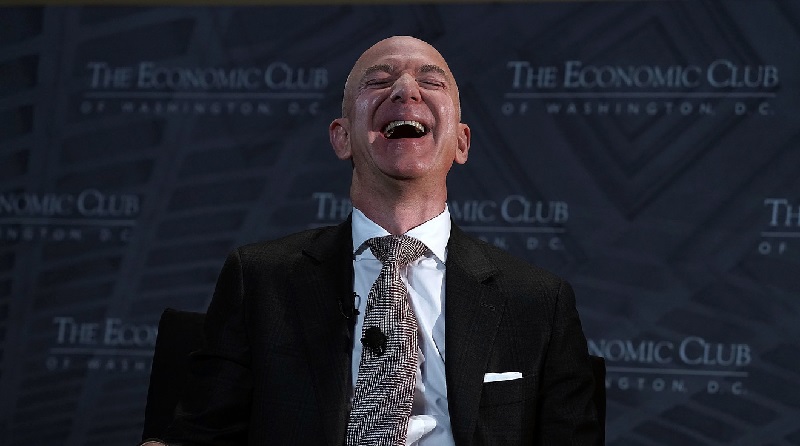
Imagine a Covid-19 lockdown without ecommerce. Magically, Amazon’s reputation before some politicians have improved significantly across U.S. and Europe as without Amazon, most might have struggled to execute their quarantine and social distancing strategies. Expect fundamental redesigns in the architecture of markets, post Covid-19.
Indeed, tech has won the hearts of many by providing critical infrastructures which have helped nations. Amazon offered grants to small businesses before governments. Amazon ramped down on profiteers before attorney generals. And Amazon prioritized essential goods even before governments could articulate strategies.
America runs on Amazon these days. By the time this pandemic is over, it is all going to be the United States of Amazon. Operational fluidity and peerless visioning process have won. Jeff Bezos runs a big part of America right now: Amazon is “calling up 100,000 troops, extending grants to small businesses, prioritizing essential goods, and cracking down on profiteers.” What again do you need a government for?
The world needs to educate some politicians on the balance technology brings. Sure, while there is a need for better regulation, yet, we must also understand that there is a fundamental advantage that comes with size. Without size, Amazon would not have executed this current playbook. This is not to write that we need only big firms!
The biggest deal right now is that Amazon cannot find enough workers to serve customers – and is no more accepting new customers on some of its product lines. Now, Amazon has a challenge: you must find workers and the politicians can help.
Africa needs bigger companies with capacities to fill the voids left by governments. Amazon is serving America big time, and Africa needs a blessing of that level. The promises of politicians are opportunities of markets. Big is not evil – we just need to ensure fair play by all.
Video Overview of Second Edition of Tekedia Mini-MBA

Tekedia Institute offers innovation management 4-month programs, optimized for business execution and growth, with digital operational overlay. To learn more about the programs and make payment, click here. This video explains the core elements.
In 33 Days: 1.3 million Internet Users Seek Information about Coronavirus Symptoms in Nigeria
Information is the blood and water of human beings and legal entities. For the two to thrive in various situations, Information seeking and sending must be prioritised. The priority, however, should not overcome verification of sources such as individuals or organisations before devouring the information.
In a crisis like disease outbreaks, people are more curious and eager to know specific information about the disease. Such information might include possible strategies and tactics for containment, treatment and vaccines or drugs. The report of Coronavirus in Wuhan, China, has changed people’s ways of seeking knowledge about health-related issues or needs in that last few months.
Various sources have been used for seeking and disseminating information about the virus. Medical experts, public affairs analysts and social commentators still believe that post-COVID-19 would strengthen the use of sources such as social networking sites and interpersonal channel by the people to express what they think, feel or experiment about different diseases as long as the media increase their attention through news to the diseases.
For instance, a recent study shows that people respond to the first report of COVID-19 by immediately seeking information about COVID-19. The study notes that they searched coronavirus, coronavirus symptoms and hand sanitizer using the Internet. This is not quite different from what happened in Nigeria on February 27, 2020. Immediately, the National Centre for Disease Control and the Lagos State Government announced the first index case in Nigeria, people’s attention shifted to understanding of the virus and how they could protect themselves from contracting it on February 28, 2020, a day after the announcement of the case.
Searching Symptoms Information
As at April 18, over 500 cases have been recorded, while more than 100 people have recovered. The trend is not limiting the people’s knowledge seeking about the virus through the Internet, especially among the people who access the Internet through mobile phone. In its latest report, the National Bureau of Statistics notes that “a total of 126,078,999 subscribers were active on internet as against 123,163,027 in Q3 2019 and 112,065,740 in Q4 2018. This represented 2.37% growth in internet subscriptions Quarter on Quarter and 12.50% Year on Year. Lagos State has the highest number of subscribers in terms of active internet per State in Q4 2019 and closely followed by Kano and Ogun States respectively, while Bayelsa and Ebonyi States have the least number of subscribers.”
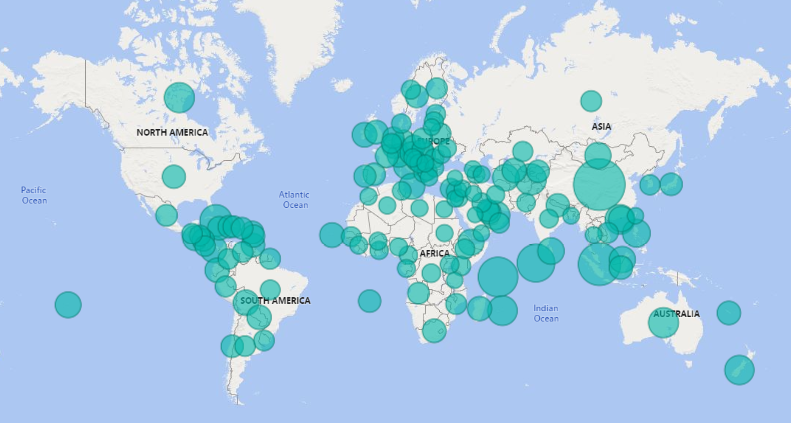
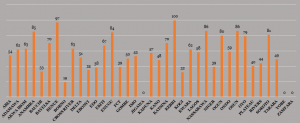
With these data, our analyst believes the subscribers must have searched specific information about the virus from February 27 to April 17, 2020. This is 33 days. According to the NBS, the total number of Internet users as at Q4, 2019 is 126,078,999. Using percent of normalised searches (0-100 threshold), we determined samples of the Internet users who sought knowledge about coronavirus symptoms between February 27 and April 17, 2020 [see Exhibit 1]. Our sample is 73,408,452. Out of this, we found 1.82% of the samples as the users who searched for coronavirus symptoms during the period. This represents a total of 1,336,033 people in 33 days [see Exhibit 2].
Exhibit 1: Coronavirus Symptoms Search per State
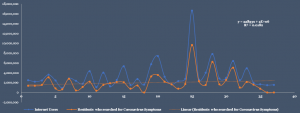
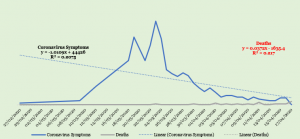
This is not encouraging considering the number of the Internet users (through mobile phones) per state, according to the NBS. Further analysis shows that the interest in coronavirus symptoms, confirmed cases and deaths grew at different degree of measurement. Our analysis establishes that the public interest in coronavirus symptoms and deaths followed the linear growth pattern, while confirmed cased grew exponentially. Our analysis suggests 20.7% linkage of interest in coronavirus symptoms with the examined 33 days. This implies that in each day, at least one search interest about coronavirus facilitated interest in coronavirus symptoms by 20.7%. It was 21.7% for deaths, indicating that report of death by the concerned authorities ensured public interest in coronavirus symptoms by 21.7% each day [see Exhibit 3 and 4].
Exhibit 3: Linear and Exponential Growths of Cases and Public Interest in Symptoms of the Virus
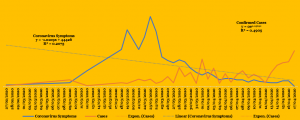
Exhibit 4: Linear Growth of Deaths and Public Interest in Symptoms of the Virus
Going Forward
During this period, our analysis suggests 5.6% growth in the number of cases with the implication that about 49 cases could be recorded from an infected person in the next 21 days. The insights from this piece indicate that concerned stakeholders, most especially the National Centre for Disease Control and National Orientation Agency need to intensify efforts on the containment of the virus through strategic public enlightenment messages. It is also important that contact tracing effort increases, while social distancing and lockdown approaches should not be abandoned by the government at state and federal levels.