DD
MM
YYYY

PAGES

DD
MM
YYYY

spot_img

PAGES

Home Blog Page 6465

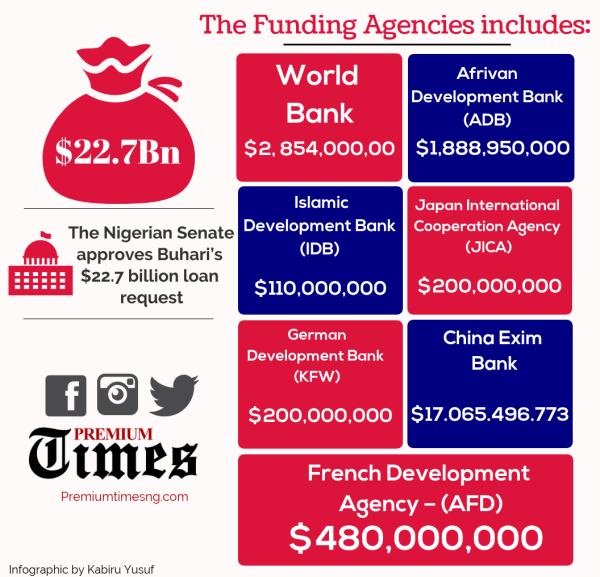
Why The Exclusion Of South East From Nigeria’s $22.7bn Loan Is Not Healthy

1

During a lecture on government a couple of years back, my professor dropped this line “… Government determines who gets what… “.

Regardless of the fact that, that practice can easily be observed in the acts of political leaders, and the fact that the man was a respected scholar, I couldn’t bring myself to subscribe to that line of thought. I resented it for the reason that it was very easy to just look at the reality that is  obvious and append ” … And whose interest end up being ignored…” to the man’s description. Doing so, the whole idea will read ” … Government determines who gets what … and whose interest end up being ignored “. That is the big problem.

The problem that such a practice creates isn’t just that those who ‘get’ are happy and those who are out-rightly ‘ignored’ are sad, angry, and resentful. Giving to one and out-rightly ignoring another expands the boundaries of inequality. It fuels restiveness. It rubs a society of the important opportunity that tapping into the talents of all its citizens affords. It fans the embers of disunity.  Are those not sufficiently disturbing problems? Should it not matter to a society not to be hell bent on creating multiple challenges for itself but to work hard in the direction of exploring its full potential in a sensible fair manner? As far as reason goes, the manner in which the $22.7 bn loan was allocated suggests something very bizarre.

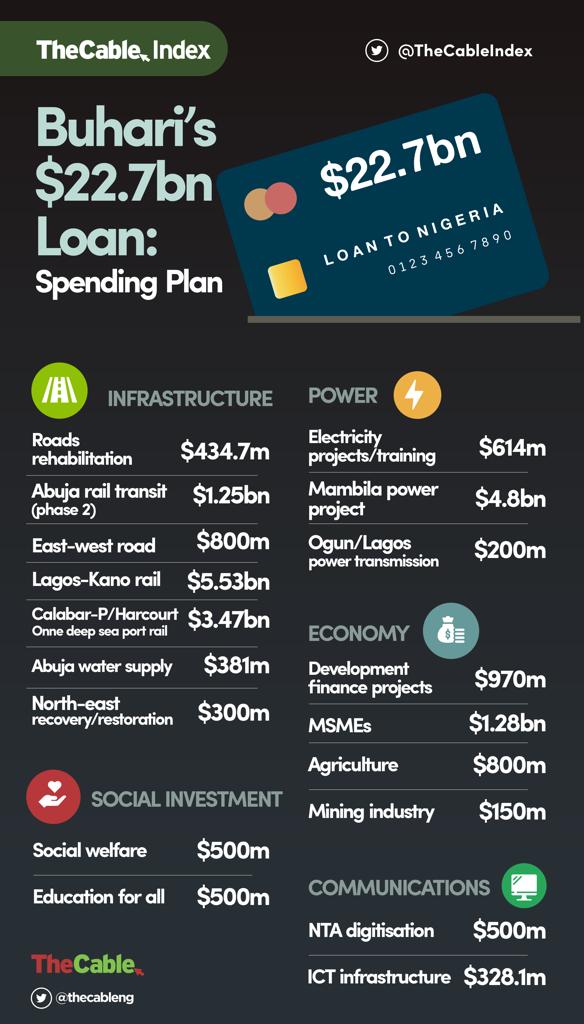
The table below shows the distribution of a 22.7 billion dollars loan to the various geopolitical zones of Nigeria.

Nigeria’s $22.7b Loan: Projects/Services By Political Zones.

1) South West:     $200,000,000.00

2) South South:    $4,270,000,000.00

3) South East:     $0.00

4) North West:    $6,372,000,000.00

5) North East:     $300,000,000.00

6) North Central:   $6,531,000,000.00

General:              $5,853,900,000.00

Source: Tekedia Network
A look at the above table should give anyone who cares the feeling “what does it all mean?” The answer to that question, no matter how fanciful it may be, won’t help the nation in the long term. That’s, if anyone cares  about long term.

It’s a clear fact that the world has undergone remarkable transformation over the past few decades. A transformation that is energized by greater acceptance of other people in spite of obvious differences, and by the drive towards freer societies, as well as by the enhancement of opportunity for all men,  women and children.

Just a couple of decades ago, Africa was at the receiving end of the worst form of exploitation that can be imagined. And throughout the rest of the world, discrimination made it so difficult for people of different races to support one another and work together to achieve the greater good doing so brings.

Given the sharp improvement in the world today compared to the sadder realities of the recent past, there’s a very straight forward lesson that can be easily learned.

Those who are hell bent on exploiting others in unfair ways, eventually keep themselves blinded to the opportunities that collaborating with those they exploit, on fair terms, could offer them to achieve greater milestones than is possible through unfair exploitation.

Just to clarify this point, I’m curious  as to why a relatively younger America became more powerful than its older colonizer. Doesn’t it seem reasonable to think that while the then unsustainable policy of ” Grab and grab all that can be grabbed ” of the European powers, placed on them a huge limitation, the willingness of America to support and expand opportunities for all it’s citizens helped it stay ahead?

It is hoped, in solidarity to Nigeria and to the call of senators from South East, for a review, that we don’t solely insist that government must be a tool for granting privileges and opportunities in such a way that, in a country of six regions, the interest of the people, of a particular region is ignored. Unless anyone who subscribes to the practice of otherwise feels that, it will be possible to bullet-proof the country from the dangerous depressions that marginalization  causes to a nation and its people.

The possibility of a greater and better Nigeria lies in prioritization of support for every citizen of Nigeria, regardless of their ethnic or political affiliation, to have the opportunity  to achieve a better, healthier life. It lies in not only making life better for the people of some regions, but in pursuing policies that fight for the wellbeing of every man, woman and child of all the regions in the country.

Nothing much will be gained by a country that works hard to keep its people angry, poor, underdeveloped and resentful. Because whatever practice that doesn’t uplift a nation ultimate retards its progress.

Week 6 Session is Live – Capital Markets,  Investing and Fundraising

0

Week 6 of Tekedia Mini-MBA – Capital Markets,  Investing and Fundraising is live in the Digital Board. A total of 8 videos covering capital markets, investing and fundraising.  All supported with a Written Material using Warren Buffett’s investing philosophy and many other constructs of modern investing. Bonds, debts, stocks, equities, etc are all covered along with a selection of active venture capitalists in Africa at the moment. Bringing it home, our capital markets expert, Azeez Lawal, used Aliko Dangote and Tony Elumelu, illustrating how they have built business empires via the capital markets. A lesson on Dufil Prima, the makers of Indomie, and how it has used capital markets to finance growth is a moment in class.

Meanwhile, on May 4, 2020, we will release a special series titled Winning in Business as earlier announced. Unlike our typical session which includes written materials, the series would be delivered via videos. To make it look like a time-limited meatspace delivery, the series will be available for 24 hours only. On the date noted, a link will become active on the Digital Board for Tekedia Mini-MBA members to access. Here are the topics:

  • Session 1 – Readiness for The Frictions of Nations
  • Session 2 – The SIX to Unlock Values in Markets
  • Session 3 – The Two Critical Playbooks
  • Session 4 –  Mechanics of growth & Investment Options
  • Session 5 – Finding the Edges and Market Opportunities
  • Deep Conversations – Answers to Big Questions

I wish you all a profitable week ahead.

Nurah Jimoh on the Place of Localisation Strategy and Progress Monitoring in SDGs Realisation

0
Nurah Jimoh

We have less than a decade for the attainment of SDGs. How would you describe global political and business leaders’ interest in the Goals since 2015?

Since the Commencement of the actualization of the Sustainable Development Goals in 2015, personally, I feel there has been great moves and interests shown by world leaders as well as Business leaders. My stand is guided by the Sustainable Development Report (2019) which showed that out of the 193 member states, 152 ranks above 50%. This impressive record wouldn’t have been possible without a direct or indirect influence of political leaders and business leaders globally. A study of actions in some countries like Sweden, Denmark, Finland, Switzerland and the likes reveals that the guiding tool or driving goal towards any developmental projects in these countries is one or more of the goals.

Sweden Leaders for example, had taken and is still taking several actions to meet up with the actualization of the goals come 2030. This is reflected in the appointment of Cross-Party Committee on Environmental Objectives with a mandate until 2020. This committee is so seeing to the realization of Sweden’s environmental quality. Another laudable action of the Sweden Government which I want to believe earned the country the top place in the ranking is the efficient and systemic follow up.

Country like Denmark is making progress on health, water, infrastructure and the likes. All these are manifesting because of the interest of the political leaders and to some extent business leaders in the goals.

However, there is need to state at this juncture that very few if not none of these countries are working towards all of the goals, that is, there is no uniform or overall performance in all the 17 goals. Most, usually focuses on one or two to the neglect of others. This is one area I would encourage political and business leaders to take note.

Have political and business leaders in Africa walked the talk since 2015?

Let me begin with a direct answer, No. African leaders have not walked the talk since 2015. In all the continents, Africa lags behind in the realization of the goals. Little or nothing can be shown so far, more than half of the population in Africa still lives below a dollar per day, a child born in Africa today still stands the risk of malnutrition, no access to quality education, good health services among many others. It is disheartening that our leaders are doing just talks with no matching walk. If we go by African leaders sophisticated and fantastic framework on the realization of the goals, we can say Africa is truly working, but reverse is the case.

Truly, our political leaders create offices and several committees to see to the actualization of the Sustainable Development Goals, but how effective are they. According to a report, (I cannot recollect the exact source) 22 African countries have a human capital index score of less than 0.4. This presupposes that a child born today in any of these 22 countries will be only be as 40% productive at 18 years of age as one who have access to quality education and health services.

According to SDGs Center’s Forecasters, All African regions are unlikely to meet up with the goals come 2030 save North Africa. Even, the little efforts that can be seen in Africa towards the realization of the goals are by Non-Governmental Organizations, not funded by the Government but by itself. It aches the heart seeing foreign organizations from other continents coming down to Africa to help alleviate poverty, reduce out of school children and many more, being frustrated by harsh and non-friendly government policies.

Once again, Africa political leaders have not walked the talk towards the actualization of the goals, I however believe that it is never too late, they can go back to the drawing table, set their goals straight and come back to walk the talk before 2030.

If Nigeria is going to realise the Goals, which of the Goals do you believe the country can attain considering the present environment?

On this, I believe the only goal the country can attain considering its current state for now is goal 16, which is peace, justice and good institution. Whenever I say this, people always look at me like of all the goals and what Nigeria is going through, why should it be this. Truly, goals like quality education, zero hunger, health should be Paramount in all countries but since 2015 Nigeria government has done little or nothing on these, we still have a lot of communities with poor educational system, we still have people with no access to health services and many more, so, why don’t we go back and restore the foundation. The country’s foundation which I believe will make all the goals achievable is goal 16. If there is peace, justice and good institution, everything good will fall in place. If you look at it from this angle too, it won’t require so much funding compared to others, and the funding part I want to believe is another reason the country is not showing much dedication to the goals. With peace, Justice and Good institution firmly actualized (goal 16) in Nigeria, I am of the believe that others will follow with ease.

You are part of the team working towards localising the Goals. What is your experience so far?

My experience so far has been interesting and fulfilling. You know, the fulfilment of seeing your action changing people’s view on a particular thing and at the same time they begin to act on it. Interesting, seeing that awe on people’s faces, in fact, communities’ leaders, when you begin to tell them about agenda 2030 and how they can act to see to it being achieved.

Currently, I am coordinating campus Ambassadors across over 120 tertiary institutions in Africa on localisation of SDGs. What we did first was to train them about SDGs, because from experience, I realised that most people, even the so-called elites, do not have sufficient information about agenda 2030. So, we trained them virtually, made them took an online certificate test on SDGs. After which we charged them to pick any of the goals and begin awareness and actions on it in their respective campuses. And I must say that it is yielding positive outcomes, some even went as far as getting the group registered in their campus as a campus group. Some campuses now have professors in their midst all seeking out to see to the actualization of agenda 2030.

I need to mention that my team has Community Leaders in all the 774 local governments areas in Nigeria with state coordinators who have been working to see that every villages, towns, communities and states in Nigeria feel the impact of one or more of the goals. Some youth corp members through our influence embarked on personal CDS in some Eastern states. Their little efforts added flesh to the localisation of SDGs in Nigeria. In all, the experience has been good, though with a little bit of risk.

As a woman and an advocate of the Goals, how would you describe the place of women in realising the Goals?

The place of women in achieving the Goals cut across all. Though, I am of the believe that if the battle against gender equality is won, then the impact of women will be felt more. The discrimination that is holding some women back is adversely affecting the entire goals too. Some women have the charisma, zeal and spirit but a form of discrimination or another is drawing them back.

Although, with the discrimination some faces, women still occupy a good spot in the campaign and actions on the Goals. We have more women as much as men, so I believe the place of women is significant and being felt in the struggle towards actualizing agenda 2030.

Which of the Goals would you say women are capable of helping political and business leaders attain? Why?

All of the goals. Women are natural caregiver, educator, and from history good leaders. If women, especially, those in the rural areas, are given a full-fledged opportunity, you will be amazed at how speedy the actualization of agenda 2030 will be. So, I believe, women can assist political and Business leaders to achieve all of the Goals, so far, the leaders do not allow gender discrimination to come to play.

Editor’s Notes: Nurah Jimoh is a legal Practitioner and an advocate on SDGs. She is an ardent supporter of Women’s Rights and empowerment; she has a special flair for Girl-Child which explain her moves on organizing awareness Programmes for girl-child on sexual abuse and many more. She is currently the Head of Programmes on SDGs at Brain Builders International.  Lagos Coordinator, Minimalist Women Nigeria, among others. She has volunteered and still volunteers for different NGOs.

As Kwara Achieves NMR target of SDGs, Expert Says Efforts on Others Not Enough

0

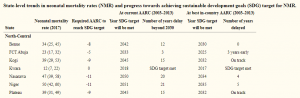
One of the researches published by the academics in 2019 indicates that the Kwara State is the only state in the North-Central region that has met the neonatal mortality rates target. According to the research, “some states are close to or have met both neonatal mortality rate (NMR) and under-five mortality rates (U5MR) targets, while others are projected to meet the targets as late as 2088 (58 years delayed). Between 850,000 and 1.89 million neonatal deaths could be averted between 2018 and 2030, while 3.1 million to 5.96 million under-five deaths could be averted over the same period.”

With this outcome, we sought the views of Nurah Jimoh, a legal practitioner and Head of Programmes on Sustainable Development Goals at the Brain Builders International, a non-governmental organisation propagating localisation of SDGs across communities in Nigeria.

Nurah Jimoh

“I must commend the efforts of the present political Government towards the attainment of the Goals, especially Goal 5 (gender equality). The current Governor of the state has 52.25% of his cabinet being women, several agencies are as well headed by women. This is a laudable effort, and there is no state closer to that yet in Nigeria, even in Africa. So, in Kwara State, I can state that the level of attainment of Goal 5 is impressive.

Moving to other Goals, the state is trying, although we are not there yet. I said the state is trying because of allocations directed towards health, education and efforts put in place by the government of the day to tackle poverty is reasonable. However, these efforts will be futile without a proper monitoring system and follow ups. This is one area I feel the state is not trying enough. So, in all, Kwara State is trying towards achieving the Goals, but it is not still enough to make agenda 2030 a reality.”

Exhibit 1: Kwara Performance in NMR

Source: Ogbuoji and Yamey, 2019