DD
MM
YYYY

PAGES

DD
MM
YYYY

spot_img

PAGES

Home Blog Page 6489

We Need a World Without Borders, Hammed Alabi Kayode Laments.

0

Can we just have a world without borders?

It hurts me when people are being denied movement because of their colour or any reason.

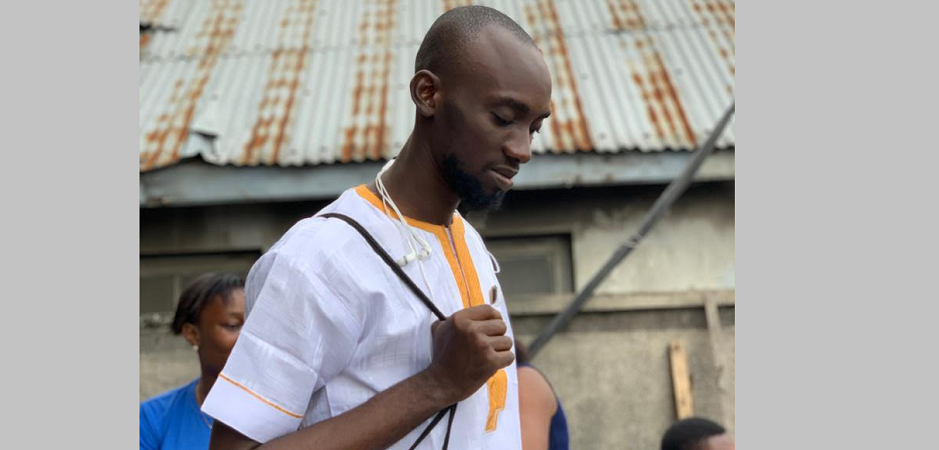
Hammed was a victim of this ugly scenario and he aired his disappointment with the Indian government.

Here’s what he shared with me:

Hammed, what’s the latest development about your travel to India?

I mean I have been selected as a young co-facilitator to facilitate a learning summit in India. I will be traveling alongside other young Co-facilitators from other countries but with what I am seeing, it seems I am the only young Nigerian traveling for the summit. My role at the Summit is to create action steps and experience that allow school leaders and teacher trainers in India to support young people in Punjabi to live holistically.

However, I am disappointed by my country’s visa policies as Indians do not accept E-visa for Nigerians despite what they do for other countries like Ghana, I think Mali. Others got their visas but I am just the only one who didn’t get it. A business visa takes 35 days before you can get it in Nigeria but in other countries, it is 3 working days. That is an Injustice. I shared a similar ordeal traveling to the UK last year.

I am very sorry this happened to you. What have you done towards this disappointment?

I mean I have sent several emails to the embassy, I didn’t get any response. I wrote on social media and tagged the Prime Minister of India and the Government of India but nothing pulled through. A connection connected me to the Ambassador. It seems something is going to work but I applied for a Business Visa and according to the rules I have to wait for 35 days. Honestly none of us is at fault and even the organizers but it’s Just my country’s foreign policies and not strengthening ties within countries. Nigerians go through hell trying to get a Visa. Most especially young changemakers working and changing their communities locally. Most times they get opportunities to travel and build more capacities. But Visa remains a stumbling block for them. One of my friends in the education and development space was recently not allowed to board in Turkish Airline because they felt she would run away. However, she has been cleared to get a visa on arrival in Tunisia.

That’s ridiculous Hammed. What do you think the government can do to ease this kind of problem in the future?

Nigeria has been a great nation that everyone respects even up till today. Nigeria is blessed and many different countries travel down here for many different reasons.

I think it’s important for the government to strengthen ties between nations and put structures in place that allows easy verification of citizens and build alliances that encourages international travels and easy visa processing. I think it’s a conversation we need to have or start having.

Visas to other countries have always been a problem and it’s a shame to our beloved country. However, how have you been able to manage the disappointment?

I mean it’s so painful that some of my dreams get clouded in visa.

However, I was doing something before the opportunities to make a global impact. I mean things happen and I can change the fact that Nigerians find it difficult to access some opportunities. The most important thing is to make Nigeria great again and be a country that others respect and value. And this is through the work that I do with children in rural communities. They will be the solution to many of these problems. So I don’t think about it too much. Yes I can be angry but I just move on.

You are always a changemaker my friend.  So what have you been up to since the visa brouhaha?

I mean I have been leading projects in different African countries through my work with Peace First. Proud to see what young people are doing to solve injustice in their communities from a young girl in Madagascar.

She’s working to ensure that Gender-based violence ends in her community and to a young Nigerian working to ensure people have access to good eye services. Supporting this project brings me joy and I am happy to be a resource to them and creating continental change. I will also be speaking at the Social Media Week on how we can harness social media to promote human progress. Excited about what will happen at the event. My organization KLCI is also planning some programs for children in rural communities and students to help them develop critical life and 21st century skills needed for the workforce.

You are a machine. I am happy to know you. What do you have to say to the government of India?

Thank you man. Nothing for real. Maybe they should give us an opportunity to also apply for an e-visa. Sometimes, it’s very stressful going through the embassy and many travels from different states because they have only two embassies.

Also, they should be an opportunity to expedite the visas, the U.K government does. There is also so much we can learn from each other. We have so many problems in common such as poverty, lack of access to quality education etc. We can leverage our Human Resources to create change and Visas should not deny us of the opportunities we can create within both countries.

Thank you Hammed for the information. I hope issues like this won’t occur again.

I mean it will still happen, so far we live in a world with borders. Maybe we need to review our meaning of global citizenship and global community and live by its value. I want to see a world without borders. I am very sure people will be scared of security and countries might be scared of losing their citizens however this is a call to make our nations livable for citizens most especially the Nigerian Government. So people would not have to migrate. However, my meaning of without borders reflects around ease of access to entry. So far verifications can be confirmed and done. There are a lot of lessons that can be learned from the United Arab Emirates, how ease of access has boosted their economy. Visas are easy to get and they monitor you once you enter their country. UAE remains a great example of a 21st century nation we can learn from. So let’s fix the gaps in our countries and ensure we solve our own challenges and then an open border can be advocated for. Not opening it down so dick and harry can enter. But again ease access for opportunities amongst nations. Business, trades etc.

Sounds good but can that be possible?

Maybe or maybe not.

Maybe the future generations would change it.

Where we respect humans and respect them, whether they are blacks or white and just treat them as humans 

Again, Visa would continue to be an issue, so far we live in a world with borders, we need to ease access to entry to foster collaboration amongst countries.

Thank you, Hammed, for the wonderful chat.

It’s always a pleasure, Chinedu.

The Joy and Challenges of being an Air Hostess. An interview with Chika Anucham

0

One thing is to go to school, and another thing is to stay relevant after graduation. Chika shared the joy and challenges of being an air hostess. I do hope the Minister for Aviation will do the needful.

Can you briefly introduce yourself to the audience?

I am Chikaodi Hannah Anucham. I am a graduate of Accountancy from the Lagos State Polytechnic and also a Licensed Flight Attendant with the Nigeria Civil Aviation Authority.

An accountant and an air hostess, how’s that combination possible?

Yes, it is very possible!

Growing up, I have always desired to be an Accountant but along the lines, my dream towards being an Accountant changed to being a Flight attendant after I finished my secondary school. But I didn’t know how to go about it.

No one around me got the idea, so I had to follow my Accounting path since it’s my parents dream to see me become an Accountant too.

Wow, that’s interesting. So how were you able to convince your parents about being a flight attendant?

It wasn’t easy convincing them because I happen to be the only daughter of my family. But then, what I am passionate about supersedes every other person’s decision.

That’s the spirit. So how did you find the journey, I mean, your transition from an accountant to an air hostess?

After my National Diploma, I worked with a Logistics firm as an account officer for 2 years which brought me close to having an idea on chasing my dream of becoming a Flight Attendant.

After I resigned from my position as an Accounting Officer, I enrolled for my HND in Accounting again as I wanted to complete my tertiary education. And as part of my findings towards being a Flight Attendant in Nigeria, you must be a highschool graduate because being a graduate gives you a high edge. So I got admitted to study Accounting with the Lagos State Polytechnic while working with a manufacturing firm so I can save up for my Aviation Course which I eventually did.

I graduated in 2018 and I also resigned from my job with the manufacturing firm in December 2018 to be precise. 

I later went ahead to attend a Cabin Crew mentorship class in January 2019 where I was given a proper insight of all I need to know about the job before I invest my hard-earned savings into it.

Having attended the mentorship class which was pioneered by Mamajaviation, I got to realise that the job is more than the glamour which people see. But then I already knew what I wanted for myself, so I took the bold step and registered for my aviation training which got me qualified for my licensing exam. I also worked with the Logistics firm from January 2015 to December 2016.

How about the exam, did you complete it?

Yes, I was able to write my exam with the Nigerian Civil Aviation Authority and I passed as I was meant to understand that if you don’t achieve a certain percentage, you can’t get licensed. And if you don’t pass the licensing exam after writing for 3 consecutive times, you are not entitled to getting a licence again.

Now that you have been certified, what has been delaying your dream of being an air hostess?

The answer to this question is quite complicated.

There’s one thing I can safely conclude and that is – the competition on the job is very much on the high side.

Less Airlines to recruit Flight Attendants with too many Licenced Flight Attendants seeking for a job. Also some airlines who recruit look towards experienced individuals. Thereby making inexperienced individuals like myself to keep applying while the experienced keep getting jobs.

What do you think is the way forward?

First of all, I implore the government to look into the current economic situation in the country as it’s the major factor affecting many airlines. While growing up, I learned about some airlines which today are not in existence again. The government should help create policies that will help airlines grow other than fold-up. When airlines grow, there will be room for employment opportunities but when airlines fold-up, it throws out experienced people out of their job thereby making the market more competitive for inexperienced Flight Attendants.

Also the Government should look into getting an agreement with foreign airlines towards coming down to our country to conduct its interviews as well.

I hope this will go to the appropriate quarters. Where do you see yourself in the next five years?

I have a believe that it will get to the appropriate quarters as the power of the Internet can never be underestimated.

Talking about 5 years from now, I would have acquired more training and certifications relevant to my career and will also love to be a voice for upcoming Flight Attendants.

I wish you all the best in your chosen career. Thank you for your time, Chika.

Thank you Chinedu. It is an honour to be interviewed by you.

The Nigeria’s CCTV Bill

0

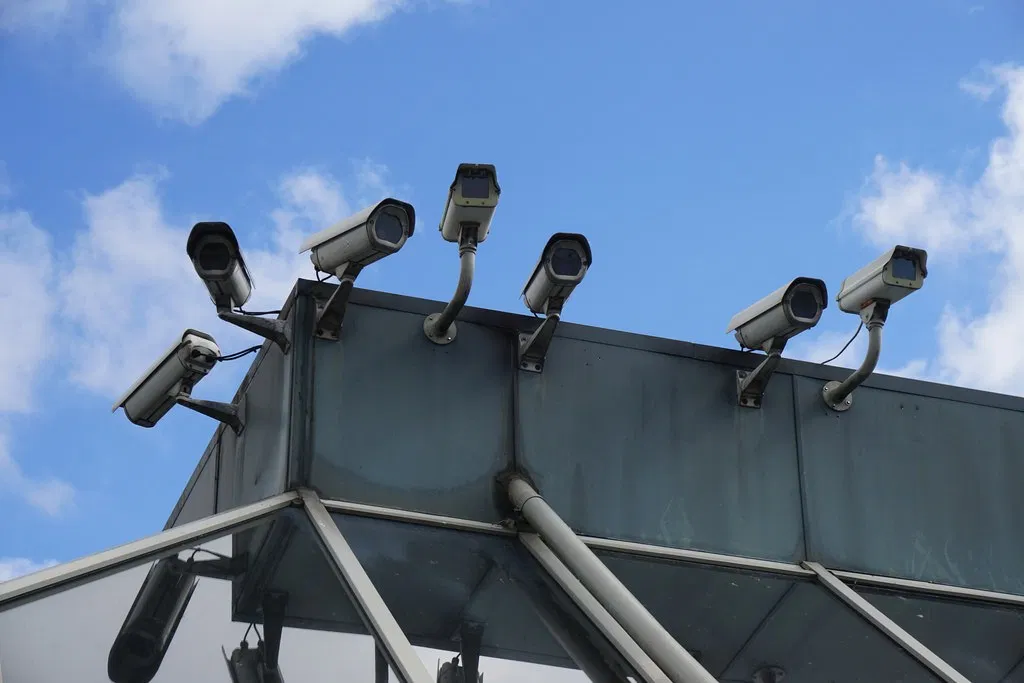
The Bill seeking to compel compulsory installation of Closed Circuit Television (CCTV) on private buildings and offices has passed second reading in the House of Representatives. The Bill was sponsored by Awaji-Inombek Abiante, with the title: “A Bill for an Act to Make Provision for the Integration of Private Closed Circuit Television Infrastructure into the National security Network in Nigeria.”

The objective is to keep the environment in check and help security agencies to solve cases of crime through a network of CCTV security infrastructure.

The Bill stipulates punishment of imprisonment and fine for any corporate organization or individual who fails to install cameras in his building or environs.

“Any company or organization in Nigeria that refuses, out of neglect, to install CCTV camera within and outside its premises is liable to a fine of at least N500,000 or an imprisonment of six months or both. Continual refusal to install CCTV camera shall attract a fine of at least N1 million or a year in imprisonment or both,” the Bill reads.

The Bill which was introduced late last year was part of the House of Representatives efforts to compel both federal and state governments to use cameras as means of fighting insecurity in the country. But it isn’t the first time Nigeria is taking a shot at security cameras.

In 2010, the Nigerian government awarded a $470 million contract for the installation of 2,000 cameras in Lagos and Abuja. About $400 million was provided by the Chinese EXIMBank for the Chinese firm, ZTE to execute the project. The Ministry of Finance and Police Affairs, and the Nigerian Communications Satellite Limited (NIGCOMSAT) came together to sign a tripartite agreement for the management of the CCTV cameras. The agreement holds the Federal Ministry of Finance as the borrower of the fund, the Ministry of Police Affairs was designated as the beneficiary while the Nigerian Communication Satellite Limited, was listed as the operator. The project was expected to be delivered by July 2011.

In October 2019, the House of Representatives was holding a plenary on the CCTV project. Nine years had gone since it was initiated and there were little sights of cameras in the Federal Capital Territory, Abuja, and the functionality of the few there are, is a bold part of the question. In Lagos, there were some cameras stationed here and there in some streets, serving the purpose of fancy poles only.

The House Committee on Finance has two questions: why are the cameras not working? And what happened to the $460 million borrowed for that purpose?

“Before this administration, we have collected some loans and the one that strikes me the most is the $460 million CCTV installation in Abuja,” Said James Faleke, the House Committee Chairman. “I want to know the position of this loan. I am sure we are paying back the loan but the CCTV is not working.”

He added: “Anytime we take a loan from China, the Chinese will come and do the job; they will bring all their equipment, the personnel and the goods, yet we do not have value for the money especially that of the CCTV.”

Nigerian government’s first attempt at security cameras appears to have ended in disappointment but not discouragement to have another shot at it.

In July last year, the federal government of Nigeria announced a plan to install cameras on major highways in the country. The cameras are to be augmented by drones to tackle incessant security issues around the country. While that is yet to materialize and the mystery of the $460 million CCTV project is yet to be unraveled, the House of Reps seems to have a better idea that will change things.

It is believed that the CCTV project failed because it is a government project. Government’s projects in Nigeria are known to have a high rate of failures owing to its explanation of many factors – mainly corruption.

In the recent turn of events, it seems that the national assembly is bullying private companies to step in where the government has failed, as the threat of fine and possible jail term suggest. Government CCTV chronicles show that there is a little chance that the federal government and states would implement the “Bill for an Act to Make Provision for the Integration of Private Closed Circuit Television Infrastructure into the National security Network in Nigeria” if passed.

Different Ways to Discover Great Product or Start-Up Ideas

0

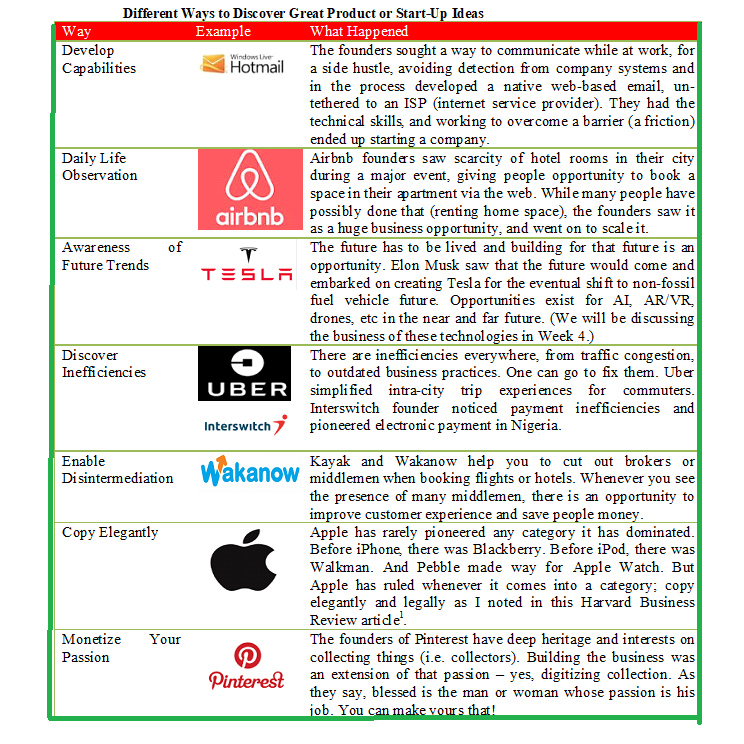
This table is from Week 2 material of our Tekedia Mini-MBA program. It helps you understand ways great products (for project champions in existing firms) or startup ideas (founders in new ones) can emerge.Credit to Harvard Business Review, Udemy, Forbes and Tekedia. Join us and register today.

How To Register: 

  1. PayPal: follow this link and pay $140 US dollars. Its supports most global currencies.
  2. Bank transfer (Nigerian naira): Pay N50,000 into any of GTBank 0114016493, UBA 1019195493. Account owner: First Atlantic Semiconductors & Microelectronics.
  3. Flutterwave: follow this link (naira) or this one (USD) to use your Verve, Visa, Mastercard, Amex, etc cards across Africa and beyond (you can use same links for other currencies, please ask for exchange rate before payment if not on Naira or USD).
  4. Automatic Access: Pay via this Tekedia link for self-automatic enrollment with username.

After payment, email tekedia@fasmicro.com with participant’s name and email to complete the registration.

Table 3.1: Different Ways to Discover Great Product or Start-Up Ideas

Way Example What Happened
Develop Capabilities Hotmail The founders sought a way to communicate while at work, for a side hustle, avoiding detection from company systems and in the process developed a native web-based email, un-tethered to an ISP (internet service provider). They had the technical skills, and working to overcome a barrier (a friction) ended up starting a company.
Daily Life Observation Airbnb Airbnb founders saw scarcity of hotel rooms in their city during a major event, giving people opportunity to book a space in their apartment via the web. While many people have possibly done that (renting home space), the founders saw it as a huge business opportunity, and went on to scale it.
Awareness of Future Trends Tesla The future has to be lived and building for that future is an opportunity. Elon Musk saw that the future would come and embarked on creating Tesla for the eventual shift to non-fossil fuel vehicle future. Opportunities exist for AI, AR/VR, drones, etc in the near and far future. (We will be discussing the business of these technologies in Week 4.)
Discover Inefficiencies Uber, Interswitch There are inefficiencies everywhere, from traffic congestion, to outdated business practices. One can go to fix them. Uber simplified intra-city trip experiences for commuters. Interswitch founder noticed payment inefficiencies and pioneered electronic payment in Nigeria.
Enable Disintermediation Kayak, Wakanow Kayak and Wakanow help you to cut out brokers or middlemen when booking flights or hotels. Whenever you see the presence of many middlemen, there is an opportunity to improve customer experience and save people money.
Copy Elegantly Apple Apple has rarely pioneered any category it has dominated. Before iPhone, there was Blackberry. Before iPod, there was Walkman. And Pebble made way for Apple Watch. But Apple has ruled whenever it comes into a category; copy elegantly and legally as I noted in this Harvard Business Review article[1].
Monetize Your Passion Pinterest The founders of Pinterest have deep heritage and interests on collecting things (i.e. collectors). Building the business was an extension of that passion – yes, digitizing collection. As they say, blessed is the man or woman whose passion is his job. You can make yours that!


[1] HBR- https://hbr.org/2012/05/when-you-cant-innovate-copy

https://www.tekedia.com/mini-mba/

What builds a Nation?

1

Many people or individuals think that money is the only thing or the only source of Building a nation.

Yes! It is true that money builds a Nation, but money is a particle created by man for a particular purpose. Sequel to this, before money came into existence, the research, law, idea and the experiment had been done by men before it was useful.

But before money builds a Nation there are some theories, laws and principles that can be carried out for the effective use of the money.

Now, thinking that money builds a Nation without knowing that there’s a mystery that behinds the growth,establishment and development of a Nation is an illusion.

What is the mystery? The mystery is the Mind.

What builds a Nation first before thinking or talking about money is the” Mind”.

A Nation can not be built without exercising the mind and the mental state positively.

If the mind is exercised positively in building a Nation, it will uplift the Nation, but If it is exercised negatively in building a Nation, it will lead to the downfall of the Nation and also the destruction of the Nation.

So, these show that before you achieve a particular thing in life you must exercise your mind, depending on the area you ‘re heading to.

Now, you can see that a positive mind comes with positive structures, plans, ideals and initiatives.

So, it shows that the budget of a Nation can be surplus which is the money, but if it is not managed properly by not applying the principles, theories and laws that behind the uses of money properly, the surplus budget can’t build the Nation. That explains why the mind which must be exercised properly.