DD
MM
YYYY

PAGES

DD
MM
YYYY

spot_img

PAGES

Home Blog Page 6491

How Nigerian FM Companies Can Protect People and Facilities from Contracting Coronavirus

1

The virus is spreading geographically with magnitude impact on people and businesses. Some public affairs analysts and economists have already predicted slow economic growth because of the ongoing stabbing of key sectors of the global economy. Global trade, tourism and stock markets have had shared of the infection. World airline market has been projected to record $30 billion losses. In the consumer goods industry, a brand in the United States has suffered loss of $170 million in two months because consumers are linking the brand with the virus.

To contain the spread of the virus, the World Health Organisation says world needs $675 million for the development of preparedness plans and a global response strategy. From Lagos to Ogun states and Cross Rivers to Ekiti states, there are have been a number of preparations by the state governments in collaboration with other stakeholders.

Despite the preparations, reports indicate that governments, health workers and built environment businesses need to increase their efforts towards the effective  containment of the virus. This piece offers insights that could be leveraged by facilities management service providers and professionals for the protection of people and facilities. This is essential considering the primary role of integrating people and technologies towards operational efficiency.

Demand-Side and Supply-Side Strategies

Before the confirmation of the first case in Lagos, Nigerians had the course for seeking information regarding the virus, most importantly specific symptoms. Apart from this, social and public affairs analysts had also explained the efficacy of the Federal government’s level of preparedness and response strategy with the mixed positions. The mixed feelings were largely premised on the poor health facilities across the country and a small number of health professionals who could respond when cases are detected, our analyst observes.

In line with the mixed reactions on the preparations and high expectation on protection at workplace and public places, it is clear that facilities management companies and professionals have a huge task to accomplish in places being managed, particularly in the development of appropriate strategies and management practices for maintenance  of critical facilities such as air conditioners, hard working tools and common rooms.

Exhibit 1: Flash Playbook for FM Companies and Governments
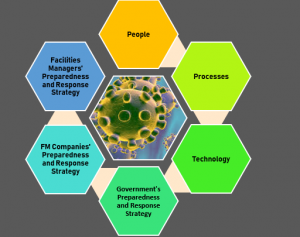
Source: Infoprations Analysis, 2020

As stated earlier, FM companies and their employees have the main task of ensuring performance of building and its facilities to the level that helps users meeting the required needs. Air conditioners are part of critical facilities being used by employees everyday. Whether indoor or outdoor air conditioning system, facilities managers need to keep the air in the system from drying out because study has indicated that low humidity levels increases the transmission and severity of the flu virus.

Delivering Supply-Side Strategies

As Lagos awaits the results of the confirmed case and those quarantined, FM companies need to leverage existing national and global information resources which include relevant facilities management standards, control and prevention measures, and the National Centre for Disease Control measures regarding isolation and transmission prevention in healthcare facilities for appropriate message development and the right communication channels selection for purposeful information dissemination to the facilities managers and clients’ workforce. This is necessary because of the need of decimating unverified information sharing about the disease.

Since it has been established that human-to-human transmission occurs when contact is made with the environment, FM companies must be more proactive in protecting their employees and others. The use of protective facemasks is a must. With this approach, FM companies and employees will compliment the goal of a patient-centric and healing environment for everyone expected at this critical period.

Though, the world is yet to find a cure for the virus, FM companies and professionals could leverage the results of a new study in addition to the insights offered in this article for possible protection of people and facilities from being victims of the virus. According to the study, “human coronaviruses such as Severe Acute Respiratory Syndrome (SARS) coronavirus, Middle East Respiratory Syndrome (MERS) coronavirus or endemic human coronaviruses (HCoV) can persist on inanimate surfaces like metal, glass or plastic for up to 9 days, but can be efficiently inactivated by surface disinfection procedures with 62–71% ethanol, 0.5% hydrogen peroxide or 0.1% sodium hypochlorite within 1 minute. Other biocidal agents such as 0.05–0.2% benzalkonium chloride or 0.02% chlorhexidine digluconate are less effective.”

Recommend Yourself If You Want To Be Recommended

0

It’s fair to understand a stranger whose response to you appears cold. This sort of understanding is even more so, if she or he knows little or nothing about you that should make her/him to be more responsive. It’s natural for people to try to be careful. And everyone tries to be.

Unless we make ourselves known to an individual, it will be difficult for the individual to cooperate with us when we seek such cooperation. And to have another person’s cooperation, we need to make ourselves likeable. No one will easily cooperate with another individual she or he doesn’t like.

How we can make other people appreciate what we are and be willing to support what we want to accomplish, forms the central subject of this discussion.

During a recent call with my undergraduate younger sister, I told her “…You shouldn’t just think that everyone out there exists to do you a favour without your input. You must understand that you have what it takes to be nice; show solidarity; and treat others kindly which will make it easier to have their support, when required…”.

Whether we’re dealing with physical persons or with strangers we meet online, there are things we can do to build rapport. One of such is to show solidarity if we find what they are doing interesting. And the benefits of lending one’s voice to issues that matter to those one seek to work with and that of offering useful suggestions to those that may find it helpful, cannot be overemphasized. Doing so goes to show who an individual is, and what  he/she can do.

It’s unhelpful to assume that people you are meeting for the first time are going to figure out who you are or what you can do on their own by looking at you. No. “We’re not defined by who we are inside but by what we do”. Physical appearance may give a clue. But such clues can’t be as loud as the impression made by spoken words or deeds. You need to make who you are to be obvious. You need to make those whom you seek to support you or cooperate with you to understand what you can do. It is worth repeating that no assumed clue can speak louder than the actual deeds done to show what you’ve got or what you can do.

Sometime ago, there were five persons including myself who were sent to assist an institution (JSS Gagarawa), as social workers for a defined period. We resumed our duties and things were moving on fine. Our relationship with the staff was good. Over time, I approach the director of the organization to discuss some plans I had come up with, which I felt will very much make things better in the organization, if carried out. While sitted with Mr Nasiru Yahuza, the director of the institution, I first carefully asked a few important questions, that I felt answers to them will help me understand how his organization views doing necessary works that are outside of one’s routine assignment. It surprised me that while answering my questions, he brought out a file from his cabinet and showed me a list of individuals that have, in the past, carried out projects, outside of their normal roles, that made things better in the institution. It surprised me because nobody has said such a thing to our team. 

Nobody even demanded that we do anything outside of our normal duties. What can one sensibly say was the reason nobody in the organization discussed such things with us? Well, it suffice to say that from that day, the director, I and other stakeholders were able to fix the gap identified in my proposal within six months. That singular extra effort, earned me an important friendship with him. That friendship is still active till date.  That was not all.

One of those days, prior to the end of our assignment in the organization, he called me and asked if I was available for outing, I told him I was available. He arranged and had me introduced to their community head and some other important personalities in their locale. Honestly, during one of those visits, I even felt I was being given far more treat that was due me for the good job the other stakeholders and I did. Fast forward to when I was required to provide recommendations from three referees, I naturally requested Mr Yahuza to be one of them. When I told him what I needed, he said “When do you need it K.K”, I provided the date, “Send in the full address of the recipient” he added. That was all that was discussed on that subject. His recommendation was sent to where it was destined to go and I got a copy from him through email.

The point being made is that, we don’t have to assume other people know what we can do without them being made to see it by us. We have to let them know who we are and what we can do.

 This is especially important for young people who are in need of assistance to start their career journey. The social media has helped us to potentially become so closer to each other from any part of the world, that we can even get professional support from someone we have never seen before, except that we happened to connect with them through the help of the internet.

In this regard, simple things like following (online) someone whose position and interests can be of help to you, showing solidarity with what they do (especially if that interest you), lending your voice where it will be useful or finding courage to speak on subjects you care about…, can help build a sort of closeness with the individuals you seek to have their attention. And that’s not a hard way to go about recommending yourself to those whose support will matter to you. That would have helped you, over time, to prepare the ground for you to ultimately Introduce yourself formally and make your request without sounding awkward.

All Hail The Category-King: GTBank’s N231.7 Billion PBT

3

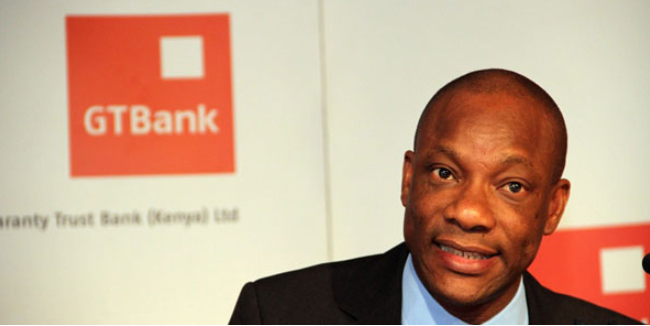
Walahi, GTBank sabi how to make money. Biko, what language do I use to explain how a bank in Nigeria took home N231 billion last year, before taxes. People, GTBank is amazing and certainly the category-king in the Nigerian banking sector. In the U.S., its stock would open tomorrow by at least 5% up. But you may be surprised, as typical in the Nigerian Stock Exchange, where there is no correlation between instant news and equities movement, nothing will happen. Of course, over time, markets equilibrate.

GTBank CEO Segun Agbaje has done well especially when you consider how he has kept cost-to-income ratio below 40% for ages now. His term expires next year and then we will see what happens. The next CEO will have to work on one thing: boosting market cap as that remains GTBank’s recent problem; all the record profits have failed to boost the stock value. 

How can a bank that rains profits be losing market cap this way, from high of N1.3 trillion to less than N700 billion in two years? Do not tell me fintech hangover or MTN listing. They need a revelation on that paralysis. But meanwhile, congrats to GTBank team.

The press release below…


Guaranty Trust Bank plc has released its audited financial results for the year ended December 31, 2019 to the Nigerian and London Stock Exchanges. 

A review of the results shows positive performance across all financial indices, reaffirming the Bank’s position as one of the most profitable and well managed financial institutions in Nigeria. Profit before tax stood at ?231.7billion, representing a growth of 7.5% over ?215.6billion recorded in the corresponding year ended December 2018. The Bank’s Loan Book grew by 19.0% from ?1.262trillion in December 2018 to ?1.502trillion in December 2019, while customers’ deposits increased by 11.4% to ?2.533trillion from ?2.274trillion in December 2018.  

The Bank maintained a well-structured and diversified balance sheet with Total assets and Shareholders’ Funds closing at ?3.759trillion and ?687.3Billion respectively. Full Impact Capital Adequacy Ratio (CAR) remained very strong, closing at 22.5%. In terms of Assets quality, NPL ratio improved to 6.5% in December 2019 from 7.3% in December 2018 while Cost of Risk (COR) remained flat at 0.3%. Complementing the improvement noted in NPLs, the Bank maintained adequate Loan Loss coverage of 126.6% for Lifetime Credit Impaired Loans (NPLs) compared to 105.1% recorded in December 2018.   

Commenting on the financial results, the Managing Director/CEO of Guaranty Trust Bank plc, Mr. Segun Agbaje, said; “At GTBank, we exist to provide excellent service to our customers and generate the returns that our shareholders expect. Our strong financial performance in 2019 demonstrates that we are delivering on both fronts. We achieved healthy growth across all our major businesses despite varying degrees of uncertainty and volatility, and we are making progress in positioning our business for long-term growth in the face of a rapidly changing competitive landscape.” 

He further stated that; “Underpinning our strong financial performance is our commitment to being there for our customers when it matters most. That is why, powered by the fundamental strength of our brand, and guided by our strategy of putting our customers at the centre of everything we do, we will continue to design and deliver financial services that not only solves our customers’ real pain points but also leaves them better after every interaction.” 

Guaranty Trust Bank plc continues to be best-in-class in the Nigerian banking industry in terms of financial ratios i.e. Post-Tax Return on Equity (ROAE) of 31.2%, Post-Tax Return on Assets (ROAA) of 5.6%, and Cost to Income ratio of 36.1%. These ratios reflect the experienced Management, and efficient Balance sheet structure coupled with operational efficiency of the Bank. The Bank is proposing final dividend of ?2.50k per unit of ordinary share held by shareholders in addition to interim dividend of 30k per unit of ordinary share bringing total dividend for 2019 final year to ?2.80k per ordinary share.                                                                                                                       

In recognition of the Bank’s bias for world class corporate governance standards, excellent service delivery and innovation, GTBank has been a recipient of numerous awards over the years. Some of the awards include Best Bank in Africa and Best Bank in Nigeria, by the Euromoney Magazine (2019), Best Banking Group and Best Retail Bank Nigeria from World Finance Magazine (2019), Bank of the Year – Nigeria from the Banker Magazine (2018), Most Innovative Bank from the African Investor (2018), and Best Digital Banking Brand in Nigeria from the Global Brands Magazine (2018).

COVID-19: China May Lose Its Place in the Global Economy

0

Chinese economy continues to plunge amidst the scourge of coronavirus. The Asian giant has had a handful from business to life losses, and it is threatening to cripple its economic power, setting the country up for a future full of uncertainties.

From tourism to manufacturing, China is helplessly watching unprecedented decline in its economy, instigating concern that the South Asia country may lose its status as world leading economy.

The National Bureau of Statistics (NBS) reported the recent decline in the manufacturing sector that has added to the woes that the country is putting on a fierce battle to contain.

According to the report, China’s official manufacturing Purchasing Managers’ Index (PMI) dropped to 35.7 in February from 50.0 in January, below the 38.8 figure reported in November 2008.

The non-manufacturing PMI – a gauge of sentiment in the services and construction sectors, also dropped to 29.6 from 54.1 in January, the lowest since November 2011.

The figures are scary because the scourge is still much at large and there is no solution in the coming weeks. Experts had predicted 45.0 for the month of February which ended up a bit higher and sent a warning of expectation for the worst.

Ren Zeping, chief economist at Evergrande Research Institute said the movement of the negative impact should be monitored as a step to curtail its escalation.

“The economy experienced huge negative growth in February, the trough has been reached, the duration of the impact should be monitored in the next step,” he explained “It is the time to call for new infrastructure to turn the crisis into an opportunity.”

The index shows a worrisome decline in export, import and employment. China’s export order sub-index dropped to 28.7 from 48.7 in January while import fell to 31.9 from 49.0. In the manufacturing industry, production plunged 27.8 in February from January’s 51.3, reading for new orders nosedived to 29.3 from 51.4 in January.

Within the manufacturing industry, employment went down also following the steps of others. There was a decline of 15.7 points from January’s 47.5, an indication of slowed activities in the import and export space. Though experts said the situation is partly due to manufacturers finding it hard to recruit the exact workforce they need for specific roles, the high input price hub attributed it to high cost of manufacturing spurred by the disruption in the supply chain and distribution of logistics as a result of coronavirus.

“The pressure of imports and exports mounted over the manufacturing sector… some surveyed companies said that they had faced more order cancellations and delayed delivery,” Zhao Qinghe, senior statistician at the NBS said.

But he also expressed confidence that the coming month of March will yield positive results: “PMIs are expected to improve in March. The work resumption is ramping up and the market confidence is steadily recovering,” he said.

While focus has been on the manufacturing industry, other sectors of the Chinese economy are suffering greatly. The NBS said the automotive and specialized equipment industry were hit hard.

“There was a plunge in demand for consumer industries involving gatherings of people, such as transportation, accommodation, catering, tourism and resident services.

“Although the new coronavirus pneumonia epidemic has caused a larger impact on production and operations of Chinese enterprises… currently, the epidemic has come under initial containment, and the negative impact on production is gradually weakening,” the statement from NBS said.

Traditionally, companies in China close for the Lunar New Year celebration at this time of the year, but the period has been extended due COVID-19. Chinese businesses have found it hard to resume and it is having a negative bearing on the economy. The business activity expectation index was 39.7, from 58.7 that it was in January.

The economy is expected to show a weak growth in the first quarter of 2020 from the 6.0 percent where it was in the fourth quarter of 2019, the lowest growth in almost 30 years, mainly due to the trade war between China and the United States.

China has been noted to be defiant about the situation of its economy as a result of coronavirus impact. The country said the impact of COVID-19 will not affect its 2020 social economic goals. But Liang Zhonghua, chief macro analyst at the Research Institute of Zhongtai said the economy has been in trouble long before the outbreak of coronavirus and its impact will likely go beyond the disease.

“Looking forward, there is still a lot of economic loss that can never be remedied, even if the epidemic has passed. The mid and long-term impact of the epidemic cannot be ignored,” he said.

While the Chinese government appears to be downplaying the effects of the epidemic, private data is reporting a situation bleaker than what the government’s projection is saying.

February’s business conditions index compiled on Wednesday last week by Cheung Kong Graduate School of Business (CKGSB) in Beijing, showed an all-time low drop of 37.3 from 56.2 in January, a massive decline in a short period which tells of futuristic misfortune for China.

While China battles to bring its economy back to track, a whole lot of factors are at play stymieing the efforts. The inability of workers to get back to work, the country’s debt pile that is at $34 trillion as of 2019, and may likely incur a heavy increase at the end of coronavirus.

Though the Chinese government has rolled out a series of financial measures to keep the economy afloat, which includes lowering borrowing rate, loan extensions, tax reductions and waivers, and an injection of RMB 200 million, it will only minimize the impact. The gap that coronavirus has created in the manufacturing industry and other sectors of the economy will need quite some time to be bridged.

Experts said that if the “recovery time” lasts longer than it should, it may create room for another country to take China’s place in the global economy. A little more push and the EU or Japan will find their places above the once south Asia bubbling giants, that’s, if these countries are spared the uncontaminated oxygen to make the needed push since they are all fighting to survive the coronavirus epidemic.

On the High Rate of Fake News on Social Media

0

On Friday, 28th February, 2020, a screenshot of alleged news presented on AIT Facebook page went viral. In that screenshot was the face of a dark man and some write-ups claiming that the man in the picture (a Yoruba judging from the name provided) was the Nigerian that took the Italian man, who was recently diagnosed with COVID-19, to Ogun State. The ‘news’ claimed that the man, after testing positive to coronavirus, escaped from the hospital and threatened to infect many Nigerians with the deadly disease unless he is paid the sum of N100m. Whoever that wrote that ‘news’, supposedly the AIT, appealed to the general public to look out for and avoid the man whose picture was in the article.

When I saw that post, I didn’t know what to make of it. I know anything is possible in Nigeria but I found it hard to believe that someone could play such a stunt. So I took it with a pinch of salt and waited for more ‘news’ on the man.

The awaited news came in the form of a video that showed this same man addressing the public, saying he had never been to Lagos for the past two years. This man said he is from Edo State and that he has been with his family all these while. He even said he was with them when he received the rumour that he drove the white man to Ogun State and that he tested positive to the virus. From what he said, you can deduce that the picture was his but the name wasn’t. Anyway, what the public cares about is the picture and not the name.

AIT has denied posting this news and has issued a disclaimer, but then the damages had been done. This left some questions unanswered, which include, “Who spread that news?” “What was his/her intentions?” “How did they get the pictures and the names?”

The problem of fake news on social media didn’t start today. It is common on Facebook (just as this present one was also sent into Facebook). Years ago, one of my Facebook contacts complained that her friends noticed that she had different Facebook accounts with different names. She went in search of ‘her’ different accounts and truly found them. She screenshot like five of them and posted them for us to see. We saw the profile pictures and they were truly her pictures. We searched those accounts and saw that the people that opened these fake accounts monitored her seriously and ensured that all her picture updates were copied into those fake accounts. In fact, you will believe these accounts were hers except that her names were different. Whoever that went into the pains of creating those accounts obviously had some fraudulent intentions in mind.

This sort of thing is also becoming rampant in WhatsApp. The one they do in WhatsApp is actually hacking into people’s accounts and using them to beg money from their contacts or transact illegal businesses. A WhatsApp contact of mine recently sent messages across to his contacts stating that all should ignore any pornographic news or posts sent by his number because he just heard that some people are using his identity to advertise pornography and pornographic sites. He later found out that his account was hacked by an Italian tech company and all.

But the one that is more destructive, in my own opinion, is that which involves purporting fake news and inserting someone’s name and pictures to it. Or where true stories were told and your picture used as the “file photo”. Imagine waking up one day only to see your face plastered all over social media and a story that sounded like something from the moon told about you. The shock of hearing that you did what you didn’t do is enough to mess up your whole day. Believe me, things like these are damaging to the personality of the person who was “lied against”.

But that still hasn’t solved the issue of “who coined those stories and for what reason.” A lot of people may claim that the stories were made up by the ‘enemies’ of the person slandered. In as much as this is the only logical answer, I still want to call our attention to the fact that some people are just mischievous. It could be that, that viral news on the Uber driver that transporter the coronavirus victim was brought up out of mischief or it could be that the target wasn’t the man whose picture was plastered there. It is possible that the perpetrator of this wicked act was targeting AIT so as to drag them to the mud for damaging someone’s dignity. For that I think AIT needs to explain better how such news could be released on their page without their knowledge.

How to Avoid Being a Victim

It is almost impossible to avoid being a victim to this malicious act. You never can tell who the devil will send your way to tarnish your image. And avoiding using social media outlets still won’t save you. But you can take some precautions to minimise the chances of being the victim.

  1. Be mindful of Your Photos: Getting someone’s picture is easy in social media, so there’s no need wondering how they did that. But one has to be careful with the kind of picture one puts up in social media. A girl on Twitter, some weeks ago, complained of a picture of her sitting with her girlfriends in a night party, or just girls’ hangout, was used as a file photo in news that told about some girls that went to night club and one or two things happened. Her picture was obviously chosen because she and her friends were scantily clad and the picture background matched the purpose of the message.
  2. Be Predictable: Some people are easily predictable, concerning what they send into social media and the lives they live outside it. For instance, if this man that said he wasn’t the Uber driver wasn’t predictable (I don’t know if he is, anyway), there’s no way he will claim not to have been to Lagos for the past two years and people will believe him. In the same vein, my contact that sent out warnings about his account being used to advertise pornography wouldn’t have been warned by his friends if he had a shady life. This is just to say, that if people can predict what you can do, and what you will never do, fake news about you can easily be refuted by them before it even gets to you.
  3. Send out Regular Disclaimers: This might sound funny but it helps. Whenever you see people claiming they didn’t do something or that they wouldn’t do something, don’t think they weren’t serious. Sometimes it is good to remind your contacts that they should be approached by ‘you’ for some transactions, they should call you first, hear your voice and verify that it was you. Otherwise, someone can use your identity and collect loans from people that know you. You should also be fast enough to disclaim any fake news about you. Don’t wait for it to linger because you believe that very soon people will forget. They may forget at that time, but you don’t know what it might lead to in the future.

Those people that easily circulate news articles that landed on the inbox need to verify to be sure what they are about to post out is authentic. For me, the easiest way I check authenticity of any news is to read national dailies such as Punch newspaper and co. But a lot of people are more in a hurry to post out “breaking news” than to be sure the news won’t bring them embarrassment.

But then, everyone needs to be on alert. Don’t assume that you are safe because it could be your turn tomorrow. Keep alert and always send out disclaimers to your friends to keep reminding them that you will not do anything to jeopardise your integrity.