DD
MM
YYYY

PAGES

DD
MM
YYYY

spot_img

PAGES

Home Blog Page 6502

Achieve the Extraordinary and Think Possibilities in 2020 and Beyond

0
Usain Bolt

The word “extraordinary” comprises of two simple, but important words- “extra” and “ordinary”. I would want to describe it as putting in the extra effort to turn your desired result from ordinary to extraordinary. To achieve extraordinary feats implies doing things differently to achieve unique results. If others are putting in eight hours a day, for example, to achieve success, you can put in ten hours a day to achieve extraordinary success. Never underestimate your capacity to achieve the extraordinary. All things are possible to those that believe! If others have done it before, then you can do likewise and even surpass boundaries and break new frontiers this year and beyond. 

We must be careful not to create self-made barriers on our way to achieving our goals in life. You must be careful what you believe about yourself, especially if it is negative and self- limiting. The only thing that can hinder you from achieving the extraordinary is yourself. A Research carried out in 2016 by the International Coach Academy Australia showed that any thought, belief, notion, or idea that is believed for long becomes programmed in the mind and ultimately becomes self-destructive. So many individuals believe that because of their poor family background, sex, age and geographical location they cannot succeed. Truth is, our limitations are not external; our limitations are internal.

Stop creating mental roadblock on your path to achieving the extraordinary. No one gave the Wright brothers (Orville and Wilbur) any chance of creating an object that could defy the force of gravity and fly. But they proved everyone wrong by inventing the world’s first airplane. Their record-breaking feat was achieved on December 17, 1903. They never allow people’s opinions to sway their self-belief. They never doubted their potentials and entered the Guinness World records with their record breaking invention.

To achieve the extraordinary, one must think the absurd; to look where everyone else has looked, but to see what no one else has seen. Barack Obama, the 44th president of the most powerful nation on earth, was never given any chance to enter the White House because many felt he was black. He brushed those sentiments aside and achieved the most extraordinary feat in U.S electoral history. He became the very first black American man, to win a presidential election in the United States of America.

Achieving the extraordinary does not usually come on a platter of gold. People will definitely want to discourage you. Internal and external circumstances may conspire to stop you from attempting to do the extraordinary. It takes raw courage and a tenacious spirit to brave all odds and go where others are too scared to go. Breaking new frontiers in any field is never a tea party. It is hard work and patience mixed with an unwavering spirit. 

If others don’t believe in you, you got to believe in yourself and your abilities, and you will achieve the extraordinary! Remember, until the first man got to the moon, nobody believed that such a lofty mission was a possibility. Neil Armstrong, however, achieved the extraordinary feat on July 20th, 1969, by landing on the moon. It was a historical moment that nullified the general concept of such expenditures. 

So many individuals have had their dreams and aspirations cut short because they were told it wasn’t possible to achieve such extraordinary feats. What they were not told is that life only rewards the brave. Life does not reward the fearful. 

The only impossible journey is the one you were too scared to undertake. You can never know how far you can go in life except you try. Just because others failed to achieve certain goals in a particular field, doesn’t mean you cannot succeed in the same field. 

Examining The Translation of Science Textbooks into Hausa

0

I needed some information on our education sector, so I went in search of Nigerian education news in the internet. To be honest, I was so surprised and impressed by what I saw. I told myself that a lot of funds and supports are pumped into our education sector, yet our public schools refused to improve.

The height of this surprise came when I saw an article on the translation of English science textbooks into Hausa. This feat was done by a team of translators from Bayero University Kano (BUK). Sincerely, I read something about this textbook translation last week but it was on someone’s personal Twitter page, so I didn’t take it seriously. But seeing Punch newspaper’s coverage of an interview with the secretary of this team changed my perception immediately.

Some people may wonder what’s so spectacular about the translation of science books into a Nigerian indigenous language. This group of people will say that other languages of the world teach science without the English language, and they are right. But we haven’t had it done in any of the country’s 500 languages, so the fact that some people have started it is something to commend.

However, there are some genuine concerns raised by Nigerians and I think they need to be addressed as soon as possible, though I will explain the concerns related to my profession.

Correctness of the Content: The first time I saw this textbook translation of a thing on Twitter, one of the comments made on the post was related to how someone can ascertain that these translations were correct. In fact, the most hilarious comment on this said, “You sure say na science textbook they translate?”

Of course, I don’t blame people for being suspicious of this new development, but I want to assuage their fears by letting them know that copies of the translated books have been sent to Nigerian Educational Research and Development Council (NERDC), an agency in charge of curriculum and book developments in the country. This means that the matter will be well taken care of.

Translation of Non-Existent Words: Someone said something about Hausa language not containing most scientific terms. For example, a question was asked by someone on what the Hausa term for “Pythagoras Theory” is. This sounds hilarious but it’s true that scientific terms are foreign to Hausa language, though I don’t speak it fluently. The truth is that no language has names for all the concepts in the world. In a case like this, what has to be done is to borrow from the source language (English) into the target language (Hausa), and then modify the terms so that they abide by the rules governing the target language. This is why linguists and grammarians should be part of this translation project. However, I was glad when I read the interview of the team’s secretary and found out that they employed this method of word formation process in their translation project.

Usage in Nigerian Schools: This is actually where I have my reservations. In as much as I encourage the learning and the use of Nigerian indigenous languages, I still acknowledge that Nigeria needs English because that’s the only language that can unify the 250 Nigerian tribes and the 500 indigenous languages.

Some people worried about these books being made compulsory in schools in the North as against their English counterparts. This part really touched me because if this is done, most non-Hausa speaking students and teachers (including corpers) will be cut off. Not everybody in the North speaks Hausa, even though a majority of their inhabitants do.

This isn’t supposed to be an issue but some comments made by Abubakar Yusuf, the Secretary of the BUK team of translators, shows that they have this in their game plan. According to him, they have started the process of making Hausa the language of science in the Northern part of Nigeria up to the tertiary level. To support this goal, he cited China and Germany as countries that teach sciences in their indigenous languages.

If I start giving reasons on why I found Mr. Yusuf’s statement disappointing we won’t leave here. As I mentioned earlier, English is the only language that unifies Nigeria and that is one major reason Nigerians can live and work in any part of the country without hitches. Making Hausa language of science in the Northern part of the country is indirectly telling non-Hausa speaking Nigerians that there is no teaching jobs for them.

As for lecturing with Hausa at the higher institution level, it means that only Hausans can study science related courses in the North. This is a way of dividing this country intentionally. We all know that children go to primary schools within their vicinity but start moving away from home from their senior secondary school. Telling them there’s no place for them in the North, well, is just the same as saying that Northern Nigeria isn’t Nigeria after all.

Then coming to the use of China and Germany as examples of countries that teach with their native languages, I want to make it clear here that these countries are not English-speaking countries, though they spend heavily to learn English as a third language. In other words, they have their books written in their own national languages. That China made Mandarin its language of education and science is because that’s its national language and, according to statistics, is spoken by 955 million out of the 1.21 billion Chinese citizens living in China. As for Germany, German is spoken by 95% of its citizens, and that is its national language. In Nigeria today, how many Nigerians speak Hausa?

It is good that BUK Centre for Research in Nigerian Languages, Translations and Folklore made out time to find ways to make teaching and learning easier and interesting for students. But they shouldn’t create more problems in their bid to solve an existing one. Left for me, I will suggest that these translated books be used as supplementary books for teachers and students. Let it be like a reference book where teachers and students can consult to get more clarifications on subject matters. Making them primary textbooks for use in teaching and learning will not solve the high level of illiteracy in the country.

I will also enjoin other universities in different parts of the country to pull off stunts like this to help in teaching and learning in their domiciled states. We need more indigenous science books, especially in Mathematics and Chemistry.

N100 Naira Flip – Why Below $1 Is Sweet Pricing Spot for Most Consumer Products in Nigeria

1

You have launched that service/product in Nigeria, and all the models are falling off. Just because of extra N100 ($0.30), no one cares to experience that great service you are bringing. Yes, for many, saving $0.30  is exceedingly important because times are hard. In my model, I expect just about 32 million to be earning income in Nigeria. These 32 million will support the other 170 million people. Because the incomes most of these 32 million earn are severely out of livable wage variance, they have no room for extracurricular living styles. Your premium, comfort, etc experiences are nonsense: man (woman) wants to just survive today.

In Nigeria, only 17 million people were paying taxes when I first put my piece [it is now 19 million using latest data]. I believe the informal sector players do earn income even though most do not pay taxes to government – I estimated the non-paying tax number to be 13 million to arrive at 30 million. Also, if you look at the number of bank accounts in Nigeria using the bank verification number (BVN), you will be in the neighborhood of 35 million. While not everyone that has a bank account earns wage, there is a very huge overlap that the 30 million makes sense.

[…]

Yet, my model is not really about the number of people on paid employment, rather the cohort within the addressable market for mostly non essential items. So, food and medicine will always have the full population of 200 million as target market while non-essentials like movie streaming can only attract from the 30 million. With government bringing extra 2 million people into the tax-fold, I can update that 30 million to 32 million people now.

Pricing is everything in Nigeria. And if you get it right like Bigi Cola and Indomie noodles, you will find market glory. Any mass consumer product that costs more than $1 in Nigeria would struggle to thrive because if most people earn $3 daily, it does not make sense to put $1 in one product (our minimum wage for federal workers is $2.7 per day). Check Indomie, Bigi Cola, Ariel, and many successful brands, you can always get them with less than $1 in one way or the other.

So, how do you do it? You break the package, making it easier to reach more people. In transport, eating mama put, and practically anything, do not neglect the delta of $0.30. It is this mass challenge that makes lending startups coming up well; people need their services irrespective of the rates (see this nice table from Techcabal)

During the Tekedia Mini-MBA, our experts would be explaining how to win in markets through efficiency on pricing and other elements. Register today.

Lending Rates in Nigeria (source: TechCabal)

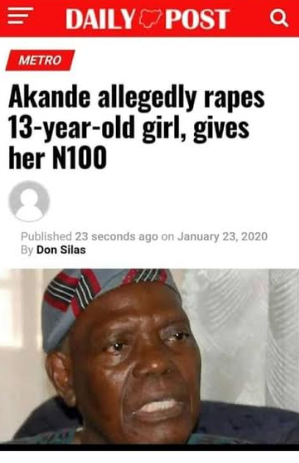
The Catastrophic Consequences of Daily Post’s Use of Chief Bisi Akande’s Picture in a Rape Case Report

0

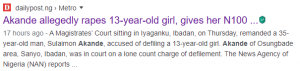
“A Magistrates’ Court sitting in Iyaganku, Ibadan, on Thursday, remanded a 35-year-old man, Sulaimon Akande, accused of defiling a 13-year-old girl. Akande of Osungbade area, Sanyo, Ibadan, was in court on a lone count charge of defilement.” That was how the journalist and editor of the story started the story that has changed Nigerians’ line of thoughts on responsible and irresponsible journalism in the last few hours on the virtual and offline spheres.

Exhibit 1: News Snippet

Source: Google, 2020

Our checks indicate that the story has been pulled down by the medium. It was discovered that the page in which the story was earlier domiciled has changed to “Error 404”, a popular phrase that usually came up when a post has been deleted by the owners from the backend of websites. Further check after the initial check in a space of 2 hours, a statement on the top of the medium website’s main menu reads “This page (https://dailypost.ng/2020/01/23/akande-allegedly-rapes-13-year-old-girl-gives-her-n100/) is currently offline. However, because the site uses Cloudflare’s Always Online™ technology you can continue to surf a snapshot of the site. We will keep checking in the background and, as soon as the site comes back, you will automatically be served the live version.”

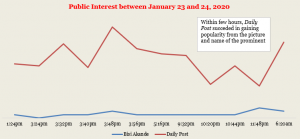
Exhibit 2: Daily Post’s Gain

Source: Google Trends, 2020; Infoprations Analysis, 2020

While conducting the checks, we discovered that the medium sought the report through the News Agency of Nigeria. Further verification shows that the report is not on the agency’s website as at the time of writing this analysis. Since the report was published with the picture (as feature image) of Chief Bisi Akande, a prominent politician in Nigeria, particularly in the South West region, professionals and public analysts have continued to discuss the medium’s action within amateurism, negligence and incompetence that have corrupted the Nigerian media space in the last decade.

On Nairaland, Nigerian social medium, a concerned citizen, says “That’s a grave error in journalism and the height of sensationalism. Using his name in the headline is bad enough, why put his picture.”

Our analyst observes that the medium’s action has further emphasised why the public would continue to lose interest in news reports as journalists and media owners linger on fielding the public information and expect them (readers) to fill in the details from their imagination. The public now have another good reason to describe Nigerian media as gutter press, media event, yellow journalism and flash & trash.

The Emerging Risks

One of the greatest risks of publishing news such as the one examined is easy consumption of falsehood and misleading information by the public, which has the tendency of fueling crisis in the society. If not because the majority of Nigerians know that Chief Bisi Akande would never involve in such act, the level of interest had about him between 1:24pm on January 23 and 6:20am on January 24, 2020 should have been enormous than what was discovered by our analyst. Throughout the world, poor reporting and bad journalism have had and still have irreversible damages in forms of reputation loss and killing of innocent.

Revisiting the Processes and Upskilling People

From the insights, it is clear that there is a need for revisiting processes being used by journalists and news media owners for news production and publication. It is also imperative to ensure adequate training for reporters and their editors towards responsible news production that left no one behind in working for mutual social and political goods in Nigeria. Teachers in universities and other higher institutions, where Mass Communication is being offered as a course, should take the advantage of the recent unbundling of the course and develop appropriate course contents capable of redirecting many journalists to responsible journalism path.

It is high time that stakeholders should use the same prism being adopted for understanding Medicines, Engineering, Law and other related courses seen as critical to society in all ramifications for Journalism and Media Studies. Students and practitioners need to acquire a broad knowledge of activities and emerging trends in journalism and media world.

African Startups Raised US$1.34 Billion in 2019

0

How much did African startups raise via venture funding in 2019? Very challenging question.  Disrupt Africa has US$491.6 million while WeeTracker has US$1.34 billion. Yes different reports with two different amounts. That is typical in our continent. I have shared both for you to decide which one is closer to reality.

Yet, the reports are not wrong.  What happens is largely how the data people classify the companies. A report can include a firm founded in America as an African company because it does most of its businesses in Africa. Another report would exclude such a firm because even though it is operating in Africa, it is not African. Because I am a Nigerian, and we like big suits, cars and only-in-number big GDP, I will go with the higher number! Not doing that will make people feel bad here.

But some things converged well: Nigeria and Kenya are the action countries, and fintech remains the sector of choice.

Disrupt Africa  – US$491.6 million

The year 2019 was a record-breaking one for African tech startups, with 311 companies securing US$491.6 million worth of investment.

For the fifth consecutive year, Disrupt Africa is releasing data on the tech investment ecosystem across Africa, contained in the “African Tech Startups Funding Report 2019”.

The report details how Kenya and Nigeria emerged as the premier investment destinations on the continent in 2019, attracting US$149 million and US$122 million in funding respectively. Egypt continued its development into a major continental tech hub, with more startups from the North African country securing investment than anywhere else. South Africa’s growth slowed, according to the report, which also contains in-depth data on the investment landscapes in Ghana and Uganda, as well as an overview of activity in 13 other countries.

The number of investors in African tech startups jumped by 61 per cent to reach 261.

Sector-specific research shows the fintech sector remained the most popular among investors, though its share of total funding fell to 21.8 per cent as other sectors, notably logistics, transport, e-commerce, agri-tech and e-health, enjoyed bumper years.

WeeTracker – US$1.34 billion

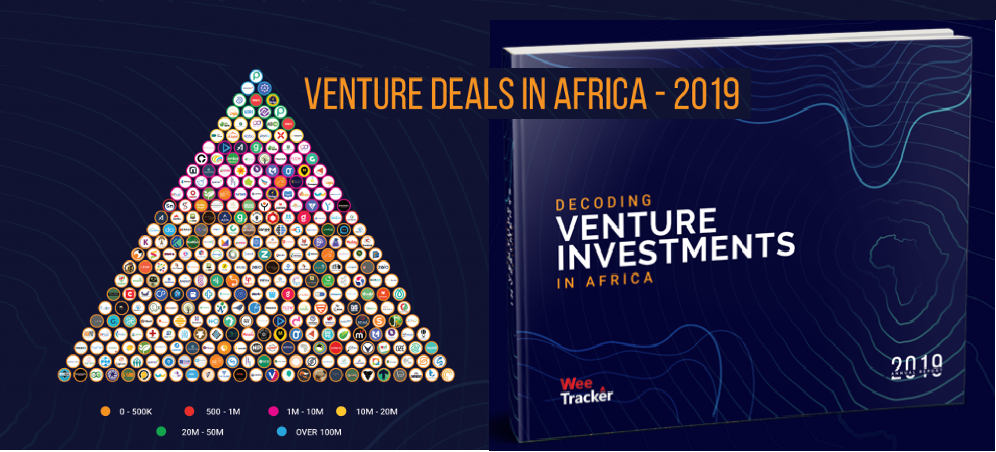
African startups attracted a record high of $1.34 billion in venture capital during 2019, with fintech seeing $678.73 million alone, according to WeeTracker.

Its Decoding Venture Investments In Africa 2019 Report found that 427 startups raised funding throughout the year, and a mere 6% of these accounted for 83% of the total investments.

Over 75% of the deals were in Nigeria, Kenya and South Africa, the report found, with fintech continuing as the sector that attracted the most funding.

Nigeria led the investments with $663.24 million, followed by Kenya and South Africa.

Kenya had 283.64% growth over the previous year’s funding amount, WeeTracker found. Nigeria and Kenya accounted for $1.09 billion or “a whopping 81.49% of the total VC money raised in Africa”.

In 2018 African startups raised $725.6 million, and $203 million in 2017.