DD
MM
YYYY

PAGES

DD
MM
YYYY

spot_img

PAGES

Home Blog Page 6504

The Fundamental Ride – Making Profits The New Investors!

2

Jumia is exiting some markets in Africa. Uber Eats has been eaten by Zomato in India. Glovo, the Spanish on-demand delivery platform is exiting Egypt. If you check these companies, one thing is clear: they are looking for a path of sustainable profitability. Businesses must make profits to be going concerns. While revenue growth is critical, a very fundamental element in business is a company’s capability to make profits. Without profit, a company dies, over time.

Oscar Pierre, the co-founder and CEO of Glovo, commenting on exits, said, “This has been a very tough decision to take but our strategy has always been to focus on markets where we can grow and establish ourselves among the top two delivery players while providing a first-class user experience and value for our Glovers, customers and partners.”

“Leaving these four markets will help us to further strengthen our leadership position in South West and Eastern Europe, LatAm and other African markets, and reach our profitability targets by early 2021. I want to place on record our thanks to all of our Glovers, customers and partners in the markets from which we’re withdrawing for their hard work, dedication, commitment, and ongoing support,” Pierre added.

I am sharing this because the playbook is changing rapidly as investors update their strategies, demanding from founders and CEOs a clear path to the desired destination: I have funded this company, now I need you to show me how you can be weaned from more outside capital and be a real business. That is a message every founder needs to hear right now. It is global and even more awakening in Africa. We need to be aware that our gestation period to profitability in Africa is long, and that requires exploring ways as early as possible to make money. When no further funding can be guaranteed, profits must become the new investors!

While you may think that raising capital may help you, most people have noticed that you can raise capital and still crash. Think of Efritin which just gave up on Nigeria. It happens daily. They think that market growth is the solution when the path to profitability is what matters [path to profitability may not matter to a U.S. founder because they have massive sources of new capital. We rarely have here].

Yes, your new business problem in Nigeria is not just capital but the long gestation period required for profitability, affected by many factors at scale.

Meanwhile, Jumia has a new boss in Nigeria. Massimiliano Spalazz takes over from Juliet Anammah who moves to Chair position of Jumia Nigeria.

Dealing with Long-Profit Gestation in Nigerian Startups

Update: You can add Lime (a scooter company) in this club of “finding profitability”.

Lime is hoping to achieve profitability this year by laying off about 14% of its workforce and ceasing operations in 12 markets, as first reported by Axios. CEO Brad Bao told us, “Financial independence is our goal for 2020, and we are confident that Lime will be the first next-generation mobility company to reach profitability (Techcrunch newsletter)

Megxit: The Price Harry and Meghan Paid for Their Freedom

0

The British Royal Family has come to terms with the decision of Prince Harry and Meghan Markle, the Duke and the Duchess of Sussex. This is coming after all parties sat on a table and talked about the announcement made by the Royal couple that they are stepping back from their roles as senior members of the royal institution.

At the break of the news, The Queen has appealed for calm and understanding as the family was trying to work things out with Harry and Meghan. The couple had announced that they will be living between North America and the UK in pursuant of independent life, but will keep the values of the Royal Family.

Part of the deal announced by the family is that Prince Harry and Meghan Markle will drop their royal titles – HRH, and would be addressed henceforth as Harry, Duke of Sussex and Meghan Duchess of Sussex.

They will also repay the 2.4 million pounds spent in renovating the Frogmore Cottage home. They are allowed to make whatever commercial deals they want as long as the monarchy values are not compromised.

The following agreement marks the conclusion of talks with the royal couple. After outlining the dos and don’ts of the agreement, The Queen was pleased that they were able to work things out with the couple. The statement issued by Buckingham Palace reads:

“As agreed in this new arrangement, they understand that they are required to step back from Royal duties, including official military appointments. They will no longer receive public funds for Royal duties.

“With the Queen’s blessing, the Sussexes will continue to maintain their private patronages and associations. While they can no longer formally represent The Queen, the Sussexes have made clear that everything they do will continue to uphold the values of Her Majesty.

“The Sussexes will not use their HRH titles as they are no longer working members of the Royal Family. The Duke and Duchess of Sussex have shared their wish to repay Sovereign Grant expenditure for the refurbishment of Frogmore Cottage, which will remain their UK family home. This new model will take effect in the spring of 2020.”

Part of the agreement is that Harry and Meghan will henceforth pay 360,000 pounds for the use of the Frogmore Cottage.

In a personal statement, The Queen thanked the couple and wished them well as she respects their decision to pursue an independent life.

“Following many months of conversations and more recent discussions, I am pleased that together we have found a constructive and supportive way forward for my grandson and his family.

“I recognize the challenges they have experienced as a result of intense scrutiny over the last two years and support their wish for a more independent life.

“I want to thank them for all their dedicated work across this country, the Commonwealth and beyond, and am particularly proud of how Meghan has so quickly become one of the family. It is my whole family’s hope that today’s agreement allows them to start building a happy and peaceful new life,” the Queen said.

Meanwhile, Prince Harry has issued his first statement on the matter since the announcement. At a dinner for Sentebale, the charity he started with Lesotho Prince Seeiso, in 2006 to help orphans with AIDS, he said the decision will not affect his family relationship, even though it’s a painful one.

“I’ve accepted this, knowing that it doesn’t change who I am or how committed I am. But I hope that helps you understand what it had come to, that I would step my family back from all I have ever known, to take a step forward into what I hope can be a more peaceful life.

“I was born into this life, and it is a great honor to serve my country and the Queen. When I lost my mom 23 years ago, you took me under your wing. You’ve looked out for me for so long.” Harry added that media is formidable force that needs to be tamed with sincere care for each other.

“But the media is a powerful force, and my hope is one day our collective support for each other can be more powerful because this so much bigger than just us.

“I will always have the utmost respect for my grandmother, my commander in chief, and I am incredibly grateful to her and the rest of my family for the support they have shown Meghan and I over the last few months.”

However, there are yet some issues not included in the agreement, one of them, the security of the Sussexes. The cost of the couple’s security is at the tune of 7.6 million pounds, and it’s likely going to be funded by taxpayers’ money.

This is a turning point in the British Royalty and the British people are accusing Prince Harry of disrespecting the Institution just to please his wife.

The Planned US Travel Ban – The Nigerian Diaspora Remittance Under Siege

0

A new list has emerged of countries that the Trump administration is considering adding to the already existing ones on its travel ban. The controversial travel ban came into play as soon as Trump assumed office, and it affected mainly Muslim countries.

It has been three years since the travel ban took effect and according to Politico, White House will announce the additions to the list on the third anniversary of the original order. The new list of countries cuts across three continents: Sudan, Tanzania, Eritrea, and Nigeria in Africa; Kyrgyzstan and Myanmar in Asia; Belarus in Europe.

According to the Wall Street Journal, “the administration plans to place visa restrictions on seven new countries: Belarus, Eritrea, Kyrgyzstan, Myanmar, Nigeria, Sudan and Tanzania. The countries wouldn’t all face blanket bans on travel to the US, but could have restrictions placed on specific types of visas.”

What is not clear is the reason behind the selection of the recent countries enlisted. The first list of countries under the travel ban has been made up majorly of Islamic nations on the basis that they foster and harbor terrorists who would eventually get to the United States and cause mayhem.

Trump signed the original travel ban on Jan. 27, 2017. But the order was met with severe opposition and court challenges, forcing the administration to modify the list. The Supreme Court eventually allowed a third iteration to go into effect, restricting Iran, Libya, Somalia, Syria and Yemen along with North Korea and Venezuela from entry into the US. The amendment removed Chad from the original list.

Trump administration has firmly defended the travel ban. White House spokesman, Hogan Gidley said the original ban has been to protect Americans from terrorists, but refrained from saying anything about the motive behind the new ban.

“The travel ban has been profoundly successful in protecting our country and raising the security baseline around the world. While there are no new announcements at this time, common sense and national security both dictate that if a country wants to fully participate in US immigration programs, they should also comply with all security and counter-terrorism measures – because we do not want to import terrorism or any other national security threat into the United States,” he said.

The new list is made up of countries that do not fall in the same category with the first; some of them are notably in good relationship with the US. The intriguing turn of events has raised some questions that its answers could be found outside the alibis of terrorism.

For instance, Politico noted that “Nigeria is a US counter-terrorism partner and the country has a large diaspora community in the United States.” Evidently, the faux behind the move has gone beyond terrorism and bilateral ties. Politico pointed out that in the past, Trump has made reference to Nigeria as a sh..hole country who he doesn’t want their citizens in the US.

The New York Times once quoted Trump saying: “If Nigerians come to the US, they will never go back to their huts in Africa.” There is an indication that the indictment of Nigeria is as a way of Trump getting back to Buhari for the excesses of his administration concerning human rights, free speech and religious tolerance. It could be recalled that in 2018, during a White House meeting between the two presidents, Trump has warned Buhari that if the religious persecution of Christians in Nigeria doesn’t stop, he will do something about it.

However, US travel ban is a development that Nigeria will find hard to cope with now. The country’s economy has been for long augmented by remittances from diaspora. According to data published by the Nigerian Bureau of Statistics (NBS), Nigeria received $96.5 billion in remittances from diaspora in 6 years. The highest volume came in 2018 at $25.08 billion, signifying 126% increase in 6 years.

The remittances represent 5.74% of Nigeria’s GDP as at 2018. Analysis  by PWC shows the inflow will like rise from $25.08 billion in 2018, to $34.89 billion in 2023. The inflow came mostly from Nigerian residents in the United States. The projected increase by 2023 was based on the number of Nigerians who are likely going to leave Nigeria in search of greener pastures in developed countries, mainly the US.

Although the restriction will make room for some types of visa applicants, with a travel ban in place, the future spells doom for dreamers whose hope for a better life depends on immigration to the United States, and for Nigerian Government whose economy is a beneficiary of Nigerian immigrants in the US.

Things South-West Stakeholders should Consider before Fully Launching Amotekun

5

When I did my youth service in Zamfara, we were more afraid of Hisbah than the Nigerian police. In fact, in Zamfara State, saying that police is your friend is true. Then, if anything comes after you, you are sure the police will rescue and protect you if you manage to get into their barracks. But if Hisbah comes for you, just kneel down and pray for supernatural help because no one can rescue you.

This is just to show how strong and influential Hisbah was between 2004 and 2005 that I was in Zamfara. They were an authority of their own; a force no one toyed with. Hisbah was more than a religious police; it was Zamfara State’s security service. It worked independently and carried out its duties viciously.

I am stating all these not to attack Hisbah but to show that there is a security outfit in Nigeria that is not answerable to the police and any Nigerian military authorities, nor does it work hand in hand with them. Hisbah has its own modus operandi, which does not favour other citizens of the country, especially those that aren’t from the state they operate in. They follow a law that is foreign to many Nigerians and do not hesitate to judge, condemn and punish anyone that does anything prohibited by that law; your origin, religion and duration of stay won’t help you here.

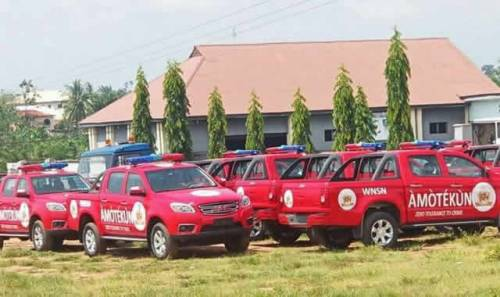
Now, we are facing the birth of another security outfit called Western Nigeria Security Network, aka Amotekun. I, personally, am not against Amotekun but I have some reservations concerning its staffing and method of working. From what I gathered, this outfit will work hand in hand with the police and other national security outfits. They are more like the neighbourhood police, the vigilante, or, like we say in Anambra, “Police Willy” or “Police Eliza”.

It is ok, very ok, if Amotekun will liaise with the national police and the Nigerian Army, Airforce and others. But how sure are we that they will stick to this? What are they actually going to do? Arrest and detain suspects? Or do intelligent works and pass on information to the police for further action? These and many more are the things the masses need to know from the South-West state governors so that they, the masses, will know whether to join forces and demand that the federal government approves Operation Amotekun.

However, my little Zamfara experience has taught me that power, when not properly handled, can become intoxicating and destructive. To ensure Amotekun doesn’t become destructive later, these governors should ensure the following:

  1. Staffing Amotekun with people of integrity. We know how things work in Nigeria. Every politician and “Big Man” will want his brother that is wasting away in the village to be employed as an Amotekun so that he can fend for himself. I’m not against people helping their own but in this type of outfit, integrity and discipline must come first. This is just to say that no matter who that person that sent an unfit to be recruited is, the recruiters should reject him (the unfit) right away. You don’t give guns to people with instabilities.
  2. Training Amotekun staff on emotional intelligence. This is one area that is very important. In fact, this is more important than training them to use guns. If these people do not know how to restrain themselves during the heat of an argument, then Amotekun is going to end up a disaster. The gory stories of how Hisbah officials flogged those that resisted arrests in those days haven’t left my memory.
  3. Ensuring Amotekun does not have a holding cell. I don’t know the plans the South-West governors have for this outfit, but building holding cells for it will only end up increasing our problems. This is because it will create room for illegal arrests and detentions. And it will also encourage bullying and extortions. Let every arrest made be channelled to the police station, that is, if they are to arrest people in the first place.
  4. Making provisions for constant training and grooming. Training these people once and releasing them into society isn’t enough. They need to be constantly trained and retrained by experts. If there is no provision for such, and it is not certain if such a provision will be made in the future, well, I think the stakeholders need to sit back and rethink. You can’t release a leopard into society without taming it every now and then. Failure to do so means you and your loved ones will one day become its prey.

There are so many things to be considered but I believe the Yoruba elders will look into them all. I may not be from the South-West but I know something will definitely take me there every now and then. What I wouldn’t want to experience is the type of tension, restrictions and harassment I met in Zamfara State. If Amotekun is there to secure the lives of every respectable, hardworking and honest Nigerian living in the South-West, irrespective of tribe and religion, then I am all for it (but they have to be well trained anyway). But if it is there to compel citizens within the geopolitical zone to live according to a law that is foreign to every Nigerian citizen, then there is need for serious deliberations on the matter.

Healthcare Issues That Affect the Whole World

0

There isn’t a place on the planet that isn’t experiencing some kind of lack when it comes to healthcare. Deterioration of culture and healthy environmental factors have big influences on how healthcare is being treated all over the planet. No matter the modernity or wealth of a country, healthcare, in all environments, is being affected more by financial gain, capitalistic healthcare, and growing health concerns for a global population. 

Here are some of the most concerning lapses that we are seeing in the healthcare world today. These issues, left unchecked, have the power to change humanity and our evolution. These healthcare issues are being faced by every country and population on the planet.

Clean Water and Sterile Environments

Although we like to think these two things are available in most parts of the world, much of the world still struggles to obtain clean water and sterile environments during procedures. These two things are important for sterilization, hydration, and preventing infection. This is still a problem for hospitals even when they are considered sterile environments. There is no way to completely sterilize an environment without sealing environments. The simple act of doctors, nurses, and patients interacting makes that complete sterile environment impossible. 

In modern industrialized cities and towns, a surgical supply store can keep healthcare facilities stocked with packaged sterile supplies. This can be counted on to keep microbes and bacteria off the instruments and supplies until they are opened. Many places around the world do not have access to these supply centers.

Birth and Postpartum

Birth and the time right after birth, called postpartum, are some of the most influential times in a woman and baby’s life. It is considered a very natural and sacred time that, in many cultures, is seen as a medical condition. In other parts of the world, it is still something done at home, far away from medical training of any kind. In either scenario, there are health concerns that can deeply affect the mother and baby for many years. 

In modern society, postpartum is often overlooked as modern-day stressors quickly take over. The repair and rest needed for a new mother is meant to be so that the body can recover from the intense trauma it goes through in labor. When rest and rejuvenation is skipped, it can have lasting effects on the female body. It also provides a birthing culture where the fear of degradation to the body supersedes the desire to conceive.

Infant mortality rates are still at high numbers in most cultures due to umbilical cord prolapse, prolonged labor, birth asphyxia, birth complications, malaria, measles, malnutrition, and low birth weight. Healthcare has yet to see the needs of mothers and newborns as one of the most natural and necessary transformations of life.

Death and Hospice

On the other side of the spectrum, also the most natural part of life, is our transition to death. In many modern countries, healthcare is focused on keeping someone alive as opposed to letting the dying process be also apart of healthcare. Hospice is one of the western services that is provided through the healthcare system that is set up to help humans through the transition of death. 

The business of healthcare has shifted its focus to keeping people alive longer to avoid death. Once someone dies, the healthcare system passes the body onto another industry. The complication with the journey to death, being apart of the healthcare system, is that there is a bias toward extracting as much money from the person before they pass in the name of keeping them alive. Hospice is one of the only services that is covered by healthcare that accepts the fact that someone is dying and they need extra support and care during that time.

Rising Inflation of Pharmaceuticals

One of the hardest parts of the healthcare system is the rising cost of pharmaceuticals that many sick people need. The more sick people get the more rising costs of medicine. As new illnesses are discovered, pharmaceutical companies have to procure new medicines to deliver. Although there have been many wonder drugs that help people, the prices tend to be too much for people to afford them.

As long as people live, good healthcare will be a concern. The quality of life from birth to death should be as good as we can make it.