This chapter discusses the reader to other technologies and developments relevant to a 5G system.
6.1 Other Technologies
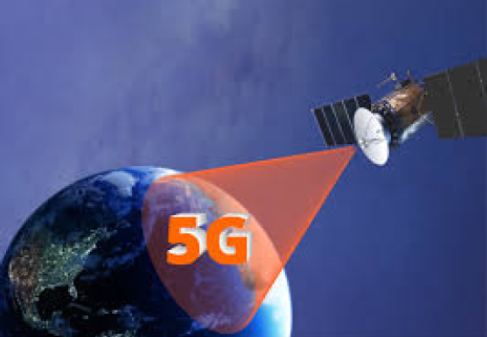
Figure 6.1: Satellites for 5G [31]There are of course other technologies e.g. Satellites which may have not been mentioned previously but have a key role to play in the deployment of 5G. For example, Satellites (see Fig. 6.1) could be used for backhaul, to offload traffic from base stations, deliver broadband services in underserved areas or emergency regions, safety services and for IoT devices. The integration of terrestrial and satellite domains within the 5G network is all due to Virtualization [20].
6.2 Waveforms and Access Technologies
There is currently research on the development of new waveforms and access technologies e.g. Non-Orthogonal Multiple Access (NOMA), Sparse Code Multiple Access (SCMA), Quadrature Amplitude Modulation Filter-Band Multi-Carrier (QAM-FBMC) etc. for use in a 5G network.
6.3 Security and Privacy
The virtualization of the network raises complex issues for critical services and security.
The heterogeneous nature of the 5G network also means that each layer of the network could be owned and operated by different virtual operators; therefore privacy become a major issue.
Interoperability is key for the different technologies to work within the heterogeneous environment; this also raises important questions on ethics, security and privacy concerns.
6.4 Green Communication Technologies
There is a target within the Communications Industry to reduce energy consumption by 90% without a reduction in performance and cost. For this reason, Green Communication technologies are being researched for implementation within a 5G network to reduce energy consumption and improve energy efficiency [20].
The 5GC represents the heart of the 5G network and has evolved towards a service based architectural system. A service based architecture enables components within a network to work together, independent of vendors, products and technologies. The service based framework has also triggered virtualisation and softwarisation within the 5GC which allows the network to meet the varied requirements of the various 5G use cases. The evolution within the 5GC has also resulted in the separation of the data and control plane. This chapter introduces the reader to the evolution and innovative concepts implemented within the 5GC.
5.1 Network Slicing
The three use cases of 5G have different stringent requirements e.g. latency, ultra-high bandwidth, dense traffic etc. It therefore becomes a challenge to support all these services within the same physical infrastructure [14].
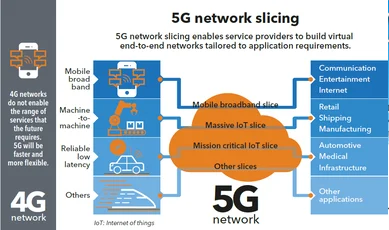
Figure 5.1: Network Slicing [27]Furthermore, the network has to be able to react to the demand of the users regardless of their geographic locations.
To address these challenges, end to end Network Slicing, has been introduced. A network slice is simply an end to end logical network running on a shared physical infrastructure as depicted in Fig. 5.1 above.
In essence, the network is sliced into multiple virtual networks to support different radio access technologies or services with different requirements transported within the same physical infrastructure e.g. a slice would be developed for low latency applications while another slice is developed for high bandwidth applications. These slices are different and would be transported within the same physical infrastructure. This is clearly illustrated in Fig. 5.1 above [14, 15, 16, 17].
Network slices can further be customized depending on the requirements of the vertical or even the operators. For example, an automated car may require high bandwidth for its infotainment and low latency for assisted driving; these services could be delivered on different slices packaged together as a business bundle [15, 16].
Furthermore, a vertical requiring two or more services may request for a unique hierarchy for delivering these services. Thus, network slicing offers the opportunity to meet personalized requests [17].
Slicing can further be categorized as vertical or horizontal. Vertical slicing refers to the development of slices to serve the different requirements of the verticals, as illustrated above [16, 18].
Whereas, horizontal slicing implies developing similar slices to meet the needs of different machines or users with similar requirements. For example, a horizontal slice could be developed to simultaneously serve the needs of a consumer in a smart home and sensors within a smart industry, since they have the same requirements [16].
5.2 Network Function Virtualization
In order to facilitate the smooth transport of the virtual slices within the network and control slices on the fly (based on application requirements), Network Function Virtualization (NFV) has been introduced. The Service based architectural framework of the core has also facilitated the use of NFV which has seen architectural elements now defined in terms of network functions rather than actual physical network entities. The recent advancement in general purpose technology, cloud computing and software defined networks [18] has also triggered the use of NFV.
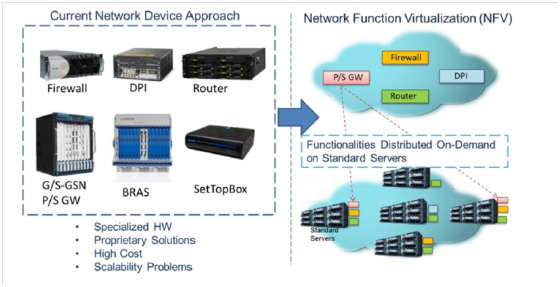
In simple terms, NFV refers to the virtualization of network functions like routers, firewalls, evolved packet core etc.; these network functions now run on virtual machines within a cloud infrastructure, as depicted in Fig. 5.2. It thus represents a shift from hardware to software within the network and leads to a reduction in capital expenditure [17, 18].
Figure 5.2: Network Function Virtualization [28]NFV thus enables the network to become programmable, agile and dynamic and reduces the costs associated with purchasing hardware for network entities. NFV would also enable the network to be able to react to the demand of the users, which is a key necessity for 5G applications [17, 18].
5.3 Software Defined Networking
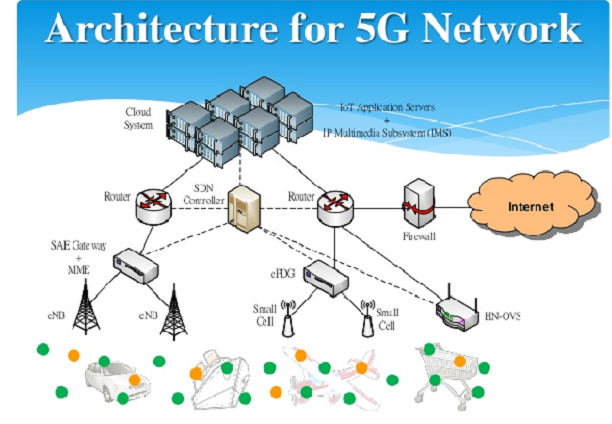
In the previous chapter, it was pointed out that 5G would most likely be represented by a large heterogeneous network. And as a network becomes bigger, agility, flexibility, control and management etc. become very difficult. Such network therefore require some form of remote control from a distance via logical interfaces. In order to overcome these challenges, Software Defined Networking (SDN), an intelligent network architecture, is introduced for use in 5G networks [19].
SDN simply replaces traditional hardware with programmable software services and separates the control plane from the data plane. It allows for a simplified network management and introduces flexibility within the network. SDN also allows for the dynamic reconfiguration of the network and thereby give users the perception of infinite capacity for their applications, as depicted in Fig. 5.3 [17, 18, 19, 20].
Figure 5.3: Software Defined Networking within a 5G system [29]
5.4 Control User Plane Separation (CUPS)
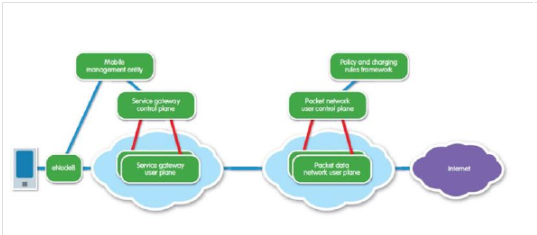
The service based architecture of the core has accelerated softwarisation within the network, and this has triggered the separation of the gateways in the EPC of the 4G network into a control plane and user plane in order to meet the low latency requirement for certain 5G use cases.
The control plane refers to a forwarding plane for exchanging signalling information needed to support the operations of the service delivered to the user. The user plane, on the other hand, represents the forwarding path for the user’s data (as depicted in Fig. 5.4) and supports other functionalities like charging, policy enforcement and a wide range of network capabilities.
With the CUPS technique (greatly facilitated by virtualisation and softwarisation), one could easily deploy a control plane within a centralized location whereas a user plane is deployed closer to the user. This has also accelerated the use of the MEC technique discussed in the next section.
Figure 5.4: Separation of gateways within the 4G network into User plane and Control plane [33]
5.5 Mobile Edge Computing
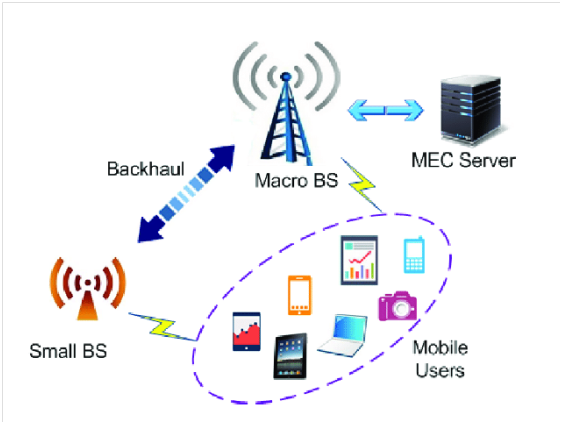
The softwarisation of the network has enabled the introduction of newer technologies like Mobile Edge Computing (MEC). This simply means bringing the cloud/IT services closer to the edge of the network or the users, as depicted below in Fig. 5.5. Here, the contents are stored on the MEC Server closer to the user. Anytime a user requires a service, it is served with little delay because of the close proximity to the MEC Server. This therefore gives the user a perception of infinite capacity.
MEC reduces latency, improves the quality of experience, allow for contextualized services and efficient use of resources [15, 17].
Figure 5.5: Mobile Edge Computing [30]
5.6 Summary
The 5GC has been designed as a service based architectural network which would allow logical entities within the virtual network to communicate via protocols. This has greatly aided softwarisation and virtualization within the network. The virtualization and softwarisation of the core has encouraged the separation of control plane from the user plane and greatly facilitated the use of techniques like Network slicing, NFV, SDN, MEC, Artificial Intelligence (AI), Machine Learning (ML) and Data Analytics etc. which all serve to meet the varied requirements of 5G applications and allow for the network to be flexible, agile, dynamic, reconfigurable and able to react and respond to the demands of the users/verticals on the fly.
The 5G network has been designed based on a new architecture which features a new air interface, called the 5G NR, which will be briefly introduced in this section. The 5G NR also presents two system architectures for migrating from 4G to 5G networks, which will be discussed in this section.
4.1 5G New Radio (NR)
The 5G NR represents a new air interface and radio access network (RAN) developed to meet the varied requirements of the 5G use cases such as high bandwidth, low latency, energy efficiency etc.
Some of the key features of the 5G NR include
Radio Spectrum: As discussed and depicted in chapter 2, 5G NR would work across a wide range of frequency bands.
Orthogonal Frequency Division Multiplexing (OFDM): 5G NR will use OFDM as its underlying modulation scheme [32].
Beam-forming: As highlighted in chapter 2, 5G NR will support the use of beamforming to achieve higher throughput.
4.1.1 Carrier Aggregation
Carrier Aggregation is a technique applied at the physical layer (5G NR). 5G clearly requires the use of different frequencies in different bands, as mentioned in Chapter 2. Carrier Aggregation thus allows for the combination of carriers either within the same or different bands.
For example, it is common for the primary control channel to be anchored on the macro cell using a lower frequency for reliability and coverage whereas the data channel can operate from the small cell using a higher frequency to provide for higher data rate and network capacity [12]. The separation of the data and control channels would be discussed further in Chapter 5.
In the next sections, the reader will be introduced to the two architectural routes for migrating from 4G to 5G.
4.2 Non Stand Alone Architecture
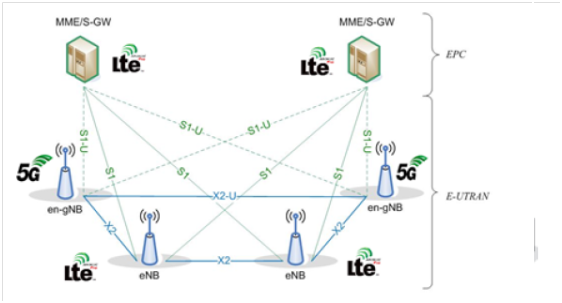
In a non-stand alone architecture, the 5G NR is used in conjunction with the 4G networks. This allows 5G based radio technology (5G NR) to be used with the existing 4G networks and represents a faster route towards commercial deployment of 5G networks.
Figure 4.1: Non Stand Alone Architecture [32]As depicted in Fig. 4.1 and as defined in 3GPP Release 15, the 5G NR (depicted as en-gNB) connects to the enhanced Node B (eNB) via the X2 interface, an interface previously exclusive for eNB connections only whereas the Evolved-Universal Telecommunication system terrestrial Radio Access Network (E-UTRAN) connects to the Evolved Packet Core (EPC) network via an S1 interface.
The Non stand alone architecture serves as a temporary step towards full 5G deployment.
Figure 4.2: Stand Alone Architecture [32]
4.3 Stand Alone Architecture
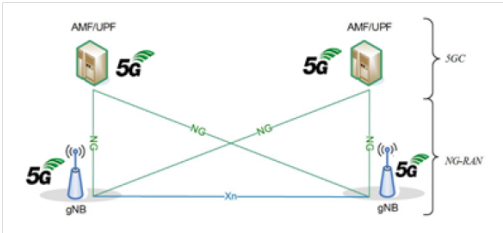
This represents the full 5G deployment and is obviously a slower route towards commercial deployment. Here, the 5G NR is connected directly to the 5G Core (5GC) network. In essence, the 5G system is made of the UE, 5G NR and 5GC.
As depicted above in the figure, the NR (depicted as gNB) connects to each other via the Xn interface whereas the New Radio -Radio Access Network (NG-RAN) connects to the 5GC via the NG interface.
4.4 Summary
In this section, we discussed two main routes towards the commercial deployment of 5G networks. One represents a faster route and involves the use of the 5G NR on a 4G network whereas the other represents a slower route and involves the full utilization of the 5G NR on a 5GC network.
In the previous chapter, we introduced readers to spectral aggregation, a technique for acquiring increased spectrum for 5G services. In this chapter, readers will be introduced to spatial densification as a way of meeting the demand for capacity in a 5G network.
In order to meet these demands, the key technologies applied at the 5G physical layer are Network Densification, Heterogeneous Networks, Cloud Radio Access Network (RAN) and Coordinated Multipoint (COMP).
3.1 Network Densification
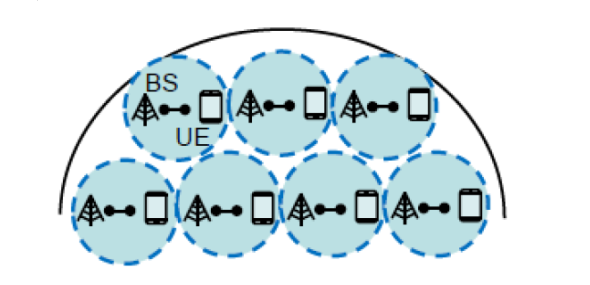
Figure 3.1: Network Densification using small cells [7]It simply involves the deployment of low power nodes (pico cells, femto cells, Distributed Antennas etc.) within localized regions of high traffic demand, as depicted in Fig. 3.1. It is anticipated that most traffic would originate from indoor areas, hotspots, public areas like stadiums, malls etc., hence it makes sense to deploy an overlay of small cells within the macro coverage area [7].
The goal is to offload some of the traffic from the base stations (macro cells) to the small cells which therefore improves the frequency reuse. This requires careful network planning to balance the load, address interference and backhaul challenges [7, 8].
Small cells require less power and cooling and can be deployed closer to the user and within existing networks; the deployment of small cells will lead to a reduction in CAPEX and OPEX incurred by operators [8].
The small cells could be deployed with self – organizing network capabilities which allows the cells to sense their environment, switch off when in idle mode (reduces energy consumption), coordinate with other base stations to deal with interference challenges within the environment [8].
3.2 Heterogeneous Network
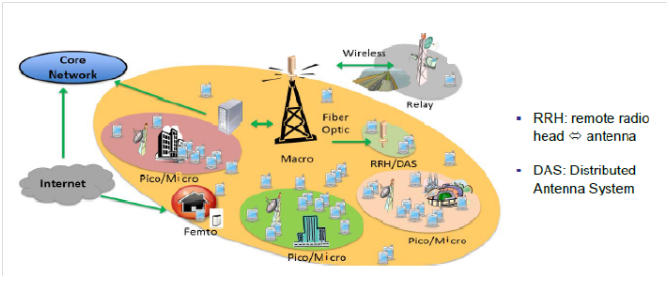
Figure 3.2: Heterogeneous Network [7]The traffic bottle neck could vary from network to network. Therefore, offloading could occur between networks of the same air interface technologies (Macro/small cells) or between networks of different air interface technologies (LTE/Wi-Fi) or between mobile operator core network and public internet.
This combination of technological solutions involving the use of network of different technologies or network of multiple layers of different sizes is referred to as a Heterogeneous Network (HetNet), as clearly illustrated in Fig. 3.2.
A HetNet consists of multiple tiers of layers of different networks of different cell sizes and/or multiple radio access technologies [7, 12].
3.3 Cloud RAN for Backhaul
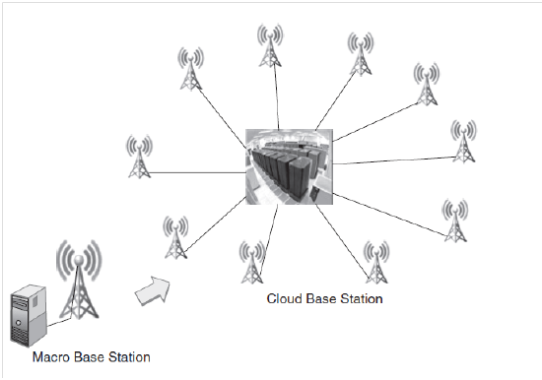
The deployment of a HetNet to increase capacity has to be complemented with a backhaul for this to translate into an enhanced user experience. The Cloud RAN has been proposed for backhaul purposes in 5G. In literal terms, it translates into Cloud Base Stations.
Cloud RAN involves relocating the signal processing from tens to hundreds of base stations to a centralized server platform (see Fig. 3.3); thus encouraging virtualization. It is especially suitable for high traffic demand areas like stadia and venues.
The Cloud RAN also reduces energy consumption by eliminating the need for air conditioning facilities at various sites. It is also able to adapt to the traffic demand within its geographic coverage daily [8, 12].
Besides Cloud RAN, Wireless backhaul can also be used within a 5G system.
Figure 3.3: The signal processing from various base stations are virtualized [12]
3.4 Cooperative Communication
Base stations can cooperate among themselves by exchanging information. Cloud RAN is a special application of Cooperation among base stations.
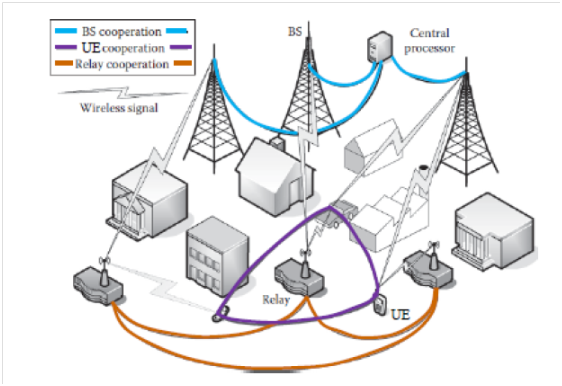
Cooperation can either be Joint Processing or Coordinated Scheduling. In a Joint Processing Cooperative Communication system, the processing of information among the nodes takes place in a central processor. The nodes could be base stations, User Equipment (UEs), relays or even a hybrid [8]. For example, the base stations in Fig. 3.4 below exchange information that is processed in the central processor.
Figure 3.4: Cooperation among information nodes [7]A joint processing Cooperation among base stations is called CoMP. COMP involves the dynamic cooperation and coordination between/among multiple geographically separated base stations to improve spectral efficiency, address interference and reduce energy consumption [8].
Whereas, in Coordinated Scheduling, exchange of information occurs among nodes but there is no need for a central processor [8].
3.5 Summary
In order to meet the increased demand for bandwidth/data, small cells are being densed in space and laid in various configurations within macro coverage areas. Besides, other air interface technologies are also been deployed and combined in clever ways, leading to the development of HetNet to provide the much needed capacity for 5G services. Cooperation among stations is also been developed as a way to meet the increased data demand; this is thus paving the way for virtualization at the radio interface.
Interoperability is no doubt vital to allow the various air interface technologies work seamlessly and fully cooperate among themselves, when deployed within a 5G network.
“Ndubuisi – your country Nigeria is losing its position in West Africa. As a government worker here in Senegal, I have been involved in four meetings where most other West African countries gathered with no Nigerian representative. The land border closure is the root cause of the decisions. Nigeria has imagined that any West African country has the magic wand to smuggling and can help protect its borders. Our big brother failed to understand that we are all victims at different levels.
The post-Nigerian era in West Africa has started and everyone is looking for alternatives. It is painful that unlike before where meetings began with Nigeria, no one cares anymore. My uncle’s seven trucks are trapped in Nigeria for months, for going there to bring in legal goods, purchased from a Nigerian factory. Nigeria will not allow the trucks to return even empty. Because the goods were prepaid, and the consignments since gone bad, the man is now depressed. He wished he bought from China, not from his friend of 30 years in Nigeria.” From a friend in Senegal.
People, it should not be surprising that Abuja is reading about the UEMOA-ECO name change from newspapers. These West African countries are running new playbooks knowing that relying on Nigeria would be damaging. I do hope our government is paying attention to the disintermediation risks.