DD
MM
YYYY

PAGES

DD
MM
YYYY

spot_img

PAGES

Home Blog Page 6528

Just in: Airtel Africa 9 months results: Revenue growth, stable OPEX, reducing leverage, EBITDA expansion…recipe for true value.

0

Airtel continues to show positive momentum as the company delivered sustained growth across Voice, Data and Mobile Money along with achieving a 100 million customer milestone in July across its footprints.

In the words of the Chief Executive Officer, Raghunath Mandava:

“Revenue growth accelerated in Q3 to 14.2% as a result of improved performance in the Rest of Africa, supported by solid results in Nigeria and East Africa. This is now the eighth consecutive quarter that we have delivered double-digit revenue growth and EBITDA margin expansion in constant currency.

Revenue growth continues to be broad-based across voice, data and mobile money. We have continued to add customers, up 9.4% this quarter, contributing to an increase in voice revenue. We are also increasingly seeing the success of our strategy to lead in the roll-out of our modernised 4G networks, with more than 40% increase in data revenues for the quarter.

Alongside this, a focus on increasing the number of use cases through international partnerships for our mobile money offer as well as increasing the distribution footprint have helped gain further acceptance of airtel money”

  1. Customer base grew by 9.4% to 107.1 Mn
  2. In constant currency terms, revenue grew by 12.4% during the nine-month period
  3. Growth was recorded across all services, with revenue in Voice, Data and Mobile Money up by 3.9%, 39.0% and 40.4% respectively in constant currency
  4. Operating profit increased by 21.3% and was up 23.7% in constant currency

“On a market specific basis, Nigeria has been leading our growth with double digit voice revenue growth and over 70% data growth as a result of our lead in 4G rollouts and the huge data capacities we are creating.”

In the Q3/9 months ended 31 December 2020, Airtel recorded the following in Nigeria:

  1. Revenue increased by 23.4% (Q2: 23.2%)
  2. Voice revenue grew by 13.9% (Q2: 13.1%)
  3. Data revenue was up by 75% (Q2: 75.7%) (largest contributor to revenue growth)
  4. Data revenue now accounts for 31.6% of Airtel Nigeria revenue

This is the 8th quarter of double-digit growth with EBITDA margin expansion across its footprints.

This performance sends a strong message to investors that Airtel has the ability to consistently grow in double digits, powered by growth engines of Data and Airtel Money.

At Capital Bancorp, we believe the company can sustain the momentum considering its consistent revenue growth, stable OPEX (operating expense), reducing leverage and EBITDA expansion.

Download full financial reports

Download summarised financial reports

Samsung Winning Tecno On Africa’s Mobile Devices Dollars War

0
Tecno Mobile

Samsung is winning the dollar wars on mobile devices in Africa, despite the supremacy of Transsion (makers of Itel, Tecno and Infinix) on total number of units sold. This battle is just starting as more Chinese brands arrive in Africa. I just hope for one thing: great value for customers.

Shenzhen, China-based Transsion is still the top-selling phone maker in Africa, according to market data from IDC. Transsion’s brands, including Itel, Tecno and Infinix, jointly dominate the feature phone space with 64% of unit shipments in the third quarter of this year. The company’s brands also maintain the lead for smartphones accounting for 36.2% of shipments, keeping with the trend since it first overtook Samsung as the continent’s top phone maker in 2017.

But Samsung isn’t going away quietly. The Korean phone giant leads the continent’s phone market in dollar terms suggesting its phones sell at higher prices on average. In addition, it has also now stepped up competition with Transsion in the market segment for lower-priced smartphones.

Samsung recorded a 61.4% growth year-on-year with phones priced between $100 and $200 in the third quarter of the year, a move which IDC says has “pushed Chinese brands to offer more affordable devices.”

The sector did well in Q3 2019, according to IDC.

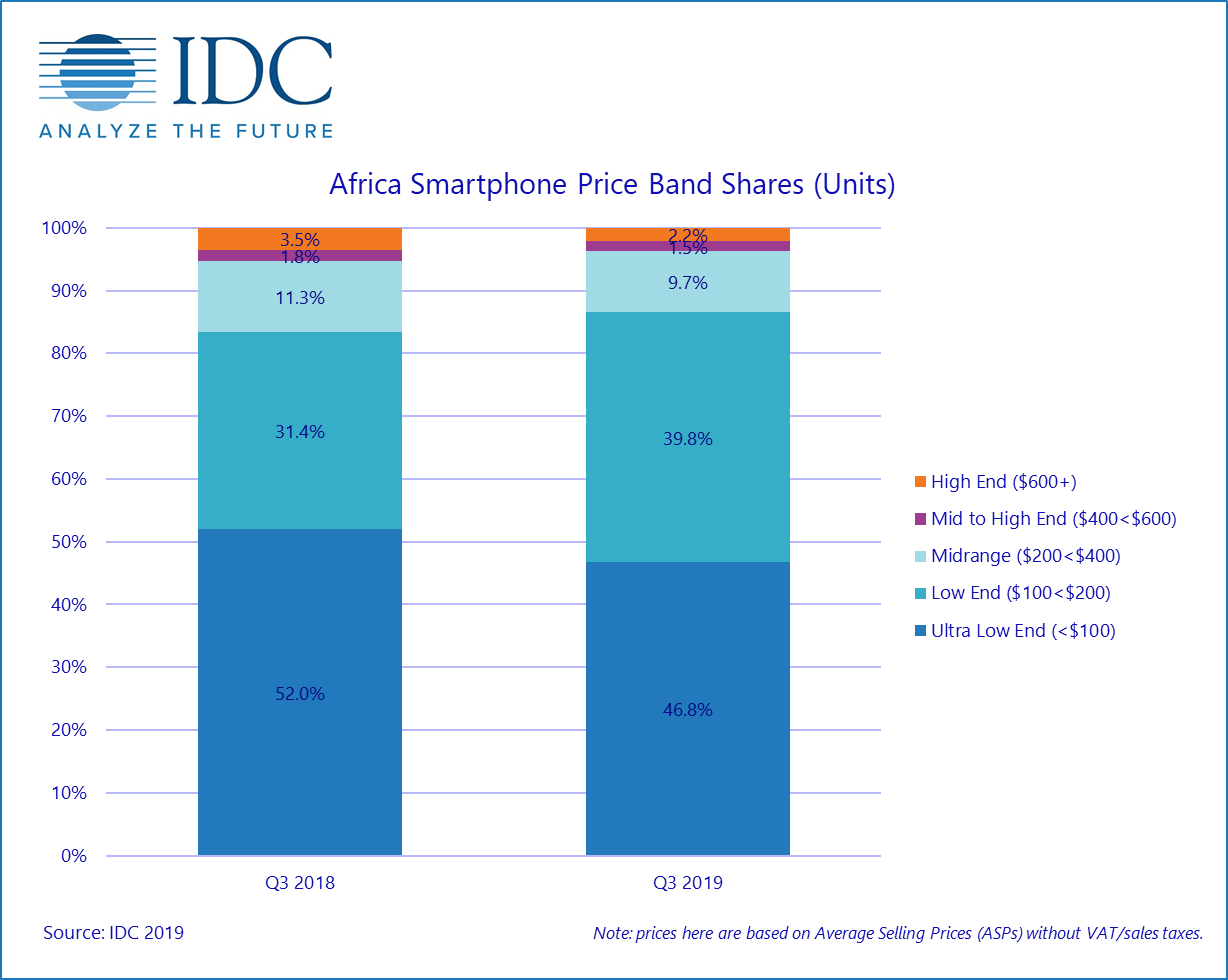
Africa’s smartphone market is also changing from a price band perspective, with the $100-$200 category seeing its share of shipments increase from 31.4% in Q3 2018 to 39.8% in Q3 2019. This growth was largely driven by the launch of new Samsung and Transsion models. The ultra-low-end band (below $100) has been declining in recent quarters and losing share to the low-end price band as brands move their device portfolios towards larger screen sizes and 4G capabilities.


The Mind of Aliko Dangote: How to become a successful businessperson (3 videos)

0
Aliko Dangote sees opportunities for everyone to invest in Africa
Aliko Dangote’s guide to being a successful businessman
Aliko Dangote says he built his fortune from scratch

Nice Move By the Finance Team on Finance Bill, 2019 (Now Finance Act) Nigeria

0
2018 Nigeria Budget

This is to commend Mr. President and the Minister of Finance on the Finance Bill, 2019 (now Finance Act) which has been signed into law by the President. I do think if the startups reinvest the profits, growth will come, even marginally. It may seem little but that spirit of allowing some of these taxes to go is one way we can help startups and broad SMEs (small and medium scale enterprises). The SMEs need this help, as most are like local government areas in Nigeria, providing their electricity, potable water, security , etc needs. Sure, the VAT increase from 5% to 7.5% reduces the fun; nonetheless, it is moving in the right direction.

The Nigerian Financial Bill was recently passed by the Senate. While it awaits the assent of the president, the Minister of Finance, Budget and National Planning, Zainab Ahmed, said the Bill will exempt companies and businesses with turnovers less than N25 million from Companies Income Tax (CIT)

She added that companies with turnovers of N25 million to N100 million yearly will be paying 20 percent as Companies Income Tax, but those earning over N100 million will pay 30 percent of their profit as income tax.

Presently, all companies are required to part with 30 percent of their profit as CIT to the Federal Government, but the Minister said there is going to be consideration to businesses earning less to enable them to expand.

Andersen Tax has some brief explanations:

  • the increase of the VAT rate from 5% to 7.5%;

  • the introduction of a N25 million VAT compliance threshold;

  • the exemption of companies with less than N25 million annual turnover from payment of CIT;

  • expansion of the scope of companies taxable in Nigeria to include companies that operate within the Nigeria digital space, among others;

  • requirement of a tax identification number for opening of bank accounts or continue operation of existing bank account;

  • provision of exceptions for the application of excess dividend tax under Section 19 of the CIT Act; and

  • imposition of excise on certain imported products.

The Nigeria’s Financial Bill And Magic of Tax-free $70,000-Turnover Companies

MPC Nigeria Raises CRR to 27.5% in the Face of Surging Liquidity

0

The Monetary Policy Committee (MPC) held its 271st meeting on the 23rd and 24th of January, 2020. The Committee noted the current environment of sluggish global economic recovery and financial market vulnerabilities, and tepid domestic growth.

Highlights of the Committee’s decision:

The Committee by a decision of 9 members, voted to alter the Cash Reserve Requirement (CRR) by 500 basis points from 22.5 to 27.5% while leaving all other policy parameters constant. Two members voted to leave all parameters constant. In summary, the MPC voted to:

  1. Change the CRR from 22.5 to 27.5%;
  2. Retain the MPR at 13.5%;
  3. Retain the asymmetric corridor of +200/-500 basis points around the MPR;
  4. Retain the Liquidity Ratio at 30%.

Their decision was guided by the following developments:

Global Economy: Outlook and headwinds

  • Global output is projected to grow by 3.3% in 2020 from 2.9% in 2019.
  • Broad slowdown in the advanced economies,
  • Resurgence of financial stress in the Emerging Markets and Developing Economies (EMDEs),
  • Rising geo-political tensions in the Middle-East and;
  • Extreme weather conditions in some regions.

Domestic Economy: Outlook and headwinds

The optimism in growth prospects in Q1 2020, and the rest of the year, is anchored on the enhanced flow of credit to the private sector, to improve manufacturing activities, and financial and exchange rate stability.

Identified headwinds to growth include:

  • Uncertainty in the oil market
  • High unemployment
  • Rising public debt and
  • Security challenges across the country.

Credit Update

  • Aggregate Credit (Net) grew to 27.33% in December 2019, from 23.12% in the previous month.
  • This was largely attributed to an increase in Credit to Government, which grew to 92.95% in December 2019, from 72.36% in the previous month.
  • Credit to the Private Sector also grew to 13.61% in December 2019, from 12.82% in the previous month.

The Committee observed with delight that, over the last six months, aggregate credit grew by N2.0 trillion and urged the Management of the Bank to sustain the current momentum of improved flow of credit to the Private Sector, while exploring other options with the fiscal authorities to strengthen the legal framework for the enforcement of credit recovery.

The Committee noted the improvement in the financial soundness indicators, growth in assets of the banking system and the gradual switch in the composition of DMB assets from investments in government securities to growth in credit portfolio.

It also noted that in some cases, DMBs were not encouraging term deposits in their portfolios and therefore, emphasized the Bank’s commitment towards the implementation of the Loan-to-Deposit ratio (LDR) policy.

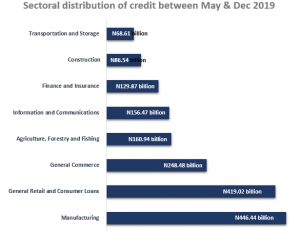
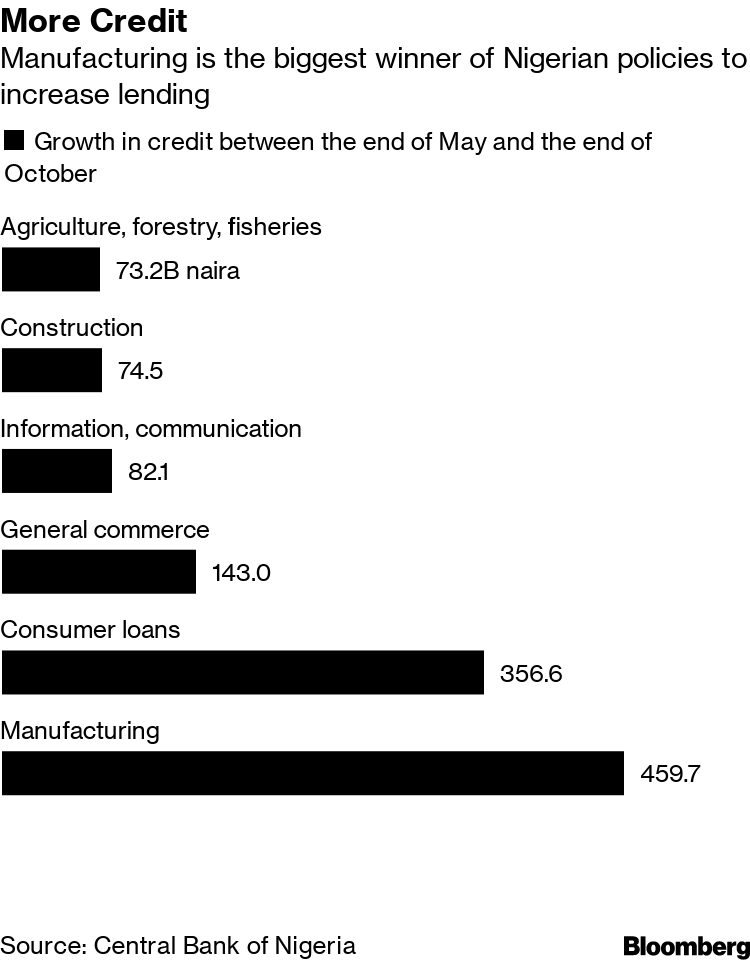
It is noteworthy that Gross credit in the industry grew by N2 Trillion between May 2019 and December 2019; channeled primarily to the employment-stimulating sectors such as agriculture and manufacturing, in addition to increased lending to the retail and SME segments, which is expected to help boost domestic output growth in the short to medium term.

The MPC believes that the aggressive pursuit of the current loan-to-deposit ratio policy thrust would continue to help to catalyze credit growth and positively impact growth and prices.

Despite the increase in CRR, we believe there is still enough liquidity in the system to sustain the current flow of credit. If you need a loan and/or credit advisory, send your request to our credit team at bjoseph@capitalbancorpgroup.com and aogunbanwo@capitalbancorpgroup.com.