DD
MM
YYYY

PAGES

DD
MM
YYYY

spot_img

PAGES

Home Blog Page 6529

Nigeria Needs Auditing-Only Firms (No Consulting Permitted) To Improve Audit Independence

1

According to Quartz, the Big Four accounting firms (PwC, EY, KPMG & Deloitte) now get the majority of their revenue from consulting, not their core auditing businesses. But can an auditor remain independent when it’s competing for lucrative consulting contracts? The constellation is that these firms are wired separately internally with big walls, theoretically making conflicts impossible. But with the level of impunity in Nigeria, believing that any wall would have a strong foundation would be dangerous. My suggestion (as articulated here) remains: Nigeria needs auditing-only companies. Yes, if you do auditing, you cannot do consulting or advisory services. This will help reduce corporate catastrophes which were enabled by auditing paralyses which are everywhere, reducing trusts on financial documents. 

At the big accounting firms, consulting is the tail that wags the dog.

It’s an open secret in the accounting industry that the biggest audit firms no longer get the bulk of their business from auditing. At Deloitte Touche Tohmatsu, for instance, only 22% of global revenues came from audits in fiscal 2019, compared with 60% from consulting and other advisory services. That’s a reversal from a decade ago, when it was 46% auditing versus 33% consulting. Deloitte’s global consulting revenue rose 13% in 2019; auditing revenue was flat.

Deloitte and the other Big Four firms—PricewaterhouseCoopers, KPMG, and Ernst & Young—have all increasingly emphasized and invested heavily in consulting in recent years. It’s easy to understand why: It’s lucrative, virtually unregulated, and offers greater potential for growth than the more-mature audit field. Advising companies on digital transformation and management is less structured and offers

(Remember: I am not against your job. Please accept that I have the rights to share my perspectives on things that affect Nigeria).

Nigeria Needs Auditing-Only Firms To Reduce Conflicts And Boost Independence

Why the Increase in Career Coaching and Skill Acquisition Trainings has not Solved Unemployment Problem in Nigeria

1

I noticed since the beginning of the year, and even towards the end of last year, that most of the online newsletters and calls for training and seminars revolve around career development. It was as if the common New Year resolution made by everybody on earth was climbing the career ladder. My inbox was loaded with so many of these newsletters and announcements that I spent my holiday enjoying free career coaching, leadership training and business management tips.

But it got to a stage I had to ask myself why my fellow Nigerians remained unemployed and underemployed despite all these free priceless tips and training that filled the internet. I also couldn’t help wondering why we still have unprofessionalism as part of the challenges Nigeria encounters.

To help from my little corner, I started forwarding some of the newsletters to some of my unemployed contacts and re-shared most of the career tips. I also asked them to subscribe to those blogs and magazines for more tips. But I can bet you one thing, these people didn’t do as I suggested.

Anyway, my little observation made me realise that battling unemployment and unprofessionalism in Nigeria is more than just putting up newsletters on the internet and calling for skill acquisition training.

Based on my observation, I can tell that the following are reasons why those newsletters and training may not solve the problem of Nigeria.

  • Unsuitable Newsletters and Blog Posts

When I noticed that my forwarded newsletters were not creating the sort of impact I expected, I decided to find out what the problem could be. The first thing I noticed was that these newsletters are not tailored for common Nigerian man. Yes, most online newsletters on career development are “foreign” to that ordinary man in the street because they come from foreign blogs and magazines. Hence, their tips may not be easily achievable in Nigeria.

This is not to say that their tips are useless, because I learn so much from them. In fact, to be honest, what I learn from these newsletters helps me in my career life. No Nigerian academic can give me freely for what these bloggers do. But for an ordinary man in the street to understand and imbibe what is in these newsletters may be too difficult. For this, almost all the newsletters I was circulating ended up unread because they didn’t capture the interest of my contacts.

  • Undiversified Training

Then coming to training, I realised that most career conferences and workshops that take place in Nigeria are for tech, finance and sales professionals. Someone once asked me when there will be trainings for writers in Nigeria and I had no answer to give. I have since then been searching the internet for workshops and conferences for Nigerian writers and I’m yet to find one. This means that people that are not into tech, sales and finance may lose out.

  • No Access to Internet

It may sound funny but it is true that many Nigerians do not have access to the internet. Some cannot afford internet-accessed phones while others cannot afford the high cost of internet in Nigeria. To be honest, someone I forwarded newsletters to bluntly told me that they consume much data. Now you can imagine what will happen if this person is asked to subscribe to a free webinar.

  • Chasing Shadows

I call this “chasing shadows” because there are many Nigerians that buy expensive android phones and load them with data just to take selfies and videos with distorted facial features and then send them into the social media. I’m not against people having fun but when unemployed youths prefer to burn their data and time on trivial things, then we have to be worried. I once asked someone like this to find and download APA referencing style, 7th edition, from the internet and she told me she doesn’t have data. But then, she downloads videos from Netflix.

  • Desire to Start Big

No one is against people that want to start big, but people kick against those that undermine small beginnings. A career coach said that one problem he always encounters with his clients is that they are too impatient to build up from scratch. This is also common among Nigerians; they don’t want to start from scratch. A lot of them want to hit it big. And so they have little interest in seminars and reading materials that will help them to build solid foundations for their careers.

  • Self-Doubt

Sometimes someone’s success story elicits doubts in the minds of the readers. Some of the writers send out their success stories or that of their clients in ways that make them seem unattainable. The consequence of this is that beginners will see the writers’ achievements as something from the moon.

A good example was when I forwarded a newsletter I got from Writers in Charge blog to one of my contacts, who showed interest in writing. The content of the newsletter was how the author, a Nigerian, managed to land a $3750 writing contract. The response my contact sent me on WhatsApp was both hilarious and heartbreaking. He said, “Nna, I haven’t even started writing and you are telling me about experts. People like me no get hope nah.”

This reply tells a lot about how people weigh the success stories of others – it motivates and discourages at the same time.

  • Nigerians Don’t Read

The people that will understand this better are the writers. Nigerians don’t read. I know a lot of arguments may come up concerning this because of the number of national tabloids published daily and the increasing number of news blogs. But what do people actually read in them?

Nigerians focus more on “gossip” stories than on career related ones (unless they are gossip-tinted). If you think Nigerians are interested in political news, I’m here to tell you that they only read those pages in newspapers because they want to see what to say about the government. Their interests are to have stories to tell about what the government did and what it didn’t do. Most of them do not make good use of the information they gathered from those dailies.

However, there is a need to make some changes towards this disturbing phenomenon. And I can only suggest the following ways:

  1. Nigerian prospective bloggers and online magazines publishers can consider opening blogs and tabloids on career tips in different professions in Nigeria. Nigeria doesn’t have much of these. And the existing ones should be willing to give out free newsletters.
  2. Associations, organisations and individuals can consider organising workshops, trainings and conferences on different career development. Life shouldn’t be all about tech.
  3. Parents, guardians and teachers should teach children the importance of reading. They can do this by making them see stories hidden in-between words and helping them to derive joy in finding those stories.

Augusta Ikechukwu Shares How to Start a Business with N10,000 and Make Profits in Short Time

1

You can start a business for as low as N10,000 naira and make great profits in a short space of time. Ngozi shared the tips to achieve this feat in an interview.

Can you introduce yourself to the audience?

Good day ladies and gentlemen, my name is Augusta Ikechukwu, a manager with Oriflame Cosmetics, Sweden.

It’s good to have you in this segment. You said, “you are a manager with Oriflame Cosmetics, Sweden, can you share more about that?

Yes, I will definitely share enough details about that.

Oriflame is a 50-year-old cosmetics company based in Sweden. Currently, it is existing in 66 countries of the world and it’s a 5-year-old company in Nigeria.

The Basics of the Business is to:

  • Look Good
  • Make Money
  • And have Fun.

We have three kinds of people that do the Oriflame business. If time permits, I’ll briefly discuss the three categories

Please, discuss the three categories.

Oh, thank you!

As earlier said, there are three categories

  • The consumers
  • The salespeople
  • The business people/networkers

I’ll discuss the categories briefly:

Consumers: These people just buy products and use. They are not interested in selling or inviting people to join them.

Benefits of the Consumers are:

  • They enjoy organic products
  • They buy goods at 23%

The Sales People: These people are only interested in buying and selling. They are not interested in bringing people or using the products.

Benefits of Salespeople are:

  • They buy products at 23%
  • They sell to make 30% profits
  • They Earn on their purchase as performance discount because of the volume of goods they buy a month.

The Business People/The Networkers: These people are the ones who do the networking aspect of Oriflame by bringing people to register under them. They are the ones who come and change things in a team. They are the game-changers. They are the ones who work and they are the ones who enjoy the big things.

Benefits of Business people are:

  • They enjoy 23% discount on the purchase
  • Get monthly payment
  • Get cash awards from Director and Up
  • Get recognition for achievement
  • Get car award from the diamond director and up
  • Foreign trips

Which of these categories do you belong to?

I’m A PROUD NETWORKER.

Good to hear. Being a networker, how has that helped to transform your business?

Well, being a networker hasn’t only transformed my business, it has made me develop myself, through reading and watching videos on personal development and networking skills

It also helped in expanding my business by building a team of persons duplicating what I do.

It has also increased my social life positively, I build my phonebook regularly, making new friends etc.

Most importantly, it allows me to build my business offline and online, but going digital is real gold.

How did you come about Oriflame?

Oh, I got to know about Oriflame from Facebook through a post by Ukadike Emmanuella, about how to become an independent lady and I was triggered by the caption. That was in the year 2015. I and Ella were just Facebook friends

As at then, was it expensive to start the business?

To partner with Oriflame is quite simple. All you need is just NGN2,990, that’s approximately NGN3000 and your startup CAPITAL 

This initial fee of 3k is called REGISTRATION FEE which allows you access to the platform to start your purchase.

In addition you are given a Starter Pack Kit comprising of:

  • 2 Catalogues
  • 1 Price List
  • Complimentary Gift (sample product) and 

other relevant literature to help you take off your business.

Running a business in Nigeria is quite tough, what will you say about running this business and what advice do you have for a newbie who wants to join?

Yes, it is. The truth is – there’s no business that doesn’t have its own challenges but your ability to overcome is what makes you successful.

For me, it hasn’t been all that rosy, but consistency has kept me and brought me far, at a point I felt like giving up but when I remember my ”WHY”, I rise up and continue.

And also my team has been wonderful. I thank God for my upline, she’s really being a great leader.

We have a group where we hold training on products, sales, and how to handle objections in business.

So my advice to prospect is be determined, be coachable, be success-driven, be positive, and erase the ’I can’t’ mentality, because once you believe you can’t do it, then definitely, you can’t. It’s all about the mindset. 

For prospects that are scared of what to tell people or how to present the opportunity, that’s not a problem because we hold training, especially for newbies.

Being a female entrepreneur, what can you say about it and what change would you love to see about this in the future?

I’ve mentioned some of it earlier, in a few years, I would be able to have changed lots of life and be at the level I’ll love to operate.

Thank you for sharing. How can anyone who wants to join your business contact you?

You’re welcome.

Before I drop that, some people might want to know precisely how much capital they need to start, let me briefly summarize that:

To start the business, you need as low as 10k. 

Starting with 10k, you get to buy few products that you can start with. However, to attain a good start, it is advisable to start with 37k.

How can you be contacted, Ngozi?

Through WhatsApp: 09098376764

Facebook here

Thank you, Chinedu.

How I crashed the “2020 Ghana Universities Sports Association Games”

0
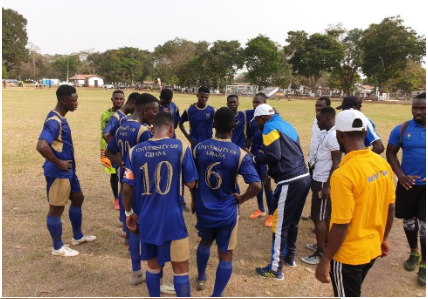
The host team getting a pep talk from their coach nicknamed “Alhaji.” Sssh I heard it through the grapevine.

OK so I arrived in Accra, the Ghanaian capital late afternoon on Tuesday 7 January 2020 on secondment from my home institution, Abertay University Dundee. The arrival happened to coincide with the maiden celebration of the Constitution Day in Ghana, as well as something that seemed to captivate my attention – i.e. youth development through sports.

Prior to my African scholarly adventure, little did I know that my arrival would coincide with two major events. The Constitution Day 2020 in Ghana and the 2020 Ghana University Sports Association (GUSA) Games hosted by the University of Ghana, which also happened to be my host institution.

The Theme of the 2020 GUSA is one I would return to “Integrating Sports into Academia for Youth Empowerment and Development.” For now, however, here is some context.

Currently in its 26th edition, the 2020 GUSA Games is a 17-day event, which runs between 3-19 January 2020. In all eleven (11) universities are competing (Kwame Nkrumah University of Science and Technology, KNUST; University for Development Studies, UDS; University for Health and Allied Science, UHAS; Ghana Institute of Journalism; Ghana Institute of Management and Public Administration (GIMPA); George Grant University of Mines and Technology, University of Education Winneba; University of Professional Studies; and the University of Energy and Natural Resource) in  twelve (12) disciplines (football, basketball, volleyball, netball, hockey, badminton, tennis and athletics) among others.

The opening ceremony took place on 4 January 2020 to great aplomb. 

At its official launch, Dr Bella Bello Bitugu, Director of Sports at the University of Ghana assured a world-class hosting of the event. According to him:

“We are very happy and looking forward to these games and we are really getting ready towards it because we want to host games that reflect the standard of a world-class university so we look forward so much. I don’t think we have so many challenges or difficulties.”

Having won the event for a record 4th consecutive times, the University of Cape Coast (UCC) are set to face stiffer competition from the University of Ghana who are aiming for a host-and-win. However, Dr. Bella Bitugu, Director of Sports at the University of Ghana (UG), does not believe in the mantra of “host and win” in competitions, but believes that the idea of hosting and winning competitions at all cost was not part of his philosophies. As he reportedly pointed out on the idea of hosting and winning competitions at all cost: 

“UG had no intention of host and win for this year’s GUSA Games, but rather provide an avenue for young people to unearth their talents” rather “Our main aim is to develop and help young talented athletes, and give them competitive spirit for future international games…”

I was privileged to witness the clash between the Ghana Institute of Management and Public Administration (GIMPA) team as they took on the Kumasi based Kwame Nkrumah University of Science and Technology (KNUST).

Recall the theme for this year’s event? “Integrating Sports into Academia for Youth Empowerment and Development.” Ultimately, while Knowledge might be Power, Sports is a “Power broker”.

I’m still loving the opportunity of working on the ManaGlobal Project on secondment from my home institution, Abertay University Dundee.

The Need to Abolish the Quota System of Admission in Nigerian Schools

0

The story of Thomas Goodness Shekwobyalo has exposed another problem with our education system – applying the quota system in university admission processes.

Thomas Goodness Shekwobyalo, a young lady from Niger State, scored 302 in her UTME (aka JAMB). She chose Ahmadu Bello University (ABU) Zaria as her choice of university, and medicine as her course of study. She sat for ABU’s post-UTME and scored 274, giving her the average of 288. However, despite her high scores in both UTME and post-UTME she was denied admission into medicine by ABU because the institution pegs its merit admission list for medicine at two candidates per state. Since there are two other candidates from Niger State that scored higher than Shekwobyalo, she lost out in the admission. As an alternative, she opted for Anatomy.

Though JAMB intervened in her case and compelled ABU to offer Shekwobyalo admission into medicine, her story has shown that a lot of candidates must have suffered the same fate and that many had no one to speak for them. It has shown that ABU doesn’t offer admission based on “merit” but based on quota system. It has exposed the fact that ABU, and maybe some other higher institutions, distribute merit admission on state basis, not based on academic performance. It also shows that it is possible that in a class where someone that scored 300 in UTME was denied admission, someone that scored 200 may be found.

The story of Shekwobyalo reminded me of what my mother passed through while seeking for admission into ABU, Zaria in the early 80’s. She wanted to study Home Economics and she sat for JAMB twice but missed admission both times. She claimed that people she performed better than were offered admission based on merit but she wasn’t. According to her, when she tried to see if she will be in the supplementary list (on her second trial) she was told bluntly that the only way non-indigenes could be admitted into departments that have high demands was through merit lists. Any other list that comes after that is for “their people”. She also claimed that she was offered Arabic Studies but she refused the offer because that wasn’t her interest.

Honestly, I thought my mother was making excuses for her “failure” (lol) because what she said didn’t make then. But now I understand better.

I don’t really know the reason behind ABU’s decision to process their admissions this way, but it is high time they reversed it. Education isn’t Federal Civil Service, where jobs are “shared” among States of the federation. Nor is it the private sector, where special positions are reserved for people from specific areas or families. Nigerians should be treated equally in every university in the country, irrespective of their states of origin.

The more I think about this admission “bias” the more I see reasons for the high number of “half-baked”, “unqualified” and “uneducated” graduates that filled our streets. If someone that wanted to study medicine (and is intelligent enough to do so) is pushed out of the way so that there will be space to bring in someone that struggled to pass Chemistry, Physics and Biology in secondary school, I think the whole system has failed humanity. This is exactly what this method of admission is doing. I have always known merit lists to be based on academic performance and never on state of origin. But thanks to Shekwobyalo’s case, we now know why it is difficult to gain admission into courses of choice in ABU, Zaria.

Another problem that arises from this method of admission is that a lot of people are pushed into courses they don’t desire. I know it will be advisable to continue trying until one gets the course of choice, but how long will you write JAMB before you find yourself among the best two in your state? By the time you try out two or three times and it didn’t work out, you will be forced to opt for courses that you find less attractive, just so you can become an undergraduate (and people like this don’t always do well in their studies). Some others may decide to change schools of choice or find other things doing.

It is good that JAMB has discovered what is wrong with ABU, Zaria’s admission method; it is time for them to call the school to order and make them change their method. It is also necessary that the concerned ministries and agencies monitor the admission processes of other higher institutions to ensure that tribalism isn’t embedded in their methods. Education knows no tribe, religion, age, race and sex; admission into higher institutions should also not put those into consideration. People should be admitted based on their academic performances; anything else is irrelevant.