DD
MM
YYYY

PAGES

DD
MM
YYYY

spot_img

PAGES

Home Blog Page 6543

How Stakeholders Can Ensure Sustainable Value Creation and Capturing in the Nigerian Logistics Industry in 2020

0
Project Management & Logistics We provide a top-notch project management services for every tier of the Oil and Gas Industry.

In the last decade, the place and importance of logistics industry have been synonymous with the changes in other industries, which the industry must serve with the adoption of the right processes, people, technology and solutions. There is no doubt the industrial is evolving everyone and a hybrid-centric one. The evolvement is a hybrid-centric because a significant number of people and governments rely on it throughout the world for employment and generating national income and foreign investments inflow.

On the demand side, the logistics industry is helping many businesses to increase competitiveness and deliver the promised value to their stakeholders. Hence, the logistics industry has a strategic mission of revitalizing and improving industries competitiveness worldwide.  Like other industries that lack sufficient data to determine market worth, there are different data on the worth of the industry in Nigeria from experts, researchers and public analysts. A recent view indicates that the value of the industry hits N250 billion in 2019.

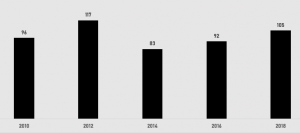
Source: Global Logistics Performance Index, 2010-2018; Infoprations Analysis, 2019

In spite of the growth, various reports have indicated that there are challenges restricting value capturing by the businesses, governments and other stakeholders. In its recent report, PwC, a business management and advisory consulting company, identifies infrastructure deficit as the greatest problem facing the industry in Africa and placing the continent well behind the rest of the world.

In Nigeria, the issue of corruption, tribalism and power supply are the additional challenges preventing the stakeholders’ from creating and sharing sustainable value, and to trade development across the country.  Despite the problems, some stakeholders believe that the future of the industry is bright. Some experts have opined that the industry needs a Commission that would continuously deal with the identified challenges.

What has impacted Quality Logistics Services

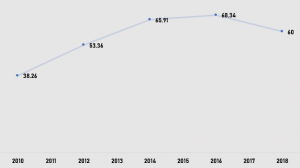
Source: Google Trends, 2019; Infoprations Analysis, 2019

Using the Global Logistics Performance Index, which is being released every two years by the World Bank, our analysis shows that the average ranking of select indicators from the Index facilitates public interest in the industry by 52.9% in 2019. Analysis further indicates that activities of the customs connected with quality logistics services by 90.2%, while tracking and tracing methodologies used by the players and timeliness (timely delivery of goods) associated with the quality logistics services by 49.8% and 31.3% respectively. In what appears as a validation of the stakeholders’ views on infrastructure being the main challenge in the industry, our analysis reveals negative connection between infrastructure and quality logistics services. We specifically discovered -5.8% linkage, which suggests a 5.8% reduction in the quality of logistics services offered by the players in 2010, 2012, 2014, 2016 and 2018. The reduction was high when we analysed the ranking of the country’s shipment of goods to other countries along with the quality of services during the period. Our analysis reveals 22.5% reduction.

Based on the insights, our analyst believes that players and government have a lot of challenges that needs holistic solutions in the next decade, if the country is really ready to be at par with other countries in the world. Beyond the identified issues, experts have noted changing in customer experience, emerging technologies and smart logistics planning and execution as trends that would impact the industry in 2020.

It is therefore imperative for the players and concerned stakeholders to reexamine the processes, technologies and people being used for offering varied logistics solutions in the country. This is necessary because Nigeria cannot continue to be a second fiddle to South Africa, which has been consistently ranked as the best logistics performer on the continent.

KongaPay Introduces Cardless Withdrawal Feature

0
Konga sale

E-commerce outlet, Konga has launched a new Unstructured Supplementary Service Data (USSD) feature on its payment platform. The new feature is designed for easy transactions and to enable card-less withdrawal from the ATM.

The Central Bank of Nigeria (CBN) has recently issued licenses to some operators of Fintech services in Nigeria who offer secure payment services to expand their services. Konga is one of those who secured the license and is putting it to good use.

Joshua Fatoye, the vice president of KongaPay, said at the launch of the new feature that the card-less initiative will give KongaPay account holders the opportunity to make withdrawal from ATMs nationwide without debit cards, apart from serving as an alternative to the web and mobile channels.

He also explained that Konga customers who wish to use the card-less services need to sign up on kongapay.com and make sure their accounts are well funded using any of their varying funding options. He said:

“All the customers are required to do is to sign up on kongapay.com and ensure that their KongaPay wallet is funded using any of the funding options. Then, the account holders need to log into their wallets via the web or app.”

How it works

Users who want to cash out will need to click on the cash-out feature on the app, fill in their mobile number or that of the intended recipient. The payment system functions on Personal Identification Number (PIN), and One Time Password (OTP). So the sender is required to use any of these security means as authorization for transactions, and the receiver does not have to be registered on Konga platform.

Fatoye explains: “The customer who initiates the transaction will receive a message thus: “your pay code request was successful,” and the beneficiary will get a SMS notification with the withdrawal code details.”

The receiver can then make withdrawal of the cash from any ATM using the card-less withdrawal function or pay code cash-out feature. But the recipient has to enter the 8 to 14 digit withdrawal code sent to him earlier via SMS to collect his instant cash.

The evolution of card-less ATM withdrawal is spreading rapidly in Nigeria, and many Fintech companies are working to make sure everyone gets on board. Although there has been little awareness about the technology today, there is hope the knowledge will become abundant in the near future.

Industry Redesign

In April, there was a report of a bank customer who was dragged to a police station by ignorant bank users for withdrawing from the ATM without a debit card in Ibadan. But the incident turned out to be an orientation, people who didn’t believe in the possibility of card-less ATM withdrawal learned that it’s no magic, and withdrawing money from the ATM without a debit card is not a crime.

However, the incident reveals that apart from Lagos, where many people can relate with the technique, several other states are yet to come into terms with card-less withdrawals. That beckons the responsibility on the banks and Fintechs to do more.

In 2016, Verve launched the system that can help anyone to make a withdrawal from an ATM without a card. Just by using codes generated through its app, even a third party can affect a card-less withdrawal transaction. Subsequently, banks and other payment platforms embraced the idea and started offering the service.

OPay and Flutterwave recently became part of the USSD family, among other services, helping in offering card-less withdrawal. But the increasing number of service providers in this feature of financial transaction is slow in bridging the gap between users, non-users and those who know nothing about the service: suggesting the need for awareness that will rid the fears of onlookers who need security assurance to make up their mind.

While the KongaPay will help, the onus is on the banks to educate the people because of the number of customers at their disposal, and the already existing trust that the card-less withdrawal service can be promoted upon.

Michael Puchercos, CEO of Lafarge Cement, Joins Dangote Group

2

In December 20, the management of Lafarge Africa Plc announced that its Group Managing Director/Chief Executive Officer (GMD/CEO), Mr. Michael Puchercos, is resigning from the company effective January 17, 2020.

The statement made available to the Nigerian Stock Exchange (NSE), and other stakeholders by the General Counsel & Company Secretary, Adewunmi Alode, reads:

“The Board of Lafarge Africa Plc hereby notifies The Nigerian Stock Exchange and the investing public of the resignation of Mr. Micheal Puchercos from the Company as the Group Managing Director/Chief Executive Officer with effect from the 17th of January 2020.

“Mr. Puchercos served the company as an Executive Director on the Board since the 1st of April 2016. During his tenure as the GMD/CEO, he implemented a successful turnaround plan for the business addressing the legal, financial and management structure of the company, Health & Safety improvements and the implementation of new operating processes.

“We wish him the best in his future endeavors.”

The statement also disclosed that Lafarge has replaced Mr. Pucheros with El dokani.

“The Board is pleased to announce the appointment of Mr. Khaled Abdelaziz El Dokani as the new Managing Director/Chief Executive Officer.

“Khaled Abdelaziz El Dokani joined Lafarge Holcim in 2004. Prior to taking over this position, he was country CEO of Iraq (2018-2019), Qatar (2016-2018), Saudi Arabia (2013-2016), Vice-President for Business Development and Strategy North America (2010-2013), CFO in Lafarge Algeria (2004-2010). He holds a Bachelor of Commerce degree from Alexandria University, Egypt.”

Prior to his resignation, Mr. Puchercos was one of the highest earning CEOs in Nigeria with annual income of N312 million, as of the year 2018.

A few days after Lafarge made this announcement, its rival, Dangote Cement announced that Mr. Puchercos will be resuming as its MD/CEO effective February 1, 2020. The same position he resigned from at Lafarge. According to the disclosure notice by Dangote Group, Mr. Puchercos appointment will be part of its agenda in its next annual general meeting for ratification by shareholders. The company said it is a standing procedure of Companies and Allied Matters Act.

Lafarge Africa Plc is a cement manufacturer with headquarters in Lagos Nigeria. It is controlled majorly by LafargeHolcim, that used to trade on the Nigerian Stock Exchange as Lafarge Wapco Plc before the merger of Lafarge and Holcim that consolidated the company’s assets in Nigeria and South Africa. The consolidation resulted in changing the companies’ name to Lafarge Africa.

It has since become one of Nigeria’s leading cement manufacturers, and distributes its products through its sub divisions that include Wapco, Lafarge South Africa, Ashaka Cement, United Cement Company and Atlas Cement. Lafarge’s brand products includes include Ashaka branded Portland limestone cement produced in Gombe State, Elephant and Superset cement produced by Wapco, Unicem, Readymix Concrete, building aggregates, and some other products from Lafarge South Africa which include artevia decorative concrete products, Buildcrete and duraBuild cement, Dura-pozz, Fast-Cast, Pozz-Fill, Powercrete plus and Superpozz.

On the other hand, Dangote Cement Plc is a Nigerian multinational publicly traded cement manufacturer that its headquarters is in Lagos Nigeria. The company is a subsidiary of Sephaku Cement and its parent company is Dangote Group. Dangote cement is known for cement production and distribution in Nigeria and nine other African countries which include Senegal and Tanzania.

These two cement companies have created impressive profiles competing to lead the way in Africa. With his 20 years’ experience, Mr. Puchercos guided Lafarge through thick and thin and led the company out of its major hurdles. So the sudden switch by Mr. Puchercos is suggesting that Dangote cement may be in deep trouble and needs the messiah in the CEO of Lafarge.

Since 2017, Dangote Cement’s stock has been struggling with losses, a situation that has been attributed to a significant drop in sales, and is obviously an indication of a need for a better hand at the helm of affairs. Considering experience and record of success in the cement business across Africa, Mr. Puchercos became the man who would wear the cap. The turnaround he effected at Lafarge has borne him a testimony to enabled Dangote Cement to snap him up.

In 2020, Send That Invoice As A Company, NOT As A Person

1

Across industrial sectors, markets are inherently imperfect, requiring “forces” to overcome frictional challenges between demand and supply. The forces are companies which through products and services solve the frictions. The formation of for-profit companies emerged well hundreds of years after the Tang Dynasty (A.D. 618-907) when the Chinese invented paper money, triggering unprecedented accumulation of wealth.

(If I have $1,000 which I do not need for a year, and open to lend it to somebody at 10% interest rate, I will need to find that person for that deal to go through. Also, the person that would receive that money from me needs to know someone who is open to lend $1,000 at 10% for a year. Unfortunately, there is a huge information asymmetry as I cannot easily find that person and the person cannot easily find me. What happens is that to ensure that money does not stay idle, I will take it to a bank which will pay me 10% interest rate. Also, the person that needs $1,000 will go to a bank to ask for a loan, and the bank will lend that my $1,000 to him for say 17%. That extra 7% is the cost of fixing the friction and by overcoming the friction, a new equilibrium point is set, bringing a largely imperfect market into a more perfect one. This is what happens in all market systems, across sectors and industries.)

So, for thousands of years, the demand/supply relationship existed across domains, outside the constructs of “companies”. Yes, as we currently have in Nigeria, there are informal economies which operate via largely direct human systems of demand and supply. Such markets are typically small with severe unmanaged perturbations. Yet, in extreme micro-elements of these economies, they operate largely “perfect” with minimal complexities requiring companies!

If you live in a very small village where a young man sells chewing stick (Walmart in U.S. calls it organic toothbrush) and people can buy direct from him, after he has harvested from the woods, there would not be a need for a “company”.  But tell that man to scale the mission, then, all of a sudden, he needs company formation to effectively utilize factors of production due to varying ordinance in trade.

As you try to solve one problem, another problem comes up, and you need other firms to help you since you cannot do everything. That is the heart of economic activity. While the toothbrush to serve a very small village can be made without a “company formation”, to scale the business, the man needs to run a company as managing most perturbations in trade are best done via companies. The different ordinances in trade favor companies over human systems. An example: it is easier to import raw materials into a country as a company than as a “person”.

The fact is this: you can have “perfect” markets in some micro-areas where there are no complexities with all factors of production easily controlled and managed. But to scale anything out of that community, operating as a company becomes necessary due to perturbation forces from many ordinances which factors of production must interact with.

It is this understanding that puts companies ahead of humans in market systems.  Companies accumulate costs just for being active, and those costs must be settled. And based on that, if you send an invoice with a corporate account number “a Company”, you have a better chance of being paid compared with when you send a personal invoice with your personal bank account number. The recipient sees the company as an entity that has bills to pay because the ordinance of trade upon which the factors of production operate make it that way. But if the invoice is in your name, he does not see any cost, and possibly could assume that you can forget the payment!

If your landlord does not want to pay for the work done for him, next time in 2020, send him your company invoice (with corporate bank account), NOT your personal bank account. Once he sees that, he will likely move faster to settle that bill. 

Get a business name – and operate as a company! As a company, you are “bigger” than a carpenter, geek, plumber, etc. A Great New Year ahead.

Unlock Your Abundance in 2020 By Acquiring a Unique Capability

How the Education System Fails Nigeria

1

It is obvious that a lot of Nigerians have lost hope in the country. The reason behind this isn’t something that could be easily analysed because a lot of things have gone wrong with the system, starting from the simplest to the most complex.

I told someone recently that our education system doesn’t encourage students – primary to tertiary – to think outside the box. Teachers and lecturers expect students to give them back exactly what they were given. Any addition or subtraction from a student automatically lands him failure and its consequent lower grade. As a result, Nigerian education system continues to revolve around obsolete information and knowledge without allowing students to add new things from their wealth of personal experiences and imaginations.

But the greater consequence of this method of teaching and learning is that the students become living zombies, who only think through their teachers. They no longer have minds of their own and they believed that their experiences, ideas, thoughts and opinions are all wrong, or inconsequential. When these students leave school and move into the larger society, they wait for their parents, employers (if they manage to get one) and government to think and act for them, after all, zombies don’t think, they just do.

This piece is spurred by the reactions that followed Prof. Ndubuisi Ekekwe’s post on LinkedIn, which can be found here. These reactions showed that though a lot of things have gone wrong with the Nigerian system, many people still blame the government for all their problems. Yes, the government has its own blame, but so do the individuals within the country. And that is why I hold teachers responsible for pushing out zombies into the system to manage the affairs of the country – both in the private and the public sector.

To explain this further, I would like to invite you to share in different experiences that can tell of the mentality of some Nigerians, which need to be quelled as soon as possible.

Tale 1

I was in a cybercafé on Tuesday, 17th December, 2019 to scan and send some documents to someone in Abuja. While there, an elderly man walked in and struck a conversation with a woman there. I wasn’t paying attention to what they were discussing until the woman started yelling.

She was screaming about how she has been submitting applications upon applications since 2015 and none of them has been approved because they said she doesn’t have the required educational qualifications. According to her, she has heard that some people in some places who did not meet up to the desired requirements were considered and their applications approved.

To her, she is suffering because government officials are corrupt and tribal. She may be right, especially since I don’t know what she was applying for. But do you think she should accuse government officials of corruption when she does not attain the basic requirements for whatever she is pursuing?

I quickly finished what I came for and left because I know if I stay longer I might tell the woman that she is also corrupt for hoping that somebody should accept her for what she is not.

We have a lot of Nigerians that think like this. They want to cut corners knowing full well they will become the proverbial square peg in a square hole. I don’t really blame them because our system allowed and encouraged that. If these people have been taught from school not to dish out half measures, I believe they wouldn’t expect to be where they don’t belong.

Tale 2

This happened around October, 2019. I was in a commuter and soon I realised the men on the bus were discussing recent occurrence in the country’s political system (sorry I’ve forgotten what). They got to a stage where they became so worked up and turned abusive on the government. Then everything they said turned into “this country is useless”, “there is nothing good about this country”, “this country should just break up let everybody go his way”, “this country can never be good again” and so many other heart-wrecking expressions.

As far as this group is concerned, Nigeria is dead and buried. They have all lost hope in Nigeria. It is people in this group that wouldn’t mind leaving the country to do menial and illegal jobs in other countries.

The major concern raised by people like this is that they can easily be turned into human weapons. They have been so brainwashed that they believed nothing good can ever come their way as long as the system remains the way it is. Even if you tell these people that there are ways out of their predicaments they won’t listen because they are better off blaming someone or something for their problems. These set of persons are the worst and most dangerous analysts I’ve ever seen.

Tale 3

This happened on Monday, 16th December, 2019. I was in a salon when a female marketer from one of the banks walked in. She came to market a special account that qualifies its holders for December raffle draw, where the winner goes home with one million naira or so. This account, according to her can remain inactive for up to 2 years before it goes dormant (I don’t know how true this is anyway). What touched me was that one of the salon workers said she won’t open the account because she can’t afford to keep it active within the next two years. In her words, “What if I open it and after two years it goes dormant because I won’t have money to pay into it?”

To say I was surprised by such an utterance would be an understatement because here I saw someone who has given up on herself. She didn’t see her future as bright or even meaningful. She has already assumed the position of the downtrodden and has decided it’s the place for people like her. Rescuing someone like this needs more than motivational talks from me and the banker.

Tale 4

This happened sometime in June or July this year. Someone came to me for some career advice. She’s a graduate but has been unemployed for years. In fact she hasn’t worked since she finished her NYSC and she hasn’t gone into any business.

I asked her what she aspires to be but she has no idea. I asked what she studied, she told me. Then I asked the industry people with her qualification work in, but she had no idea. I was in a fix because I needed to help her out.

Well, I told her the only thing I tell graduates that really needed to get something doing but have no idea where to start. I told her to find a teaching job and allow it to navigate her. She told me plainly that she won’t be a teacher because they are not well paid. Well, I told her I’m a teacher and I still manage with what I’m paid. The long and short of it is that she came to me to give her my “connection” so she too could get a federal job.

I don’t know how to say this but it is quite unfortunate that most Nigerians believe without “connection” they won’t get good jobs. Maybe we should know the difference between “connection” and “referral”. You might be highly connected without landing that dream job, but a good referral is all you needed to be where you desire – and that’s how to land a federal government job. And if you don’t meet up to expectation, no amount of connections or referrals can get you there (even though federal character policy is undermining this).

The essence of this is just to state that there is need to rescue those people that remained unemployed because they are waiting for someone to give them “connections” to land jobs. They should start up something and then find out where they truly need to be. By the time they have navigated their career properly, they can then seek out referrals for their dream jobs.

We still have a group of people that don’t even know what is happening in the country. There are people that can’t tell you different occupations that exist in Nigeria and how to get them. This group really needs all the help they can get from us. If I meet any of them, I simply direct them to LinkedIn and ask them to “endure” the professionalism in the social media until they find their bearing. Permit me to say that most of them run off and never come back.

The truth is that there are so many things that need to be done to get Nigeria working as it should be. We may first start with our education sector, which needs to be overhauled. This doesn’t really need money; it’s just a matter of adjusting the way teachers are trained so that they could adjust the way they teach students. What Nigeria actually needs are people who can independently think for themselves and believe in themselves – be it in the private or in the public sector.