On Monday and Tuesday, I will run The Vanguard Newspapers Executive Masterclass in Lagos. The list I have received from Vanguard does show that heavyweights are coming. Yes, respected businesspeople anchoring the health of this economy. As always, whether in Cambridge, New York, Cape Town or Lagos, I enter those classrooms with humility knowing that some of the participants are more battle-tested, more versatile, and eminently legendary for what they have accomplished in the markets. Some come to validate their playbooks, and what they have been working on.
But yet, I would be the professor – to provide guidance, and take them into a new excursion into knowledge as they acquire new capabilities to fix market frictions. We will have 3 Labs and 2 Group Discussion sessions.
Also, as we go through the program, I bring in constantly what I call Flash Case. We have it over my slides Indomie Moat, Jumia Pivot, Konga Hybrid, Interswitch Damp Proof Course, OPay Blitzscale, Flutterwave Waves, Airtel Lite, GTBank Paradox, Silicon Valley Bank ALL, Tesla Edges, “XYX” Petro Data, Apple 3.0, WeChat Universe, FlipKart Base, and Kudabank Byte.
Program begins 9 am tomorrow. You can still Call Jude on 08034187233 or Email:Conferences@vanguardngr.com to get in.
The year is coming to an end, and with that comes the festive period, which is ushered in by Christmas and led out by the New Year. This period is always accompanied by a mixture of emotions – gaiety, anxiety, sadness, anger and so on. These feelings arise as a result of the heavy money-spending culture associated with the period. But then, as a lot of people have so much to spend, some have nothing at all. In-between these two extremes are those who wish to manage the little they have so that there will be enough to see them through the first month of the New Year. Consequently, this period is always the best time to show appreciation to all your employees.
Most employers overlook creating atmospheres of festivity in their offices believing that it is trivial. Some see it as a way of wasting resources. And then, there are those that feel that such practice may lead to the breakdown of order in the office.
However it is looked upon, workers need to unwind every now and then, even if it is once a year. This isn’t just a case of all work and no play makes Jack a dull boy, but also the case of Jack becoming an angry bird.
It is also true that some employers feel they have done all that is needed to appreciate workers because they pay them salaries. They, however, need to understand that salary is not a form of appreciation. Salary is payment for work done.
There are different reasons why employers need to appreciate their workers especially during this on-coming festive period. These include:
Motivation: Workers are easily motivated by exhibitions of gratitude, especially when it comes from their employers.
Assistance: The gifts received by workers within this period help them in their celebrations. For example, when workers know they will receive bags of rice for this Christmas period, they will divert the money for rice to something else, say meat, for the celebration.
Fulfilment: What most employers didn’t know is that these workers expect “something” from them as Christmas gifts. By the time they received nothing from their bosses, they go home grumbling about how they are not appreciated for their efforts during the year.
Now, here are ways bosses can show their gratitude to their employees as they close shop for the year:
Parties and Picnics: This method is usually applied if the boss wants to spend some quality time with his workers. It mustn’t be something elaborate. It could be done within the office premises and simple menu could be ordered for. The best way to make this party or picnic fulfilling is to ask the workers to invite their family and friends.
Prize-Giving and Awards: This method motivates hard workers and encourages the slackers. But then, if this is not well handled, it could create friction among workers. The best way to give awards and prizes is to be neutral in selection. If non-recipients of awards suspect foul play, or partiality, they will be discouraged from giving in their best when they resume in January. It is, therefore, advised that companies set up modalities for presentations of awards and prizes at the beginning of the year. This is to enable all workers to judge themselves worthy or not of the prizes.
Allowances and Bonuses: Some offices pay End of Year Allowance, popularly known as Thirteenth Month Salary. Most times, companies that pay these 13th Month allowance do not bother organising parties and award-giving ceremonies for their workers. But those that can afford it can still go ahead and do it. As for bonus, it all depends on how much the office was able to generate within the year – it is usually not a regular thing (unlike 13th Month allowance).
Gifts from Employers: It is actually common in many parts of Nigeria for employers to give their employees food stuffs such as rice, vegetable oil, tomato puree, and, sometimes, bouillon cubes, for their Christmas celebration. But a lot of companies have either not subscribed to this beautiful tradition, or they have unsubscribed from it. There is need to re-invoke this tradition because it has saved a lot of people from the humiliation of not being able to celebrate the Christmas season with relish. Note that you mustn’t buy 50kg or 25kg rice and 20L vegetable oil as gifts for your staff. Just go for the much you can afford; they will appreciate it. In as much as people appreciate food stuffs more, especially those that have dependents that need it, there are still other gifts that can be given to staff members. The choice of gifts to be bought and shared depends on the make-up of the staff members. For example, if there are more married women and men, kitchen utensils and food stuff will be good options. If the staff make-up comprises of more bachelors, neck ties, cufflinks, belts and mugs should be considered too. As for spinsters, household items (such as buckets), kitchen utensils (such as smaller pots, vegetable cutters, and so on), small packs of foodstuffs and cloth (such as Nigerian wax) will suffice.
Early Closure: Closing early from work gives the feeling of holiday. Employers may decide to close a day earlier (say on 23rd December) or a few hours before closing time. Works can also be scheduled within the week of festivity (27 December – 2nd January) in such a way that each worker has a day or two days off from work. It will be better if each of them is asked beforehand to state the days they wish to work within that period.
It is still too early to plan for the best way you can show gratitude to your workers for helping you grow your company within this year, 2019. Energise them now so they will make your 2020 a better and more fruitful year.
A lot of people have the title “Influencer” attached to their names in social media. The first time I saw this on LinkedIn, I couldn’t help wondering whether it was a job title or something else. When I noticed that more and more people were adopting the title I decided to monitor what they do.
At first, all I saw were people collecting massive followers and dishing out posts that have little or no impact, yet they collect so many ‘likes’ and comments. I always asked myself what was so important about the posts of most of these influencers that people liked; and why will the posts that are greatly impactful not collect as many likes as those vain ones? It’s yet to make sense to me anyway.
Today, I read a post somewhere, where the writer said that all entrepreneurs need influencers if they want to take their businesses to the next level. I couldn’t help wondering why this person assumed that, especially since the people I’ve seen with the “Influencer” title on LinkedIn do not project anybody’s business despite the massive followers they have. Most of them are actually people that are directly or indirectly looking for their own “customers”.
So, today, I asked myself this question: Who is an influencer?
To satisfy my curiosity, I searched the term in the print version of the Oxford Advanced Learner’s Dictionary (9th ed.) and noticed there is no entry for the word (I only saw influence). I went online and searched through Cambridge and Merriam-Webster dictionaries and saw the following entries on the term.
From Cambridge Dictionary
An influencer is
“someone who affects or changes the way other people behave”
“a person who is paid by a company to show and describe its products and services on social media, encouraging other people to buy them”
From Merriam-Webster Dictionary
An influencer is
“one who exerts influence”
“a person who inspires or guides the actions of others”
“a person who is able to generatea interest in something (such as consumer product) by posting about it one social media”
After reading up these definitions of “influencer” I realised that the term is obviously a new one, which is still generating more meanings and usages. For example, the post that advised people to follow up influencers and win their attention so they can bring sales to their door steps indirectly defines influencers as “carriers and distributors of luck and customers”.
Of course, there is need for luck in everything we do but it is not enough. This is also the case with succeeding in getting an “influencer” with many followers to advertise and recommend your product to his numerous connections. It is possible that his followers will turn and purchase most of your products at that point in time, but that may be all. Unless you were able to retain this influencer and pay heavily for his services, or you managed to retain some of the customers he brought your way, trust me his followers will follow him to other products that won his attention. Put differently, using influencers may only bring temporary sales; they may not give your business that needed jolt.
Who then should be your influencer?
Based on the definitions given by the dictionaries, it will be deduced that, in the business arena, an influencer is someone that helps you to make sales. He is someone that attracts customers for you as well as inspires you.
Whether you have someone on your payroll with the name “influencer” or not, the following are the best influencers any entrepreneur could have:
Your Customers
I have always believed in customers being the best influencers anybody could have. If you look at it critically, you will notice that the best form of advertisement is customer relations. If your customers are happy, they will recommend you to others. If you treat your customers well, they will never leave you. All you need to keep them and attract new ones is to give them satisfaction for their money.
Customers’ feedbacks are also necessary for company’s growth and development. It is a pity that a lot of entrepreneurs do not create room for feedbacks. Instead they spend so much on advertisements and unnecessary promos.
Your Employees
Happy employees bring forth better services. If your workers are unhappy, they will not hesitate to send away your customers. They will even recommend your competitors to your prospective customers. But when you treat your workers well, they will take care of your business, treat your existing customers well and attract new ones.
Your Competitors
As absurd as this might sound, you still need your competitors to keep you on the right track. The good thing about having competitors is that you keep finding ways to impress your customers. You will continue to initiate new and better things that will keep you abreast or ahead of your competitors. The presence of competition is all you need not to slouch.
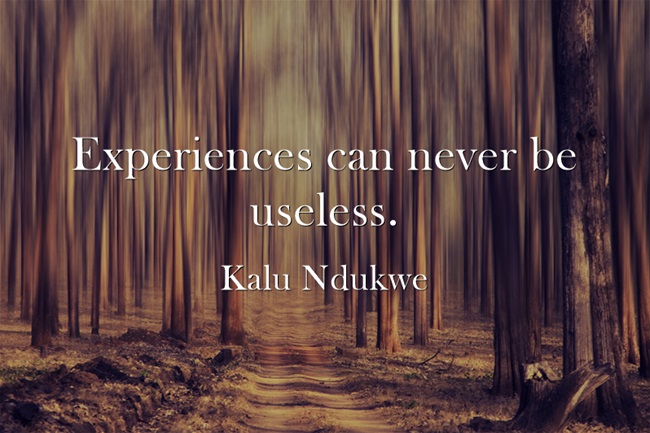
Experiences can never be useless. They are part of us – whether exciting or hurting. For that reason, they should be made to count in making our lives better and more fulfilling.
In a world where everything is judged by its usefulness, it’s the height of self disservice not to get the most out of ugly experiences, knowing that we as individuals are constantly being judged and rewarded according to the perceived value of the contribution we make.
This pattern of looking at things in our world made it so certain that anything that did not go as those to whom it matters would want it go, is highly frowned at or immediately dismissed with impatient awful thumb down. Often times, even the affected individual suffers the same ugly fate of various forms of negative public review, dished out with such reckless abandon, sufficient enough to close the chapter of one whose mind is not strong enough to bear the pounds of the punches and still keep faith.
Whatever be the case, it does not in any way reduce the promise of usefulness inherent in ugly experiences, mistakes or failed attempts. This is so, notwithstanding the impatience of the public. But it is the individual concerned that must constantly review the ugly experience in the light of other realities to ensure that the same route, that led to previous ugly destination, is not taken.
History has been very kind to those whose painful experience influenced them to push for innovative reforms, more justice and fairness as much as it’s been to those who, through their exciting exposures, made a positive impact in their societies.
Rising above the negative reviews, which are usually a given, to focusing on lessons that can be learned and converting those lessons into valuable personal guides for delivering better services (including sharing the knowledge to those it might help) are the most important uses to which one can apply an ugly experience.
Construction of magnificent structures have been one of the great characteristics which have differentiated the human race from other species. These structures include the Seven Wonders of the Ancient World of the remarkable constructions of classical architectural splendors built during the 1st-2nd Century, including:
Temple of Artemis in Ephesus (near Selcuk in modern day Turkey),
Statue of Zeus at Olympia in Greece,
Mausoleum at Halicarnassus in modern day Turkey,
Colossus of Rhodes in Rhodes Island Greece,
The Pharos Lighthouse of Alexandria in Egypt built during the reign of legendary Greek emperor Alexander the Great whose territory expanded into the city which was named after him,
The Great Pyramids of Giza, Egypt also known as the Pyramid of Khufu which was constructed by Pharaoh Khufu(4th Dynasty) between 2560-2580 BC as a tomb at 146.5 metres (481 feet) and was the tallest man made structure in the world for more than 3,800 years.
Largely, for centuries, man has always craved for the design and development of architectural masterpieces. The tomb of the Pharaoh attracts millions of tourists from around the world annually, who come to Egypt to visit the ancient wonder which still stands today thousands of years since it was built.
As human civilization grew in leaps and became unbounded and unconstrained, the Medieval (Middle Age) era saw architectural masterpieces which challenged the landmarks of its predecessors.
The Ancient Roman Empire during the era of Emperor Vespasian in AD 72 began the construction of the Colosseum, an oval shaped amphitheater in the city centre for entertainment which could take about 50,000 spectators. It was built with travertine limestone, tuff (volcanic rock) and brick faced concrete and completed in AD 80 by Titus and had some modifications during the reign of Domitian(1081-96), all rulers from the Flavian dynasty.
The Great Wall of China was begun during the reign of Qin Shi Huang (220-206 BC), the first Emperor of China and completed during the Ming Dynasty(1368-1644) to protect the various parts of China from foreign invasion, for border controls, imposition of duties on goods along the Silk Road Route, regulation of trade and immigration and emigration control. To serve its original defense purpose, it had watchtowers, troop barracks, garrison stations, military signals through smoke or fire while its path served as a transportation corridor.
Hagia Sophia, Istanbul, Turkey started in AD 360 and completed in AD 537 as the former Greek Orthodox Church Cathedral was the epitome of Byzantine(era of Constantine The Great) architecture which redesigned architecture. It was designed by Isidore of Miletus and Anthemius of Tralles. The construct was built using the best masonry available with a combination of brick and mortar joints, which are 1.5 times the width of the bricks, and the mortar joints are composed of sand and minute ceramic pieces displaced very evenly throughout the mortar joints, which were considered to be equivalent to modern concrete at that period.
The Porcelain Tower of Nanjing, a pagoda which was part of the Great Baoen Temple located on the South Bank of external River Qinhuai in Nanjing, China constructed in the 15th Century during the Ming Dynasty and was destroyed during the 19th Century Taiping Rebellion. Chinese real estate magnate Wang Jianlin of Dalian Wanda Group donated about $165 million to get it redeveloped to modern standards which has been accomplished.
The Taj Mahal was an ivory white marble mausoleum built on the South bank of the Yamuna River in Agra, India during the reign of the Islamic Mughal Emperor Shah Jahan(1628-1658) as a monument of love for his departed wife Mumtaz Mahal from 1632-1653 after architectural design by Ustad Ahmad Lahauri for 32 million rupees ($1billion today) with 20,000 artisans. It covers 17 hectares and is 73 m(240 ft ) and receives about 8 million tourists annually.
Fascinated by all these ancient masterpieces which were reference points, five years ago, a young Nigerian entrepreneur Sijibomi Ogundele established Sujimoto Construction to redesign Nigeria within Africa’s luxury landscape by bringing the best construction available in the world to Lagos and other cities across Nigeria. Sujimoto which means excellence in Japanese has never compromised on its quality standards since it commenced operations as it replaces faulty fittings or amenities in its tenants apartments within the first five years.
It has developed game changing projects such as Medici By Sujimoto terraces in Milverton, Ikoyi named after the famous Medici family of Florence which was the architect of the Italian Renaissance that transformed human civilization with intellectual capital and sprung forth creative artists like Michelangelo, widely considered to be the greatest artist of all time. The Medici won the prestigious International Property Award 2017/2018 for Best Residential Development in Nigeria.
Guiliano By Sujimoto, in Africa’s richest neighborhood Banana Island which is redesigning human living standards from the foundation, to its finishing exhilarating luxury of the finest order with its Porcelanosa by world acclaimed Zaha Hadid Sanitary Wares which won the best bathroom collection at the World Built Awards 2018 to smart home features and private elevators in each unit earning early investors over 90 percent returns on investments with guaranteed rental value of about 30 million naira per annum. Integrity is key to its success as it not only doesn’t compromise on the quality of each project but does refund to clients when it fails to deliver at the expected date to clients.
Sujimoto is currently developing the Lucrezia, an architectural wonder which will feature the best condominium in Nigeria with sanitary wares from Zaha Hadid Sanitaries, latest 2.0 Crestron Home Automation which is one of the best in the world, an Imax cinema effect for every residence to experience Hollywood standard cinematic experience, Interactive lobby, standard and convenient crèche, 4 metre floor to ceiling height which gives the royal effect in each room, Olympic size swimming pool, state of the art gym and a Glass Reinforced Concrete Façade which is the first of its kind in Nigeria. The Lucrezia Penthouse will feature a private golf garden, private elevator, private pool on the 12th floor and private gym and upon completion of the structural stage and Structural Integrity Test, it is expected to last for the next 1,000 years which is worthy of commendation in a country saddled with reported cases of buildings collapsing less than 50-100 years after construction.
Sujimoto does Construction As A Service for its clients in Banana Island, Ajah, Ikoyi and Victoria Island and should scale this into a digital platform integrating artificial intelligence, data analytics and mixed reality in order to better understand its existing and gain new clients from across Nigeria with different tastes through predictive, prescriptive and recommendation insights based on various sources of data it will generate in delivering personalized experiences to them. Also, it should launch a Construction Startup Fund to invest in cutting edge technologies transforming real estate which will be developed to transform the real estate industry with accessible, affordable properties for millions of unserved Nigerians.
Its future projects scheduled for 2020 include The Leonardo another tall masterpiece on Banana Island, an African inspired luxury hotel brand, Sujimoto Center, a 6 in 1 commercial space which will be the first of its kind in Ikoyi and Nigeria with a boutique mini mall, a 4,000 event sitting capacity detachable to 1,000 or 500 as the user deems fit, approximately 20,000 square metre of office space, 60 suites for guests lodging, state of the art gym, rooftop pool and lounge and parking space for 1,000 cars.
It is a recipient of various awards as ‘’2019 Bold Initiative In Property Development’’ by the Nigerian Institute of Architects and ‘’Luxury Developer Of The Year’’ at the Nigerian Business Leadership Awards, a globally acknowledged award organized annually by Business Day Media, Africa’s premier business publication. As it looks ahead to another five years, it should be a major contributor to the Nigerian Stock Exchange economic activity.