DD
MM
YYYY

PAGES

DD
MM
YYYY

spot_img

PAGES

Home Blog Page 6556

Festivals and Holidays: How Nigerians Will Patronise Motorbike Service Providers amidst Market Share War

0

In the last two decades, Africa’s transportation problems have continued to be complex due to many factors identified by experts and policymakers. The continent remains one of the continents in the world that has a high population growth percentage. It is a continent where governments spend less on infrastructure, especially public transportation despite its economy which needs modern trade routes. No doubt, transport is a perpetual problem on the continent.

This explains the reason for the influx of motorcycles from countries such as China, India, among others, for easy movement of people and goods. For instance, statistics says the two-wheeler market in Nigeria would surpass $153 million by 2023. Before 2023, global motorbike market is expected to be $9 billion in value by 2021 with Nigeria as one of the three biggest markets.

The major focus of the providers in the last three years is to take prospective riders to their destination, spending less time. This has continued to increase the competitive space with the providers battling for traction and market share in the main cities such as Lagos, Abuja and Port-Harcourt.

In order to get the needed traction and market share, some providers have made a number of strategic moves. Some have improved delivery processes and sourced funds from investors. Recently, Gokada raised $5.3 million. Max.ng is targeting an accumulated total of 2 million rides by the middle of 2020.

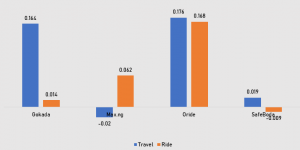
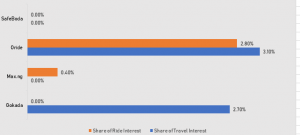
As the strategic moves continues, analysis has shown that the main players would compete more during festivals and holidays. Between September and November, 2019 analysis indicates that Oride and Gokada had a significant share of public interest in travelling and taking ride to various destinations [see exhibit 1 and 2]. This translated to more sales for the two providers, analysis suggests.

Exhibit 1: Link among Public Interest and Motorcycle Ride Providers
Source: Google Trends, 2019; Infoprations Analysis, 2019

Exhibit 2: Share of Ride and Travel Interest
Source: Google Trends, 2019; Infoprations Analysis, 2019

During the period, public interest in travelling and taking rides resonated with Gokada by 8.7%, Oride by 27.8% and SafeBoda by 1.7%. It was a reduction for Max.ng. We discovered a 9.8% reduction in the provider when the public interest in travelling and taking rides was at 1%.

Going forward, Oride is expected to dominate public minds in December, 2019, January and February, 2020, analysis reveals. Passengers are expected to develop an interest in using the provider in December, 2019 more than other providers. However, the interest would dip in January and February, 2020. In January 2020, SafeBoda would be the only provider that would compete with Oride [see exhibit 3]. Others need to aggressive digital marketing in addition to other demand driving strategies.

Exhibit 3: Projected Interest in the Providers
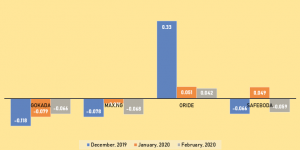
Source: Google Trends, 2019; Infoprations Analysis, 2019


How to Save for New Year

1

Everybody knows that December is accompanied by heavy spending. No matter how hard you try to avoid it, somehow, you will still find yourself spending so much within the month. You spend money on clothes, food (you even buy more groceries than you needed within the season), gifts, transportation and so many other things (both the necessary and the unnecessary ones).

I was caught up in this year’s spending spree since October. I wrote down all the things I needed to buy for the festive period in a jotter and kept it close to my pillow (so I can add or remove items as the case might be). My list kept growing and re-growing everyday. I even noticed there is nothing in the list for me; everything there is for others – neighbours, blood relatives, friends and close associates. I really wanted to make sure I sent out as many Christmas gifts as I could.

Each time I went through this list, I asked myself how I was going to fund it. I had believed that planning early will help me achieve my goal of sending out gifts to people that have been there for me and still be able to have enough savings for myself. But each day made me realise that it wouldn’t be possible. So I needed to cut my coat according to my cloth (I can’t come and kill myself). But I wasn’t sure of how to go about it.

To say I wasn’t disturbed by my long to-do list will be a great lie. Each time I remembered I haven’t been able to achieve a thing from the list, my heart goes flip-flop. I was literally over-thinking and unhappy until I shared my worries on my WhatsApp status and received lots of enlightening responses from my contacts.

A lot of people responded to my post with hilarious memes of how large their Christmas budgets were and how little their salaries are. Of course those memes made me feel better but my decision to cut down (or rather slash my list) came through pieces of advice from some financial experts.

The suggestions I received (and the ones I read up elsewhere) on how I could manage my finance this festive period and still save up for January included:

Budgeting for Christmas Season

Of course I made budgets for this season and that was why I came out with a long to-do (or rather, to-spend) list. But from what I understood, my list is supposed to be within the limit of the amount of money I earmarked for the festive period.

This advice is good but it doesn’t really work within Nigerian context. A good example of how this method won’t work is that most of us are going to receive last-minute invitation cards to weddings and traditional marriages by our close relatives and they will expect us to honour their invitations. These people won’t understand when you tell them that they aren’t in your budget. So, you see, you may plan yourself very well and still be caught up unawares.

Make your Purchases Early

Everybody knows that Nigerians increase the prices of commodities during the Christmas period (when they are supposed to give promos). So it will be better to make some purchases early so that you don’t get yourself caught up in the price hikes.

This method is good if you are purchasing non-perishable goods like rice, vegetable oil, clothes, shoes and the rest. But you can’t buy meat, tomatoes and other perishable commodities early.

Cut Down on Expenses

Someone said here that I should make sure I don’t spend more than I earn. This is very necessary, especially for those of us that made long lists of things to buy. This season has a way of making people spend more than they have. I believe it comes from seeing others spend theirs and the expectations of people close to us. But, if we keep hammering it into our heads to cut down on expenses, I believe we will spend less.

Save for January

January is always the longest month of the year because a lot of people have little fund to see them through the month. The Christmas celebration has its way of getting the best of people and eating deep into their pockets. For this, people need to save for January.

Someone said that those that can’t help spending whatever they have should consider investing in money market funds, which they can withdraw in January. Another person said the best way to save for January is by moving a certain amount of money into an account that has no ATM card so that you don’t force yourself to withdraw it during the festivities.

I buy both ideas; they are good. But, the best way to save is by disciplining ourselves. If you lack discipline, you will still withdraw from those accounts within the period.

Creating an Emergency Account

I learnt this from Toyin F. Sanni, the Group Chief Executive Officer of Emerging Africa Capital Group. She advised that everyone should have an emergency account that should be fed every now and then. She said that this account should be fat enough that, in case of job loss, it will feed the owner and his dependents for a minimum of six months.

Now, just as in the case of moving money into an account that has no ATM card, there is still a need for discipline for this emergency account to work.

All these suggestions are good, but they failed to solve the problem of how we can spend the little we have in order to show appreciation to people that have been there for us throughout the year. I believe it is important to show gratitude to these people as the year runs out because we still need them in 2020. An article on how we can spend little to achieve greatly within this Christmas period will be posted later.

The Challenge Ahead As Nigeria Makes Progress on 5G

0
5G network, adaptable business model

On the 25th of November 2019, Nigeria beat other West African countries to trial 5G. Spearheaded by MTN, the telecom giant basked on the technical platform provided by the regulator, Nigerian Communication Commission (NCC), to put the possibility of fifth generation network in Nigeria to the test; and it worked out fine.

The world has been pushing for a faster internet speed, an alternative to 3G and 4G, and China and the U.S have been in the forefront of the quest. With this trial, Nigeria has shown its readiness to take advantage of modern technologies to promote efficient communication and faster internet services.

The benefits of 5G have been measured and its weight is expected to have a positive impact on businesses, healthcare and general services enabled by the internet. The 20 Gigabyte per second speed is a life-saving alternative to the crawling speed of 3G that is mainly available in Africa, and has been immobilizing innovative ambitions.

The impact is also expected to spur efficiency in the manufacturing and agricultural sector, creating smarter and faster ways of doing things. It is also a fundamental platform for the Internet of Things (IoT)- a collection of devices collecting, connecting, transmitting and sharing data via the internet.

However, Nigeria’s 5G ambition has not come without its challenges bordering on the availability of the spectrums and licensing needed to foster the establishment. Though in November 2018, the Executive Vice Chairman (EVC) of NCC, Umar Garba Danbatta, said that the regulator has made adequate provision for the infrastructure needed by operators to execute 5G related tasks. He told BusinessDay:

“We have taken steps to preserve the 26GHz, 38GHz and 42GHz spectrum bands for 5G. There will be a number of slots in all these bands and the commission has also made provision for subsidy payment for infrastructure companies who wish to deploy 5G. Public private partnership, infrastructure and the right regulatory standards are also necessary to facilitate deployment of 5G services across the country.”

Danbatta also stated in Abuja recently, during the trial of 5G that NCC will involve many stakeholders by consulting widely so as to ensure that the measures taken cover the security aspect of the framework.

“We are not oblivious of the global concerns around 5G network security vulnerability, and we will be working with our Parent ministry and security agencies to develop measures to ensure a high level of cyber security of 5G networks,” he said.

The Commission has been praised for its efforts in providing the needed infrastructure and support for operators who are willing to go 5G. The president, Association of Telecommunications Companies of Nigeria (ATCON), Olusola Teniola, said:

“In the case of MTN, the NCC allowed the operator to use 100MHz of spectrum to enable them to demonstrate the capability of 5G. The commission has vowed to support other 5G trial with Airtel, Globacom, 9mobile and other service providers when they apply. This demonstrates the readiness and dedication of the regulator to ensure that as many Nigerians that want to experience very high speed internet and innovative technology are able to do so.”

But there are other concerns, while the Commission has been lauded for the steps it took so far to implement the 5G network, transitioning from 2G to 3G to 4G and 5G, analysts are concerned that the provision may not be enough. There is a need to create enabling environment to accommodate foreign investors who would want to establish 5G networks in Nigeria in the coming few years.

“There are other factors that need to be taken on board to be able to commercialize 5G technology. We need to ensure that government is able to support the roll out of significant fibre across the country. We also need the support of government to ensure that the number of base stations deployed is at least doubled within the next two to four years. Currently, we have 39,000 base stations. We need 80,000 as minimum,” Teniola added.

Another concern has been the availability of 5G devices. GSA reported 15 new 5G devices addition in the last month, making it 48 in total. But that excludes regional variants and prototypes not expected to be commercialized. For Nigeria, the availability of these devices is going to take longer due to regional factors and product priority.

Copia Has The Best B2C Ecommerce Model in Africa

1

This is the most potent ecommerce model in Africa at the moment; Copia is on a mission. The company raised a $26m Series B funding round a few weeks ago and investors are congregating because it has something that is evidently amazing.

Largely, Copia is a consumer goods catalog and delivery service for Base of the Pyramid consumers in the developing world. It leverages mobile technologies and a network of agents serving as distribution points of aggregation to make a wide range of quality goods accessible to rural and peri-urban consumers.

Through this mechanism, Copia has fixed the marginal cost problem, and that makes its model supreme. It does everything through aggregation which means it can pursue a near-zero marginal cost in its scaling. When the “postal system” has aggregated agents, good things happen!

Copia’s model is hinged on a 5,000-strong agent network comprising mainly of local, small shopkeepers who earn commissions by serving as “points of aggregation of orders and delivery distribution.” Essentially, rather than make purchases online via a website or consumer-facing mobile app, Copia customers walk into stores of partnered agents who place orders on their behalf, take payments and serve as delivery points. Beyond the strategic benefit of solving postal address problems associated with deliveries in some African cities and rural areas, these agents also serve another purpose: “We established relationships with agents in these areas because those agents are trusted members of the community and through them we build a direct relationship with the consumer,” Steel says.

Users can also make orders through USSD codes—the 20-year old mobile technology that’s become widely adopted on the continent as a workaround to boost financial inclusion via simple feature phones.

[..]

While the average value of orders placed on Jumia over the past year stood at $66, Copia records average order values of around $10, Steel says.

Migo Raises $20 Million Series B Equity Round

0

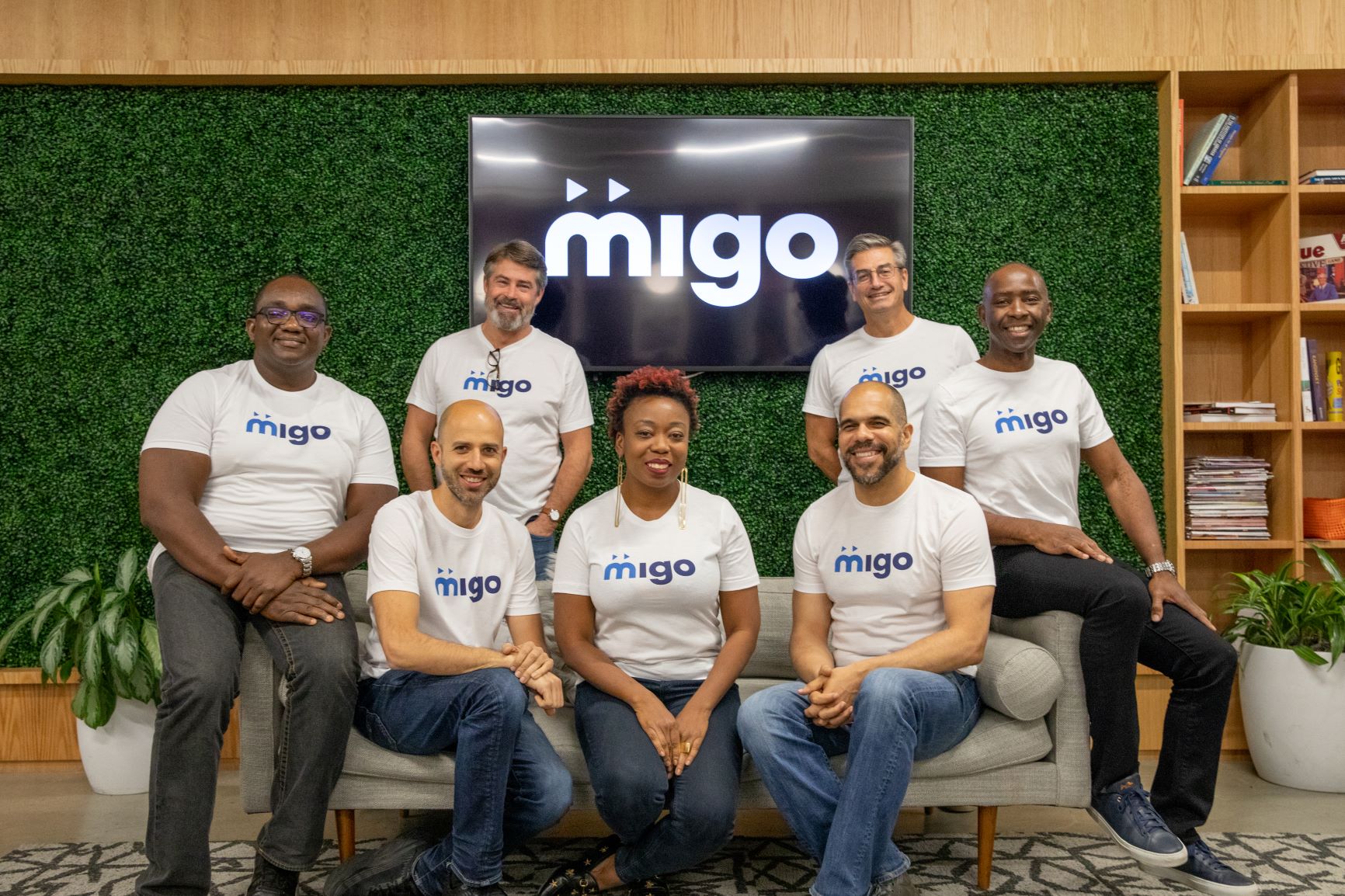
Migo (formerly Mines.io), a startup reinventing the way people access and use credit in emerging markets, has completed a Series B equity round of $20 million led by Valor Capital Group, a Brazil-focused venture capital firm. Existing investors, The Rise Fund (managed by TPG Growth) and Velocity Capital, also joined the funding round along with new investors, Africinvest and Cathay Innovation. This financing will support talent acquisition and Migo’s launch into the Brazilian market, as well as its continued growth in Nigeria.

Migo is a cloud-based platform that enables companies to offer credit to their customers, augmenting traditional bank and payment card infrastructure. Companies like banks, telecommunications operators and merchants integrate Migo in their apps and Migo underwrites customers to provide them with a digital account and credit line. The customers can use this credit line to make purchases from a merchant or withdraw cash without the need for point-of-sale hardware or plastic cards. Migo is headquartered in San Francisco, California. 

Migo is a cloud-based platform that enables companies to offer credit to their customers, augmenting traditional bank and payment card infrastructure. Companies like banks, telecommunications operators and merchants integrate Migo in their apps and Migo underwrites customers to provide them with a digital account and credit line. The customers can use this credit line to make purchases from a merchant or withdraw cash without the need for point-of-sale hardware or plastic cards. Migo serves underbanked customers who are not typically covered by credit bureaus, having underwritten more than seven million of these customers to date. An estimated 90 million adults in Nigeria and 100 million adults in Brazil have no access to credit, and this is a massive area of untapped growth for emerging market banking ecosystems.

“Our mission is to drive commerce around the world by injecting liquidity into the last-mile retail sector,” explains Migo CEO, Ekechi Nwokah. “We believe the best way to achieve this goal is to build digital infrastructure to empower local enterprises that already serve millions of consumers and small businesses.”

Migo offers a simple API so its partners can offer co-branded credit services in their own apps and websites, increasing customer engagement and serving customer segments they were not previously able to serve. Migo is particularly attractive for merchants and payment gateways since it can grow merchant revenue due to increased customer purchasing power and transaction completion rate.

As part of the financing, Antoine Colaco from Valor Capital has joined the Migo Board of Directors. “Migo combines world-class technology with a deep understanding of the needs of consumers and small businesses in emerging markets. We are excited to partner with them in Brazil and beyond,” Colaco said.

Migo enables some of the largest retail enterprises in Africa—from mobile operators like 9mobile and MTN to payment companies Interswitch and Flutterwave to banks like Bank of Industry and Fidelity Bank.  Migo is now expanding to Brazil and partnering with some of the largest retail enterprises in Latin America. “The typical Silicon Valley approach of move-fast-and-break-things doesn’t work well in emerging markets. To create durable solutions, it is important to combine the audacity of cutting-edge technology with humility to the nuances of local markets” says VP of Growth, Adia Sowho.

Migo started out as a research project on high-performance artificial intelligence led by Migo Chief Scientist, Kunle Olukotun, a professor of computer engineering at Stanford University. This project came to life after a chance meeting between Olukotun and Nwokah, a computer scientist working on big data projects at Amazon Web Services. Following their meeting, the pair teamed up to direct the technology toward solving credit in emerging markets. This big data approach is one of the company’s key advantages, as it aggregates massive amounts of data across all of its partners to improve population coverage and credit decisions over time.