DD
MM
YYYY

PAGES

DD
MM
YYYY

spot_img

PAGES

Home Blog Page 6584

Instagram Begins Cloning TikTok To Save Its Future

0

As TikTok fights to stay alive in the U.S. over the government’s investigation into its activities on the suspicion that it’s enabling the Chinese government to spy on the U.S., it seems there is yet another battle it has to fight: Instagram.

Instagram is launching a video-music remix feature that will replicate major functionality of the Chinese Social media, the “Reels” feature. Instagram is not developing it as a separate app though; it’s introduced as a new feature in the app’s stories.

“Instagram is launching a video-music remix feature to finally fight back against Chinese social rival TikTok. Instagram Reels lets you make 15-second video clips set to music and share them as Stories, with the potential to go viral on a new Top Reels section of Explore. Just like TikTok, users can soundtrack their Reels with a huge catalog of music, or borrow the audio from anyone else’s video to create a remix of their meme or joke” – TechCrunch.

The Reels will enable users to create short videos which can be shared and remixed, a feature so typical of TikTok. Although Instagram director of product management, Robby Stein, gave the credit to musically, it is an obvious rip off. He told Techcrunch:

“I think Musically before TikTok, and TikTok deserve a ton of credit for popularizing this format.”

One thing is clear from this blatant attempt to discredit TikTok in a bid to justify the replication – Facebook has become wary of TikTok, and it is just one of the many promising social media platforms that have made it paranoid.

In 2008, Myspace was commanding the usage of over 75 million people monthly, a number that drastically fail in two in the space of two years, due to the emergence of Facebook. It was not a tragedy that Myspace saw coming, neither were they ready to handle it. So the once bubbling social media site became a once-upon-a-time tale. Facebook knows that it could be next if it doesn’t tread carefully, and the paranoia has left them with two options whenever they figure out a potential threat: Buy or copy.

Armed with a great number of over 2 billion users and a lot of cash to spread around, Facebook took the position of the defender and the attacker at the same time.

In 2012, Instagram was just two years old, commanding 30 million users, with the potential to amass more. It had something Facebook didn’t have, and people were finding it captivating. Facebook was going to clone it, whatever it was that kept more people going to Instagram, but on second thought, they changed their mind. Why duplicate a function that you can buy in full? Mark Zuckerberg rolled out $1 billion, and Instagram became part of Facebook.

In 2014, Facebook doled out a whopping $19 billion for the messaging App Whatsapp. It’s become a threat to Facebook messenger, taking millions of people off Facebook with the speed of raging fire. All efforts to tame the tide by improving Facebook Messenger were unsuccessful. So Mark activated the first option in neutralizing a threat – Whatsapp became part of Facebook.

Around that time, another potential threat was lurking in the corner, though not visible enough. Until a huge number of young people started turning away from the features that Facebook once used to entice them – it was no longer cool. It was then that Facebook saw who was receiving the large number of people it was losing – Snapchat.

Facebook knew it’s another war it has to win using any of the options in its arsenal. The statement they issued then confirmed that:

“We believe that some of our users, particularly our younger users, are aware of and are actively engaging with other products and services similar to, or as a substitute for, Facebook. For example, in the third quarter of 2013, the best data available to us suggested that while usage by U.S. teens overall was stable, DAUs among younger teens in the United States had declined.”

It was more of a call for action than acknowledgement that it’s losing on many ends. In the next few years, Facebook was aggressively offering to buy Snapchat, and attempt that did not materialize like in other cases because Snapchat refused to sell. Their decision not to sell only meant one thing; Facebook would activate option number 2, which they did.

Facebook started cloning many of Snapchat’s features and functions, the mimicry got to the point that Miranda Kerr, the fiancé of Snap Inc. CEO Evan Spiegel took a shot at them. She said:

“Can they not be innovative? Do they have to steal all of my partner’s ideas? I’m so appalled by that… when you directly copy someone, that’s not innovation, it’s a disgrace. How do you sleep at night.”?

Many would have been glad if the story ended with Snapchat, but it didn’t, and didn’t surprise them either. TikTok has become the latest victim of the bully’s paranoia, a symptom of phobia of being relegated by a newcomer. Though most of the cloned Snapchat’s functions didn’t survive the test, the attempt slowed Snapchat down, and it took a couple of years before it got back again on its feet.

TikTok may face the same fate, and in the face of current government’s inquiry into its activities, the recovery may take longer. Though Instagram said the feature will only be available in Brazil for now, it doesn’t need a rocket to get to other countries. With Facebook user numbers and financial status, eliminating competition has become more of a figure of speech than a rigorous action.

The call to break Facebook up has been because of its ever growing influence, a dangerous trajectory to the competitiveness of the tech industry.


Using “Fear of Losing Out and Need of Urgency” To Drive Customer Acquisition

0

The Too Good to Be True Offer

Scaling up as a startup could be a really daunting task, hence many startups come up with what I call the “The Too Good to Be True Offer” where they clout themselves by offering very affordable services at zero percent profit margin, no profit or even at a loss. This would actually gain them traction quicker in terms of customer base acquisition. But coming from Nigeria where the popular saying “AWOOF DEY RUN BELLE” is common on the lips of every person in Nigeria, this trend has to be explained in another angle.

Nigerians no doubt like free things a lot and wouldn’t hesitate to clout, carrying out tasks the company gives just as long as the Awoof period is still on. But now for the company they are enjoying the Awoof patronage which would later run their belle in the sense that when they finally want to adjust their business models, for profitability, they end up not having those customers they thought they had initially. This is because Nigerians would rather patronize the next man if their current man hikes the price.

A clean case sample is the platform Kudi.ai which when they first started out weren’t charging commissions from their customers, for transactions carried out via their platforms, and when they finally decided to start charging, I read an article on how the CEO stated they lost a whole chunk of their customers. That happened because they noticed that these clients were only there for the freebies; nonetheless, it helped them to re-strategize and refocus on KYC better and to further serve customers better.

The same applies to the telecoms disrupters back then e.g. Multi-Links. This company came up with the cheapest phone that could do everything back then and to top it all free calls and browsing. It initially captured the market but when it wanted to remodel, everybody dropped their phones and moved back to their respective Telco phones.

I always advise people not to grow their pages using giveaways and freebies even though they are very effective.

However MTN, Glo and Econet (now Airtel), knew this trick on-time and they exploited the offer by capitalizing on two customer acquisition models, Fear of Losing Out and Need of Urgency in the sense that a lot of people were tired of Nitel, the inefficient state monopoly.

Hence Nigerians urgently needed a fresh of breath air, and when it came, they were all scared of losing out of the offer due to their need of urgency.  No wonder, reports have it that MTN achieved profitability ahead of projections.

Aliko Dangote – The Dean of African Markets and Why He Wins

3

Dangote is a business legend. Reading many LinkedIn comments on the fascinating piece by Azeez, I want us to look back to the playbook of the dean of business deals in Africa. When I developed the Accumulation of Capability Construct, I used Dangote as an example. Today, if you google “accumulation of capability construct”, Google will give you a definition from our works. Yes, we brought that lexicon into business, and I have used it in a piece in Harvard Business Review.

But the greatness of Dangote comes not just through the accumulation but compounding the capabilities. His brilliance is in his meticulous paced-acceleration into industrial sectors, mastering the elemental constructs of negotiation and time, unlike any other. With that zen-movement, nations have begged him after annoying him (Tanzania), and he has effectively imposed conglomerate tax on citizens he serves because he has leveraged his capabilities at the upstream to rewire the architecture of market systems, shifting the equilibrium points where his textbook becomes the recommended one. Yes, he is the Dean, and he approves all course materials. Get to this video again.

Firms win by accumulating capabilities. From Google to Dangote Group, when companies accumulate capabilities, they operate in domains that generate higher value (usually upstream) compared with where typical firms operate (usually downstream). Dangote Group can deploy massive assets and technical know-how in cement production, making it harder for new entrants and rivals.

To rise to the level to extract Conglomerate Tax on nations and citizens, capabilities matter. Amazon taxes the digital economy through Amazon Web Services. Dangote Group taxes Nigeria because it solves problems which few can imagine. For solving those hard problems, the firm demands special treatments in different ways from the government. What it does is typical: Amazon, GE, and global conglomerate live on that.

It is not Dangote Group’s fault; it is simply Nigeria’s fault that it has only one true (industrialized) conglomerate in the 21st century.

NDPR-Compliant Layer3Cloud Offers Affordable Hosting in Nigeria

0

The Nigerian data protection regulation (NDPR) is a big deal. If you serve any public institution or agency, at LGA, state or federal level, you are required by law to have the data managed in a special way. Also, if you work in some specific sectors like mining or finance, data handling is very critical. To startups and anyone here, local or foreign, if you are looking for a partner that offers NDPR-compliant data hosting in Nigeria, Layer3Cloud is available. Layer3Cloud offers data sovereignty and meets NITDA compliance requirements, giving you peace of mind with the regulation. I visited the datacenters and touched them in Abuja. 

Hosting starts from N13,600 ($40) if you contact Layer3 and mention NAIJA.


Africa’s Digital Trek: From Kenya to the World

0

Prior to posting this article, I had considered numerous alternative titles before settling for Africa’s Digital Trek: From Kenya to the World. Before I go into the details of the post, I think it is only fair that I shared what could have been the title and why. 

First, I thought about “The Long Walk to (Digital) Freedom” mapped against Nelson Mandela’s biopic “The Long Walk to Freedom.”

A second option could have been “Digital footprints on the Silicon Sands of Africa poised on developments in the burgeoning innovation hubs in Africa. 

However, “Africa’s Digital Trek: From Kenya to the World,” it is! And here’s why. It is the most appropriate considering all the hype around the digital exploits of Africa. 

With this upfront disclaimer, I opine that there is a need for caution in the hype. Yes, numerous innovation (mostly digital) hubs have sprouted across Africa and a range of stakeholders including policy makers, the media and scholars (yes I am also complicit in this category) have gone ahead lost in optimism of the emerging entrepreneurial system and Africa’s response to the “Silicon Valley” innovation exploits. 

However, it has since become obvious that this model has its darksides with the job cuts of tech developers in the sub-region and the inappropriateness of the so-called emergent “digital footprints” responding to the well-established “Silicon Valley” narrative.

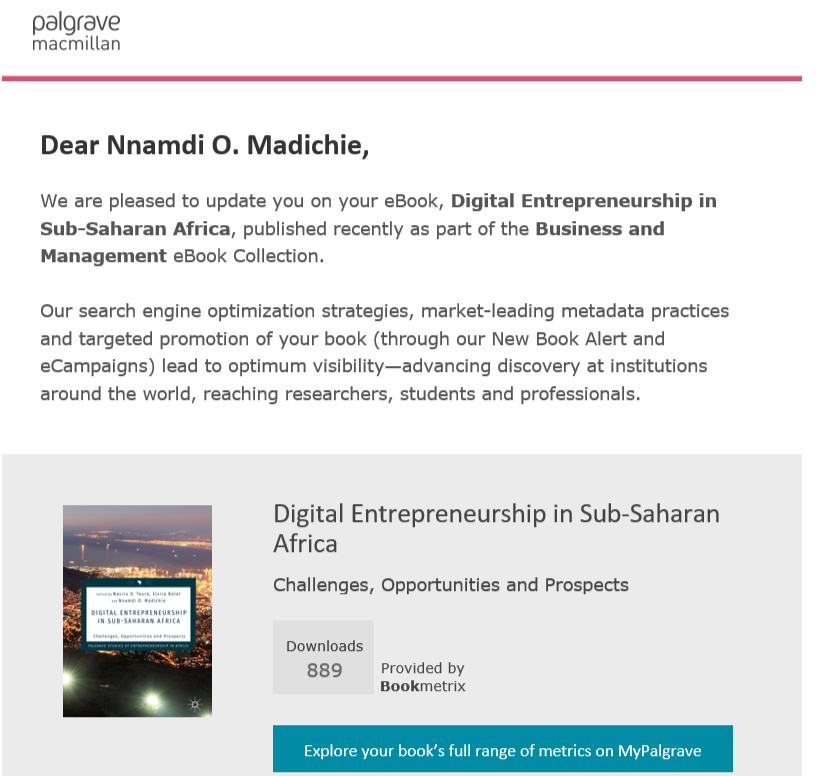
At this point, however, I would like to reflect on my recent book entitled “Digital Entrepreneurship in Sub-Saharan Africa” and its precursor “Digital Kenya” both published my the Palgrave-Singer alliance. Indeed, in one of the chapters from the latter book entitled The KINGS of Africa’s Digital Economy Eric Osiakwan points out that:

 “The tech wave is now moving through Kenya and has produced some of the country’s and the continent’s leading tech innovations—for example, Erik Hersman’s iHub and Safaricom’s M-PESA (made possible because of Vodacom’s prepaid airtime). The wave is now making its way to Lagos, Nigeria, and Abidjan, Ivory Coast. In my view, the wave’s route across and within these countries—namely, Kenya, Ivory Coast, Nigeria, Ghana, and South Africa (KINGS)—is worthy of exploration.”

 “The digital economy in Africa started in Cape Town, South Africa, in 1995 when Mark Shuttleworth built Thawte, a leading certificate authority, and sold it to Verisign when Vodacom championed prepaid airtime.”

 He also pointed out that:

 “The wave then moved to Ghana in 2001, when, together with Mark Davies and others, BusyInternet was built—a multipurpose tech hub through which I started the Ghana New Ventures Competition in partnership with the MIT $50K Competition, bringing about www.smsgh.com

My colleagues and co-authors not long provided a snapshot of this book in an article entitled “Digital technologies are transforming African businesses, but obstacles remain,” unfortunately I was left out due to the business model of the outlet. But that’s a matter for another day. For now, however, I would like to highlight the contents of the book and how it speaks to the current winds blowing across the continent. I would proceed with an audacious statement, “our book goes one step further” by asking pertinent questions such as:

What next for digital entrepreneurship in sub-Saharan Africa?

The book draws insights from the views of notable actors, insiders or those with a wealth of experience in researching some of the themes covered within it. From Ayodeji “Jobberman” Adewumi previously covered on this platform, to Professor Francoise “Ijeoma” Ugochukwu, also previously profiled on Tekedia.

Following on the heels of a sister book, Digital Kenya: An Entrepreneurial Revolution in the Making, this recently published book on Digital Entrepreneurship in Sub-Saharan Africa Challenges, Opportunities and Prospects, part of the Palgrave Studies of Entrepreneurship in Africa series, highlights the intersections of entrepreneurship and the “world of digital” in a context undergoing pubescence.

The collection showcases the exploits of digital enterprises in SSA drawing upon a range of case studies across sectors from agritech, fintech, media, animation and games. It also highlights the challenges and barriers that are in place and how some outstanding digital firms deal with operating in a hostile business environment. While digital platforms have created equal access for small businesses, many digital entrepreneurs in SSA continue to struggle with local environments replete with corruption, and other economic inefficiencies.

The contributions move the debate forward by addressing the challenges, opportunities, and prospects of digital enterprise in the sub-region. The book thus contends that, while on the one hand, digital platforms have created equal access, on the other hand many digital entrepreneurs in SSA still struggle with rather turbulent local environments. Consequently, this article touches upon three key sectors: Technology-enabled agriculture in Africa; Arts, Media and Entertainment ; and Innovation Hubs in Africa.

Technology-enabled agriculture in Africa

Two contributions focus on tech-enabled agriculture. The first entitled “The Nature of Corporate Digital Agricultural Entrepreneurship in Ghana”,  takes the reader through an interesting research area on corporate digital entrepreneurship from the Ghanaian perspective. A similar view is expressed in the second contribution entitled “Agri-tech Opportunities at the Bottom of the Pyramid: How Big Is the Opportunity and How Little Has Been Exploited? Some Selected Cases in Nigeria”,  which closely examines the rise of a distinctive form of entrepreneurship at the bottom of the pyramid interfaced with digital technology, illustrating the massive opportunities that could potentially be exploited. As the UN environment report points out, and instructively: 

“From invaluable farming advice shared via text message to livestock vaccines delivered when and where they are needed thanks to a mobile phone service, Agri-tech and precision farming are changing the face of agriculture across Africa.”

This transformation is an urgent imperative. With global warming threatening harvests, and the world’s population set to grow to around 10 billion by 2050, a sustainable agricultural revolution is needed to secure food supplies and protect the resources that sustains society from the purview of the subregion and well beyond.

Arts, Media and Entertainment 

In the sector of Arts and Entertainment, three chapters highlight prospects and challenges – albeit from a two-country perspective – i.e. Kenya and Nigeria. In the first of these chapters, Callus on the topic of “Shifting Cultural Capital: Kenyan Arts in Digital Spaces”, examines the impact of digital technology on cultural capital that is associated with curatorial practice, the gallery, and the marketplace. The chapter draws from the theory of cultural capital and illustrates how digital art challenges notions of authenticity in the discourse on African art.

As the emphasis shifts to the Nigerian context and especially in a  more recently recognised entertainment sector, two further contributions are made. In the first of these,  Bolat in her contribution entitled “The African New Media Digital Revolution: Some Selected Cases from Nigeria”, explores the historical timeline of and changes in the media landscape and presents an empirical investigation of new media SMEs (small-to-medium enterprises), reflecting on their journeys in establishing technological enterprises, the media used, and the resources that were critical to manage and run these businesses, as well as general commentary on enablers and barriers.

In the second contribution , “The Impact of New Media (Digital) and Globalisation on Nollywood”, the Nigerian movie industry is investigated in the light of digitalisation and new media. The article examined and highlighted how two major forces—new technologies and globalisation—have impacted (and are still impacting) upon the Nigerian film industry (also known as Nollywood), drawing on theories of value chain in production, distribution, and marketing of cultural products (i.e. movies), and its internationalisation.

Innovation Hubs in Africa: What Do They Really Do for Digital Entrepreneurs?

In a contribution of the same title of this section, one contribution provides a grounded perspective on Africa’s most widely noted type of digital entrepreneurship support organisation i.e.  the explosion of innovation hubs across Africa and the claims being made regarding how they facilitate entrepreneurship, including digital entrepreneurship, in Africa. Indeed, this subject was also touched upon in Digital Kenya: An Entrepreneurial Revolution in the Making where the digital evolution is reported to have kicked off in 1995 starting out in South Africa (Cape Town) with Thawte, a leading certificate authority – later sold to Verisign when Vodacom championed prepaid airtime. Moving  through to Ghana in 2001 with BusyInternet and www.smsgh.com and onwards to Kenya a leader in Africa’s tech innovations with structures such as Erik Hersman’s iHub and Safaricom’s M-PESA, and Yaba, a suburb of Lagos, Nigeria, labelled the country’s Silicon Valley with an established start-up ecosystem firmly in place.

Overall there is a need for more interrogation on how both incumbent and new players in the subregion are shaping the landscape and forging a renaissance – with a view to meeting the UN (United Nations) Sustainable Development Goals (SDGs). The book also concludes with some thoughts on the subject of digital entrepreneurship in SSA and its many facets and a call for more research into this topic by both students and staff in business schools across the globe with an interest on entrepreneurship in the subregion whether facilitated or constrained by digitalisation.

Note: 

This article is based upon  recently published book on Digital Entrepreneurship in Sub-Saharan Africa Challenges, Opportunities and Prospects as part of the Palgrave Studies of Entrepreneurship in Africa series edited by three UK-based academics of African heritage .

The book may be cited as follows:

Taura, N. D., Bolat, E., & Madichie, N. O. (2019) Digital Entrepreneurship in Sub-Saharan Africa Challenges, Opportunities and Prospects.

Digital Entrepreneurship in Sub-Saharan Africa