DD
MM
YYYY

PAGES

DD
MM
YYYY

spot_img

PAGES

Home Blog Page 6618

Nigeria’s Aso Rock – This House Cannot Thrive On The Shoulders of One Man

0

From the beginning of time, the concept of division of labor has been a sacrosanct requirement for maximized productivity.

Division of labor involves the separation of tasks in any system so that participants may specialize at divisional levels of management in order for desired outcomes to be effectively and efficiently maximized.

In the Christian account of the story of creation recorded in the Bible, God created the first man Adam, but then, the omniscient God sensed a lack of completion in His creation. He felt that it is not a good thing for Adam to take sole management of the world He has created, so God created woman called Eve to partner and assist Adam.

The partnership and assistance provided by Eve led to the multiplication of the human race such that the world population currently stands at more than 7.7 billion.

Even if your scientific mind doubts the biblical account of human creation, it is impossible to fault the fact that it must have taken the existence of a first man and woman for the human race to have multiplied.

Such is the power of a divided labor!

One of the early thinkers of the division of labor concept which led to its formal practice in economic and political management was Scottish social philosopher and economist Adam Smith, who lived from 1723-1790. He believed that a society with a sophisticated usage of division of labor can be more productive and therefore, would develop more quickly than a society without it.

A cursory look at the management system of the Nigerian state reveals a system that assumes a management stance of being wiser than God. It shows a management system that stubbornly refuses best global management practices for a system that depends on the whims and caprices of whoever wields state power.

Nigeria practices a federal system of government in which there is a central government and federating units. This is why we have a federal government, 36 state governments and 774 local governments.

The governance system is designed in such a way that the powers of a single President who heads the federal government is greater than the combined powers of 36 state Governors and 774 local government Chairmen. What makes this Presidential power much more dangerous is the fact that the accountability system to checkmate it is weak.

To put this insane power in clearer perspectives, the incompetence of a single President can render useless the competency of 36 state Governors and 774 local government Chairmen when measuring national progress with varying metrics.

Consequently, in order for this peculiar power to be maximized for the progress of Nigeria, whoever wields it must have the moral and intellectual embodiment that is at least equal to that of 36 state governors and 774 local government chairmen combined. Of course, this is impossible! No single human being can be that blessed.

This is why the country keeps running around in the same circle. The fate of a complex diverse nation has always been placed in the hands of one man who wields presidential powers and the country’s progress inevitably becomes dependent on the action and inaction of one person.

Definitely, this kind of system is a recipe for disaster in productivity and development. The current state of the Nigerian economy and politics perfectly explains the result of not fully embracing division of labor in political management practices.

David Hume (a Scottish philosopher and economist) has this to say of the indispensability of the concept of Division of Labor –

when every individual person labors apart, his force is too small to execute any considerable work; his labor being employed in supplying all his different necessities, he never attains a perfection in any particular art; and as his force and success are not at all times equal, the least failure in either of these particulars must be attended with inevitable ruin and misery. By the conjunction of forces, our power is augmented: By the partition of employment, our ability increases: And by mutual succor we are less exposed to fortune and accidents. It is by this additional force, ability and security, that society becomes advantageous.

Division of labor creates strong institutions. When institutions are strong, the deficiencies of certain individuals will not be able to create a major damage to the whole system.

The Nigerian police for instance is performing dismally in internal security because it operates a centralized management structure. The heavy corruption and criminality within the Nigerian police force continues to thrive because of a centralized system that is unable to conduct effective oversight of the operations of its vast security network.

It is common sense that the best way the Nigerian police can function effectively is to put their operations under the complete authority of state Governors. The empty argument against this is that state Governors cannot adequately fund a police force except for Lagos. It is a simple mathematics – the allocated funds deployed to run a centralized Nigerian police force should be re-channeled to the 36 states to fund a decentralized police force. The state Governors can take it up from there.

The vast kilometers of federal roads in Nigeria like the Lagos-Abeokuta express road are in a state of rot because they are under the authority of the President. Put these roads under the complete management of state Governors and the residents of each state will be able to effectively hold their Governors accountable. The state of these roads continues to undermine the economy and put citizens’ lives at risk.

That state Governors rely on monthly federal allocations to fund their operations is an archaic, inefficient and enslavement financial management practice. The system needs to enable state Governors independently manage their economy and generate their own revenue. The 36 states combined will most likely outperform a single federal government in fiscal management.

Immanuel Kant noted the value of division of labor:

All crafts, trades and arts have profited from the division of labor; for when each worker sticks to one particular kind of work that needs to be handled differently from all the others, he can do it better and more easily than when one person does everything. Where work is not thus differentiated and divided, where everyone is a jack-of-all-trades, the crafts remain at an utterly primitive level.

By the virtue of conferred powers, the Nigerian President is a jack-of-all-trader. Such trader ends up being a master at nothing. An historical observation of the performance of different heads of state in Nigeria reveals a tale of management failures.

A look at the proposed 2020 budget of Kaduna state under the management of Nasir el-Rufai clearly shows that the fiscal intelligence that goes into preparing that budget was more thorough and progressive than that of the 2020 national budget.

The management style of the current Governor of Oyo state, Seyi Makinde, easily beats that of the President of the Federal Republic of Nigeria in all parameters of good governance. Yet, the President holds all the powers that matters to the nation’s well-being.

No matter the good management practices in Kaduna, Oyo, Lagos etc, they are all still within the Nigerian entity and are not insulated from the consequences of action and inaction of the Nigerian President by virtue of the insanely concentrated powers in that office.

Lord Acton, an historian and moralist said:

Power tends to corrupt, and absolute power corrupts absolutely. Great men are almost always bad men. When a person’s power increases, their moral sense diminishes.

It is therefore not a surprise that presidential aspirants passionately make developmental promises during election campaigns and become something else when they enter Aso rock. The powers vested in the Nigerian presidential office is more than enough to make any human beings grow complacent and disconnected from the people he represents.

The federating units of Nigeria needs to be fully constitutionally empowered to take control of their socio-political, security and economic fate. The excessive presidential powers needs to be shed off and given to federating units for optimum use in bringing about transformative sustainable development.

It is a once in a lifetime that exceptional leaders like Nelson Mandela, Lee Kuan Yew, Abraham Lincoln and the likes emerge to change the fate of a nation. Strong institutions can consistently be relied on to get the job done. Strong institutions only exist where there is a clear-cut division of labor, clear-cut division of power and authority such that an individual is unable to do reasonable damage to the system no matter how powerful he/she is. The case of Donald Trump and the United States of America is a classic example.

In my reasonably factual opinion, Nigeria cannot get out of this circle of mediocrity until the constitution is fundamentally altered such that the President, by virtue of conferred powers, ceases to be the Alpha and Omega of the Nigerian state.

Olusegun Obasanjo, Musa Yar’Adua, Goodluck Jonathan, Muhammadu Buhari etc – they have all failed to give us the Nigeria of our dreams. We need strong institutions, not strong leaders.

We need a system that can survive all seasons. A strong, truly federal system.

Financial Inclusion, Cashless Policy and Electronic Transaction Charges

2

Data from the World Poverty Clock shows that the number of people living in extreme poverty in Nigeria as of October 11, 2019 is about 94.5 million. As scary as the number is, more worrisome is the fact that the report also puts the current escape rate at -4.4 people per minute. This means on average, about four Nigerians become poor every minute!

Though poverty can be self-inflicted by one’s actions or inactions, a large chunk of it is milled out of bad government policies. In essence, government policies and programmes, especially as they affect access to quality education, healthcare services, availability of critical infrastructures, among others are the major determinants of the number of people that would slide in and out of poverty at any point in time. Successive governments in Nigeria have rolled out programmes after programmes with promises of changing the economic fortune of the country while lifting millions of citizens out of poverty. 

As it has always turned out, the country and her citizens are often worse off at the end of the day. Most of the programmes are often borne out of what is in it for the powers that be at the time of their initiation. Hence, they are not institutionalized, usually wrapped in corruption, and therefore lack continuity after plunging billions of naira into them.

Well, the crux of this piece is to examine the impact of the recent introduction and enforcement of fifty naira stamp duty for Point Of Sales (POS) transactions on the already impoverished masses and Micro, Small and Medium Enterprises (MSMEs). How would this affect both the cashless policy and financial inclusion drive?

I recall clearly that one of the cardinal objectives of the financial inclusion strategy, which is aimed at bringing as many people into the financial system as a way of taking them out of poverty, is to make financial services accessible to the excluded populace at a minimal cost. From my interactions with some merchants, as expected, they are looking for ways to pass the cost to their customers without having to lose market share. What did I hear you say?

Let’s have a look at what would play out between retail merchants, small scale (financial) service providers and their customers. For instance, a retail trader who bought an article for N900 and decides to sell at N1,000 and also wants to be compliant with cashless policy would have to contend with: merchant service charge (0.5% of the transaction amount, N5 in this case), N50 stamp duty, taxes from local government, shop rent, transportation cost and electricity bill. 

All these are supposed to come from the gross profit of N100 per article! Mind you, we are talking about a retail trader in a rural environment. Meanwhile, the trader has option of dealing in cash and ‘saving’ the N55 charge associated with the attempt to go cashless. Should the trader toe the path of cash based transactions to avoid stamp duty payment, it would be an obvious blow to the cashless drive. What if the merchant wants to pass the POS associated cost to the consumer? Assuming the buyer has no option, his purchasing power would be affected and consequently his living standard. But if the buyer has cash purchase alternative, he will certainly choose that. Still a knock to the cashless society pursuit. A friend said he would slow down on POS usage as much as the stamp duty charge persists.

In my opinion, this recently introduced N50 stamp duty charge for every POS transaction value for N1,000 and above, is at variance with both the cashless society and financial inclusion drive. To achieve the cashless society or financial inclusion objectives, the use of POS and other electronic means for financial transactions are supposed to be incentivized instead of being ‘punished’. If the N50 stamp duty as a means of revenue generation must be implemented on POS and other electronic transactions, the applicable threshold should be reviewed upward, say N10,000 and above.

Also, while it is important that government expands its revenue net, it is even more crucial that leakages in the existing revenue collection structures and in the application of the revenues generated are sufficiently plugged. If corruption right from revenue collections to civil service payroll fraud and inflated contracts are not tackled, no amount of tax increment would be enough to settle Nigeria’s debt obligations let alone build the much needed infrastructure. 

Thankfully, as one of my bosses, Chima Azubuike (a passionate man about data and technology driven governance) would say, “Internet of Things (IoT), Big Data Analytics, Machine Learning, Cloud Computing, Artificial Intelligence (AI), Blockchain Technology and Robotics are near convergence. This will deliver superior services to global population and streamline processes… Get ready!” and “What’s your experience with doing business with entities with zero integrity? 

Yes, I mean trustless people and companies? The wheel of the law is so slow and most times frosted in aberrations beyond sensibilities. Not to worry, we are approaching the dawn of SMART CONTRACTS. Self-executing agreements leveraging Blockchain Technology, where information and data decentralization will unmask dangerous patterns and profiles, so as to nip criminality in the bud”. However, my question is, will the current crops of politicians ever think of deploying such technology in governance?

SON New Standard On Plastic Recycling – Big Business Opportunity

0

Recently, I had the privilege to join other industry experts invited by the Standard Organization of Nigeria to develop the draft policy for the use of recycled plastic PET Bottles for food contact application in Nigeria. The standard when signed into law will tackle plastic pollution in Nigeria arising majorly from the effect of single use plastic bottles. This is a laudable initiative and a drive towards a sustainable environment. Sustainability focuses on meeting the needs of the present without compromising the ability of future generations to meet their needs.

In the last decade, production and demand for the use of plastic packaging has been on the increase due to benefits of affordability and ease of use it offered compared to other forms of packaging. However, the increase has also led to continuous degradation and pollution of the environment which if not controlled will greatly affect everyone. Around the world and in some certain Africa countries like Rwanda and Tanzania, there are ongoing initiatives and reforms to combat the effect of plastics on the environment and its associated health risks. It is good to see that Nigeria has joined the global communities in addressing the plastic crisis.

Each year, at least 8 million tonnes of plastics leak into the ocean which is equivalent to dumping the contents of one garbage truck into the ocean every minute. The best research currently available estimates that there are over 150 million tonnes of plastics in the ocean today. In a business-as-usual scenario, the ocean is expected to contain 1 tonne of plastic for every 3 tonnes of fish by 2025, and by 2050, there will be more plastics than fish (by weight).

Nigeria being one of the biggest countries in West Africa generates an average of 32 million tons of solid waste annually and plastic packaging contributes about 2.5 million tons. This is a challenge especially in the urban settlement where the plastics are ends up in drainages and gutters thereby causing serious environment concerns. With the new standard, It means that the plastic bottles currently littered in the environment can be picked, cleaned, recycled and re-introduce into the production process for other application as already been practiced in developed countries.

This will lead to job opportunities which can be harnessed to reduce unemployment and poverty in the country. There are already existing recycling companies in Nigeria but they are not enough to tackle the environmental concerns arising from plastic pollution. More so, there will still be need for more middle men, collection hubs, and storage facilities along the supply chain to ensure that the plastic bottles get to the recycled plants at the right quality. The draft policy is the first step in achieving the ultimate goal and drive towards a circular economy and tackling environmental concerns from plastic wastes. It is important for everyone to start seeing this plastic bottles as a source of revenue and a means of turning waste to wealth. There are presently some neighborhoods where people are more conscious of the value of the plastic bottles.

For Instance, in Lagos, there is an initiative called the Recycle Pay Project where parents who are unable to afford school fees for their children can pay using collected plastic bottles in Ajegunle. The implementation of the standard will require support from all major stakeholders as collective efforts will be required to derive the gains from the policy. Proper and adequate collection sites have to setup to enable consumers drop off their plastic waste without any hindrance. Sensitization of the public will also be needed to ensure that everyone is aware of what needs to be done because we all get affected either directly or indirectly by the effect of plastic waste. The opportunities are huge and is still a relatively blue ocean. It is only the first that tap into the opportunities that will benefit fully before new entrants and competition begins to control the market dynamics.

The Glo-Airtel Disconnection: Punishing Nigerian Subscribers for Errors of Telcos

3
Glo

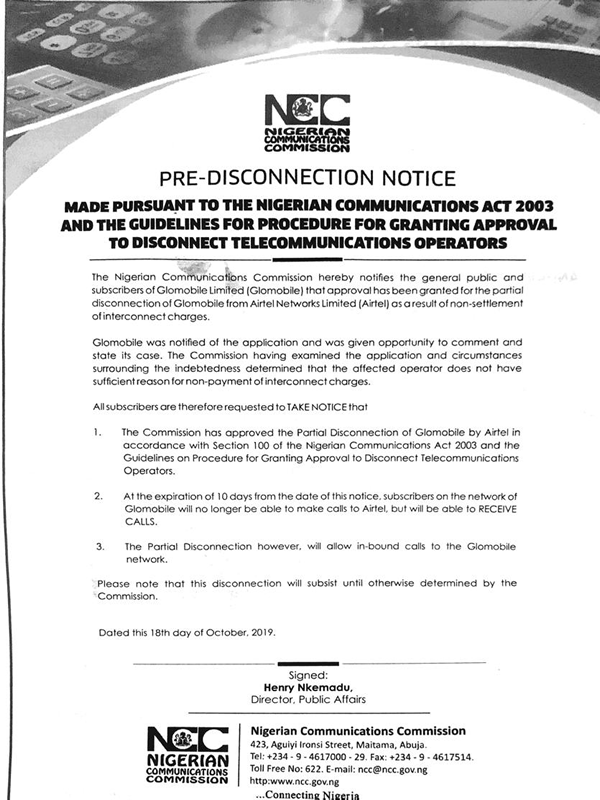
“The Nigerian Communication Commission hereby notifies the general public and subscribers of Globacom Limited (Glomobile) that approval has been granted for the partial disconnection of Glomobile from Airtel Networks Limited (Airtel) as a result of non-settlement of interconnect charges.

Glomobile was notified of the application and was given the opportunity to comment and state its case. The Commission, having examined the application and circumstances surrounding the indebtedness determined that the affected operator does not have sufficient reason for non-payment of interconnect charges.

All subscribers are requested to take notice that:

“The Commission has approved the partial Disconnection of Glomobile by Airtel in accordance with section 100 of the Nigerian Communication Act 2003 and the Guidelines on Procedure for Granting Approval to Disconnect Telecommunications Operators.

At the expiration of 10 days from the date of this notice, subscribers on the network of Glomobile will no longer be able to make calls to Airtel, but will be able to receive calls.

The partial disconnection however, will allow in-bound calls to the Glomobile network.

Please note that this disconnection will subsist until otherwise is determined by the Commission.”

This is a statement signed by the Director of Public Affairs, Nigerian Communication Commission (NCC), Henry Nkemadu. And it is telling an unpleasant story that network subscribers have heard and experienced before, and it didn’t sound or taste pleasant.

In July, Glomobile got into the same fight of non-interconnect charges with MTN Nigeria, putting subscribers in a situation of non-communication. MTN partially restricted calls from Glo, and the dispute lingered until August when Glo paid the N2.6 billion interconnection charges.

People thought they have learned their lessons and it’s never going to happen again. But they were wrong, and this time it even got messier. The intervention of the NCC here, as in other occasions, has been to recover the money for Airtel at the expense of subscribers.

Subscribers have to bear the brunt of the fight between Glomobile and Airtel, and the only alternative is switching to some other networks. Business lines will not be reachable from certain customers, and so it will be with every other thing powered by the interconnectivity of the two telcos.

The question everyone is asking is: Why do subscribers have to suffer the consequences of a telcos’ shortcomings? The NCC should find another means of debt recovery that will not penalize subscribers for offense they did not commit.

In the past, many of the operators had been caught up in one saga or the other with the regulator, and fines were levied against defaulters. For instance, in 2015, MTN was handed a record $2.5 billion fine for failing to disconnect unregistered SIMs, and the fine has kept them on their feet since then when it comes to SIM registration.

The Nigerian Communication Commission should have followed the same pattern and leave subscribers out of a squabble they have nothing to do with. If Glomobile knows that they are going to pay more than they owe in fines, they would not hesitate to pay their interconnectivity charges.

USSD Charge in Nigeria: Blame the NCC, Not the Telcos

0

Since 2011 when the Central Bank of Nigeria (CBN) introduced cashless policy, aimed at reducing the cash-based culture that Nigeria has been functioning on, there has been one development or the other contradicting it.

The most recent has been the introduction of charges on Unstructured Supplementary Service Data (USSD) transactions. Some Telecommunication companies on Saturday 19th of September sent messages to their subscribers as notice of charges on USSD.

“Yhello, please note that from Oct 21, we will charge N4 per 20 seconds for USSD access to banking services. Thank you.” The message from MTN reads.

This means if you spend 5 minutes checking your account balance, you will be charged N60. It was a rule approved by the Nigerian Communication Commission (NCC), without prior notice, and it is one among many.

Although the Ministry of Communication reacted quickly, a statement signed by Mrs. Uwa Suleiman, the spokesperson to the Honorable Minister of Communication, directed the NCC to discontinue the plan with immediate effect. It reads:

“The attention of the Federal Ministry of Communications has been drawn to the viral text message allegedly sent by the Mobile Network Operator MTN Nigeria and other Mobile Operators notifying subscribers of a four naira (N4:00) charge per 20 seconds on USSD access to banking services from the 21st of October 2019.

“The office of the Honorable Minister of Communication Dr. Isa Ali Ibrahim Pantami FNCS, FBCS, FIIM is unaware of this development and has hereby directed the sector regulator, the Nigerian Communication Commission (NCC) ensures the operator suspends such plans until the Honorable Minister is fully and properly briefed.”

It is becoming a norm. The viral outrage that instigated the intervention of the Communication Ministry has been that these agencies in collaboration with corporations, in the exercise of their independence are obnoxiously imposing one extortive rule or the other.

And in the case of Telcos, it is happening when subscribers are facing a lot of hiccups in voice and data networks. A UK based price comparison network, cable, counted Nigeria, out of top 10 African countries. with data price concern. A situation the Minister of Communication found worrisome.

What is more is that over 174 million subscribers who are paying the high price are not getting the service they deserve. There are complaints of illegal deduction of data amidst the high cost.

It is against these backdrops that the NCC approved charges on USSD that was designed to encourage cashless policy and ease banking services. Although Hon. Pantimi, has ordered downward review of data prices, and improved quality of service, there is little hope it is going to solve the problem.

The bone of contention has been who is going to pay for the USSD services. The agreement that birthed the service seems not to favor telecom operators anymore, so they want to make subscribers the scapegoats with the support of NCC. That means as usual, the banks will have nothing to lose.

So the despair emanates from the perception that the supposed umpire (NCC), is part and parcel of every undoing of the telcos. And it wouldn’t take long before another exploitative rule is introduced. Many believed that the solution lies with the regulator, not service providers who only need to obey the right rules if they are made.

So to solve the problems of the telecommunication industry in Nigeria, the Nigerian Communication Commission needs to do better.