DD
MM
YYYY

PAGES

DD
MM
YYYY

spot_img

PAGES

Home Blog Page 6623

A Lab for Einsteina: ‘Witches’ Might Be Africa’s Lost Scientists

0

In this Afrocentric piece, Amara Sesay makes a case for the witch child or housemaid in the family and concludes that our ignorance of the strange gifts of these young stars has deprived our continent of many great minds.

If the much feared old woman in your  village had the same nurturing and encouragement as Einstein, your village, country and continent would have never been the same afterwards.  If we never feared, mocked and suffocated the strange gifts and talents God gave them…If we accepted their weirdness as their ability to think differently and not some form of organized rebellion against society, something great could have happened to scientific and technological advancements in Africa.

A comparison of the childhood of some of the world’s finest thinkers and inventors- Edison, Shakespeare, Einstein inclusive- and that of the “child witches” we exorcised of curiosity and appreciation for enquiry goes to show why we lost out in Science and  Technology in the past 200 hundred or so years. The interesting thing is that those who were lucky to escape the “witch hunt” either by relocating to the West or by being discovered by a talented teacher or scout, turned out to do great things for themselves and humanity.

A deep thought on some of the women and young girls  we despised for “eating our babies, ” or hindering our growth in life  will uncover how our ignorance conspired in decimating some of the fine talents we needed for advancement on the continent. Some of these talents right from childhood were feared for “seeing” more than the ordinary eyes can  see, and for the almost near precision of their predictions.

We feared them because we could not withstand them. Their electromagnetic beings burned out our  happiness any time they came around us. They made us feel uneasy, belittled and powerless. Their magnets drained us of energy and because we thought of them in negative, rather than affirmative terms, our thoughts became the things we feared. Truth be told, most times those very thoughts were the witches we mistook our young  geniuses for.

We could not be their Sullivans so we became their victims,  psychologically. They killed our babies, they prevented our destinies, they inflicted our parents with the diseases that led to their demise, they even prevented us from giving birth after many years of marriage. Remember the bold young house maid we blamed for the poor performance of our kids in school. That was so because even when we  denied her education, she always looked more productive and far more intelligent than our entitled and spoiled kids. Such was the fear that even the powers the Almighty reserved for Himself were attributed to these witches. They certainly were masters of mind and they could control us because they had such access to our minds that we ourselves did not have.

My sense here is not a justification for the evil forces that exist in our villages, and the world at large. Or to deny the existence of  witches altogether. I am only asking that we reconfigure our mindsets with regards to how we perceive strange gifts and talents in our families and societies. Don’t beat the brain out of her only because she thinks differently from all the other kids in the house. Don’t scoop bravery out of her because she is too intimidating for your liking. It is okay for you to be ignorant about some aspects of child upbringing, so find the courage to ask those who know more. Learn from the experts and do not deprive your family, country and continent of another Einstein.

We Are All Techies

0

In this piece, Amara Sesay contends that the reason why most people are not considering a role in technology is because of a limited understanding on the scope of Technology. He argues for a new understanding of technology. 

Don’t be confused when people tell you they are into tech. Tech is not a world people enter into and leave the rest of mankind waiting for crumbs that drop from that world, high above. Tech is the ENABLER  for everything there is to life. The very medium through which we came this far as humans. So, all of us made this happen together! It is the collective heritage of everybody as long as they once breathed in a place called earth.

Tech enhances and brings ease to what could have been an improbable or  even impossible to achieve. It gives meaning and adds flavour to the laborious Science of  Everyday Survival. Tech is our collective effort at injecting ease injected into an otherwise difficult process of learning, moving, doing business, etc.

So, what Techies do with these  high sounding phraseologies from Coding to Machine Learning  is to keep off the less courageous men and women from a field that could have  otherwise been the choice of everyone. The same trick has been used by people in the legal profession over the centuries to create a facade of a world that is broadly and brutally divided between learned (read: legal minded) people and laymen. If you take your time to study all those  jaw breaking Latin words and phrases that mostly spice legal discourse, you will discover that they are saying the same things your mother always told you: stay out of trouble!

Anyway, to cut a long story short, you are a techie short of the jargons and a rucksack!  Damn the Silicon Valley hype, you don’t even need a hoodie or a garage. You need you, all of your brain/mind. That’s all! You are just a mentor, two courses and three months away from techie guy you always wanted to be . But it  takes a lot of commitment, asking, peer learning and resilience. Many things will go wrong in the beginning and that is where persistence and emotional support of mentors come to play. Now, are you still sitting there. Get up and get stupid about learning new codes and designs. When? Now!

The Effect of True Capitalism in Efficient Sectors

0
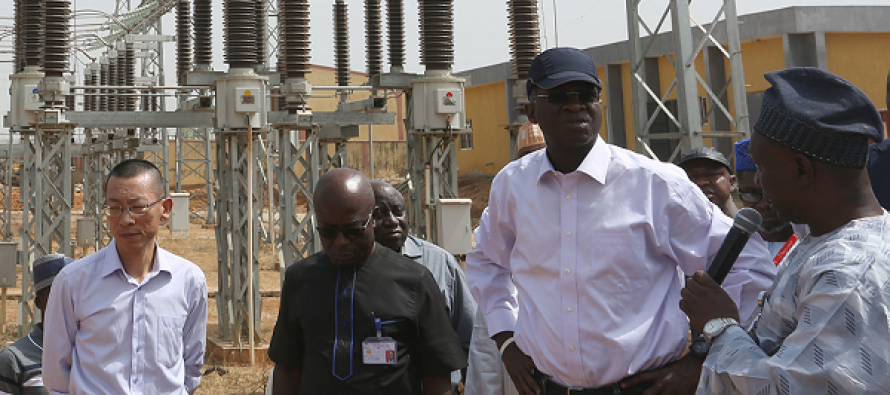
Mr B. Fashola is Nigeria's energy minister

Considering the current population growth, and the ever increasing demand for energy and the obvious inability of our energy sector to meet up with all these components, I don’t think there will ever be a time when steady power supply will be achieved in Nigeria as a result of government investment. This isn’t me being pessimistic, this is me being realistic. In some ways, one can conclude that the government has given up building more or upgrading existing refineries to meet up with local demands, going by the emphasis and attention being given to the refinery project by Dangote. A lot will be solved by that project when it eventually gets completed.

There are so many reasons why getting complex things done by the government get eventually complicated along the line given the very complex nature of our socio-political space.

Take public water supply for instance.  Public water supply existed in Nigeria before independence until it gradually wound down around the 80’s. And then the era of chronic inefficiency where water boards would supply water to towns and villages say once every week or as it pleases them.  This continued until gradually though painfully Nigerians began to supply their own water by sinking boreholes. Today practically every home owns one or has access to one, and the water board is no more. The death of public water supply was caused by inefficiency and negligence.

We can also have a look at what happened in telecommunication. The collapse of NITEL  for instance was as a result of how redundant they became when the GSM market opened up in Nigeria, bringing in competitors like MTN, GLOBACOM  and many other pioneers in those early days. Today NITEL is gone, and Nigerians are communicating better.

You can add NIPOST and Nigerian Airways  to the list if you like. Then we have our primary education system. It was pioneered by the government in the past, today whoever wants quality basic education would send his or her ward to a private school.

So maybe I can say that capitalism is taking over the country. Or could it be that in our own case capitalism encroaches to replace inefficient systems? We’ve seen it happen.

So could it be that the inefficiency in the Power sector is a good sign?  A sign of the looming taken over by the private sector or the fact that soon the average Nigerian will be able to power his home and workplace from a source outside the national grid?

Considering the trend, I think it’s a good sign. Renewable energy is getting more available though the immediate initial cost is high. But that was exactly what happened in the telecom sector but today most Nigerians can afford a mobile device . The prices of mobile devices fell drastically in the years following its introduction to the Sub-Saharan African market.

The same is expected to happen with photovoltaic cells. In fact, it has been happening constantly for months and years now, as the technology gets better and the efficiency of the PV  cells increases.

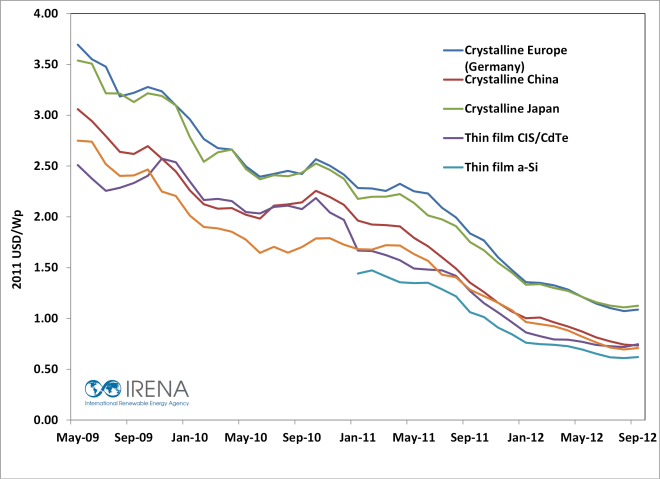
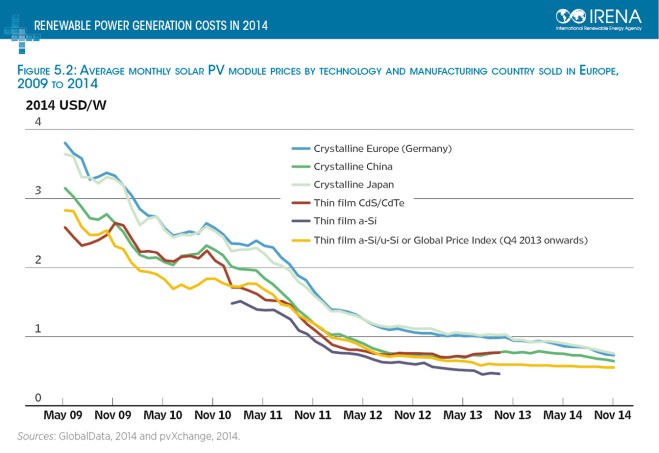
These graphs below from IRENA (International Renewable Agency)  shows a steep decline in prices of PV cells in different countries.

Average monthly solar PV module prices by technology in Europe


Average monthly solar PV module prices by technology and manufacturing

As you can see, they are all pointing downwards.

So hopefully it will get to a point where just like mobile phones, most Nigerians can own a PV Panel which could ultimately lead to the total collapse of the government-anchored power sector.

I would expect also that big industry players would also start investing in power for business.

Largely, as we continue to further our journey into true capitalism, expect a lot of government owned agencies to become redundant.

The New Nigeria Communication Commission (NCC) Directive

0

I recently wrote about the new Nigeria Communication Commission (NCC) directive. It generated mixed reactions, as expected. Many are outraged, and others have gone to read through the new directive to indeed find out if this is true. A couple of people have specifically referred to words like monitor and interception in their plain every-day language without looking at the definition of the words, as used in the directive. I therefore thought it best to shed some light on the definition of these words, as given in the document, for those who do not have the time to read the whole document.

Page B117 of the Lawful Interception of Communication Regulation, 2019 clearly define the terms used in the document, as given below.

Monitor means the recording of communication by means of a monitoring device.

Monitoring device means any instrument, device or equipment which is used or can be used, whether by itself or in combination with any other instrument, device or equipment to listen or record any communication

Interception and cognate expressions shall be construed (so far as it is applicable) in accordance with these Regulations and shall include an interception of archived communication or communication in the course of its transmission, by means of a communication system if, and only if, another person

  • a) Monitor by means of aural or other acquisition of the contents of any communication

  • b) Modifies or interferes with the system, or its operation

  • c) Monitor’s transmission or archived data made by means of a monitoring device

  • d) Retrieves communication data on a communication system

  • e) Monitors transmission or stored data made by wireless telegraphy to or from apparatus comprised in the system, as to make some or all of the contents of the communication available, while being transmitted, to a person other than the sender or intended recipient of the communication

Page B110

10)1) Every Licensee (telco) shall take necessary steps as the commission may by way of notice direct from time to time, to install interception facilities that allows or permits interception of communications.

11) 1) Notwithstanding any other law in force, no Licensee (telco) shall provide any communication services which does not have the capacity to be monitored and intercepted.

2) Every Licensee shall within such period as may be specified by the commission, acquire all necessary facilities and devices to enable the monitoring of communications under this regulation.

3) The investment, technical, maintenance and operating costs to enable the Licensee give effect to the provisions of these regulations shall be borne by the Licensee.

The document also mentions a warrant will be required to obtain intercepted communication and lists the authorized agencies that can request the intercepted communication.

For more details, please read Lawful Interception of Communication Regulation, 2019 on NCC website.

The Tragedy of “African Time”

0

Over the years, Africa has been plagued with a chronic malady instituted in the minds of its people. The high disregard for time and the lackadaisical attitude behind the default in time consensus is alarming. The mindset of arriving minutes or even hours later than pre-agreed has been subtly built into the mental residence of the African people. An average African will never keep to the time, earlier agreed upon, but instead go by the so-called slogan – “it is African time”. My question now is, what is this “African time”?

African time is an erroneous ideology that incorporates in it a disregard for the significance of time. It is an ideology that creates the spirit of irresponsibility meditated in the soul of procrastination and revealed in the body of lateness. “African time” is simply a slogan that  unveils the retrogressive mentality of the African people as Algaswhyneh and Basri (2015) puts it that people’s loss are more pronounced when time is wasted intentionally. Hence, the reason for the loss or retrogression of the African continent. 

Time is one of the most essential resources of life that when misused cannot be regained neither can it be saved for the future. Alwan and Ahmied (2009) had this to say, time is an opportunity to achieve set goals and objectives if used judiciously and could also be a means to failure if wasted. This implies the double-edgedness of the sword of time. Given these statements, one factor responsible for the slow pace of growth and development in the African continent is this issue of time. Africans fail to understand that negligence in keeping to time for a particular event will of a certainty have a ripple effect on the arranged schedule of other events for that day which could spill over into the next day and continues like a chain.  Now, when the achievement of set goals and objectives of an individual are on a go-slow combined with that of other individuals, we discover that the macro entity becomes unable to achieve its set goals and objectives at a fast pace. Thus, a reason for the slow progress being achieved in Africa.

Taking a cursory look at the continentality of advanced nations, one identifiable similar characteristics is the high value placed on time. The high esteem being placed on pre-agreed time for rendezvous or events translates into the positivity seen in their respective nations. It is no surprise that Africa is way behind them because of poor value for time. 

For Africa to experience rapid progress, individuals both leaders and followers must pay respect to the factor of time, put on the garment of responsibility that kicks away procrastination and avoids lateness. Events at all levels should no longer commence later than stated even in the scantiness of attendees. These of course would not translate into positivity suddenly but if consistently executed would re-shapen the mindset of Africans and consequently produce positive results. 

African time is not a positive ideology but an erroneous one that promotes irresponsibility which ultimately translates into failure both at the micro and macro levels. Therefore, the term “African time” should not be seen as a casual or common societal parlance but a societal psychological disease worthy of eradication. Hence, the formulation of the topic, “the tragedy of African time.”

References

Alghaswyneh, O. F., & Basri, W. S. (2015). The role of time management and its impact on students’ academic achievement: A case (students at Northern Borders University). International Research Journal of Finance and Economics, 136, 118-125.  

Alwan, Q.N., & Ahmid, N. R. (2009). Time management: Concepts-operations and applications. Amman, Jordan: DarAl-Thaqafa.