DD
MM
YYYY

PAGES

DD
MM
YYYY

spot_img

PAGES

Home Blog Page 6654

Nigeria’s 2020 Budget – From The Lens of a Democratic Spectacle

0

Nigeria is officially identified as a democratic state. Simply implying that we are a nation defined and governed by democratic tenets.

There is a timeless definition of democracy that most people are aware of and would probably never forget. That definition was given by Abraham Lincoln in his famous Gettysburg address which was given in honour of soldiers who sacrificed their lives for the greater good of a unified prosperous United States of America.

Abraham Lincoln defined democracy as ‘’that government of the people, by the people and for the people’’.  He further stated – ‘’as I would not be a slave, so I would not be a master. This expresses my idea of democracy”.

It is that second quote by Abraham Lincoln in reference to his understanding of democracy that profoundly unsettles when looking at the 2020 Nigerian budget and the general state of affairs in the nation.

As I would not be a slave, so I would not be a master.

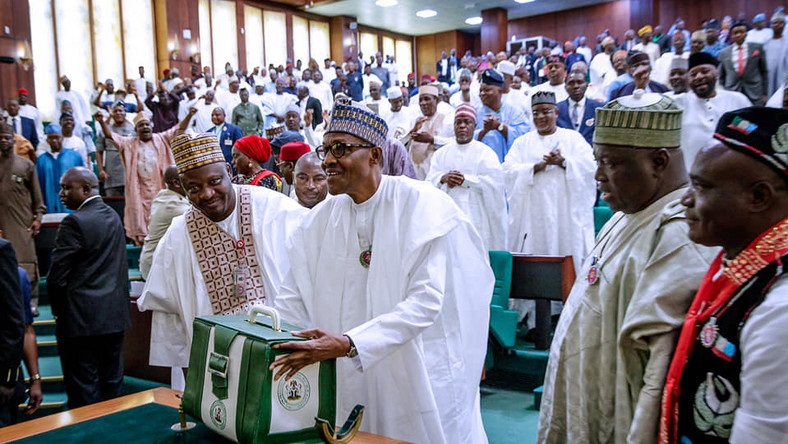
Looking through some details of the Nigeria 2020 budget as presented before the National Assembly by Muhammadu Buhari, the President of the Federal Republic of Nigeria, I see a recurring phenomenon present in national budgets of Nigeria for decades now.

The political elites, always assuming the position of a master, properly and excessively caters for their personal and positional needs as leaders no matter the national financial constraints. It doesn’t matter the vacuum of desperate needs in critical sectors of the socio-economic strata, it doesn’t matter that the population of poor Nigerians has so much swell that the country has been officially declared as the poverty capital of the world.  No matter how bad the situation of things are in the Nigerian state, her political leaders always find a way to comfortably cater for their luxurious needs with the limited national cake.

The 2020 national budget has put total expenditure at 10.33 trillion naira. 2.45 trillion will be expended on debt servicing, 2.14 trillion on capital expenditure, 4.88 trillion naira on recurrent expenditure and 556.7 billion naira goes to statutory transfers.

A noticeable feature that stands out in the 2020 budget is the 50% increase in the Value Added Tax (VAT) from 5% to 7.5%.  The VAT increase was premised on the increase in government expenditure for 2020 due to the increase in minimum wage from 18,000 naira to 30,000 naira amongst other reasons.

A 60% increase in minimum wage has therefore led to a 50% increase in VAT. 

Everyone should certainly look forward to a further increase in the price of goods and services. Cost of transportation will definitely increase and the average worker/trader who travels long distances to work every day will feel a painful bite in income. In the end, the working class Nigerians will have to wonder how an increased salary refused to change their living standard. The millions of unemployed Nigerians will experience deeper agonies of living without a source of income in a costly society.

While I leave the technical analysis of the 2020 budget to the data pundits, I was more interested in how that budget provides for personal and positional needs of the political elites. 

I gathered this little information out of what I believe would be numerous provisions for the Nigerian political leaders:

  • Out of the Statutory Transfers, 125billion naira goes to the National Assembly while 110billion naira goes to the Judiciary. Do not forget the stupendous monthly paycheck of an average Nigerian lawmaker.
  • 3.327billion naira goes to the President and Vice President for foreign and local trips in 2020.
  • 4.062billion naira will be expended on annual routine maintenance of mechanical/electrical installations in the state house.
  • 1.492billion naira to be spent on the upgrade of some of the aircraft in the Presidential fleet.
  • For the President and VP, 149million will be spent on foodstuffs and catering materials while 43million naira will be spent on refreshment and meal. 135.668million was also budgeted for same refreshment and meal in the budget of the State House headquarters.
  • For the President and VP, honorarium and sitting allowance is budgeted at 183.438million naira. 478.313million naira was allocated for same honorarium and sitting allowance in the budget of the state house.
  • 526.234million naira allocated for the phased replacement of vehicles, spares and tires in the presidential, CVU security/police escort and State House operational fleets.
  • 389.64million for outstanding liabilities on routine maintenance and other services in 2016.
  • 91.681million for the purchase of vehicle tyres in the state house.
  • 32.199million for fuel and lubricants, 32.5million for wildlife conservation and 45.4million naira for sewage charges.

These figures are just an excerpt of budgeted allocations for political officers and appointees. They do not include the salaries and allowances of the President, Vice President and political appointees in the executive arm.

The figures in the provisions above contained in the 2020 budget totals approximately 246billion naira. That is a budgetary allocation solely for the benefit of less than 0.00005% of the Nigerian population.

246billion naira splashed on personal and positional needs of less than 0.00005% of the population is 5 times more than the budgetary allocation for Education (which is 48bn), 3 times more than the budgetary allocation for Agriculture (which is 83bn) and more than 5 times the budgetary allocation for health (which is 46bn). 

Yet, these are critical sectors that are meant to serve the health, education and agriculture needs of more than 200 million Nigerians. The sum of the budgetary allocation to these three sectors is not even up to 246bn.

Ali Ndume, a senate leader, recently asserted that there is no solution on ground to alleviate the hardship being experienced by a large percentage of the population. But it is noteworthy there is always a solution on ground year in year out to provide for the sumptuous wealthy lifestyle of the people in power who are supposed to represent the interest of the rest of us. What a travesty!

How can my representative be stupendously rich off the national wealth while I am wretchedly poor? What sort of democracy is that?

That nobody should be a slave has a ring of truth in the democratic practices of the Nigerian state. However, to say nobody should be a master is the second half of the Nigerian democratic tenets that has been well resisted by the Nigerian political leaders.

Leaders in this part of the world do not lead by example. The citizens must make the necessary sacrifices where the nation’s progress is concerned while the leaders continue to forcefully live in the affluence that power provides.

That is the truth of the 2020 national budget as with preceding annual budgets. It is a budget that makes allocation for the master and his subjects, it is a budget that ensures that the political elite continue to live in abundance no matter the dire state of the Nigerian economy. It is a budget that is far more dictatorial than democratic.

When you consider the hundreds of billions of naira that will inevitably be lost to corruption in order to further satisfy the unending masterful desires of individuals in the corridors of power, you would understand why decades of huge budgets coated with big grammars couldn’t translate to clear developmental progress for Nigeria.

Representative democracy must be clearly seen in national budgetary allocations for positive sustainable development that impacts the lives of the greatest number. It must show that there are neither slaves nor masters. 

Annual national budgets must allocate national resources in such a manner that everyone benefits without sharp widened differentials that ends up making the rich dishonestly richer and the poor unjustly poorer.
The China-Africa Debt Problem

0

Is China good for Africa?  What about their loans, are they worth taking? When taken, how easy is it to pay back?

On many occasions, we’ve seen the World Bank and other western countries forgive our debts, the ones we couldn’t pay back .That makes me uncomfortable when I hear of African countries taking loans from China.

China has done a lot for Africa, and Africa has also done a lot for China. In some ways, the relationship between these two are symbiotic. The Chinese have what Africans need but cannot afford, so somehow they make it available at a price that seems, at least on the surface, far lower than what you will likely pay if you were dealing with the West.

I recall a particular incident, where the design and construction of a power transmission line was awarded to an Italian firm. After a series of reviews and consideration, they dropped out on the construction phase  as it was practically impossible for them to break even at the price the contract was awarded.

As usual, China came to the rescue.  They took over the construction phase and set to work immediately. It still remains a mystery to this day to many western firms how the Chinese are able to penetrate Africa given the very limited amount that some of these African countries have to pay for some of these services.

Still it cannot be excused that the lower prices the Chinese have to offer often comes at the expense of quality.

Often times, the initial costs are low but eventually they stack up skywards in the long run. So who gains in the end?

From mobile phones to power banks, to railway gauges, the Chinese have been offering Africa what they think they can afford.

Earlier this year, two Chinese banks –Export-Import Bank of China and the China Development Bank – committed in loans about $1.902bn into railway and deep seaport projects in Nigeria.

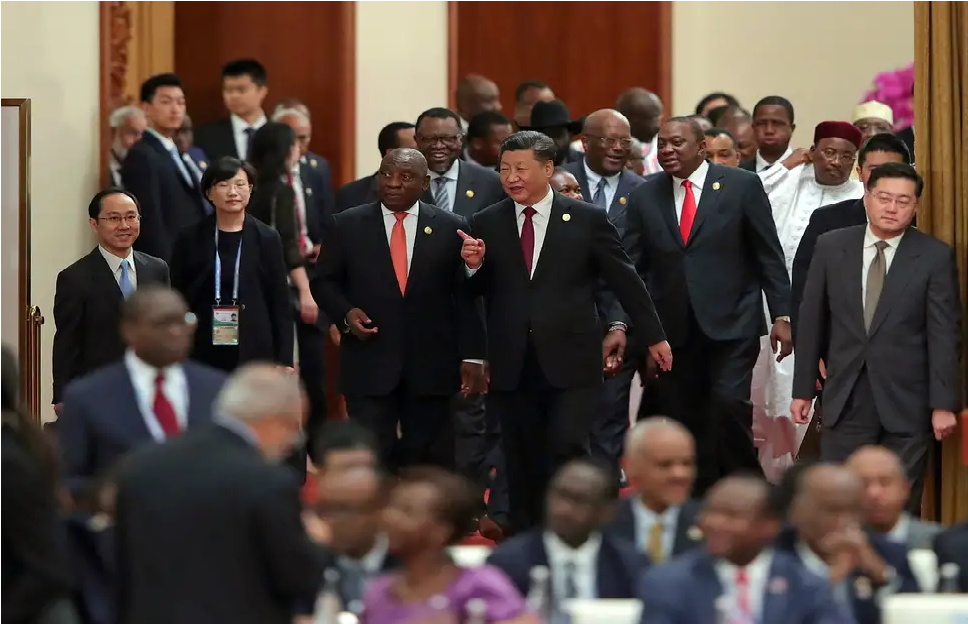
According to the Commercial Consul, Consulate General of the People’s Republic of China in Lagos, Mr Liu Junsheng, during a press briefing on China’s second Belt and Road Forum for International Cooperation, held in Beijing between April 25 and 27.

“The Export-Import Bank of China provided $1.267bn of the concessional loans accounting for 80.14 per cent of the total contract sum of Addendum No.2 and 2A; and the Nigerian Federal Government provides counterpart funds of $314m, accounting for 19.86 per cent.”

In other words, we borrowed money from China,  gave it back to them in contracts, and still we owe them some money. At least, they aren’t violating the terms and conditions of the contract may be excluding the part that involves durability. Hopefully we keep ours too.

Not long ago, a report came out on China taking over some of Zambia’s national assets including their National Electric Power Company. Not surprising if you ask me. Who takes a loan thinking of not paying back?

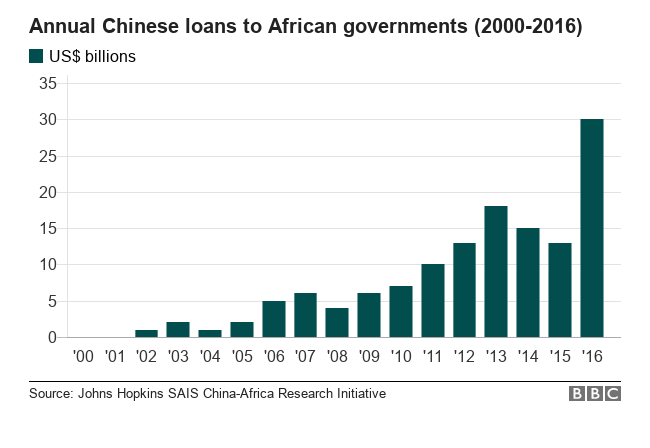
Just in 2017 alone, the value of Chinese contracted projects in Africa registered $76.5bn, according to  Jeremy Stevens, a Standard Chartered Bank Economist. “However, despite a sizeable remaining infrastructure deficit on the continent, there is a concern that African countries’ debt-service ability will soon dissolve.”

Nevertheless, our own Akinwumi Adesina, the head of the African Development Bank (ADB), a former Nigerian agriculture minister, is among the Chinese defenders. “A lot of people get nervous about China but I am not. I think China is Africa’s friend,” he told the BBC.

According to this report from the BBC, “China is now the single largest bilateral financier of infrastructure in Africa, surpassing the ADB, the European Commission, the European Investment Bank, the International Finance Corporation, the World Bank and the Group of eight (G8) countries combined”. By and large,  if Africa must look east towards China for loans, it must understand that debt forgiveness isn’t a right, and that the Chinese may temporarily forget, but may never forgive.

Jumia Evolves With JumiaOne Lending – Borrow Money in 5 Minutes

2

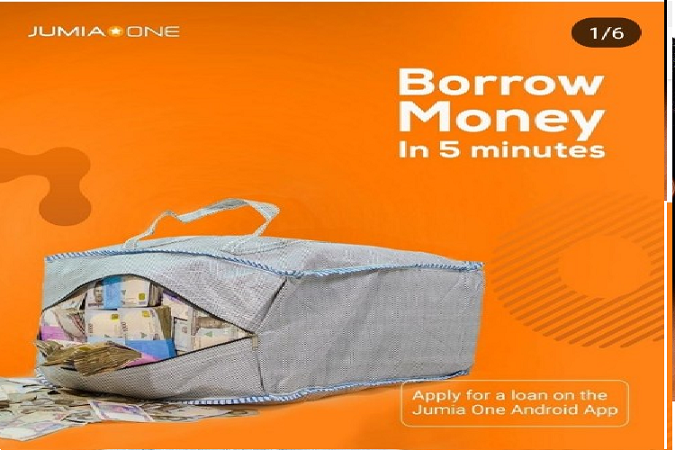
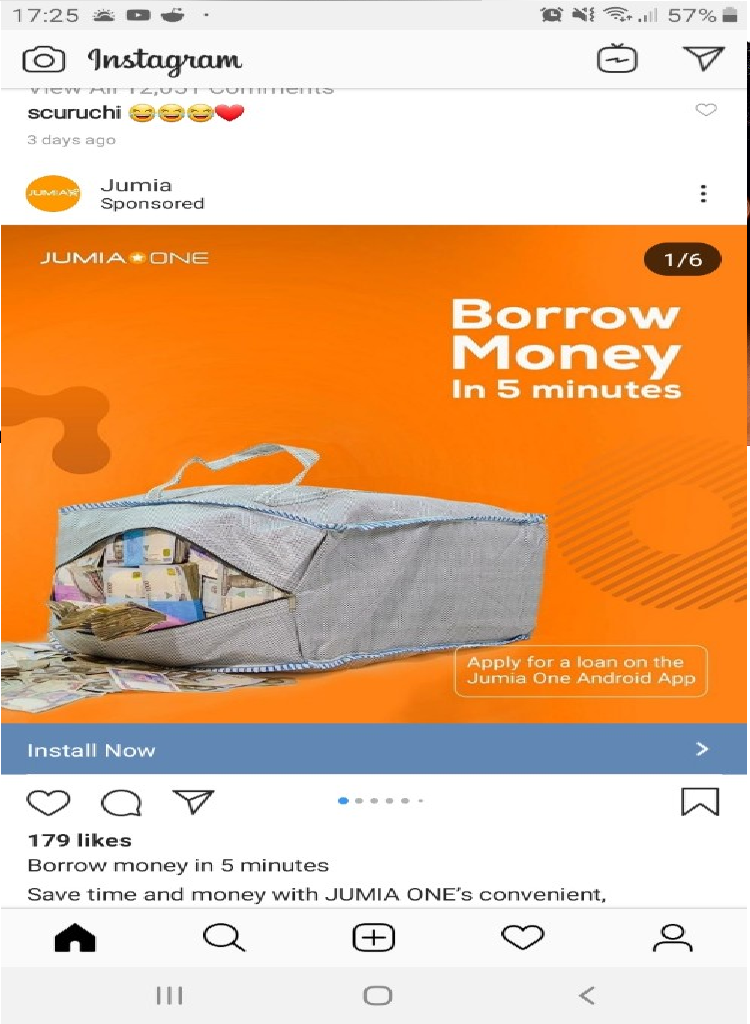
Last month, I commented on a Jumia job post (looking for lending officers), and noted that it was an “amazing” move by the ecommerce company. I saw the move as positive as no ecommerce company in the emerging markets like India and China has done well without  building a great fintech company. China’s Alibaba has Alipay, India’s Flipkart has PhonePe. It is a slam dunk – Jumia needs to have a fintech company to have a chance in Africa. JumiaOne, the brand name for Jumia payment, is here.

I expect JumiaOne to become the most important component in the Jumia Group in coming years as it morphs pieces of Jumia brands to feed transactions into itself.  Yes, the ecommerce can struggle but the fintech unit will win markets and territories – and profits.

JumiaOne ad on Instagram

Fintech and logistics deliver great balance sheets. Logistics is pay & carry while fintech is my commission & fees. With Jumia One, the mess of African ecommerce paralysis which I have articulated many years in Harvard Business Review will become muted. Jumia needs that as its stock in the NYSE has dropped from near $50 to about $6 now. Yes, Jumia needs to execute the double play strategy where fintech will help it manage the paralysis in the broad ecommerce sector.

Of course, JumiaOne lending arm has to battle Carbon (PayLater), Lydia, and other lending focused fintech companies across countries it operates. But it has a chance as many of these companies can co-exist as everything is still at infancy.

Jumia Reveals Its Future With New Job Postings – And It is Amazing

Soulmate Industries – Join A Session for Global Partners and Distributors

0
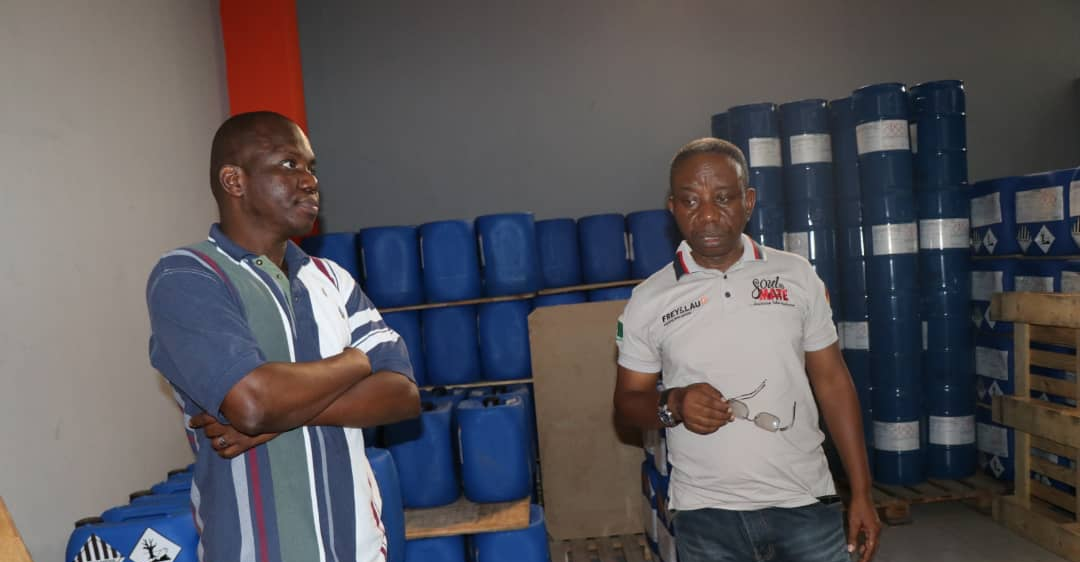
In Soulmate Factory with Founder

Soulmate Industries Ltd is a leading indigenous haircare brand with industry-leading products. It has a big factory in Ikeja Nigeria where the Founder, Sir Ndukwe Osogho-Ajala,  commercialized his undergraduate chemistry project. Soulmate products are used across Africa and beyond. It is today one of the largest indigenous manufacturers in Africa, employing hundreds of people.

If you visit Soulmate complex, you will see amazing young researchers in one of the largest biochemistry industrial labs in the nation. They research, create and launch beauty products whose IPs are 100% Nigerian and African. Soulmate is a leading exporter- it exports agents of beauty to the world, from Nigeria.

With Soulmate Founder in Soulmate Factory

Soulmate Industries is a client in my practice. We will run a retreat in Lagos. Though structured for the business executives, I will have a session for potential partners, local and international.

My wife Ifeoma wants to buy Soulmate in Wal-Mart; Soulmate’s Hair Conditioner Plus was formulated for her hair!. There are other African women in Gambia, Mali, Kenya, UK, etc who are connected to this brand. And we hope to stimulate new demand fans through symphonic innovation. We want partners through different vehicles – JV, MR, etc – to make Soulmate reach these customers.

Email here (on click) – we will want to have a conversation with you on the opportunities. You may need to join us in Lagos if you are in Nigeria; digital connection will be available for partners outside Nigeria or want to connect remotely. The exact dates and venue will be provided to you once we have received your note. Please while writing, tell us a little about your business and experience in the sector.

Soulmate – it’s always amazing when you have found your mate!

A Tour of Soulmate Industries – Sub-Saharan Africa’s Largest Indigenous Hair Beauty Brand

Ndubuisi Ekekwe To Keynote Nigerian Association of Petroleum Explorationists (NAPE) Conference

0

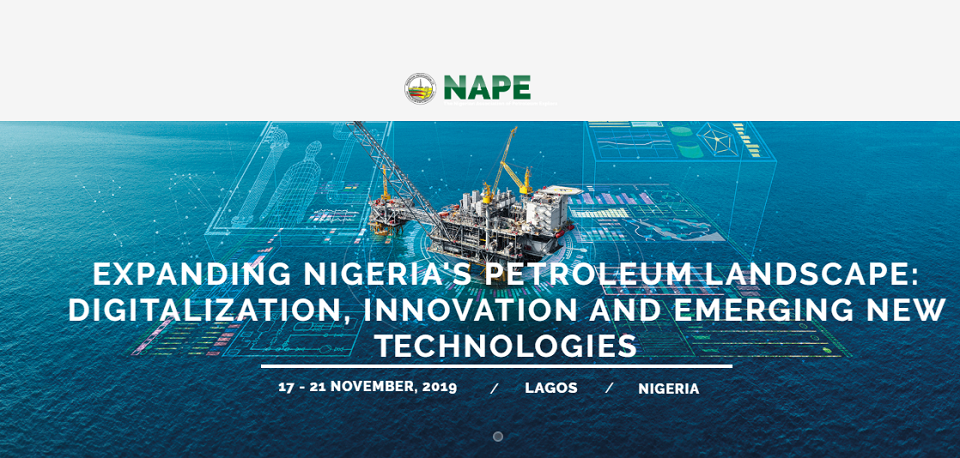
I will keynote the Nigerian Association of Petroleum Explorationists (NAPE) conference next month in Lagos. NAPE is the largest professional association of petroleum geologists and related disciplines in Nigeria and Africa. Members include geologists, geophysicists, CEOs, managers, consultants, students and academicians..

I will speak on a topic I have titled The Explorationists: Abundance in Data.

As an undergraduate student in FUTO, I did two internships in the oil sector – all in NNPC’s Nigerian Gas Company (Owasa Gas Station, NGC HQ). During the 3rd internship, I served in Shell’s Kolo Creek flow station (near Yenagoa). The first night in the station was memorable because I poured vinegar like water as I worked hard to eat everything on the table (those days!).

The industry has changed since those days. We will be having a conversation during NAPE.