DD
MM
YYYY

PAGES

DD
MM
YYYY

spot_img

PAGES

Home Blog Page 6660

The AfCFTA Challenge Ahead As Nigeria Reintroduces Toll Gates

1

On Wednesday, the Nigerian Government announced its decision to reintroduce toll gates on federal highways in the country. The announcement came from the Minister of Works and Housing after the Federal Executive Council meeting.

This is coming 15 years after the Obasanjo’s administration scrapped the tolls. For some years now, the Works and Housing Minister, Babatunde Fashola, has been preaching the reintroduction of the toll gates as a necessary evil. A preachment he backed by the success of Lekki Toll Gates. Although the Federal Government was adamant to act upon his suggestion, its empty purse has pushed it to succumb just as it has done in many other tax advice from government agencies.

The introduction of online VAT is one of those: It came just at the time when Nigeria is claiming to encourage her cashless policy: A contradicting step that FinTech startups would pay the price because the likelihood of decline in online transactions for avoidance of the VAT will result in low patronage when the policy takes effect in January 2020.

And there is also the increment of VAT to 7.5% from 5%, which part of the justification by the government and many others is that Nigeria’s VAT is the lowest in the world. The adverse effects these decisions will have on startups and local businesses was maybe, not considered, or was, but pushed aside for the greater interest – revenue generation for the government.

The decision to reintroduce the toll gates is also aimed at revenue generation. Apparently, it is evident that the Government is broke and desperate for funds. The oil based economy is struggling, and the only option that the government seems to have is to tax businesses and the people to make up for the downturn. But it’s a poor step, with a high price that will be paid now, and in the future.

Few months ago, Nigeria joined other African nations to sign the African Continental Free Trade Area (AfCFTA) agreement. A bold step the African Continent has taken to promote intra-continental trade. Though Nigeria was reluctant to join the pact for obvious reasons, the decision to join is looking like a big mistake.

One of the reasons the Manufacturers Association of Nigeria (MAN) and industrialists in Nigeria vehemently opposed AfCFTA is because they know that Nigeria cannot compete with many African countries. Infrastructure and policy making win it all, and many African countries are ahead when it comes to that.

In 2017, the Ghanaian Government announced the abolishment of some taxes aimed to stimulate economic growth. The 1% Special Import Levy, Kayayei market tolls, 17.5% VAT/NHIL on selected imported medicines, 17.5% VAT/NHIL on financial services, 17.5% VAT/NHIL on domestic airline tickets, 5% VAT/NHIL on Real estate sales, duty on imported spare parts, excise duty on petroleum.

As a result of this abolishment, the Ghanaian GDP grew to 7.8% in the first half of 2017, against 2.7% in 2016, while inflation reduced to 11.6% by October 2017, from 15.4% in December 2016. Evidently, the tax cuts and abolishment boosted Ghanaian macro-economy that the government initiated further tax cuts in 2018 to encourage micro-economy. That included cutting income tax rates for people earning below 20, 000 Cedis from 35 to 30%. Reviewing of corporate income tax from 25% to 20%, replacing the 17.5% VAT/NHIL with 3% flat rate for traders. There was also tax waiver for entrepreneurs. The economic progress stemming from these fiscal policies attracted applause from the International Monetary Fund (IMF) and economists. And it spurred the country to do more.

In April, in a bid to curtail smuggling, Ghana announced a benchmark review of her import duties, reducing it by 30% and 50% for vehicles. While Ghana is fertilizing her soil for economic growth through tax cuts, Nigeria is increasing taxes to generate revenue for the government at detriment of her economy. Among other anti-economic measures taken by the Nigerian Government is the closure of its land borders in an attempt to curb smuggling, and there’s report that Nigerian Custom Services is invading hotels, impounding vehicles to extract custom duties.

As AfCFTA unfolds into reality, its fortune favors only the countries who made preparations for it. The cost of production in Nigeria is high that it cannot compete with products from many African countries; and that’s due to lack of infrastructure, poor fiscal policies and government imposed levies (like the toll gates) that have left producers with no option than to increase the cost of their products. So in trade related infrastructure and productive capacity, Nigeria is lost based on her current fiscal policies. 

The factor market agreement of AfCFTA enables integration, which means that every African country will have equal right to sell goods and services in member states. And the competition will beckon prosperity only on those whose infrastructure has cut the cost of their production. The cheaper the goods and services, the more patronage. It wouldn’t take Nigeria long to realize how much it has cheated herself through the revenue generating policies and basic infrastructural decay of today.

A Call to Stop Using the Sick and Defenseless as Begging Tools in Nigeria

0

I don’t enjoy making Nigerians seem bad to the outside world, neither do I want to reveal our weaknesses. But when a monster raises its head, and the only way to battle it is by shouting to call the attention of others, I’ll do so without looking back.

There’s something gradually eating deep into our society and people seemed not to be bothered about it. We may not really know how bad this is because we look at it as a way of helping others. But we may not actually be helping, but destroying.

On the 1st of October I happened to be in Awka. My brother was taking my boys and I to Eastern Mass Transit park in UNIZIK junction so we can board their bus back to Enugu. We were close to Eke Awka Market when suddenly someone thrust a bag through the car’s window and into my face. I was annoyed by such audacity and raised my head from my phone to see who this intruder could be. I was so shocked when I turned towards the offender only to see a sickly young lady with protruded shiny stretched vein-lined belly beside him. You can imagine the goose bumps that filled me up when I beheld this pathetic looking figure. The only thing I could say was “Oh my God.”

I then looked around and noticed that there were other people like this intruder holding sacks made of cloth, with rings around their tips to keep them ever open and handles used to extend them to passers-by. The lady that is their ‘decoy’ to attract ‘customers’ was half- naked, obviously a strategy devised to make people do exactly what was expected – to put money, a huge amount of money, into the extended sacks.

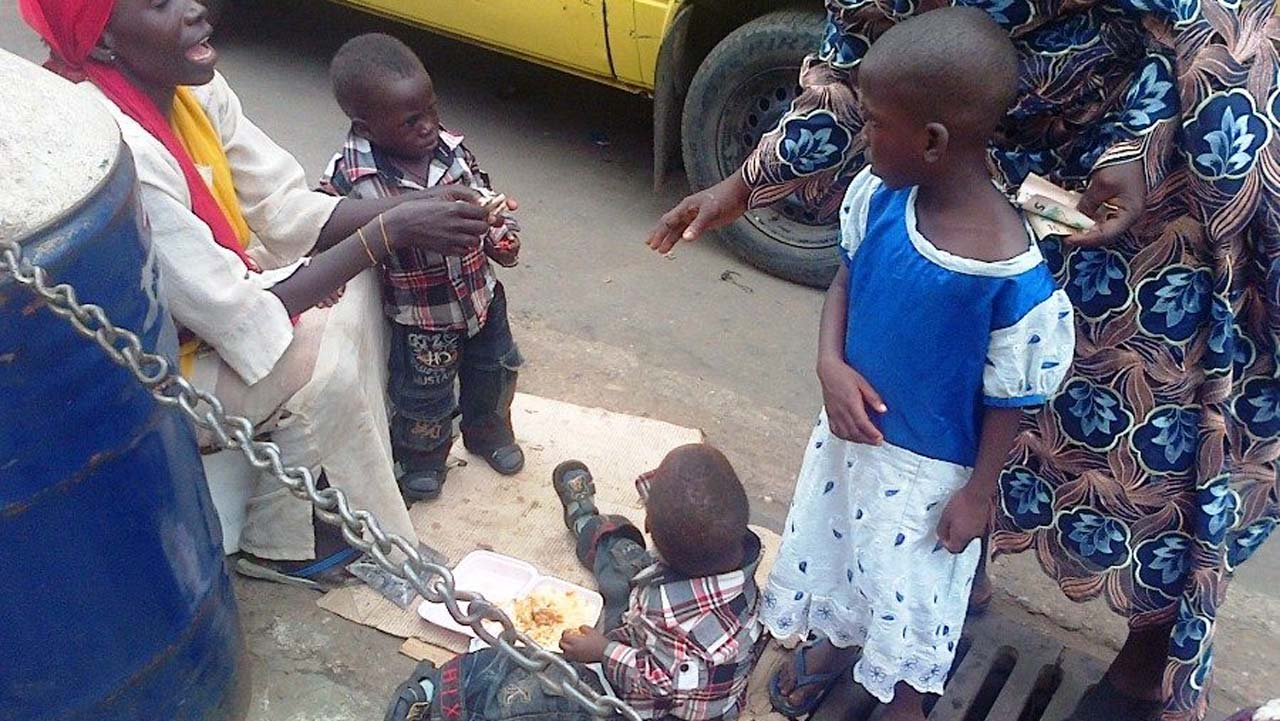
This system of ‘begging’ is not only seen in Awka. It is more here in Enugu. The one that pains me most is that people that use babies as a begging tool. I saw one of such persons in Abakpa Market (near Ukwu Aki), Enugu, some time last year. She was sitting under an old umbrella and displayed a set of three babies that were about two to four months in front of her. She was shouting, “Help me to feed my triplets,” and then something about God blessing people that help babies and stuff like that. Being a mother, I was touched by the sight of innocent babies kept under such condition, so I dropped money into the bucket she kept (do I need to tell you that the bucket looked appetising with the type of money inside?). But I couldn’t just go. I engaged the ‘mother’ in a short conversation, which made her so uncomfortable.

Now, I don’t need to say what I asked her and all, but I can bet you my one month salary that the ‘mother’ has not given birth to a child in the past two years, not to talk of nursing three-month olds; you can tell a nursing mother or a woman that just gave birth by her looks. Another thing I discovered is that those children don’t look like they came from the same mother – their features and ages were just different. Anyway, I told the woman I will return later to bring more things for her ‘babies’ but I didn’t see her again. Oh, one more thing, while talking to her, I noticed her eyes kept darting towards a middle aged man sitting down in one of the shops.

See, I know what charity is, and I know what charity isn’t. What these people that uses the very sick and the defenceless to do isn’t charity; it is another form of extortion. To be honest with you, they are callous.

When I was younger, back in my primary and secondary school days, I used to see ‘mad’ people tied together, beating musical instruments and singing. The persons at the beginning and the end of the line are always sane people and they are the ones that hold out bags for money. These people sing and perform so people could give them alms. No one knows who sends them to do this though the public didn’t complain much because they look at it as a way of housing and feeding the mentally deranged. Later on, accusing fingers began to point around because it was believed that they kidnap imbeciles from their homes to use them for this business. But it seems that method isn’t paying off again so they have resorted to using babies and sick people as a means of extorting from the public.

Now, before you judge me for not being human and not following what the Bible says, I’ll like to make it clear to you that even if those people want to help raise funds for those sick people (most of whom have cancerous growths and enlarged body parts), they can do that without bringing them to the public. I have seen some women carrying envelops about asking passers-by to make contributions for the sick and the motherless. In as much as I can’t say these people are genuine, I still give them the little I have. It is still better than bringing them out so people can see them and sneer or grimace.

One other thing I want to say is this – how do you even know that these people collecting huge sum of money in the name of paying medical bills of those sick people are genuine? How do you tell what that money you put into that bag is used for? How sure are you that they take care of those sick people? Why won’t they go to organisations to seek for help? I know that most churches help to raise funds for people like this, but they have to monitor how the funds are utilised. So for these people to avoid organisations that will monitor them makes me suspicious. So, don’t blame me, yet.

Please, I don’t want to discourage anyone from giving alms, but I want to discourage the use of babies and sick people as tools for begging. I don’t know what the concerned government agencies and departments are doing about this. These people need to be called to order and questioned thoroughly. No matter how we see it, it is wrong.

And as my brother rightfully said, the government needs to start taking care of the citizens. Sick people should stay in hospitals and sick beds. We have good government hospitals where they can be looked after, not on the road where they make money for some mean spirited individuals.

As for those that display babies to attract alms, they should be out rightly arrested (whether they are their true mothers of not). They have no excuse for their wicked acts.

May God bless and heal Nigeria.

Our Helicopters Have Started Arriving Nigeria

0

Our helicopters have started arriving Nigeria. We are bringing a new layer in fixing frictions in the broad transportation domain in Nigeria. As a Co-founder of this business, I invite everyone as we build a new element to improve the speed of commerce and industry in Nigeria. How may we be of help? We want to understand your needs; our team will be in NG to meet from next week. Email my team (on click) or InMail me.” RoadToFirstFlight

Meet Our Team in Lagos – “Uber for Helicopter” Services Across Nigeria

Africa’s Top-selling Smartphone Maker Rises in Shanghai STAR

0

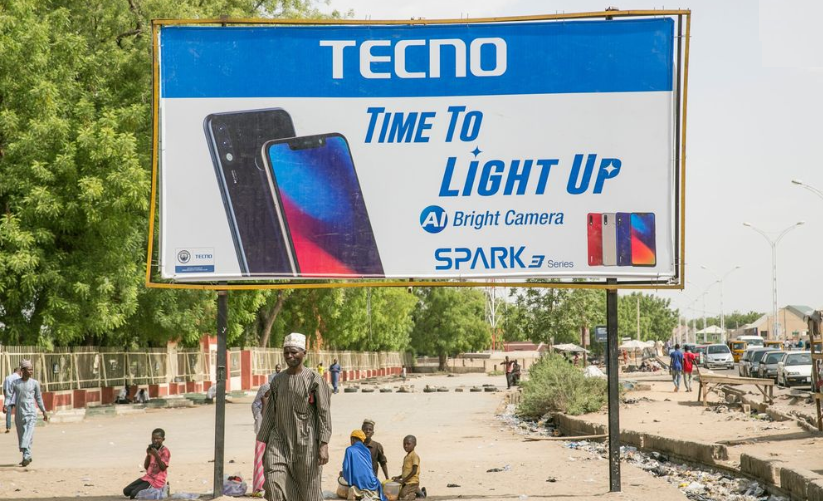
Transsion Holdings is a Shenzhen-based OEM which wants to be the most preferred smart mobile devices and platforms of choice for emerging market consumers. Its ecosystem consists of African market smartphone leaders. Tecno, Infinix and Itel which dominate with about 48 percent market share. It has ecosystems like Carlcare ( sales services), Palmplay (social network), Palmpay (payment gateway for anything), Boomplay (Africa’s leading music streaming platform), Oraimo for smart accessories and Syinix for home appliances.

Transsion Holdings is a manufacturer of mobile phones based in Shenzhen, China. It was the largest smartphone manufacturer by sales in Africa in 2017, and also sells mobile phones in South Asia. Its brands include phone brands Tecno, Itel and Infinix, after-sales service brand Carlcare, and accessories brand Oraimo (wikipedia)

In 2018, it sold 124 million mobile phones globally and according to IDC ranks 4th in global mobile phone brands. It is the category-king in the African smartphone market.

With R&D Centres in Shanghai and Shenzhen who collaborate with local R&D teams in Nigeria and Kenya, who help in engineering its world-class products for the African market, it has achieved integrated innovation through in-depth and customized cooperation with the smartphone supply chain.

Its manufacturing capabilities have been deepened with facilities in China, Ethiopia, India and Bangladesh and a global sales network which covers more than 70 countries and regions worldwide.

The firm has gone public in the Shanghai Star.

 Transsion’s (makers of Tecno) closed at $6.48 billion valuation on its IPO debut, well ahead of $4 billion it was priced.

The Chinese smartphone company that’s taken Africa by storm had a gangbusters stock market debut. Transsion, which dominates Africa’s phone market with its Tecno brand, soared as much as 96% on its first day of trading on China’s Nasdaq-style stock market, briefly pushing its valuation to $7.7 billion.The stock later gave up some of those gains but still closed up 64%, valuing Transsion at 46.24 billion yuan ($6.48 billion).

Updated: Tecno’s Transsion Closed at $6.5 billion on IPO Debut

Why Do Nigerian Graduates Face the Future with Little or No Confidence?

2

  • I should be happy but
  • It scares the shit outta me
  • But Alhamdulillahi for the gift of life…….

I copied this quote from a younger friend and student of mine who just graduated from a university in Southwestern Nigeria. He was in the usual passing out mood of the average Nigerian graduate, yet he was not happy as captured from his quote.

The question is why is it that after spending four or five years studying a course in a university, Nigerian graduates are afraid to face the future? I have noticed that a typical “uneducated youth” who spends two years or thereabout learning a trade is more confident of himself than a Nigerian graduate. Such a person is sure that once he has the toolkits for his trade, he is good to go.

 The typical Nigerian graduate despite the number of years and amount of money spent on getting trained still appears not to know what is next after graduation. I know them by their responses to my usual question: what next after tertiary education? Many would retort national service. And I throw back, but NYSC is just a year?! The blank looks on their faces tell it all. And I ask myself, but why?Is it a function of the school attended? The course studied in school? Or the level of awareness or lack of career clarity? What should our institutions do to ensure their products are not confused after graduation? What should the concerned graduates do to bail themselves from this fear of the unknown?

In search of answers to these questions, I conducted a kind of informal focus group discussion with selected people including an entrepreneur, a human resource management personnel, recent graduates and other concerned stakeholders. The focus of the discussion was to find out what could be done to ensure that Nigerian graduates are given education that makes them look at the future with some measured confidence. Some nuggets were revealed.

The problem with the education system

When asked what the problem was with the Nigerian tertiary institutions, one of the participants exclaimed : “ I have had courses to interview several graduates for jobs,most of them simply don’t have anything to offer. If the business organisations do not teach them what  to do, they have no initiative . Hence, the majority of them feel blank and really they are.” This points to the fact that the universities are not producing industry ready graduates. This speaks volumes of the distance between the classroom and the industry.

Another participant said there is a need to re-jig the country’s education system focusing on its curriculum. He concluded that: “the country is implementing a curriculum as handed down by the colonial masters which cannot help solve present societal problems.” One of the participants also posited: “in most tertiary institutions, they teach more of theories than practical skills. This is compounded by the dearth of resources to equip their students with skills that would empower them.”

Participants also agreed that most courses do not give relevant knowledge to their students until they get to the penultimate or final year of their study. Why teach accounting students history of computers, MS DOS and abacus instead of teaching them sage, Peachtree, Quick Book or at the very least, Excel spreadsheet operations, “ he quipped.

These submissions point in the direction of re-evaluating both the curriculum and its implementation. A continuation of the present scenario in the Nigerian institutions would rather guarantee a more chaotic unemployment situation in the country. 

The way out of the cul de sac

When asked the way out of the debacle, participants offered solutions to the precarious problem ahead of Nigeria with her teeming unemployed youths. The obvious mantra of curriculum change dominated the discourse. Participants called on government and its regulatory agencies to strengthen the curriculum to produce graduates who will have society relevant skill sets. This will help in two ways. One, it would make graduates fit in to the jobs of this time. Two, such graduates could easily become job creators instead of job seekers. They should create conducive environment for entrepreneurship ideas of students to ideate, incubate and accelerate.

More attention was directed at the students or graduates. They were charged to deliberately seek out skills that would set them apart and create a path for them. Their future is in their hands and not someone else. They should learn more out of the classroom than within. The internet is a larger canvass for them to warehouse skills depending on their interest and passion. Prospective students are also advised to get career clarity before they seek admission into tertiary institutions. Such can be built through formal or informal internship and mentorship programmes. Careers do not start at the end of a four-year course, it does before the journey starts at all. Other amendments are along the line.