DD
MM
YYYY

PAGES

DD
MM
YYYY

spot_img

PAGES

Home Blog Page 6666

How The Human Situation Shapes Technology

0

Technology is almost as old as man himself. From the very beginning, man has been looking for ways to improve his quality of life. We may call it primitive technology, but it advanced to a more complex state from the creation of tools made of wood and later of iron to the structural and architectural wonders of the ancient Egyptians and Aztecs.

It goes without saying that Technology is for man and man is not for technology. So, human needs and desires are responsible for the increasing advancement of technology in our day. Many problems of the human situation are being solved by enterprising young men and women.

Facebook, for instance, arose out of the desire to save and share pictures as precious moments in time. Storing hard copies of pictures has its challenges. Moisture, dust and pests could ruin those pictures and result in a loss of decades-old memories. For instance, I lost pictures of my childhood to mold and just thinking about it gives me pain. I wish I had been able to store them in the cloud. Sadly, that technology was not available at the time.

Another example is Zenvus by Fasmicro Group. After noticing the problem of low agricultural yield, the team invented a way to monitor, and predict yield so as to increase the predictability of commercial farming, and make it easier to make a profit.

Yet another example involves the way search engine optimization has evolved. SEO used to be about putting as many keywords as reasonably possible in any online content so that the bots can pick it up. But now it is more about creating content that is meant for easy human consumption and that adds to the body of knowledge available online. This is where engaging storytelling wins. Brands that will dominate the online space and grow will be ones that take this into consideration and consult experts to do this for them.

What is your current situation? Chances are it is already shaping a technological solution.

Nigeria’s FRSC Needs To Improve

1

I love it when the government officials carry out their duties diligently and faithfully. If I break the rule, deal with me. But sometimes I think they need to be taught empathy and emotional intelligence. Most of these government officials lack these things. To make it worse, they are so corrupt.

I wrote about corruption in the country in my previous article, which is something I am going to talk about today after witnessing another corrupt practice from an FRSC official with the official number – 18411 in Ibadan.

I was driving down to church on Sunday, 15th of September, when I was stopped by the FRSC officials along Bodija-UI road, Ibadan. I was charged for a traffic offence which I admitted because the person sitting beside me wasn’t using the seat belt. I asked for the next step, he demanded 2000 naira from me, or else I will be taken to their office where I’ll be booked 8000 naira for my offence.

I tried to explain and even told him that I admitted my wrong. After all, he could see that I was using the seat belt. He wasn’t interested in my plea and his crew never helped the matter.

”Book him!” That was what one of them said.

They were three standing by the roadside and stopping almost every vehicle passing by. They find fault in almost everyone they stopped and demanded a certain sum of money to release them or they’ll be taken to their station where they will get booked.

Although I paid him a sum of 2000 naira, I had no choice at the moment. If I refused to pay, I will be taken to the station, and my car would be seized. Since banks don’t work on Sunday, it means I can’t pay till Monday.

He pocketed the money and gave me my documents.

However, I looked at his chest and picked his official number. The last five digits of his official number are 18411. I couldn’t see his name clearly but I’m very sure of his official number and also he works in Ibadan.

I wish the government would look into this and deal with him and his team.

It makes no sense when government officials intimidate citizens and also cheat on the government. The money should have been credited into the government accounts but they took it. We have many more scenarios like that from these FRSC officials.

Shame on them!!!

What Happened to the Algorithms?

2

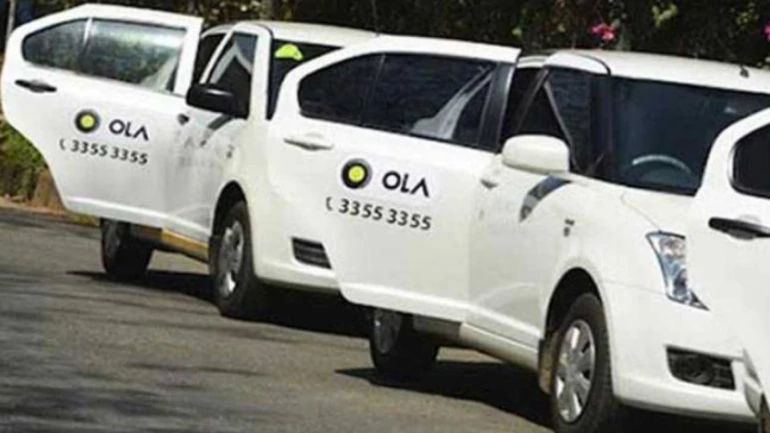
This is from an intro to a report on Ola, a ride-hailing giant in India. This is the key line: “Ola Electric wants to put one million electric vehicles on the roads by 2021”. That is scary – if Uber matches it, you may end up having a dislocation in drivers-passengers ratio across cities.

Ola is today among a handful of India’s multi-billion dollar unicorns. And it’s worthy of your attention: The young company is locked in a cutthroat battle with US ride-hailing giant Uber, and recently Ola has taken the war abroad to Australia, New Zealand, and the UK as well.

  • India’s ride-hailing market is worth over $10 billion. Ola and Uber are neck-and-neck when it comes to saturating cities with cabs, but it’s still anyone’s game. Are they India’s only two options?

  • Ola Electric wants to put one million electric vehicles on the roads by 2021.

  • Driving is the sixth-most common job in India.

  • The average order value on Ola’s food-delivery service, Foodpanda, fell from over Rs300 ($4.22) to under Rs120 ($1.69) during 2018, and market share and reach plummeted, too. Ola is revamping the business.

  • Like Uber and other American unicorns, Ola has been posting massive losses for years now. (Source: Quartz)

I am beginning to think that ride-hailing may not be helping cities in reducing the number of cars on the road! Yes. the redundancy rates of these empty cars which are always on the move looking for passengers need to be examined. I have no empirical data to support my perspectives but like what Toyota wants to do with Didi in China, these ride hailing platforms could be dumping grounds for car companies looking to hit earnings projections.

We were promised that algorithms will make available cars to work optimally for all. Now, platforms are ordering millions of cars! Does it mean that the algorithms have failed or that platforms have stimulated new demand, necessitating the need of new cars?

In Nigeria, especially Lagos, we do not have a car issue [platforms are not buying cars]. Rather, we have a motorbike concern [platforms buy motorbikes]. Lagos state government must ensure there is optimality. Ideally, a fairytale world where Gokada, ORide and Max use one app, reducing inefficiencies on assets would have been amazing. Of course, business does not work that way! Yet, more motorbikes should not be the core gameplan in these entities – they need to come together for a better framework where assets can be shared in some ways.

How To Build A Personal Or Corporate Brand

2

The word “Brand” is something that is on the lips of a lot of people these days. They freely use it both rightly and wrongly. But what exactly is a brand?

Put simply, your personal brand, for instance, is what they say about you when you’re not in the room. It is how people feel and think about you behind your back. I say “behind your back” because that is when most people’s actual thoughts and feelings about you come to light without them having to feel any shame or hesitation. This same definition applies to a corporate brand. The feelings and thoughts that come to your mind when you think about a Coke is different from what you feel and think about a Pepsi. Even though they both belong to the same category, the difference is clear. That, my friends, is the power of branding. So, how do you build a brand?

For the sake of simplicity, I will focus on building a personal brand but please note that the same principles apply to building a corporate brand. Besides, a brand is a living, breathing thing as I will explain, not the brick and cement of neither an organization nor a commodity you buy and consume and forget about.

Building a brand begins with a deep understanding of yourself. You must take a hard look at yourself and identify your skills, beliefs, fears, hopes, dreams and core values. You must know both who you are and who you are not. It is also important to ride on your strengths. Those things you are really good at should be your focus. Are you well-established on LinkedIn, Facebook or Instagram? Then focus on them first.

While you should be well aware of what is going on in the society around you, you must select what you accept in line with your core values.

This takes us to another thing you need to do: Identify your purpose. Why do you do what you do? What drives you? What is your end game? Doing that will give you a clear path to your goal.

The next thing to do is to understand your target audience. It involves knowing who they are; where to find them, online or offline; what they do for a living; what they really want; how many children they have, if any; what their fears and desires are; etc.

You must also understand how others feel about you and what they think of you. Ask your friends, family members and acquaintances to tell you their perception of you. They key is to get as much information as possible from them. Ask them to describe you in a single word. Describe specific situations and ask them what they think you would do if were you to be in that situation. Like I said earlier, a brand is what people say, think and how they feel about you, so this part if extremely important.

Another important thing to do is to be honest. In all your contact with your target audience, you must be honest. When they sense that openness and sincerity, along with your skill set, they will be drawn to you, and to what you offer.

Be as unique as possible. People don’t want to see some copy of someone they already know. They want to open their mouths in surprise and say “wow, who is that?” You can be the one to make them do that if you do things in your own original way. If you do things in a way that is in line with your personality and purpose.

Clearly express your value. No one is going to blow your trumpet for you. No one is going to say you are great, unless you say it first. When you show how great you are at what you do and how you are different from everyone else, you will begin to get followers both online and offline – people who will sing your praises as your brand ambassadors. Your audience wants value and will be glad you are giving that to them.

Craft a powerful brand promise. Every brand has a promise. Yours should not be an exception. BMW promises sheer driving pleasure and they deliver that every single time. Driving their cars is one of the nicest things a car lover can experience. They make sure that every car they produce lives up to that brand promise. You must remember that people buy an experience and your product must be true to that experience.

Have a consistent content strategy. You also need to decide on what channels you will use to communicate with your audience and how that communication will be done. Everything you say must be in line with your brand personality. No room for stray thoughts.

Brand image is everything. The places you are seen at; the people you are seen with; the things you are seen doing; the colours you are seen wearing, all define your brand image. So, think carefully about each of these things.

Hold on to your passion. Passion is contagious. If you work on things you are passionate about, your audience will notice the enthusiasm and will more readily buy into it. But you must clearly define what you are passionate about and how that can add value to the life of your audience. Even the most ordinary task done with full passion will always draw attention. How much more so will your work which expected to be full of value and real purpose!

Never relent. Building a brand is not a day’s job. It takes a lot of time and effort – it takes years actually – still, the gains make it all worth your while. Not only will your audience love the strong brand that comes as a result of your hard work but you will love the profits that flow in day after day and year after year, because you took the time to not just focus on short-term profit-making but long-term brand-building.

BudgIT’s Seun Onigbinde Bows to Pressure, Resigns

0

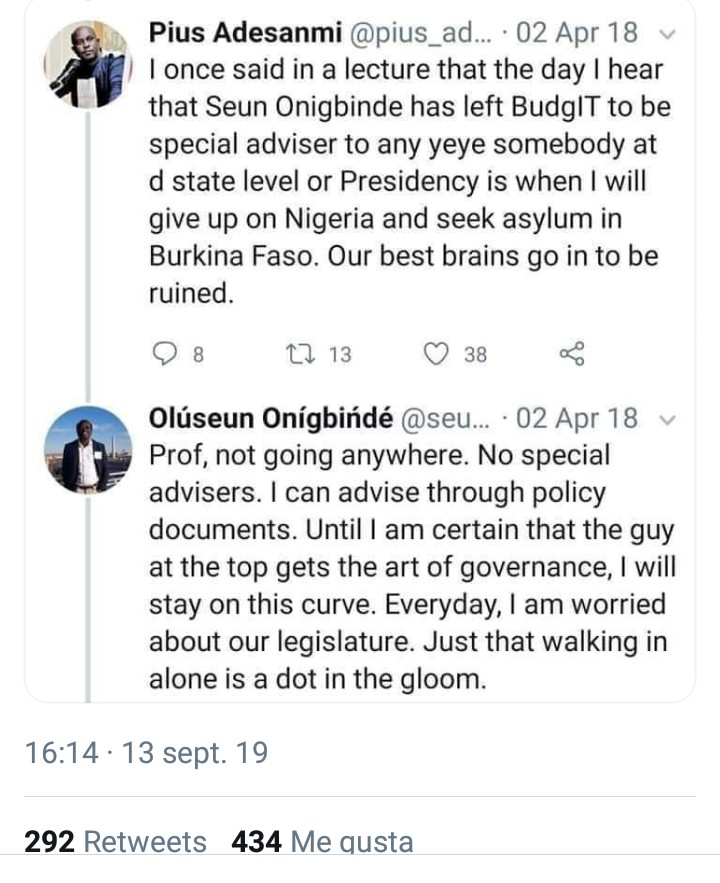
Co-founder of BudgIT, a budget and finance accountability platform developed to check government’s financial recklessness and to effect transparency, especially on budgets, Seun Onigbinde, on Monday, announced his resignation as the Technical Adviser to the Minister of State for Budget and National planning, Clem Agba.

He took to his Medium account to announce his decision to resign the appointment. He wrote

Kindly recall that I sent out a note recently on my interest to seek new experiences and that I would be working as a Technical Adviser to the Minister of State for Budget and National Planning for a short period.

It is clear that recent media reports about my appointment have created a complex narrative, which I believe would engender an atmosphere of mistrust, as I planned to proceed.

Upon further reflections on the furore that has been generated by my new role as the Technical Adviser to the Minister of State for Budget and National Planning, I humbly resign the appointment.

The announcement of his appointment was greeted with a lot of backlashes, owing to his inclination toward the present administration.

Onigbinde has been a vocal critic of Buhari’s method of governance, and BudgIT has become a necessary tool in doing so, and has won the trust of Nigerians over time. Many who have supported his views believe that a person of his caliber shouldn’t have anything to do with the people he condemns.

His resignation has been applauded by many who were concerned that he accepted the appointment in the first place. A situation they believe could affect his well-founded reputation and the credibility of BudgIT.