DD
MM
YYYY

PAGES

DD
MM
YYYY

spot_img

PAGES

Home Blog Page 6677

BudgIT’s Seun Onigbinde Bows to Pressure, Resigns

0

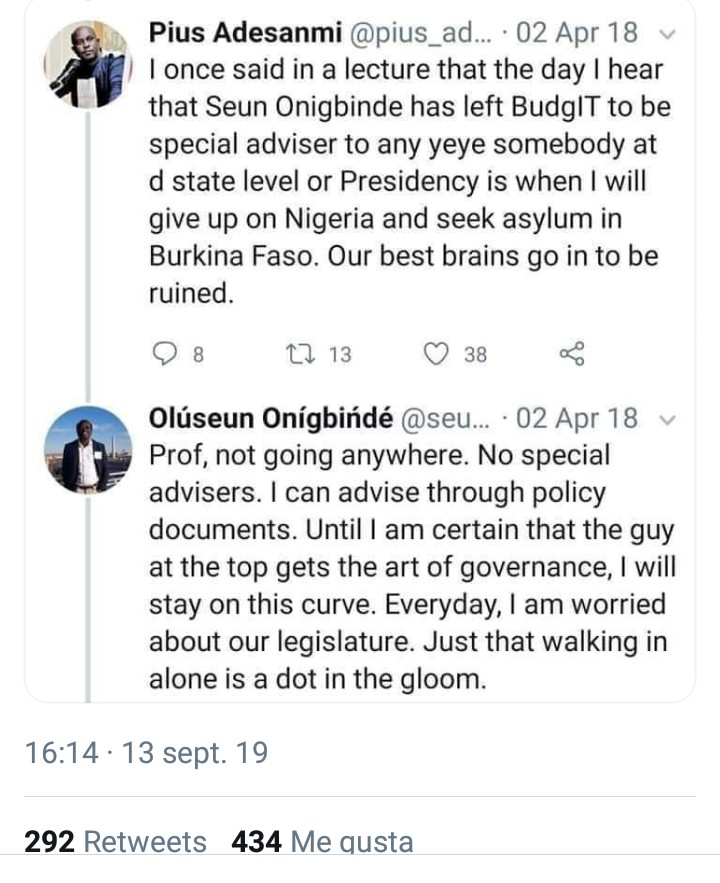
Co-founder of BudgIT, a budget and finance accountability platform developed to check government’s financial recklessness and to effect transparency, especially on budgets, Seun Onigbinde, on Monday, announced his resignation as the Technical Adviser to the Minister of State for Budget and National planning, Clem Agba.

He took to his Medium account to announce his decision to resign the appointment. He wrote

Kindly recall that I sent out a note recently on my interest to seek new experiences and that I would be working as a Technical Adviser to the Minister of State for Budget and National Planning for a short period.

It is clear that recent media reports about my appointment have created a complex narrative, which I believe would engender an atmosphere of mistrust, as I planned to proceed.

Upon further reflections on the furore that has been generated by my new role as the Technical Adviser to the Minister of State for Budget and National Planning, I humbly resign the appointment.

The announcement of his appointment was greeted with a lot of backlashes, owing to his inclination toward the present administration.

Onigbinde has been a vocal critic of Buhari’s method of governance, and BudgIT has become a necessary tool in doing so, and has won the trust of Nigerians over time. Many who have supported his views believe that a person of his caliber shouldn’t have anything to do with the people he condemns.

His resignation has been applauded by many who were concerned that he accepted the appointment in the first place. A situation they believe could affect his well-founded reputation and the credibility of BudgIT.

Steps to Managing Stage Fright

0

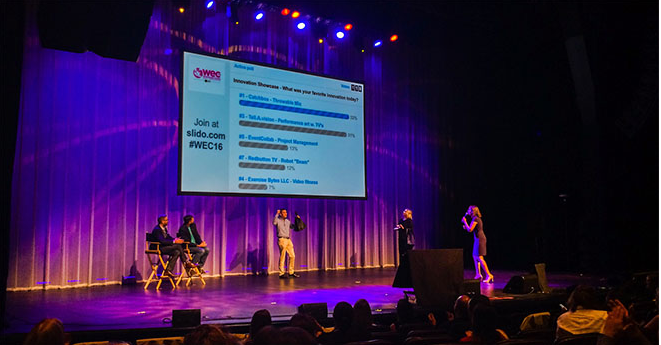
Imagine losing a job, or a mega million contract, just because of stage fright. Imagine flunking that presentation you’ve been preparing for all these while because you couldn’t get your lips to say what you believe was in your head. Imagine what it will be like fainting on the stage before a great number of viewers.

Well, you are not alone. Stage fright happens to everyone. You only need to learn how to manage yours to conquer it.

I’ve heard people saying that there are those that were born without stage fright. I don’t really know how true this is because I’m yet to see any of them. I know that some people are more outspoken and bold, naturally, but that doesn’t mean they could stand before a crowd without those butterflies fluttering about. The only thing I know is that when someone starts from a tender age to hold the stage, he may not really know what stage fright is because he learnt how to manage it early.

When I say stage here, I’m not just talking about the raised platform where people had to stand and face a crowd. Stage here means anywhere you are that exposes you to the attention of others. Your audience could be just one or a million persons. It could be your juniors, your peers or your superiors. It could be someone that is same sex with you or not. Your audience can also be strangers or your close associates. What really matters here is that you have the full attention of somebody who waits to hear you talk.

I believe that the cause of stage fright is the fear of making mistakes. You are just afraid you will make a mess of yourself and be booed. Or maybe you are afraid that people will not like or agree with what you were going to say. Whatever it is, you just felt you are not good enough to be out there.

The different signs of stage fright, which I believe everyone that has been there knows, include:

1. Shortness of breath
2. Butterflies in the guts
3. Blurred vision
4. Pressure to use the bathroom
5. Dizzy spell
6. Shaky voice
7. Blank memory (lol)
8. Loss of words (of course your memory went blank)
9. Incoherent utterances
10. Talkativeness
11. Making silly jokes and laughing at the silly jokes
12. Inaudible utterances
13. Extra brisk walk
14. Fidgeting and non-relaxed posture
15. Increased and unsteady heartbeat
16. Higher pitch in the voice

Well, these are just some of the signs that will tell you that you are stage fright. So, you may need to relax and let it go before it messes you up.

Before you get on that stage, I’ll like you to bear the following in mind:

i. Nobody knows it all. So don’t be afraid when you are going to face people that have deeper knowledge than you. In other words, always remember that you have something new to add to the existing knowledge. And you want this people to learn about it.

ii. Everyone is capable of making mistakes. I’m stating this here because sometimes, the fear of making mistakes can mess up our presentations. So, remember that you are human, and so are your audience. If you are capable of making mistakes, so can they. In other words, they will definitely bear with your mistakes.

iii. There is Day 1 for everything. This has always been my slogan each time I want to encourage people to go out there and show what they are capable of. The logic behind this motto is that you shouldn’t be surprised when you make mistakes on your first attempt. All you should be concerned about is learning from your mistakes and making necessary adjustments. So, on your first day of facing an audience, remember you are just a rookie and will be perfect as you continue with the job.

iv. It is not possible that everybody will like your performance or idea. Make up your mind to receive lots of criticism – both constructive and illogical ones.

v. There is nothing like a perfect presentation. Just be yourself and don’t copycat. In fact, make yours unique.

vi. Stage fright is natural. It happens to everyone that holds the stage. So yours isn’t out of place.

vii. That time you have the stage, it is yours to manage as you deem fit. But put your type of audience, occasion and time allotment into consideration.

Alright, so here’s the main thing that brought us here – how to send that fear out of the way when it comes.

a. Prepare your speech early. Please, don’t cram everything you will say there because it will make you sound like a machine (and if you forget a word…., well you know the rest). What you have to do is write down what you will like to talk about and mark off the keywords in them. You may need to jot down those keywords so you can refer to them as a guide.

b. Practice the speech delivery in the comfort of your home. Face a mirror, pretend that you are the audience, and talk to yourself. Be sure to look yourself in the eyes as you do so. When you are confident enough, get someone else to listen to you.

c. If you are called to come forward to talk, get up and deliberately walk in calculated steps towards the stage – don’t rush it. These actions have a way of building up your confidence and making your audience feel ‘subdued’ by your presence. It will also send away dizziness, blurred vision and quickened heartbeat. Take it easy and slow.

d. Don’t talk immediately you got to the stage. Take some seconds (not longer than ten seconds, please) to let your eyes roam over the heads of the crowd. This will give you some time to take some deep breaths and to quieten your heart that wants to jump out of its cage. Remember to smile to the audience as you do this. Whether they smile back at you or scowl at you, just remember you are already there and most do what you came for.

e. When you start talking, deliberately bring down the pitch of your voice and start slowly. This will help you to sound calculated and more confident, even to yourself. In other words it will make you feel in control. Gushing out words can make you sound incoherent and make your voice shake.

f. It is good to maintain eye contact so you can engage your audience. But you need to be strong to do this because you may meet sneering and scowling faces and get discouraged. And it will be improper to just focus on one person or area. Keep your eyes moving from one face to the other and ensure that you bring everybody onboard, unless you are actually addressing one particular person. If you are so uncomfortable looking into people’s eyes, look over their heads. In fact, admire their hairs and head gears and you will see reasons to look into eyes (don’t laugh at this but it is possible that you may see one spectacular hairstyle or head gear and will want to know the owner).

g. If you are not good with telling good jokes, please leave off jokes. Dry jokes sound silly. And when people don’t laugh at your joke, you feel fidgety. So, stick more to examples, instances, facts and figures.

h. If the butterflies in your stomach wouldn’t just go before you started talking, report them to the audience so they can laugh them away. This trick works if you learn how to use it. It will automatically make you relaxed and more confident. But remember it is not in every occasion that you will employ it.

i. If your voice gets shaky as you talk, stop and take a deep breath. When you want to start again, start slowly. Don’t ignore or wish the shaking away because it will get more pronounced. Talking slowly will help to reduce the rate of your heart beat and the shortness of breath that accompany the shaky voice. By the time your breath and heartbeat are normalised, your voice will follow suit.

j. When you want to leave the stage, please don’t trot. You are not running anywhere even if you have an emergency meeting to attend. Walk slowly and majestically back to your seat, relax a little and then go out for some fresh air. You truly need it (lol).

Now you are good to go. Remember, everyone has stage fright, you can only learn how to manage yours. So, go out there and conquer.

How To End Building Collapse And Build Resilient Cities In Nigeria

2

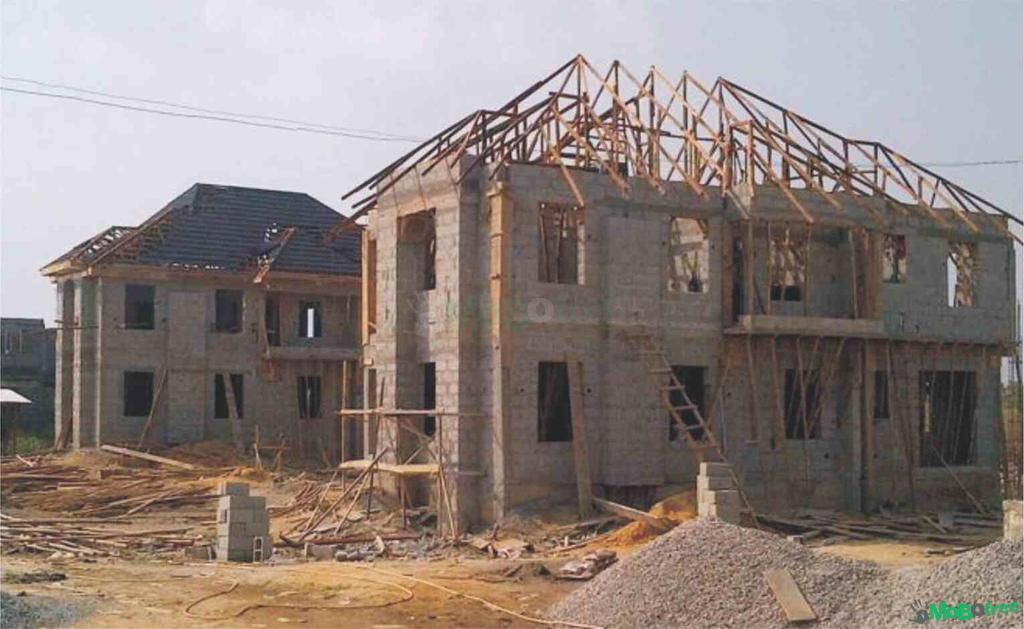
Whether rich or poor, three things are paramount to human existence and survival. Man cannot do without clothing, food and shelter. Out of these basic essentials of life, house or building, an offshoot of shelter, is being possessed and occupied at various degrees and different locations. Despite the significant amount of money committed to the construction of buildings with the intent of protecting lost of lives and wastes, the last two decades have been characterised with incessant collapse.

Between 1971 and 2016, 175 cases of building collapse were recorded in Nigeria with most cases occurred in cities and towns. During this period, Lagos, Abuja (FCT), Rivers and Oyo states had the highest number of cases. They were also the locations with the highest number of causalities. From 2017 to the present year, the trend has not really changed as the two states –Lagos and Oyo continue to dominate the places with the cases of building collapse. Early 2019, Lagos recorded two cases within two weeks, while one was reported in Ibadan, the capital of Oyo state.  This increased the public concern over the building collapse in South West region with the significant interest in Lagos.

In the last 5 years, analysis shows that public has been wondering about the best approaches to end the collapse.  Their concern about the right procedures voiced through the media and public engagement platforms with the expectation that the concerned stakeholders will take decisive action on the collapse remains a mirage as the experts from government to the private circles do not hesitate to reel out the reasons and solutions for the collapse.

Many have cited climate change and laxity of the professionals, who failed to live above board in their professional calling towards saving life and resources, as the main reasons. However, this piece is not about citing or describing the reasons that have been cited in the last two decades. Rather the piece intends to take a critical look at the reasons from local and international perspectives. Among the people, the questions have been that what is the place of the professionals, regulatory agencies and effectiveness of building and professional codes in ending the collapse? Some have equally argued that it would be difficult for Nigeria to achieve the targets of Sustainable Development Goal 11 –to make cities inclusive, safe, resilient, and sustainable.

Place of Built Professionals and Other Stakeholders
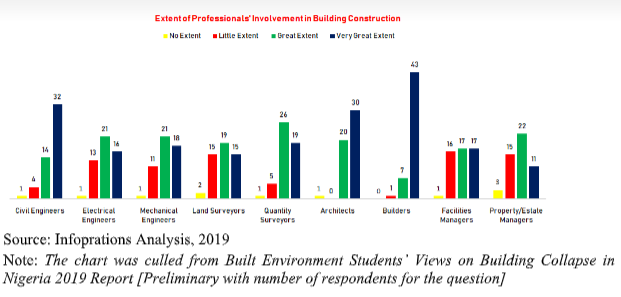
Throughout the world, before a building could be constructed, certain professionals are aggregated as a team for planning and execution. These are the people who have been taught the nitty-gritty of putting each component of a building together towards safety and health of the people and materials likely to be kept in the building.

Like other countries, Nigeria has engineers, surveyors, architects, builders and facilities managers who are supposed to be assembled from building construction. But, the recent reports indicate that the professionals or building owners are either skipping one or two professionals from the Construction Value Chain or approaching the stages haphazardly. The consequence has been what everyone is witnessing in cities and towns –building collapse and loss of lives.

How long Nigerians have to continue counting their losses when the building collapsed? Public believe that professionals have more important roles to play than the governments, analysis suggests. From the analysis, it is clear that governments have the right policies and initiatives to end the collapse, but the activities of the professionals, especially those in materials and supplies markets are not enough.

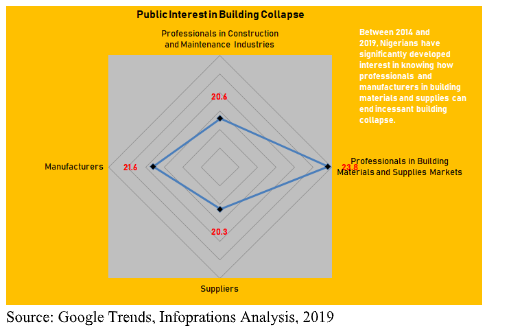
Using the real time data, public interest in how the professionals will end the collapse to save the life of young and old people who are expected to contribute to the growth of the economy has been on the increase in the last 5 years. Between September, 2014 and September, 2019, the more Nigerians had an interest in building collapse, the more they developed more interest in professionals responsible for building construction and maintenance. This result is also recorded for the interest in professionals, suppliers and manufacturers within the building materials and supplies markets. The high interest in professionals and manufacturers indicates that the public wants them to position themselves towards the right processes, people and materials.
Enabling Framework

As pointed out earlier, formulating policies and initiating programmes have never been Nigeria’s disease towards development. The main disease has been a lack of political and institutional will to implement the policies and programmes.  Since 1960, Nigeria has had various professionals and national codes for built industries. These codes have been reviewed on many occasions to meet the trends in the industries.

In 2013, Ms Amal Pepple, former Minister of Lands, Housing and Urban Development, noted that the Nigerian government has reviewed the national building code to check incessant building collapse. According to her, the code provides sanctions for any unethical behaviour in the construction industry. Five years later, the federal government through Mr Babatunde Raji Fashola, Minister of Housing and Works, announced a new national building code, aiming at improving on measures to safeguard lives and property in the country.

“We have come up with the new code because government is aware of the fact that most deaths and injuries caused during building collapse are results of unacceptable ways of building. You can find out that in most cases safety measures are not considered in erecting most of the failed structures,” he said.

Deviating from the normal tradition of asking professionals and concerned stakeholders in the public sector about the effectiveness of the codes –national and professional, students’ views about the effectiveness have been sought and analysed. According to them, in spite of having the right building regulations and standards in Nigerian built industries, the lack of full implementation has continued to endanger life and property across the country.

When they were asked about the effectiveness of the national building code in reducing building collapse, over 39% said it is less effective while 31.4% said it effective. Their responses to the effectiveness of professionals code is mind-blowing, as over 45% said existing professional codes have not really helped in containing incessant building collapse.

From this, one needs to be curious about the basic of constructing or developing standard building being taught in Nigerian higher institutions. Why is it difficult to translate the fundamentals that have been proved to the academics for the award of degrees into practice? The students answered. Forty-nine percent of the students said the fundamentals are practicable, while 11.8% indicated that they are very practicable.

Those who belong to less practicable criterion (37.3%) more than those who believe in the high practicability of the fundamentals in the industries. From these results, it is glaring that governments, professionals and civil society organisations need to come together and map out how the building construction fundamentals, regulations and professional standards should be enforced. This has been further intensified based on the outcomes of the analysis of the country’s Global Competitiveness Sustainable Construction and causes identified by students and professionals (see below chart for further clarification).
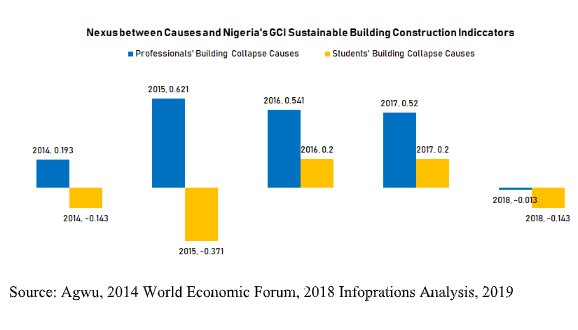
Failure to map out and develop the right strategies will continue to be the source of incessant building collapse. The students believe that in the next 5 years Nigeria will experience building collapse more than what she has had in the previous 5 years. Already, available statistics have shown that the cumulative number of lives that would be lost in the next 50 years varies between 1,775 and 1,790.

Can Resilient Cities Be Achieved in Nigeria?

Nigeria really needs to be worried about the building collapse because it will never be left out from the countries that have been projected to have more than 1 billion new houses by 2050. Less than 31 years to the year, many houses and structures have sprung up in cities such as Lagos, Ibadan, Port-Harcourt, Abuja, Kano among others, while the old ones are begging for preventive maintenance.  With the effects of climate change that have projected to have significant impact on buildings with substandard materials, the concern now is can Nigeria build resilient cities in its six regions? How can it be achieved? The results of analysis of the country’s position on global competitiveness index provide the answers.

As the analysis establishes, Nigeria needs to work on her Global Competitiveness Index Sustainable Building Construction Indicators. It needs to work on reliance on professional management, trustworthiness and confidence, availability of latest technologies, firm-level technology absorption, local supplier quantity and production process sophistication.

When the professionals’ identified causes (use of substandard designs, materials, manpower and procedures) of the building collapse are analysed along with the severity of these indicators, analysis reveals that one unit of the causes reduces one unit of having good rankings for the indicators by 38.3%.  Working on the causes (bad designs, wrong foundation, wrong site, bad usage of the structure, poor technology and inexperienced contractors, high population, weak building process and poor physical development control) identified by the students will help Nigeria to achieve a 93.1% increase in good rankings.

These results were further explored with correlation analysis of the indicators between 2014 and 2018. Analysis shows that the rankings earned in 2014 and 2015 were linked strongly. This is also obtained for 2015 and 2016, 2016 and 2017. However, the indicators failed to connect in 2017 and 2018, indicating disparity in the rankings. The implication of this is that in the previous years (2014 to 2016), Nigerian governments’ efforts to improve on the criteria being used by the World Economic Forum for the indicators measurement did not yield important results.
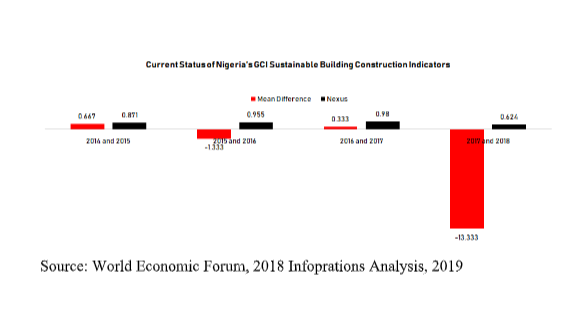
From the analyses, it has emerged that professional codes of conduct, institutional and legal framework are weak to ensure sustainable building construction. As long as these continue to be the pain points, saving lives, money and building resilient cities will remain unattained for the next few years. According to the World Bank, “Building codes and land use planning have proven to be the most effective tools to increase health and safety in cities and reduce disaster risk.”  Yet, Nigerians remain vulnerable to building collapse despite the structured of its code that ensures inspection of  building at pre-design, design, construction and post-construction stages.

With the persistent collapse and the number of people who have lost their lives, it would not be a bad suggestion if Nigeria goes Hammurabi’s way. According to many sources, the Code of Hammurabi is one of the oldest written laws in human history that criminalises poor construction practices beyond the mere prosecution of the offenders. Between 228 and 233 codes, “If a builder builds a house for a man and does not make its construction firm, and the house which he has built collapses and causes the death of the owner of the house, that builder shall be put to death.”

This code simply tries to create proportional justice. When the code is adopted, the family of a building collapse victim will have two options. Having family member of the contractor or builder killed in the same way the victim died or taking blood money, equal to the value of the victim.


Why the Nigerian Government Should Stop Encouraging Loans for Small Scale Business

0

The loan has been received after numerous application for the meager loan that would soon destroy the lives of the founders. They are thinking it will be sweet experience, they just like other SMEs (startups) don’t realize that they have become prey to the most dangerous mindset that kills even the most successful business. . .

Small and medium-sized enterprises or small and medium-sized businesses are businesses whose personnel numbers fall below certain limits. According to the Central Bank of Nigeria, a SME is a company that employs from 11 to 100 people and has assets between ?5 and ?500 million. There are a lot of SMEs in Nigeria.

Yes, SMEs are cut across the entire nation. Many of this SMEs are Startups. You might ask, what is a Startup? A startup or start up is a company or project initiated by an entrepreneur to seek, effectively develop, and validate a scalable business model. Hence, the concepts of startups and entrepreneurship are similar.

A startup is a business structure powered by disruptive innovation, created to solve a problem by delivering a new product or service under conditions of extreme uncertainty.

Many entrepreneurs and renowned business magnates define startup as a culture and a mentality of building a business upon an innovative idea to solve critical pain points.

Paul Graham, the founder of Y Combinator, has further simplified the definition of the startup and associated it with growth. According to him-

A startup is a company designed to grow fast. Being newly founded does not in itself make a company a startup. Nor is it necessary for a startup to work on technology, or take venture funding, or have some sort of “exit.” The only essential thing is growth. Everything else we associate with startups follows from growth.

As Startups and SMEs grow in their services and scale, there comes the need to boost the revenue of the SME. During this phase, it becomes a critical factor and time for SME owners, they begin to source for funding like workers in a bee hive. While this moment might not be the best time for any business, it is very important to take note as to why seeking a loan for your business at it’s early growth stage could leave you in critical conditions.

What is a Business Loan?

A business loan is a loan specifically intended for business purposes. As with all loans, it involves the creation of a debt, which will be repaid with added interest. Businesses require an adequate amount of capital to fund startup expenses or pay for expansions. As such, companies take out business loans to gain the financial assistance they need. A business loan is debt that the company is obligated to repay according to the loan’s terms and conditions.

Fun Fact: Trader Moni is an Empowerment Scheme of the Federal Government created specifically for petty traders and artisans across Nigeria.

How does a Business Loan Work?

Business loans are offered by lenders. And in exchange for the money, they’ll charge interest on top of the loan amount?—?in the most basic loan structure, interest is charged as a percentage of the loan’s principal. … While business loans work with this basic structure, they do vary by the type of business loan they are.

Small-business owners often need financial help to turn their entrepreneurial dreams into reality or keep an existing company afloat. If you need cash to purchase business equipment, fund your marketing campaign or cover your payroll, it may be necessary to take out a small-business loan. A small-business loan is different from other types of loans, and it’s beneficial to understand how the loans work before you apply for one.

Why You Should Avoid Business Loans!

They say a difference between a good loan and a bad loan can go a long way in defining the outcomes of business. Here are top reasons not to embark on this route that has even taken the heads of big companies.

  1. The Rush to Payback Fast: Many business owners want to pay back their loans as quickly as possible in an effort to become debt free. Again, it’s important to reduce debt, but doing so too quickly can cost your business. That’s because you may leave yourself short of cash. Or the extra money you’re devoting to debt reduction might be better spent on profitable growth projects.
  2. It Put You on Impulse: Perhaps there is a new technology or machinery you think would benefit your business, or maybe you want to remodel or upgrade your facilities. While all of these things may prove advantageous to your business, you won’t be able to reap the rewards if you have leveraged all of your assets and the extra profits you make go toward repaying the loan. If the idea doesn’t bring in extra revenue, you are still responsible for paying back the loan. If you used assets to secure the loan, you may end up without a business at all.
  3. There is Always Interest: Interest, in finance and economics, is payment from a borrower or deposit-taking financial institution to a lender or depositor of an amount above repayment of the principal sum, at a particular rate. It is distinct from a fee which the borrower may pay the lender or some third party. As it goes, you as the SME owner will foot the interest. As you know, interest will always go up and its not constant, so the vibe of if i don’t pay this month I’ll pay later, will lead to your business accumulating a very nice junk of debt which if left unchecked will put you in the rubble.
  4. Your Lines of Credit are Maxed Out: If you have exhausted all other available credit, maybe taking on more debt is a bad idea. When lenders see that you are overextended, you will likely be required to secure the loan with assets. If you are having difficulty paying your existing financial obligations, you are entering risky territory by gambling with your facilities, inventory, equipment, or even worse, your own house.
  5. The Thought of Paying Back: Hmm, it’s no funny when the business is not giving you ROI as expected when projected and then you have debts to pay. The next thing you’ll ask yourself is if you even invested the money well or you are dreaming. Wait, wait, wait. . . Oga/Madam, you’re not dreaming! You’re owing the bank, or that agency that gave you loan oh. This is a reactive stage, and it is mixed with harsh emotions. Nigerian SMEs can tell you the stories of other business owners who allowed loan to put them in the box.

What Should the Government Do?

It’s not funny anymore that the Trader Moni scheme is a joke from glance. But then you come to think of it. What is the Trader Moni? According to the offical website of Trader Moni, TraderMoni is a loan programme of the Federal Government, created specifically for petty traders and artisans across Nigeria. It is a part of the Government Enterprise and Empowerment Programme (GEEP) scheme of the Federal Government, being executed by the Bank of Industry.

While this is just for roadside traders and petty business vendors, there is still much to be done in maxing the credit potential of the financial sector industry. The less loans given out by the Government through Commercial banks and Bank of Industry will pave way for emerging SME’s to grow admist the chaos. Let’s face it, many SMEs can’t bare to withstand the harsh times of initial setup. It’s not really funny. So where do we go from here?

There should more credit maxing systems in place to put things in scope. The need and urgent call for giving out “Grants” to business owners and SMEs cannot be under-emphasized! One major thing to denote is that Grants are free money which does not require repayment. Conversely, repayment of the loan is a must, in equal monthly payments or lump sum or on demand. Grants are non-interest bearing in nature, whereas Loans carry an interest rate, which varies from loan to loan.

How can this be made possible? How can the Government checkmate the activities to deduce the effectiveness of the grants received? Who should receive this grants? These and more will be considered in the next article.

A Masterclass on AI in Business – Oct 18, Lagos

3

Through Marketing Research Academy, I will hold a Masterclass on the mechanics of data science and AI in business, for business executives, on Oct 18 in Radisson Blu, Ikeja, Lagos. It is a free event, but by invitation only. 

The evening will be divided into two phases: I will deliver a presentation in the first two hours, then, other professionals will join me for another two hours. 

My presentation will explain how technologies, specifically AI and data science, are enabling new business models and solutions, anchoring improved efficiencies in the utilization of factors of production in fixing market frictions across industrial sectors. I have written how these modern business enablers are redesigning markets in recent articles in the Harvard Business Review.

To request an invitation, click here.