DD
MM
YYYY

PAGES

DD
MM
YYYY

spot_img

PAGES

Home Blog Page 6681

The Coming of Africa’s Commodities Exchange – Agenpo

1

It is befitting that in my first ever article on Tekedia, I utilise the opportunity to set the stage for the emergence of Agenpo’s commodities exchange platform. The commodities exchange platform will be the bedrock of my official contributions to the growth and development of the African economy, starting from Nigeria.

Agenpo started in 2016 as an agro commodities trading company. The following year, we added solid mineral commodities into the mix. Therefore, we’re basically a company that buys and sells agricultural and solid mineral commodities. However, this changes from Friday 20th September 2019 when we officially launch our commodities exchange platform. In other words, we will pivot from trading selected agricultural and solid mineral commodities to providing a technology-enabled marketplace where the trading happens.

This pivot didn’t just come up. It’s been two years in the works. Yes, it took me just a year as the Founder to realise that there was a huge problem in the space in which my company was playing. Being a trader, I was essentially a middleman between farmers and artisanal miners (producers) and manufacturers and processors (off-takers). My position as a middleman gave me a unique view of the commodities space which I probably wouldn’t have gotten any other way.

There are so many problems and inefficiencies in the commodities trading space that are begging for solutions. The only solution is a functional commodities exchange. Reading this, you may be thinking, “well, there are those in existence already”. However, when you think of it that commodities exchanges don’t buy or sell commodities, then it dawns on you that those names that quickly come to mind aren’t actually doing commodities exchange work. This is where Agenpo steps in.

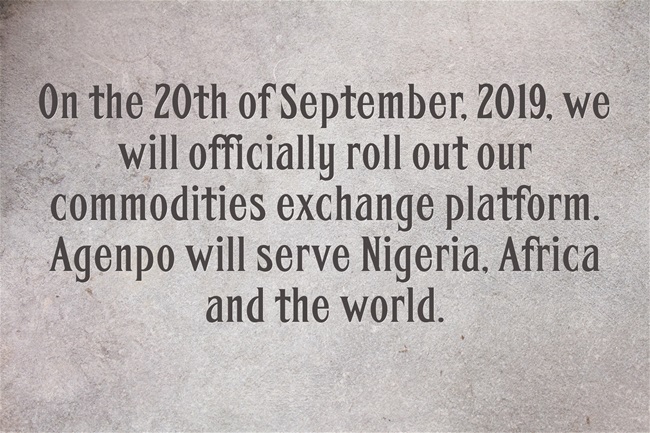
So, on the 20th of this month, we will officially roll out our commodities exchange platform. It will be like no other in Nigeria, Africa or anywhere in the world. We have not bought any foreign software, neither have we copied any existing model. We have simply come up with a market-driven model aligned with Nigerian peculiarities but that’s not all. We have basically come up with a commodities exchange that is unbounded and unconstrained by geography in Africa. Yes, this is a commodities exchange for Africa tailored to the peculiarities of each country. So, while we’re launching in Nigeria on the 20th, we will open up to the rest of the continent before the end of the year.
The strategy is simple. Farmers and artisanal miners of selected commodities in Africa will we able to register themselves on the exchange. The same goes for other stakeholders in the value chain. Find your service and register yourself! By doing this, off-takers throughout the world will be able to simply get their required commodity raw material with just a few clicks. With a few clicks, everything happens. Literally, everything! Money moves, produce moves. With very minimal human intervention in information flow. So, it’s a commodities exchange that aggregates end-to-end commodities trading operations to farmers, artisanal miners, commodity transport and warehouse providers, as well as off-takers, to achieve an efficient commodity trading framework. It’s an ecosystem for African commodities trading.

The efficiency we will achieve will be due to some key factors. One of such factors is that ‘middlemen’ like us in our current state will be cut out of the value chain, thereby leaving only value-adding stakeholders in the value chain. Another is that prices are transparent and show in real-time. This eliminates time-wasting experienced when haggling over prices. It also ensures that the producers are not short-changed. In effect, we will be doing real commodities exchange work. Agenpo will not be buying or selling anymore.

All the relevant regulations in each of the countries will be met as we’re very ethical in our business practice. Where that is impossible within a certain time, we will seek to get legal waivers until we’re able to meet such regulations. Until then trade must happen for the sake of the African rural economies. Trade must happen economic growth of nations. Trade must happen for peace amongst countries.

Nigeria and Africa in general are in dire need of manufacturing and processing concerns. Therefore, while presenting a business case to existing ones to use an efficient and regulated commodities exchange, thereby cutting down on their robust procurement operations (with each company running its own independently), we will be presenting a business case for establishing new ones so that African commodities undergo value addition within the continent to create African jobs, grow African economies and achieve African peace. I have a feeling this aligns with the ideals of Mr. Tony Elumelu’s “Africapitalism”.

I am not on this journey alone. There are indeed some human enablers within and outside of Agenpo involved in one way or another. More details on this on the launch date. In the meantime, I’d like to hope that this pre-launch article inspires one person to be proud of mama Africa knowing that the technology to power this dream was built from scratch by Nigerians in Nigeria.


Alfa Belgore And P&ID – What Nigerian Constitution Says

1

As expected, many lawyers are attacking my piece that former Chief Justice of Nigeria was “dangerous” to have provided legal expert services to a company (P&ID) that sued his country. That is their rights; some are even commenting that the man was just doing what retired lawyers do: offer advisory services.

That some people passed through law school without knowing that once you get through  a certain level in government, you are barred from some jobs because of uncommon privileged access is unfortunate. If you did an MBA in Nigeria, most schools during the business law component will explain why to you.

To help these people, including the lawyers, I refer them to Section 5 of the Fifth Schedule of the 1999 Constitution: 

5. (1) Retired public officers who have held offices to which this paragraph applies are prohibited from service or employment in foreign companies or foreign enterprises.

(2) This paragraph applies to the offices of President, Vice-President, Chief Justice of Nigeria, Governor and Deputy governor of a State.

I expect these people to keep digging. He was a CJN and this firm was not a Nigerian company but a Virgin Islands firm. You decide the legality of his service to P&ID, but my call is that the act is dangerous even if not evidently illegal. I do think it is illegal, though.

The Most Dangerous Man in Nigeria – Alfa Belgore

From LinkedIn

The Law: “5. (1) Retired public officers …are prohibited from service or employment in foreign companies …. (2) This paragraph applies to the offices of …Chief Justice of Nigeria, ….”

Argument that Belgore Acted within the law: “…This provision excludes judicial officers upon ceasing to hold office not to appear before any tribunal or court of law in Nigeria. This obviously didn’t preclude them from being solicitors/consultants as in the Alfa Belgore’s case. Belgore was not an employee, not a retainer and not a servant of the foreign company. He acted within the bounds of the law.”

My response: “…n Legal Practice, a service is typically assumed when there is “payment”. If Alfa was paid, irrespective of what you may call it, he had offered a “service”. … In Nigerian business law, most times, contracts are consummated upon payment. Few years ago, I wanted to do a community project. The community offered to give me the land free. I offered to pay them N1 (one naira); they refused. Then, I pulled out. With the one naira, there was a sale by law but without payment, it was a gift which could be withdrawn later.”


Read the full statement offered by Alfa

The Fading of Six Sigma

2

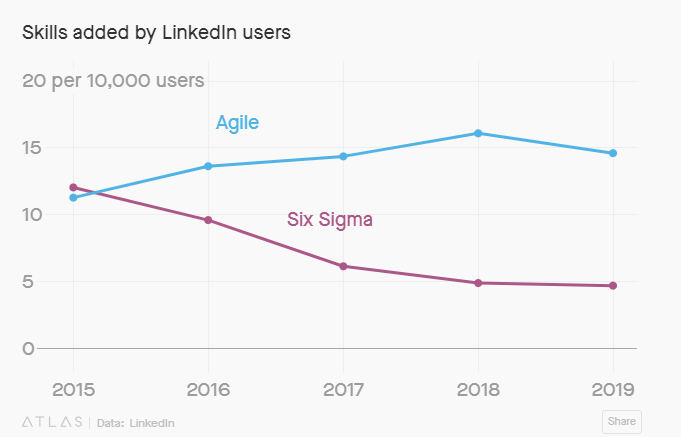
Six Sigma, a once celebrated system of defect reduction through statistical engineering, was a critical component of business systems, popularized by GE under the leadership of Jack Welch. But today, six sigma has lost its spark – and gone into obscurity as digital companies pursue the mantra of “move fast and break things”, and then fix them later. Yes, vigorously pursue innovation over pure efficiency in production processes. That does not mean that six sigma is dead. What has happened is that no one really cares about it when building digital ecosystems.

Even GE, the home of six sigma, is seeing lesser value using it: “The company’s [GE] market cap, which reached a high of nearly $600 billion in mid-2000, sank to around $60 billion late last year.” With the fading of GE, so is the spark in six sigma. That does not mean that the problem is with six sigma. What has happened is that people do not want to think into the pursuit of perfection philosophy that supports six sigma; if you want to be wholly perfect before you can launch a digital product, you will never launch. Yes, the speedy shall inherit the world.

Six Sigma, at its core, is a system for eliminating defects in manufacturing. The name refers to a statistical model, based on deviations on a bell curve, that dictates the number of acceptable defects per million manufacturing steps. Achieving Six Sigma means an organization tolerates just 3.4 defects per million steps, insisting that 99.99966% of its products or services are without flaws. Historically, most industrial companies operate between three and four sigma, making them between 93% and 99.3% defect-free (these figures can vary slightly depending on the statistical model).

The Greatest Mistake â?? Attaining PERFECT Product Vision

What You Need To Do

This old article explains in detail why pursuing six sigma and TQM (Total Quality Management) will hurt your digital business. This certainly does not mean that you should not pursue quality. Yes, quality is critical at elemental level. But in the broad scheme of execution, it becomes meaningless to hit perfection, typical in manufacturing systems, when building digital products which are built under the construct of positive continuum. Simply,you never finish them as products. They will continue to build Facebook and Google for years while the electric iron and refrigerator in your house were finished products before they were shipped to you.

Today, you build for a balance between quality and quantity. Yes, you launch a half-baked web product in the day and wait for comments to fix it in the night. You make a video game in the day and wait for comments to fix it in the night. You make a hardware product (yes voice assistant like Alexa) but the development never finishes because the AI that powers it in the cloud is a continuum. The ways products are engineered are changing.

[…]

While TQM and Six Sigma remain for the industrial age firms, pursuing them in knowledge age companies would slow you down. If Alexa had waited to improve its voice assistant product to the level it is now instead of launching it few years ago, it would not be in the leading position it is now. It came with defects and errors but with the web distribution, it has been fixing those issues. The Six Sigma would not have approved such a product for launch. Yes, Alexa would never be a completed product because the AI would keep evolving.

[…]

You need quality but it must have a balance. In web business, your recall happens in minutes and can be fixed in seconds. That is different from making turbines and power plants where recalls could destroy a business. So, do not apply management systems designed for such businesses in your firm. Learn how they break things in Facebook, Google, Amazon and Snap and keep moving. You complain, they fix and tomorrow everyone has forgotten.

The future is now Agile: “Agile project management is an iterative and incremental approach to delivering requirements throughout the project life cycle. At the core, agile projects should exhibit central values and behaviours of trust, flexibility, empowerment and collaboration.”

3 Tasks for Government: Replace Inefficient Workers, Pay Promptly Street Workers, Save NPower

0

The worst place anyone can visit is government parastatals. Sometimes, I wonder if their administrative officers were actually employed to work there, or they were forced. They have zero customer service.

It reminds me of the horrible experience at my former school, Federal Polytechnic, Ede, Osun state in 2015. I was in the HOD office to sign my clearance form. I needed to sort it out that day, so I could meet up with the NYSC program.

On getting to the office, I met the secretaries to the HOD and I explained the reason why I was there. Instead, I was told to get out of the office for interrupting them.

Like seriously, did I interrupt you guys? I asked in disagreement. There was no reasonable thing they were doing other than having a meaningless discussion when I walked in. To have said, I interrupted them was so untrue.

I tried to be polite but they brought out the devil in me. I had to shout back at them and become dramatic before they could give me an audience.

This is rampant in government parastatals. Those in the administrative section are the worst kind of people you can ever meet. They make you feel like they are talking to their child. They impose their egos, trying to be a demigod.

This is a major reason why things don’t really work in the government parastatals. They would barely work on any file. Government organizations are always a place of gossip and irrelevant discussion. Activities there are slow.

Ask any graduate that served or did an Industrial Training there, they don’t learn anything because the people there have nothing to offer.

No wonder, the minimum wage of 30,000 naira is a problem for the government to pay them.

The government needs to shake up that system and replace these old and outdated administrative workers. They are the reason why government efforts are not being seen or felt by the people.

Owing Street Cleaners

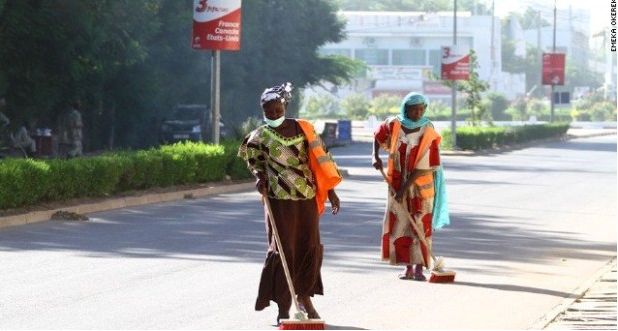
I read it somewhere online that the governor of a state (I won’t mention the state), is owing street cleaners their monthly salaries.

That’s wickedness!

Considering these people are always on the road sweeping irrespective of the weather. What touches me most, these people are old and could barely do anything than this job given to them. They had no choice but to accept this role so they could get their daily bread and stop begging for alms on the roadside.

If any government would owe workers, it should not be them. Besides, their salaries are very low compared to what other government workers are earning.

One thing I also noticed, road users, treat these workers like trash. I do see them driving and dropping things on the road, littering everywhere. I think the mindset of these road users, dropping things on the road is – the street cleaners will tidy them up.

I would appreciate if the government would impose severe punishment on anyone found littering the road. This can be achieved if the street cleaners are also given the power to punish any road user found littering the road. Better still, the government can assemble a law-enforcing body that can work alongside our street cleaners. That would bring some kind of decency to road users.

A true government should have equal respect for a cleaner or a manager. After all, both are humans working for the betterment of the state/country.

Saving NPower Beneficiaries

The Npower program has been a blessing to many unemployed graduates since 2016.

The government absorbed 500,000 unemployed graduates in 2016, and added over 200,000 in 2017. Kudos to President Muhammadu Buhari and Vice President, Professor Yemi Osinbajo.

Since the commencement of the program, the government has been paying their monthly salaries on a regular basis. Another stand out act from the government is, the recruitment exercise was free and fair. This should be the first type of free and fair recruitment in the country.

Although the government planned to absorb these graduates for two years, that is, 2016-2018, the program still continues after the second year that was meant to lapse. According to the government, he doesn’t want them to fall back into the street. That was a smart move from our President.

However, my concern – after Npower, what next?

Most of them are underemployed, that is, they are underutilized. You don’t expect anyone without any teaching experience to enjoy going to classrooms. Yes, I learned most of them were absorbed into the schools.

What does the government actually have to help these people? Npower has come to an end, but the government is still holding on to them. I applaud the decision, but for how long will this continue. They need to be fixed into something more meaningful and productive.

They need to be given a long term opportunity. The stipend being paid to them is not enough. Half bread is better than nothing, I agree, but we must think about the long run.

The best way to save them from going back into the street is when the government provides a long-lasting solution for them.

Think about when your tenure as the President ends, what will become of them. I hope every state can absorb them too. This is a big task for the president but with the help of the state, they won’t go back to the street.

Pleading to all government and private sectors, please save the Npower beneficiaries.

How to Protect Your Nigerian Bank Card From Fraud

0

Debit card fraud is increasing on a daily basis because it is one of the easiest ways to get your hands on cash and at the same pay for online transactions.

The National Bureau of Statistics (NBS) said Automated Teller Machine from selected banks across the country recorded transactions valued at N39.15 trillion in the fourth quarter of 2018.

It said that the N39.15 trillion was derived from 616,528,697 transactions recorded as data on “Electronic Payment Channels in the Nigeria Banking Sector” during the period.

Regardless of this seamlessness and due to increased dependence on debit cards, you have to be circumspect as there are online and offline thieves desperately wanting to steal your information.

They will have unauthorised access to your account if you are careless and you will lose your hard-earned money.

With this understanding, here are ways to protect your debit card from fraud.

Be careful when you use your debit card online

Many pay for their online transactions with their debit cards. However, before you punch in the numbers on your card and make a payment, ensure that the website is safe and secure. If you suspect anything, simply do not use your card. If what you are buying is important, contact the customer service team of the platform you are buying from.

Use ATM at a bank’s premises

Today, you will find ATMs at different locations that are not at the bank’s premises. For whatever reason, you should not use such an ATM. It is advisable to visit the one at the bank. In case of anything, you can easily walk into the banking hall to resolve any issues or lay a complaint.

Protect Your PIN

The way you handle your Personal Identity Number (PIN) can go a long way in determining the degree of your account security. Whenever you perform a transaction, guard your debit card PIN jealously as exposure can be fatal. Be warned.

Check your card activities regularly

No matter how thorough and protective you are with your debit card and your PIN, you should always check your account activities. There is a tendency for you not to check because nothing has happened to your card. Be proactive and always check your account activities.

Report suspicious activities to your bank

If you notice any suspicious activities with your account or card, do not hesitate to report to your bank as soon as possible. You can reach your bank by calling them, sending them a direct message on social media and chatting them live on their website.