DD
MM
YYYY

PAGES

DD
MM
YYYY

spot_img

PAGES

Home Blog Page 6728

Don’t Try To Move Mountains, Tend To The Gardens You Can Touch

0

We’ve all gone nuts, I mean crazy and it’s ruining us. It’s blinding us, it’s killing us.

There’s this major mindset that has been passed to us just because the world is getting worse daily which is to do the impossible, dream big, solve big problems, making it all look like its a race to solve the biggest problems of the world in order to either be rich or get famous.

I was once in that shoe and I got burnt badly. Fine, I am passionate about the educational system and I felt that if I could solve the “BIG PROBLEM”, I would be crowned a hero and make my billions. The truth is, I didn’t know where to start, I didn’t know how to start, it was a big mountain and I have a shovel.

Everyone else had their big mountains and a shovel so there’s no one who can assist. We all want to win the crown for the world. That is what the motivational speakers say, that is what they big entrepreneurs say, that is what our parents and teachers say. But is it possible to move a mountain with a shovel?

The fact is that we have so much obsessed ourselves with big problems that we do not have any sight left anymore to see what we can actually do. We keep fighting to become very strong to solve that big problem, to win millions of crowds and to build the big companies that we totally overlook how we can win the hearts of the hundreds around us.

Like I said, I was once in that shoe. I have written a post earlier on how SMALL is the new BIG. Truth is, if we all pay attention to the little things out efforts can achieve, we’d begin to build big communities of loyal people. If I want to solve the educational system, why don’t I fix for the first few hundred around me.

It would not lead to frustration, they are in my environment. If I give you a hundred thousand naira to start a business in either your location or another country you don’t know anything about, which would you choose?

Which will have effect and impact?

Don’t try to move that mountain, it’s a trap!!!

Why not tend to the garden you can reach, then create a forest, then make some money and buy a drilling machine.

Lots of youths get burnt out trying to solve big problems and it’s fine if you want to solve big problems but how do you want to solve it?

By commanding the world to help you or by raising faithful tribesmen to help you convince another tribe, then another tribe, then another tribe and like that.

There’s power in small beginnings. Mountains didn’t erupt in a day; you can neither surmount it in a day nor move it on your own.

You cannot do the impossible; start with the possible. I wish those youths trying to be heroes will see this and start small; those who are also frustrated about not getting the impact they want would also see this, and those who are trying to make more money would read this.

SMALL is the new BIG. Start small, build a tribe, and move and expand.

Africa’s Infrastructure Deficit, A Drawback To The AfCFTA

0

It is no longer news that the African Continental Free Trade Agreement (AfCFTA) became effective May 30, 2019 with 54 of the 55 African Union nations agreeing to a borderless and tariff-free trade agreement. The number of signatories to this agreement makes it the largest in the world in terms of participating countries since the formation of the World Trade Organization (WTO) in January 1995.

Low Intra-African Trade

According to the United Nations Conference on Trade and Development (UNCTAD), at the continental level, inter-regional trade was highest in Europe followed by Asia and North America. Inter-Europe trade, as at 2017, stood at 68% while inter-Asia and Northern America trade were 59% and 31%, respectively. Within the same period, inter-Africa trade recorded 17%, the lowest of any region globally. With an estimated population of 1.2 billion people and gross domestic product (GDP) in excess of US$3.4 trillion, Africa not only has the market but the potential for organic growth through strategic, complementary and mutually-reinforcing trade partnerships.

Benefits of the African Continental Free Trade Agreement

AfCFTA promises the diversification of Africa’s industrial export by encouraging a transition away from extractive commodities such as oil and minerals through continental economic integration, harmonization of customs/border checks and free flow of human and material resources. The agreement also advances the African Union Agenda 2063 which envisages a single African air transportation market. Besides the direct economic benefits to airline operators and the revenue gains to governments within the region, the air transport liberalization is expected to reduce the cost of air transportation. The welfare gains therefrom could be channeled to other alternative uses to increase the quality of life of Africans. However, for AfCFTA to realize its full potential and for Africa to possibly catch-up with the Western world, the continent must address, as urgent and important, its infrastructure deficit which the African Development Bank (AfDB) estimates to be about US$170 billion annually.

Infrastructure Development, a Necessary Condition for AfCFTA’s Effectiveness

Why is infrastructure important to AfCFTA? The Economist argues that good ports are perhaps more important to Africa than any other region since 90% of trade happens by sea. It is, therefore, worrisome that the United Nations Office of the Special Adviser on Africa (UN-OSSA), reports that poor port facilities add 30-40% to intra-African trading costs and Foreign Direct Investment (FDI) and this could more than offset the potential gains of a tariff-free continental trade agreement. Empirical evidences suggest that, “the poor state of infrastructure in Sub-Saharan Africa cuts national economic growth by 2% points every year and reduces productivity by as much as 40%”, while “the output elasticity of infrastructure in South Asian countries ranges between 0.24 and 0.26 percent”. The implication is that investment in infrastructure contributes about a quarter to the growth outcomes in South Asia. Africa’s Pulse, a biannual analysis of African economies by the World Bank, reports that closing the infrastructure quantity and quality gap relative to the best performers in the world could increase per capita GDP growth by 2.6% per year.

What can Africa do to address this infrastructure shortage? Just like France, Spain, Italy, Germany, Austria, Sweden, Belgium, the Netherlands, Russia and the United Kingdom are connected to a cross-border high-speed railway through the Trans-European high-speed rail network, sub-regional economic giants like Nigeria, South Africa, Egypt and Kenya should be connected through a Trans-African high-speed rail network with connecting stations through other African countries on the rail link as shown on the map below.
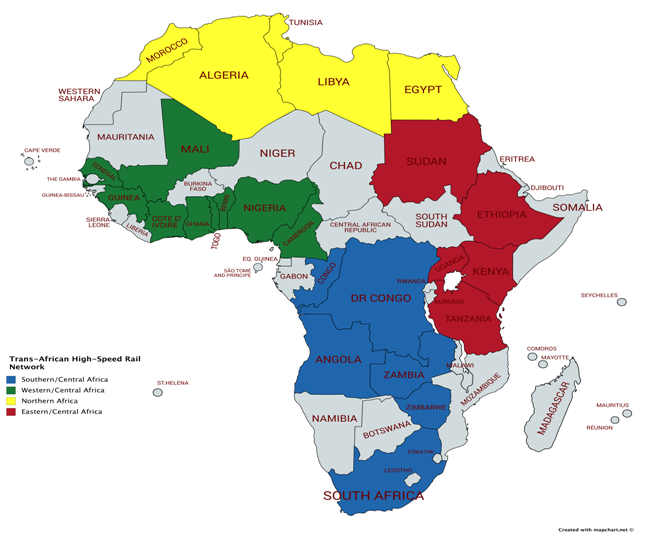
Created by the Author using mapchart.net

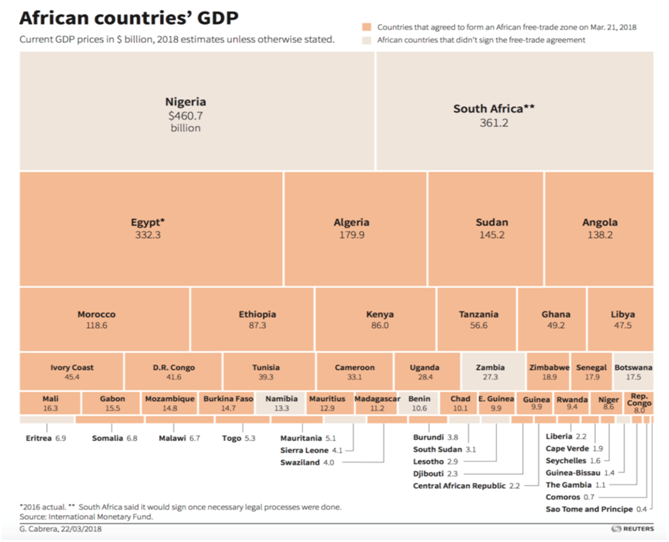
This proposal is based on the size and contribution of countries along the high-speed rail network to Africa’s overall GDP as shown on the chart below. Investment on the Trans-African high-speed rail network is expected to not only reduce the cost of cross-border transportation and transaction costs but also ease the pressure on seaports and airports.
Source: International Monetary Fund/Reuters/World Economic Forum


Financing Africa’s Huge Infrastructure Deficit: Challenges and Opportunities

Following the first Africa Investment Forum in Johannesburg, South Africa in May 2018, where discussions were held as to how to further strengthen Africa-led response to the continent’s infrastructure-financing deficit, the AfDB in November 2018 approved an equity investment of US$50 million in African Finance Corporation (AFC). According to the AfDB, “the equity investment is aimed at strategic partnerships with some Development Finance Institutions (DFIs) that have comparative advantage at regional or sub-regional levels in certain strategic sectors”. Given that bridging Africa’s infrastructure deficit would require about US$170 billion annually (which is 5% of the continent’s GDP), the reasonable question before policy makers at the regional level is where will the money come from? Should Africa rely on Nigeria, South Africa and Egypt that cumulatively account for more than 50% of the continent’s GDP? Can Africa fund Africa’s infrastructure need with Africa’s resources or should we seek external assistance?

What financing options can Africa explore? AfDB is expected to lead the charge here by structuring loan syndication partnership deal with other multilateral development banks (MDBs) like the World Bank, European Investment Bank, International Development Association, Asian Development Bank and Inter-American Development Bank. Loan syndication with a consortium of MDBs has the added advantage of risk diversification. This consortium of MDB lenders with the ratification of the African Union (AU) can select through competitive bidding, a concessionaire with expertise in rail construction and management to guarantee the viability of their investment. The elegance of structuring concession contracts that bundle construction and service-provisions together with a single private operator is that it is generally believed to be incentive-efficient and yields the best outcome.

Alternatively, Africa could also explore financing through Sovereign Wealth Funds (SWFs). With a global cumulative asset of over US$7 trillion, SWFs are better placed to finance large scale infrastructure of this magnitude. Policy Analysts tend to prefer SWFs to institutional investors like Pension Funds because SWFs have longer investment horizon and they do not have substantial explicit liabilities (specific obligations created by law or contract, that government must settle). Additionally, SWFs are not subject to the “prudent person” investment regulation, which prevents large exposure to long-term infrastructure projects.

Africa Infrastructure Bond Market could also be a financing option where the AfDB together with sub-regional and national development banks like ECOWAS Bank for Investment and Development (EBID) and Development Bank of Nigeria (DBN) create infrastructure development bonds with different tenors and yield. This would encourage Africans (within and outside the continent) to invest in Africa and with “strength in numbers” (credit to the Golden State Warriors), Africans can build the Africa of our dreams.

Although the United Nations Economic Commission for Africa (UNECA) has estimated that AfCFTA could potentially boost intra-Africa trade by 52% by 2022, but to realize that estimate, the task of addressing Africa’s infrastructure deficit must be accorded the urgency and importance it deserves. Until then, like Jaramogi Oginga Odinga titled his 1967 Classic, it is not yet uhuru (freedom in Swahili) for Africa.

Attending United Nations Launch Event in New York Next Month, Connect

0

Yesterday, I accepted the invitation of the United Nations Development Programme (UNDP) team to attend a special “Launch event” in New York at the UN Secretariat on Sept 22. If you are in New York, and there is something big happening, email my team and we can explore to connect.

About to board a UN Helicopter for a mission for UN


New Article Coming Next Week in Harvard Business Review

0

My Harvard Business Review editor just approved a piece. It is a really nice article on industrialization, single currency, China – and yes AfCFTA (the African trade agreement). Depending on your HBR subscription, it will be up next week. For my Vanguard Newspapers-anchored workshop, we will be looking at the thesis of this particular piece from the nexus of digital in Africa. Vanguard will begin promoting the event on print and online in the coming days. One of our Directors, a Fellow of the Institute of Chartered Accountants of Nigeria, Mr. Gbenga Bamiji, will drive the program with me. Continue to email to my team so that we will inform you once the registration goes live.

Something big is coming. I want you to hold that training budget intact [do not spend it yet] because I will run a workshop in coming weeks under a partnership with Vanguard Newspapers. I promise you that it would be SUPERB. The location is Lagos – the centre of excellence. I will co-learn and co-share with the participants on the mechanics of business as we walk through innovation, growth, and digital.

An Online Voting System Will Be Better in Nigeria

0
Election cycle

Nigeria is a great country that is full of milk and honey. The giant of Africa, no doubt.

But the political system is really worrying. They said politics begin at home. Yes, I believe this. We are all politicians. We practice it at home, work and even church. Let’s take a look at this, a father who favours one child over another already portrays an act of politics.

According to history – Elections have been the usual mechanism by which modern representative democracy has operated since the 17th century.

Despite election has been around for decades, our registration and voting system still has numerous problems. During this year’s election, some voters experienced many difficulties. Some polling centers ran out of ballot paper. Some of the voting machines did not work. The registration database contained errors which prevented some from voting. Millions of disabled voters were not able to vote. In some cases, voters stood in line for hours. Other problems occurred at some polling centers including altercations.

I was opportune to work as a Presiding Officer during my NYSC Program in Kano this year, 2019. Many corp members see it as an avenue for making money. Everyone was asked to sleep at the RAC center in order to collect all the materials. I couldn’t sleep overnight because of unexpected violence that can occur at any time.

As usual, many lives were lost. The annoying part was, INEC promised to pay 30,000 for the two elections that were conducted but failed to redeem it. Instead, they paid based on random selection. What about the people that lost their lives during the course of the election? Nobody remembers them except their family and friends. If INEC couldn’t pay the living, I doubt that if they would remember the victims.

One more thing, I realize that many people are scared to come out during election time. They don’t want to endanger their lives.  In a situation like this, we need an online voting system.

There are many advantages which could be made possible with Internet voting. There would be an increase in the number of voters as they would enjoy convenience just like they have in many aspects of lives – banking, healthcare, education, entertainment, and e-commerce. Our overseas citizens can also vote from anywhere in the world without having to rely on the outdated paper ballot and postal system.

Going for online voting will surely reduce the high rate of violence during election time, reduce election manipulation and also increase the number of voters.

Advantages of online voting.

  1. It reduces violent: The high rate at which our voting system claim lives is acerbic. I think by using an online voting system, it will surely reduce the act of violence in our country.
  2. Security and confidentiality. A properly designed, secured online voting system has safeguards in place to protect voting information and voter identities. A voting website hosted on a secure server will only be accessible to authorized members through unique voter logins. Online ballots are transmitted from voters’ computers or mobile devices to balloting systems using SSL (Secure Sockets Layer).
  3. Fast and accurate: We don’t have to wait for many days for the winners to be announced. With the advent of technology, it will be fast and accurate.
  4. Convenience: Anyone that is of age to vote can vote at any convenient time and place. This eliminates the need for transportation, and problems such as lack of childcare, illness, confusion about polling locations and queues. It would make voting easier and more private for those with disabilities, anxiety issues or serious medical conditions.

I don’t know if it’s possible to implement online election, but I think we should give it a try. We are Nigerian. The giant of Africa.

God bless Nigeria!