DD
MM
YYYY

PAGES

DD
MM
YYYY

spot_img

PAGES

Home Blog Page 6749

Building The Right Entrepreneurial Mindset

0

“In order to succeed, you must first survive”. I have seen several people use this quote and attribute it to Warren Buffet; so I will reference him. This post is addressed to wantpreneurs and young entrepreneurs as well, and it is a practical approach to the reality of entrepreneurship that many people have not been told. So, you get to run up and down doing the wrong things because you have not built for yourself the right mindset. It will cost you a whole lot if you want to dabble into entrepreneurship without having foreknowledge of what it is all about.

  1. Entrepreneurship Is Not For Everyone: There has been the whole noise all over social media that entrepreneurship is now the new profession which is actually not correct. The story goes in a way that the economy is bad and that the only way to be guaranteed success is if you venture into entrepreneurship. That is not true. The first lesson I want you to learn before I proceed to the next is that you should have it at the back of your mind that it isn’t for everyone, which means it’s not something you find yourself in, rather something you make a decisive effort to be in.
  2. Be Ready To Face Risks: The honest truth is that not everyone is actually fit to face risk. Risk means trying out something when you’re not sure of its outcomes. Fine, you may have prepared all the business plans, and it all looks like everything will turn out fine. However, there will always be a five percent uncertainty in the achieving of such moves, and that five percent is capable of ruining you. That means that it’s either you back out or continue. What you must ensure is that you make calculated risks and not assumptions. They seem similar but are actually different. Calculated risk means you are partially aware of the consequences of any move you make but you make it because it is a step to your progress while assumptions has no research behind them. Matter of fact, this will not happen once or twice and may sometimes lead to the loss of your finances, but you keep moving.
  3. Survive before you succeed: This lesson is golden and in a continent like Africa where there is no life support for entrepreneurs, it is paramount that you have a constant source of income. Yes, a safety net. By safety net, it means that you have something to fall onto when you go bankrupt. It could be your parents wealth or another access to assets. You cannot build a billion dollar company on an empty stomach which means that you need to take on jobs. I perfectly understand that there will be time conflict and how you can manage them and that it means you might not have all the time for 9 – 5 jobs. However, you need to get gigs, per time jobs or work during the day while you build at night.
  4. Have a long term mindset: If there’s anyone who should have a long term mindset, it should be entrepreneurs. Firstly, you need to take off the mindset of fast growth or overnight success. It has never in any day of history happened where an entrepreneur succeeded overnight. The reason this piece of advice is priceless is that it will shield you from all forms of pressure from the society. The pressure to want to quickly show off your success. There’s no shortcut to getting to make millions, the only shortcut is that you need to wait for your fruits to ripen before you pluck them. People don’t eat unripe fruits and if you try it, they wouldn’t return to you after discovering you tricked them.
  5. Understand the habit of spending: This is not a poverty mindset piece of advice. This advice will save you from going bankrupt before you start. If your goal for going into entrepreneurship is to show the fancy cars and expensive wristwatches, chances are that you may never get to really be a successful one. This mindset is actually the poverty mindset in itself because you will want to show gratification based on material things. This means that your first profit, your little income will be spent on showing how successful young are. Entrepreneurs have a different mindset to building wealth. They do not see wealth as the cars at the garage or the expensive suit in the closet; wealth to entrepreneurs is based on values that are not yet seen and cannot be quantified.

You necessarily don’t need a car unless the car can help you move from one point to another for your business success. You don’t need a new pair of suits if you are not having another meeting to attend with that new investor. The social media has painted success in entrepreneurship as standing in front of expensive cars and jets which is actually fake life. Success in entrepreneurship is actually the amount you have net disposable income. The amount you earn is totally different from the amount you are worth. Your car is simply equal to cash at hand except the car on its own produces money, then it becomes an asset.

I have experienced all these and I know this is part of what defines an entrepreneur. With this mindset, you’re not far from success.


The Choice To Be Somebody That Matters

0

There can be just one president for a nation at a particular time, there can be just one vice president, so also one governor for a state, and just one leader for a role for a period of time. So where do we fit in? Those of us who also want to be presidents, those of us who want to be governors, those of us who want to be leaders, and those of us who want to own companies.

Is there any space left for us to occupy? Can we build the next Facebook and send Zuckerberg home? We all want to matter; we all want people to notice us, to give us respect and honour the big guys have. But how are trying to get it? Now, I would say this as mild as possible. You cannot overthrow the president while he’s on seat by attacking him, you cannot throw away the governor on seat by facing him head on.

You cannot send Zuckerberg home by building the next social media. I’m so sorry but you’d fail before you start and I’ll tell you why and what you need to do. The reason is simply because it’s totally impossible to come into a tribe and seat on the throne by throwing away the leader while the tribesmen watch you. Matter of fact, they would rebel against you. The leader has won their trust over time and trust is all you need to rule. You need their loyalty else they sneak up at night to kill you or escape from the town.

These big businesses you want or wish to overthrow have millions and billions of loyal tribesmen (customers). I call it tribesmen because they have for years successfully gained the attention, trust and loyalty of those customers making them part of the brand, community, state and even area. You would need more money, more magic to win in this case. So does this mean you cannot still be a president or governor or leader? You can! Absolutely!

Here’s what you need to do: You need to seek a small group of people that you matter to. It’s a choice. You choose to become the president of the blind and make them recover their sight, soon enough every blind person who has recovered their sight becomes loyal to you. Then they convince another blind person till the whole country is filled with people who have recovered their sight who see you as the leader. These people are your new tribesmen and it’s easier for them to whisper to even those who were never blind to tell them about your generosity and just like that, your idea spreads.

You cannot build the next Facebook that just connects people and advertises, you have to create a social media for grannies to connect and have memories of the times they’ve spent together. Then the grannies convince their children and their grandchildren and your idea spreads. What I’m implying is that you have to seek a set of people who you would matter to, who would be loyal to you, then you rule over them in generosity and transparency and they spread your idea.

This is a choice you have to make. Don’t go fighting the air. Most times you may not need to be the president of a nation, you just have to be the president of the writers, athletes, and the artistes. Who are the people you matter to? What do you matter to them on? Do they recognize it? Is it something they need? Don’t try to go and rule in a kingdom that doesn’t need you; you’d be fruitless. Seek those you matter to, and nurture them.

Lead your tribe well. That’s how you matter!

The ORide/OPay Double Play Strategy – Lose Money in Okada, Make It Up via Paytech

6

Many have commented that OPay did not raise $150 million as I noted in the Gokada piece: “$150 million OPay has raised [$50m for OPay and the reserved $100m].” You are technically correct as the $100 million fund was not specific for OPay.

Yet, these are all semantics. Do not be fixated on it. I go beyond press release in my analysis; I think beyond the press. Since Opera raised $100m for Africa, it has not done anything, at scale, in any other country but Nigeria. I do believe that majority of that $100M  is mapped for Nigeria even though it used Africa in the statement. Then, ORide/Opay/OFood got $50M. Nigeria is the only country it is building startups at scale. I don’t really care what they have on press release to make sense of what they are doing. This company wants to build a fintech (OPay) but it needs to acquire customers from different areas to help seed the transaction volumes.

OPay is the operating vehicle as they want to build transaction processing feeders to make their paytech system dominant. I did not say ORide; I said OPay because ORide is under OPay in the grand Opera strategy.

This is a double play strategy: Opera will lose money in transportation, ride-hailing, food delivery, etc but will make money through OPay payment processing fees. So, as it pursues market share challenging Gokada and Max.ng, do not think it is stupid for losing all that money.

Yes, provided the chip business has an internal customer (the mobile device unit, the oasis in my strategy), Samsung will continue to commit resources as the oasis has removed most of the risks in investing billions of dollars to build new factories in the chip business. Yes, the mobile device unit (the oasis) makes the chip business better by being a “reliable customer”, irrespective of whatever happens externally. That is the heart of the one oasis and the center of Double Play Strategy in business.

Most of the comments here have focused that ORide will go bankrupt when its money finishes. The commenters do not know that ORide is structured to provide transaction fees for OPay. Provided ORide does that at scale, Opera will make money via OPay even if ORide is never profitable. Sorry that I have to repeat that again.

I told a firm to adjust strategy last week immediately my Practice came to the conclusion on this OPay strategy. Without a payment system, no ride-hailing startup in Nigeria can challenge ORide headson. Of course, there are other options on what players like Max.ng and Gokada can deploy.

This  double play strategy is common. Amazon/AWS uses it. Alibaba/Alipay uses it. And Opera is working on it in Nigeria. If you want to compete against ORide without OPay, you will go bankrupt because ORide may never be designed to be profitable. But the parent company will be fine provided OPay is making money through commissions on transactions.

LinkedIn Summary

I browsed through the comments on Gokada and was surprised that our mini-MBA is not yet efficient. ORide will not go bankrupt for giving cheap rides in Nigeria. ORide, OFood, etc are designed to be payment transaction volume feeders into OPay. So, provided they bring volume, even when losing money, Opera will make its money from payment fees. That is the Double Play Strategy: lose money in one thing but make up in another.

For Gokada, Max etc to compete with ORide, they need a Double Play. ORide business model is not to make profit on transport but to feed payment commissions to Opay. One of the best strategies for Gokada and Max will be to buy a fintech firm (I have some suggestions) to compete.

Alibaba/Alipay and Amazon/AWS are examples of double play. Read more on click. Do not be distracted by the discounted rates of ORide/OFood. It will be fine because of its OPay.

The Double Play Strategy


The Thank You from Kobo360 After $30 Million Backing from Goldman Sachs

0

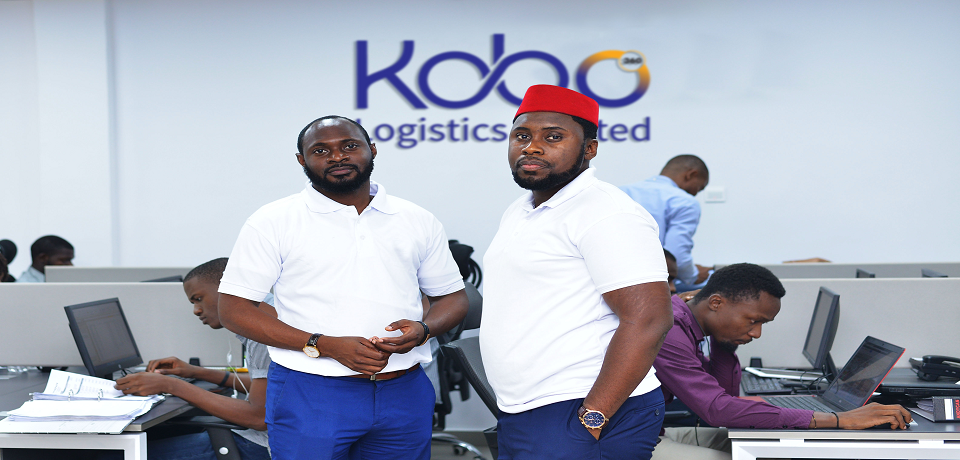
Our Founders – Obi Ozor and Ife Oyedele II, and the Squad Team- take all the glory. But permit the Prof to celebrate.  Everyone is happy here because $30 million from Goldman Sachs into Nigeria is a great validation. But this is just the beginning: the G-LOS is engineered to be a global logistics operating system, out of Lagos. 

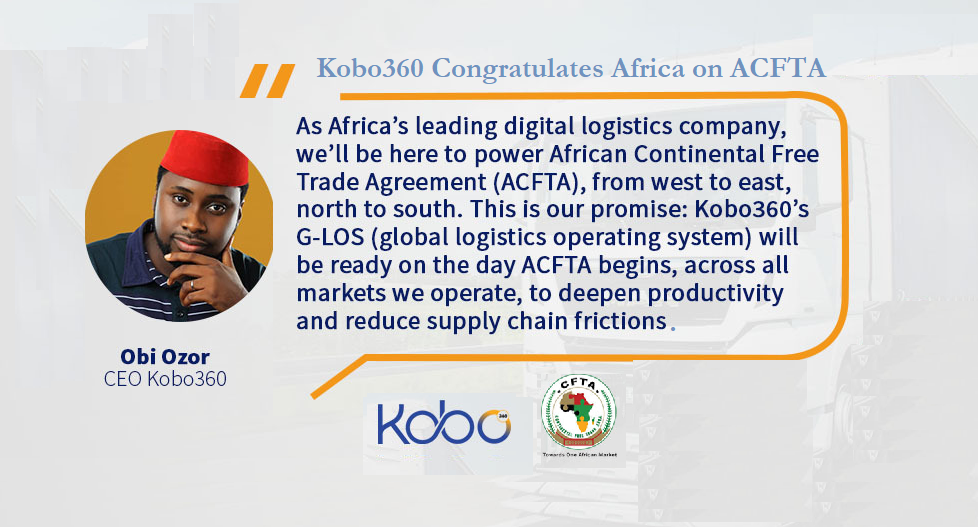
And the AfCFTA (Africa’s free trade agreement) is going to harmonize most of the elemental frictions to enable attaining equilibrium faster. The mathematics of Africa supply chain is the calculus of African commerce. Our model is incorporating AfCFTA to be ready on Day 1.

Think Logistics. Think Kobo360.

Nigeria’s eLogistics Pioneer Kobo360 Raises $30 Million Led By Goldman Sachs

Nigeria’s eLogistics Pioneer Kobo360 Raises $30 Million Led By Goldman Sachs

2

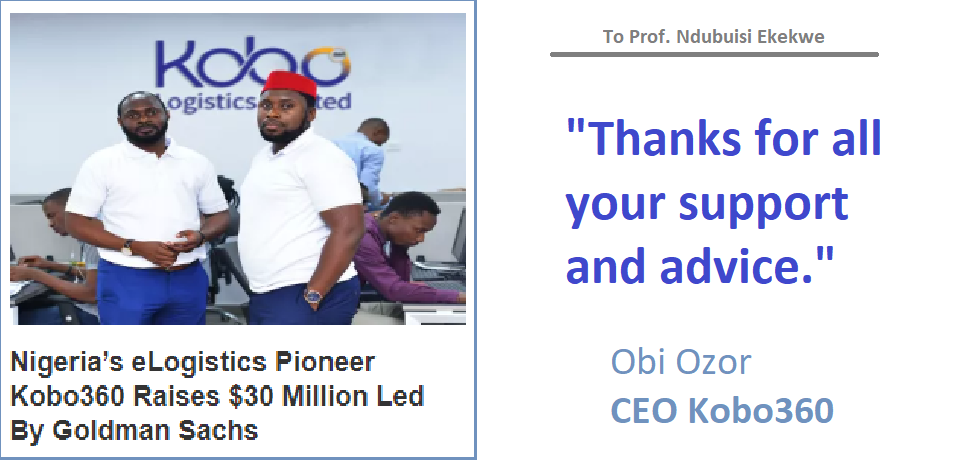
Nigeria’s e-logistics pioneer Kobo360 raises $30 million led by Goldman Sachs. Congratulations to the Squad  for executing the mission at the highest level. As part of this announcement, I wrote a brilliant piece on the sector yesterday for people to understand what Kobo360 is doing to reduce frictions in Africa’s logistics and broad supply chain.

As we celebrate here, the best moment arrived when the CEO of Kobo360, Obi Ozor, dropped this line, this morning to me,  “Thanks for all your support and advice.” I am very proud of what Kobo360 has accomplished and even more optimistic that Kobo360’s mission to build a logistics operating system in Africa will advance our continent in the age of AfCFTA.

The two Founders – Ife Oyedele and Obi Ozor – are amazing operators.  What they have accomplished in Africa within a really short period is largely unprecedented.

Kobo360 is a tech-enabled digital logistics platform that aggregates end-to-end haulage operations to help cargo owners, truck owners and drivers, and cargo recipients to achieve an efficient supply chain framework. Through an all-in-one robust logistics ecosystem, Kobo uses big data and technology to reduce logistics frictions, empowering rural farmers to earn more by reducing farm wastages and helping manufacturers of all sizes to find new markets. Kobo enables unprecedented efficiency and cost reduction in the supply chain, providing 360-visibility while delivering products of all sizes safely, on time and in full. The Kobo mission is to build the Global Logistics Operating System that will power trade and commerce across Africa and Emerging Markets.

Congratulations to Nigeria. Congratulations to Africa. Congratulations to Kobo360.

How Emerging Technologies Are Transforming Logistics in Africa

The Press Release

August 14 2019. Kobo360, the digital technology platform disrupting African third-party logistics, today announced the completion of a $20M Series A equity round led by Goldman Sachs, with participation from Asia Africa Investment and Consulting Pte. and existing investors including TLcom Capital, Y Combinator, the International Finance Corporation. An additional $10M in local currency working capital financing has been secured from Nigerian commercial banks.

Launched in 2017 by Nigerian entrepreneurs Obi Ozor and Ife Oyedele II, Kobo360’s tech-enabled full truckload offering enables the development of an efficient supply chain for end-to-end long-haul freight operations, connecting and supporting cargo owners, truck owners & drivers, and cargo recipients. The company has moved over 500Mkg of goods, aggregated a fleet of over 10,000 drivers and trucks, and services SMEs and over 80 large enterprises such as Dangote Group, DHL, Unilever, Olam, African Industries, Flour Mills of Nigeria, and Lafarge. Located in key strategic trade hubs in Western and Eastern Africa, the e-logistics company will continue its expansion with the ambition to build a Global Logistics Operating System [G-LOS] powering trade and commerce across Africa and emerging markets.

With the funding, the team will continue to scale the organization, develop the technology offering and accelerate supply growth – planning to add 25,000 drivers to the platform in the coming months to power the recent Africa Free Trade Continental Agreement, expected to catalyze intra-African trade. Kobo360 is also planning to significantly broaden its reach in Africa, entering 10 new countries by the end of 2020 beyond its footprint in Nigeria, Togo, Ghana and Kenya.

Obi Ozor, Co-founder and CEO of Kobo360 said, “Our Series A allows us to invest in growing our talented team that is working hard on the ground to systematically address the inefficiencies within the African logistics sector, and strengthen our already extensive network of clients and truck owners across the continent. We are also focusing on developing the partnership with drivers, ensuring that they are trained to use mobile-enabled technology, so they can convey goods seamlessly and earn more money. We are already seeing drivers running trips on the Kobo360 platform increase their monthly earnings by 40%, as we work together to mobilize logistics across Africa.”

Jules Frebault of Goldman Sachs said, “Kobo360’s on-demand logistics offering has generated impressive traction and we are excited to support Obi, Ife and the team as they harness technology to tackle one of Africa’s most pressing development challenges – increasing market transparency, improving reliability and unlocking efficiencies for all participants in the logistics ecosystem”.

Senior Partner of TLcom Capital, Omobola Johnson said, “We see this Series A round as a means to support an ambitious, laser-focused company who are using technology to actively solve problems for enterprises across the continent, and we look forward to working with them as they continue to scale and transform the African logistics sector.”

Kobo360 is also developing a suite of driver-focused products to support the over 10,000 drivers on the Kobo360 platform. It has launched KoPAY, offering access to up to $5,000 monthly working capital; KoboSAFE, access to an insurance product; and KoboCARE, access to discounted petrol, comprehensive HMO packages and an incentive-based education program for drivers’ families.

Wale Ayeni, who heads venture investing in Africa for the International Finance Corporation, added, “IFC’s continuous investment into Kobo360 stems from the company’s successful track record. Kobo360 is empowering and enhancing the capacity of the vast underserved network of “micro” fleets in Africa to serve the huge unmet long-haul freight needs of large enterprises and SMEs, delivering value to both sides.”