DD
MM
YYYY

PAGES

DD
MM
YYYY

spot_img

PAGES

Home Blog Page 6755

M-PESA Global Has Promise of Africa’s Unified Payment Platform

2

M-PESA Global is a service that enables M-PESA registered customers to send and receive money globally. Kenyan M-PESA customers will be able to send funds to East Africa (Rwanda, Tanzania & Uganda), globally (to millions of Bank accounts and over 500,000 Western Union locations globally), and Paypal. Also, M-PESA registered customers could receive funds from abroad on their M-PESA account. Looking at it critically, this product is becoming an operating system, connecting Kenyans to other domains in the world, on transfer and remittance of money.

And it is growing; according to Safaricom, the mobile operator which owns it, M-Pesa Global handled Sh101 billion (about $976 million) or a third of all diaspora remittances into Kenya in the financial year ended March. This product has the capability of becoming that special fintech product I had posited that Africa needs. Pity Kenyan banks!

“The company rolled out the international money transfer business through its 100 percent owned subsidiary, Instaconnect Limited, and injected additional capital by acquiring assets worth Sh397 million and a cash transfer of Sh10 million,” Safaricom says in its latest annual report.

“We expect that due to the above investment, there will be more activity that will have a positive impact on the reported results of full year to March 2020 from the operations of the new businesses.”

Safaricom says the international money transfer business, branded M-Pesa Global, handled Sh101 billion or a third of all diaspora remittances into the country in the year ended March.

The platform allows customers to send and receive money, make payments and participate in international e-commerce through partnerships with other payment platforms such as Western Union, PayPal and AliExpress.

Simply, this product has the capability of becoming that special fintech product I had posited that Africa needs (the video on click). But it has to find new markets urgently.

How Secondary Education Can Be Improved in Nigeria

0

Secondary education in Nigeria is at the center of the educational system. It is strategically placed in the system and I believe it affects employment, hence its importance. In this article, I will examine secondary education and share ideas on how it can be improved in Nigeria.

In Nigeria, secondary education is the type of education a student receives after primary education. It is that kind of education that precedes tertiary Education.

Over the years, the structures and patterns of secondary education and indeed the educational system in general has changed. From the 6-3-3-4 system which states a child goes through 6 years of primary education, 3 years of junior secondary education, 3 years of senior secondary education, and then 4 years of tertiary education. Today, we have the 9-3-4 system. This system explains that a Nigerian child will undergo 9 years of basic education (which invariably is the combination of the 6 years’ primary education and 3 years’ junior secondary education), 3 years of senior secondary education and 4 years of tertiary education.

As at today, secondary education is controlled by individual states of the Federal Republic of Nigeria. Which means that state governments are directly in charge of regulating and financing secondary education in their respective states. We also have Federal Government Colleges, a secondary school which is directly managed by the Federal Government of Nigeria.

Improving secondary education

One way to improve secondary education in Nigeria is to re-examine the goal of secondary education. According to the National Policy of Education (2004), the goal of secondary education in Nigeria is to prepare the individual for 

(a) useful living within the society; and

(b) higher education

These goals are noble but taking a closer look at them reveals that only one of them is being achieved. And that is ‘preparing students for higher education’. This is made possible by the certification one receives after completing secondary education. At the end of secondary education, a student is examined on various subjects in line with his or her proposed career goal and then the student is presented with a certificate. This certificate is the proof that a student completed secondary education and it certifies the student for tertiary education. 

For me, this is where the problem lies. The goal of secondary education should not just be a certificate. The goal of secondary education should be self-reliance. Secondary education should not just leave the student with a certificate; secondary education should leave the student with a skill – a life skill, a survival skill, a marketable skill, and economically viable skills. Secondary education should leave students with a skill, or some skill sets that helps the individual to be productive and self-reliant. 

I think that the focus on the two major goals of secondary education should be re-examined. Apparently, more attention is paid to preparing students for higher education than preparing them with viable 21st century skills for useful living within the society.

My point is this. Secondary education should not just be about preparing you for University. Secondary education should be about preparing you for life. How? By empowering you to discover and develop your skills, gifts and talents, so you can start up a business and offer your skills to solve problems. Secondary education should be skill based. The focus of secondary education should be skills, practical and relevant present day skills.

So with this system, a student who has completed secondary education can decide to start something with the skills that he has learned or developed. He could decide to further develop and explore those skills at the tertiary level, in universities, polytechnics and specialized tertiary instructions.

Some may argue that it’s too early to talk about skills at the secondary level of education, but I think that’s where it starts from. We need to begin as early as possible to position and fortify our students with relevant 21st century skills that they can always hold on to after secondary education. I tell you, this will have a positive ripple effect and reduce unemployment.

2019 Eid al Kabir: How Nigerians Will Patronise Bus Transport Service Providers

1

Whether you call it Eid-al-Kabir or Eid-al-Adha, it is the 10th day of the Muslim lunar month of Dhul Hijja. This is the day of festivities for Muslims and lasts for four days throughout the world. Already, the federal government has declared August 12 and 13 as public holidays to mark the 2019 Eid-al-Kabir.

Before the declaration, some Muslims faithful had started travelling from cities to cities and cities to the hinterlands across the country.  Non-Muslims are not left out in the movement as analysis indicates that they have been traveling to celebrate with their Muslim friends and family members. To contain possible crimes and crises, considering the high level of insecurity in the country, security agencies have ordered round the clock security of lives and property.

Like what was obtained during the previous celebrations, ram sellers and transporters have increased their prices and fares because of the increase in the demand of the commodity and service. For the ram sellers, the consequence has been the low patronage from the Muslims eligible to slaughter ram and other categories of animals prescribed for the celebration.

Despite the increase in transport fares, analysis shows that travellers remain resolute in their movement to various places. According to them, travelling to their destinations is more important than purchasing rams and other such as sheep, cows since it is not compulsory to make the sacrifice, according to the religion provisions.

Regardless of this view, analysis establishes that the interest in the festival connected with ram by 50.4% in the last 7 days. This further indicates that people will continue to seek knowledge about the categories of ram they could afford.

The increase in transport fares is not new because latest statistics from the National Bureau of Statistics indicates that the average fare paid for Bus journey from one city to another increased by 0.17% (month-on-month) to N1, 606.92 in June, 2019.

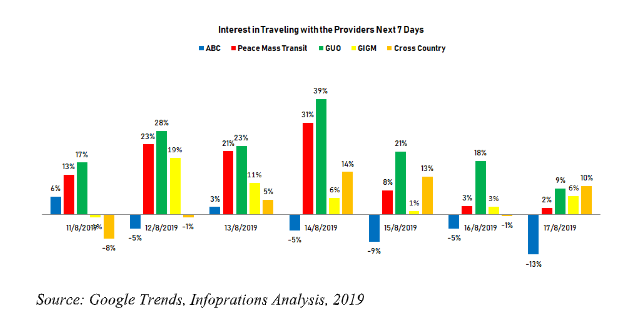
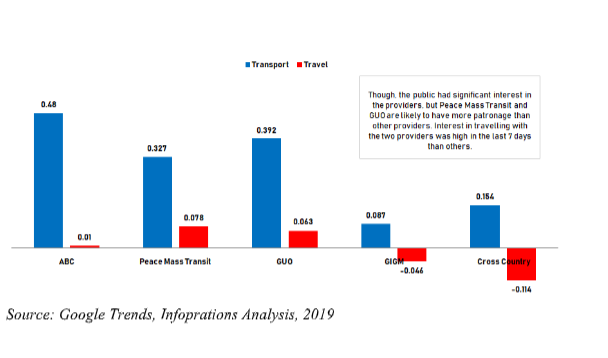
Checks show that places that cost N3, 000 before have been increased to N5, 000 while those with N5, 000 have been increased to N8, 000. Despite the fact that the linkage is not strong as expected, analysis reveals that one unit of interest in the festival has increased travellers’ one unit of interest in transport service by 20.9%. Throughout the 7 days, travellers have sought information about ABC Transport, Peace Mass Transit, GUO Transport, GIG Motors and Cross Country Transport than other providers. Though, the public had significant interest in the providers, but Peace Mass Transit and GUO are likely to have more patronage than other providers. Interest in travelling with the two providers was high in the last 7 days than others.

For the next 7 days, the two providers are expected to have substantial patronage as analysis suggests a good connection between them and the travellers’ movement to various places. From August 11 to 14, GUO Transport would experience high patronage while the trend would reduce on August 16, 2019. One of the key reasons that could be adduced for the change is the expiration of the festive period. Peace Mass Transit should expect travellers surge to her locations, especially in the main cities, between August 12 and 14. The increase is expected to be driven by the people’s readiness to return to their various destinations.

To capture value from the insights, analysis suggests that the transport service providers need to work on customer engagement and provide adequate security for the passengers throughout their journey.

Assimilating into New Teams and Mastering Workplace Procedures

0
Work Space

Finding yourself in a new work environment is something that can leave you second guessing all the time. First, it takes some time to get used to new ways of doing things, new work schedules and even getting familiarized with new colleagues. Of course, a few awkward moments are expected. This is normal. 

In one particular instance, a worker who was new in a particular organization, and who happened to have met a new acquaintance at work was given a list of dos and don’ts by his new “friend” on how to approach every manager. I understand what the friend was trying to do. He was just trying to make things as easy as possible for his new colleague.  This isn’t particularly a bad thing as many organizations even organize orientation programmes for new employees as it helps in familiarization.

Still, it is important to note that studying the organization by making your own observations will give you a perspective that suits you. There is no guarantee that Manager A who reacted in a particular way under a particular circumstance to Mr B  will react in a similar way to Mr C in the same kind of circumstance. This is true for so many reasons. One being that the difference in personalities can make people to react differently even in identical circumstances . Hence, you get situations like this where a particular individual does a particular thing and gets away with it, whereas another fellow who does something similar pays dearly for doing the same thing. Then he thinks it has something to do with bias. Maybe it does, maybe it doesn’t. The tips outlined below can help one familiarize in a new work environment:

  • Get Updated: Go through their website, study space,  come a little bit earlier than the other workmates so you can have that extra hour you need to look around and see how things are.
  • Be Friendly and Create A Good First Impression: This helps in so many ways as many people will continue to see  you based on the initial impression you created. Introduce yourself to people properly. Try to mingle, don’t isolate yourself.
  • Ask Questions. Asking questions where you need clarifications will save you the time and embarrassing associated with making unnecessary assumptions.
  • Maintain Neutrality: Don’t take sides on issues you don’t know how it began or what led to it. Don’t see anyone for now as an ally. 
  • Be Positive and Optimistic: You can see the changes from the positive end. It could be a new adventure worth embarking on; just explore the new opportunities and also see it as a forum where you meet new people .

Remember this isn’t just about getting familiar with people in a new place, it is also about understanding organizational procedures. The essence of having these procedures is to eventually make the system function in a smoother and more efficient manner. In some firms, money cannot be taken out of the company account without the endorsement of maybe two or three principal officers. This kind of additional protocol would help prevent unnecessary withdrawals from a particular individual for personal  reasons. In some organizations, an additional protocol may be created to provide an additional line of security to checkmate illegal activities from taking place.

An organizational procedure by definition  is a step-by-step description of the tasks required to support and carry out organizational policies. They also help to provide a clear understanding to employees of what is actually expected of them.

In many instances as I have seen, some organizational procedures create unnecessary bottlenecks preventing  the smooth flow of work. There have been instances where work has been delayed or eventually suspended because of the signature of a particular official after two or three other signatories may have given their consent. We see that all the time in many agencies and yet wonder why some establishments fail to live up to their full capacities. 

So before creating or continuing a particular organizational process we should ask the following questions:

  • Will this procedure lead to quicker work delivery?
  • Does it serve as an additional security check?
  • Does it improve documentation and record keeping?

If it passes these tests, then maybe you can consider having that process as part of your organizational procedure.

Did A Workshop In Flour Mills Nigeria Plc

0

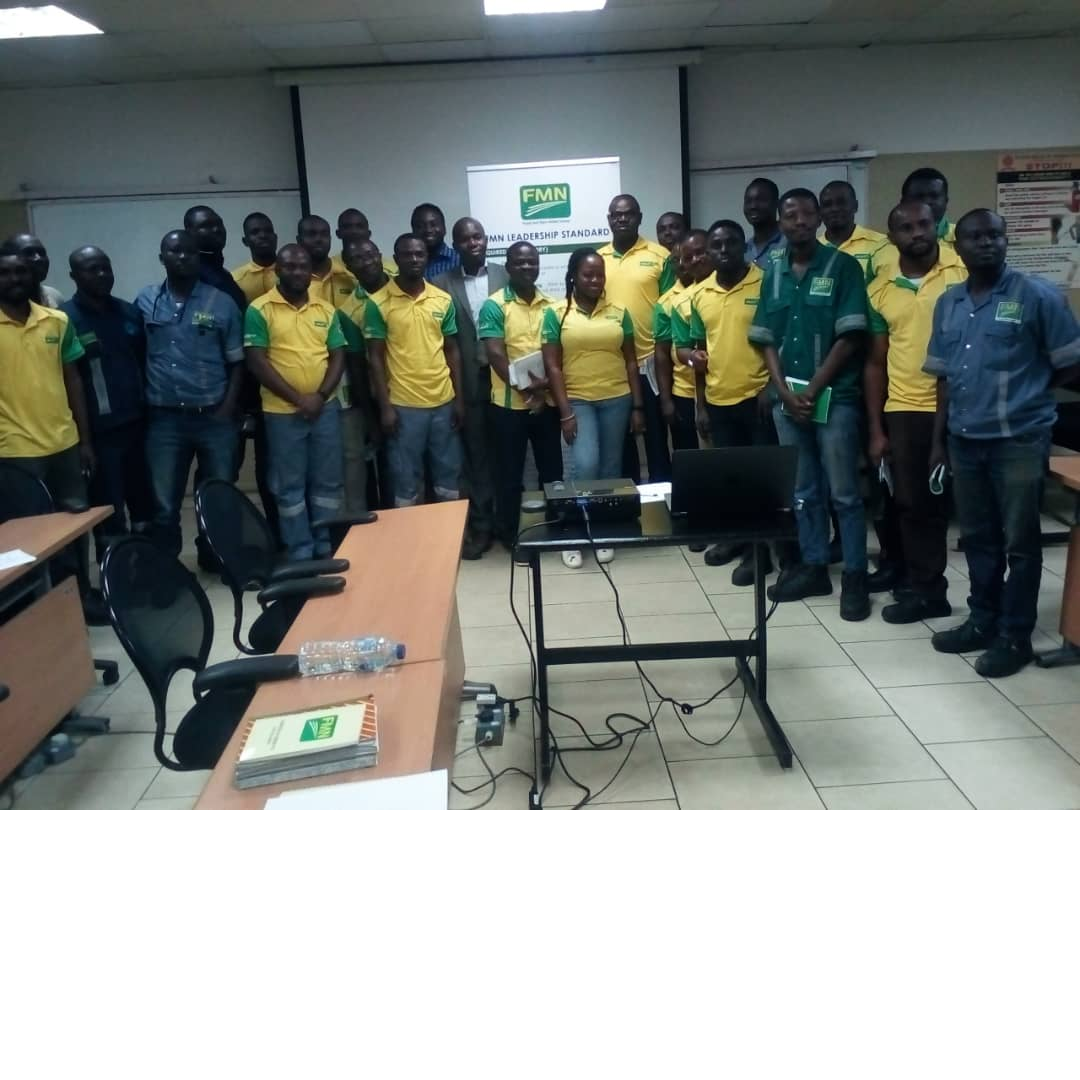
We all grew up using their products. Flour Mills Nigeria Plc is an iconic company in Nigeria.  Golden Penny brand has supported families across our nation; the company has Golden Penny Flour, Golden Penny Pasta, Golden Penny Garri, and many more. The Garri one is amazing on the redesign and elevation FMN effected on this Nigerian food heritage. Yesterday, I spent time in this company, on a Management and Leadership workshop, explaining the mechanics of modern leadership, flavored with digital, and how brands like FMN can innovate, grow and  keep pace in a changing world.