DD
MM
YYYY

PAGES

DD
MM
YYYY

spot_img

PAGES

Home Blog Page 6762

Problems of Overthinking – And How To Stop Overthinking

0

Overthinking can deprive you of the benefits of life because it could hinder your sleep and make you restless, undermine your work performance, and could even ruin you totally. It doesn’t only leave you mentally exhausted but also distressed.

It’s quite important to know that you can overcome this because overthinking is not a problem. In fact, the word “Overthinking” shouldn’t sound notorious to anyone. Overthinking shows you are human who is also going through life challenges just like everyone else. So don’t feel weird for overthinking; it is normal. However, dwelling too much on it could lead to serious problems.

Research shows that overthinking can trigger some parts of the brain that are involved in fear and anxiety. Think about yourself as a problem solver, your greatest asset, which is your mind could be attacked, affecting all your analytical decisions and making you unproductive and effective.

Often times, you don’t know you are overthinking. Perhaps, it is unconscious to you. The few symptoms below could be warning signs to you.

Symptoms of overthinking could be:


  • Lack of sleep


It becomes difficult to sleep when the mind is cumbered with lots of thoughts and judgments. 


  • Gets tired easily


Since the body is being deprived of sleep, it gets tired easily. 


  • Trying to have total control of life


This is always as a result of overthinking. You always want to be in total control of life because it makes you feel safe. But in the real world, can you control everything about life? Life is meant to be lived. 


  • You are a perfectionist


You are obsessed about failures. You are always scared of trying something new. Break out of it. Failure is part of life. The lesson is always priceless. 


  • You lack self-esteem


Everything you say or do is never the best to you until you get validation from the outside. 


  • Fear of the future


No one knows what the future holds. We can only make judgments or predictions. When you start to fear the future, you are overthinking it. 

Adil Taher shares some major causes of the problems of overthinking:

  1. Your judgments get cloudy
  2. Stress level increases
  3. Too much time spent on negativity
  4. Hampers the growth
  5. Kills the creative side.

How can you overcome these issues?

According to Adil Taher, he shared some key points to overcoming the problem of ”overthinking”. 

  1. Optimism: Always be positive i.e. rather than thinking about what could go wrong, think about what would happen if things go well. Be optimistic. Create inception, an imaginary world where you are a winner. Nothing beats a positive mindset.
  2. Shun negativity: Try to distance yourselves from negativity. This could be negative situations or negative people. They suck up your energy. Rather try to get yourself into something new.
  3. Gratitude: Gratitude is key. Instead of concentrating on what you don’t have, be grateful for the ones you have. Appreciate God for what he has given to you. Remember, thousands would wish to be in your shoes. The best thing in life is life. Inasmuch as you are still alive, anything is possible. You are still in the race.
  4. See a Psychologist.

 Have a negative-free week.

This Plot Shows The Biggest Challenge for Welfare-Boosting Single African Currency

4

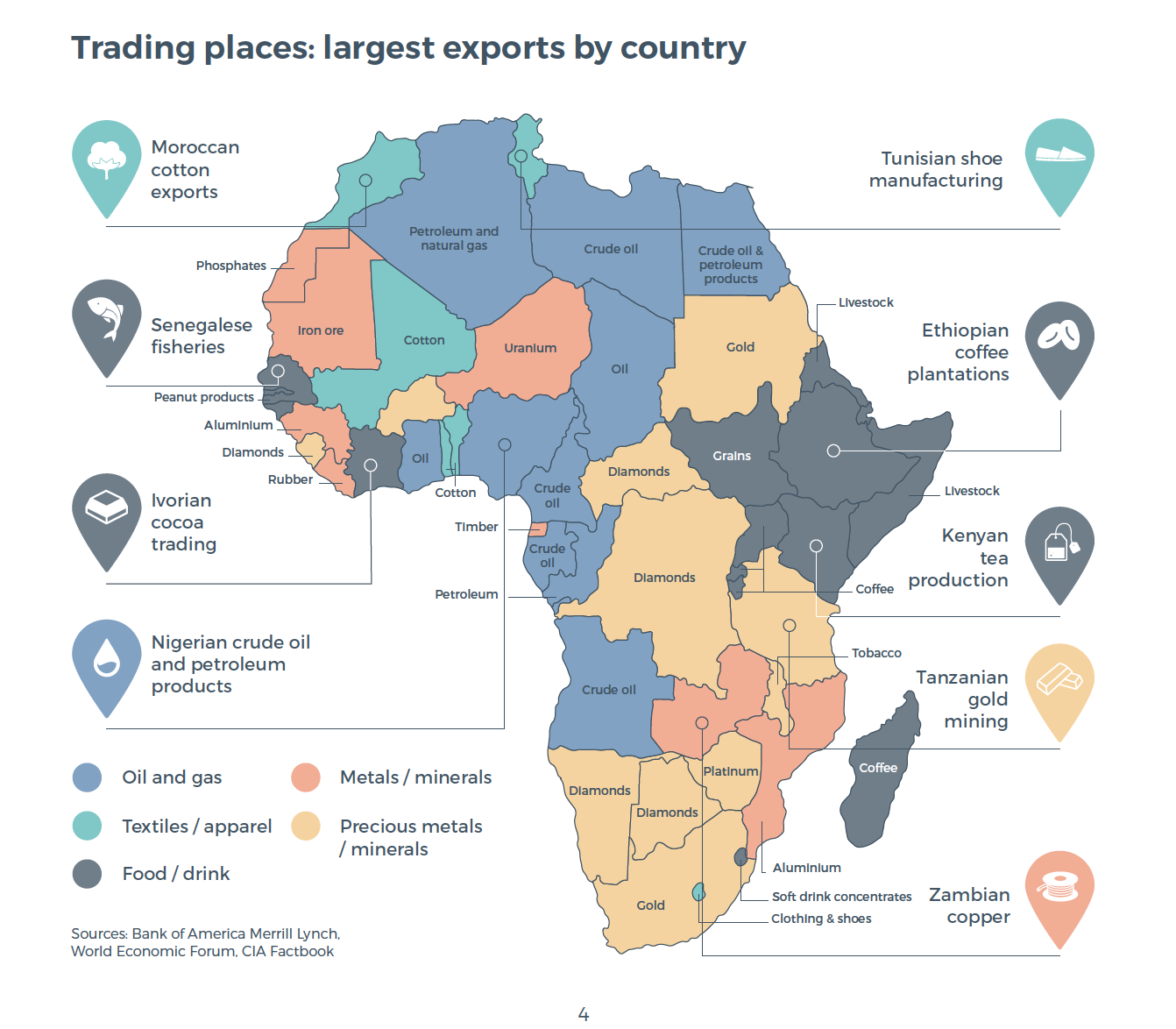
This plot shows why a single African currency under a supranational bank will be nearly impossible to improve the welfare of Africans. There is no banker in the world that can design a welfare-boosting monetary policy in such a heterogeneous market as shown in the image. By looking at the export nexus, what Nigeria needs is orthogonal to the needs of Rwanda, and yet you want them to be driven by a common monetary policy. Scale that to 30 divergent shocks, you have multiple-whammy paralyses.

One of the biggest challenges the monetary union which African Union plans to implement in the continent will be lack of flexibility to use monetary policies to drive economic agenda for respective member states. In other words, if a supranational bank which will become the central bank of the member states takes over, monetary policy tools cannot be deployed to fix some economic situations at member country level.

Source: the African

African Vogue Hiring General Manager, Digital Marketing Manager in Lagos

0

General Manager

African Vogue Nigeria Limited (AVNL) is a registered company with a focus on providing financial and educational services across major industrial sectors, and customers of all categories, including consumers, corporations and governments. In our consumer business, our grand objective is to bring to the doorstep of  bottom of the pyramid a broad array of educational and financial services, including credit, insurance, and cross-border remittance along with the traditional mobile money capabilities for bill payments, money transfers, etc.

We are currently seeking a General Manager for our business. We are seeking a candidate who desires a long-term career opportunity with a company in the broad financial and educational sectors.

Essential Duties and Responsibilities

  • Lead and oversee daily operations of the business
  • Direct and oversee staff members to make sure operations align with the vision of the company and our customers
  • Drive sales through new and existing client engagement to exceed targets – this includes going for presentations, reaching out to new customer segments, ensuring post sale service is improved and maintained at all levels in the business
  • Research and identify new growth opportunities
  • Design and execute strategies to grow the business
  • Manage production of monthly management reports
  • Provide weekly updates and reports to CEO
  • Ensure all staff are properly trained and equipped to effectively provide excellent service.

Minimum Qualifications (Knowledge, Skills and Abilities)

  • At least a bachelor degree in any discipline 
  • Strong relationship building skills – must be able to manage customer relationships effectively
  • Minimum 5 years work experience in a similar role at management level
  • Financial acumen is a must and accountancy experience is highly desirable
  • Experience designing and implementing strategies to meet your targets
  • Sales and marketing experience is also highly desirable
  • Business development experience (looking for individuals that have won customer orders, contracts etc)
  • Results oriented with proven record of success – success does not only have to be with sales, process improvements, effective cost reduction etc are also applicable 
  • Experienced with managing people, identifying promising talent and helping them grow to support business strategy
  •  Performs with minimal supervision.

Location: Lagos, Nigeria

Application Closing Date: 30th August, 2019

Method of Application: To Apply, send your resume to jobs@africanvogueng.com


Digital Marketing Manager

African Vogue Nigeria Limited (AVNL) is a registered company with a focus on providing financial and educational services across major industrial sectors, and customers of all categories, including consumers, corporations and governments. In our consumer business, our grand objective is to bring to the doorstep of  bottom of the pyramid a broad array of educational and financial services, including credit, insurance, and cross-border remittance along with the traditional mobile money capabilities for bill payments, money transfers, etc.

We are currently seeking a Digital Marketing Manager for our business. We are looking for an amazing, data-driven inbound marketer to own the majority of the marketing funnel for our company. You will be in charge of attracting site traffic, converting that traffic into new leads for the business, and nurturing those leads to close into customers, the latter of which sales leadership will help you accomplish.

Essential Duties and Responsibilities

  • Develop and implement strategies for generating and qualifying leads for business by identifying target audiences and devising digital campaigns that engage, inform and motivate in order to drive sales.
  • Design and oversee all aspects of our digital marketing department including our marketing database, email, social media, and display advertising campaigns. 
  •  Develop and monitor campaign budgets. 
  •  Plan and manage our social media platforms. 

Requirements

  • At least a bachelor degree
  • 3-5 years proven experience as Digital Marketing Executive or similar role
  • Demonstrable experience leading and managing SEO/SEM, marketing database, email, social media and/or display advertising campaigns
  • Highly creative with experience in identifying target audiences and devising digital campaigns that engage, inform and motivate
  • Experience with A/B and multivariate experiments
  • Experience in setting up and optimizing Google Adwords campaigns
  • Strong analytical skills and data-driven thinking
  • Up-to-date with the latest trends and best practices in online marketing and measurement

Location: Lagos, Nigeria

Application Closing Date: 30th August, 2019

Method of Application: To Apply, send your resume to jobs@africanvogueng.com

A Credit Bureau Model for Nigeria

2

Equifax, a credit bureau company in U.S., is paying at least $650 million in a settlement related to its 2017 data breach which affected about 150 million people. Of that sum, $425 million is kept for consumers, notes Fortune in a newsletter. As fintechs and credit bureaus mushroom in Nigeria, Nigeria needs to develop protocols to harden the protection of its citizens’ data. I have noted that credit bureaus in the Western world do not overly care on protecting citizen data since their actual customers are financial institutions which buy citizens data for loan making and more. Nigeria adopted that model, and that is bad. In this piece, I proposed a model that will ensure Nigerian credit bureaus can deliver value to the financial institutions and the citizens simultaneously by aligning all the interests.

Yes, it is evident that the credit bureaus do not really care about the security of citizen data. Banks do care because losing customer funds through cyber-breaches will cost them money. The credit bureaus do not see citizen data as being that important. Their customers are the banks and not the citizens, and that is why they never care what they send to the banks. The citizens cannot take the jobs away from them. They have no incentive to be absolutely correct on the data they send to banks. The banks pay them and the banks are their customers, and provided they are happy, the citizens are irrelevant.

So for Nigeria, we need to do things a little different. We need to have within the Central Bank of Nigeria a unit that will supervise credit bureaus the way we do to banks. Also, citizens must enroll before any bureau can monetize their data in the specific system. By asking the citizens to enroll before banks can use their data, via credit bureaus, it creates incentives for the bureaus to make efforts to be optimal in their services.

Good credit scores are desirable for firms and people

Sure, it can hurt the citizen if the data is not reported but it will also hurt the credit bureau if it has no data to monetize. We have existed for decades with no credit system and can wait for few months to get it right. But for the credit bureaus which are starting, they need the citizens’ data. I recommend the following in Nigeria to make sure we break any oligopoly power as is being experienced in the U.S. credit bureau sub-sector:

  • CBN should register and give licenses to at least five credit bureaus
  • Credit bureaus can get data from all the banks and approved sources but they cannot profit from them until a customer approves for them to monetize the data. By pushing them to wait until a citizen approves, they have an incentive to be optimal to the services they deliver to the citizen besides the banks
  • A citizen must sign up with at least three bureaus at all times
  • Where it is evident that a specific credit bureau is not performing well, a citizen can withdraw its approval to report its credit. That can happen once per two years. Once that happens, it will take another two years for that customer to rejoin that specific credit bureau. But at the time, the credit bureau will still be collecting the data but cannot monetize it with banks.
  • A citizen at all times must have its credit records approved for monetization with at least three bureaus

By having this structure, a citizen will have leverage thereby reducing the poor reporting and lack of efforts by credit bureaus to harden systems to avoid identity thefts. A credit bureau that neglects its systems resulting to massive hack can lose all customers and will have nothing to sell to banks. So that creates an incentive to deliver better protection unlike what we have today. The addition of this citizen component will seed incentives for win-win in the sector.

The alignment of the interests of the banks, credit bureaus and citizens will be catalytic in establishing a functioning credit ecosystem in Nigeria. This is not included in the current CBN’s guidelines for establishing credit bureaus in Nigeria. We cannot do it the way the Americans have done it. We need a system that provides a citizen element so that credit bureaus have clear incentives to deliver good services. You cannot be selling people’s data and yet have no incentives to serve the people and protect their data. With this proposed model, the oligopolistic system that runs in the credit bureau industry will be dismantled in the Nigerian model. The outcome will be a virtuoso credit bureau system that secures customers data as it serves its core customers, the banks.

NGOs and Missions of Driving Socioeconomic Change

0

Value creation and influencing economic and socio-political issues are no longer the exclusive reserve of organizations involved in international profit-making business. Non-governmental organizations’  impact in creating channels for political and economic empowerment can be traced to before the founding of the internet. Contrary to popular belief, for instance, some of the first internet service providers was created by a global electronic NGO network: International Coalition for Development Action (ICDA).

NGOs (non-governmental organizations) have multiplied in number and in capacity to influence political and economic decision-making process within countries, as well as on a global scale. Many economic and political shifts the world has seen in the last decade can be traced to the activities of NGOs working in those regions in collaboration with a young generation of disaffected, educated, and sometimes unemployed individuals willing to see socioeconomic changes in their communities and their nation. As NGOs influence and impact on global socioeconomic and political policies continue to grow, so will the challenges NGOs need to overcome in breaking the ‘glass ceiling’ which governments seek to impose on NGOs. 

Sociopolitics and NGO Impacts

National and international sociopolitical movements have often placed a demand on governments and businesses to respond to unsatisfied economic and political interests of the populace. While governments have sometimes addressed these interests fully or partially in some cases, these interests have gone largely unattended to by businesses and governments in others, leading to violent reactions. Where local reactions have not been backed by NGO activities or ‘characteristics’, the agitations and interests of the people have been suppressed by force or threat. According to Peter Willetts in his article on NGO’s unique role in global governance, citizens’ growing loss of trust in institutions they rely on to protect the interests of social import has fanned a need for new mechanisms to foster social capital formation.

Many of these agitations have transformed the movements themselves to formal NGOs which present a more organized and recognized platform for the advancement of their interests before businesses and the government. More organized NGOs are able to advocate their interests and those of the communities they represent by conducting research and enriching existing databases, serving in the role of ad hoc advisory experts to policymakers, holding conferences, staging citizen tribunals, monitoring and recognizing the service of public office holders, and lobbying. At the UN, NGOs have the greatest influence on environmental policy, women’s issues, development and human rights, and can use the media and lobbying efforts on individual governments to set UN agenda, obtain UN endorsement of their policy goals, and contribute text to international treaties. 

Challenges NGOs face

NGOs are seen as the logical purveyors of norms central to the decision-making process in matters where conflicts emerge between market-driven economic efficiency and ethically bound social efficiency considerations. However, indigenous NGOs within developing countries are less likely to have the resources to act independently at national and international levels and are therefore more relevant in pushing their agenda as members of an international NGO or transnational network. When governments like those of Zimbabwe, Singapore, Russia and Malaysia criticize NGOs as ‘meddling foreigners’ their aim is to limit the activities of indigenous NGOs and global NGOs operating within the state. Also, though NGOs have permanent formal participation rights in the UN General Assembly and at special UN conferences, receiving UN documentation and debate their own agenda before the UN, they as yet have no formal rights in the strategic policy-making bodies of global economic institutions such as the World Bank, the WTO and the IMF. Furthermore, the inability of NGOs to exercise their influence in a vote at the UN can be seen as a drawback and as an advantage: their lack of democratic legitimacy as a body which advocates its own interests does not detract from NGOs’ relevance as a major player in advocating and promoting democracy and global political processes in government. 

Recommendations

Based on the foregoing, the following are recommendations for NGOs engaged in issues pertaining to global governance:

  •     NGOs must understand that they cannot effectively represent all the diverse interests of all their members and therefore cannot form an efficient collective assembly or policy-making and advisory body similar to the UN; NGOs must recognize their limitations.
  •     NGOs can improve on their efforts to enhance the free flow of information or political education among populations on local and national political issues, and economic policy making processes through new media. NGOs can organize political debates and events which bring political representatives closer to their constituents. This will stimulate a better understanding of the specific needs of communities, and illuminate the impact of policies, thereby promoting the effectiveness of government.
  •     Similar to the activities of the Commission on Presidential Debates in the US, NGOs can play an important role in giving voice to a broad constituency of people by ensuring that political debates cover all issues within a wider context and political aspirants address important economic policy issues vital to the interests of the populace prior to elections.
  •     While seeking global relevance, NGOs must remember to also focus on addressing the needs of the grassroots for development packages in the areas of formal education, food, and healthcare by providing the necessary funding and directed program assistance in rural communities.

NGOs have been known to not recognize challenges as barriers to how far their influence can reach. The elimination of the ‘sovereignty barrier’ under the 1987 agreement for the Convention against Torture reached by Amnesty International only goes to show that with time NGOs will overcome barriers to their influence and continue to champion sociopolitical and economic issues on national and international levels.