DD
MM
YYYY

PAGES

DD
MM
YYYY

spot_img

PAGES

Home Blog Page 6783

China Takes The Baton, Overtakes U.S. in Fortune Global 500

2

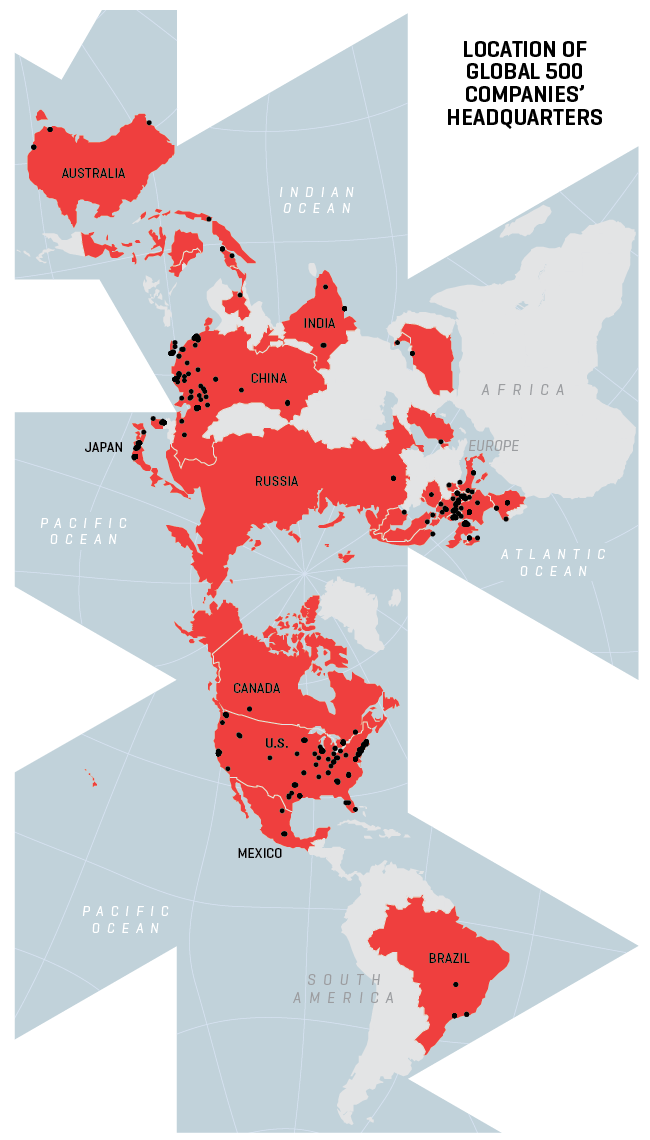
This is how Fortune magazine introduced its latest Fortune Global 500, the largest companies in the world by revenue:

“As the Chinese Century nears its third decade, Fortune’s Global 500 shows how profoundly the world’s balance of power is shifting. American companies account for 121 of the world’s largest corporations by revenue. Chinese companies account for 129 (including 10 Taiwanese companies). For the first time since the debut of the Global 500 in 1990, and arguably for the first time since World War II, a nation other than the U.S. is at the top of the ranks of global big business….It’s true that Chinese companies’ revenues account for only 25.6% of the Global 500 total, well behind America’s 28.8%. But that’s to be expected. China is the rising power, economically smaller but growing much faster.”

Yes, there are more Chinese companies than U.S. firms in the 2019 Fortune Global 500. Also notice that Fortune has called it the “Chinese Century”. As I always write, it is all China from here:”China now accounts for a whooping 42% of global commerce – more than France, Japan, the U.K. and the U.S. combined.”


The Challenge as Nigeria Restricts Sale of Forex for Importation of Milk

0

The Central Bank of Nigeria (CBN) has added milk to the list of items that their importers have been restricted from accessing Forex. It was a decision that did not go down well with many. The development was so unwelcomed especially in the social media that CBN has to issue a statement to clarify and defend its decision.

“For the avoidance of doubt, milk importation is not banned. Indeed, the CBN has no such power. All we do is to restrict sale of forex for the importation of milk from the Nigerian Foreign Exchange.” A statement issued by the Director of Corporate Communications, Isaac Okoroafor, said.

But the Nigerian people did not buy the message, their reaction is that milk is an essential food item that most people can’t do without, restricting access to forex for its importation is tantamount to a ban. A decision that will only increase the chances of malnutrition in a country where poverty reigns supreme.

Although the CBN stated that the decision dated back to 3 years ago, when the policy to encourage backward integration to conserve foreign exchange and create jobs for people were formulated. The policy which has seen some 43 imported items blacklisted on the Nigerian forex was aimed at fostering local production of the imported goods. And there has been provision for soft loans by the Apex Bank to encourage that. It doesn’t matter, people are skeptical about the timing, some saying the CBN is looking for an idea that will justify RUGA.

There are also claims that Nigeria doesn’t have the capacity to produce sufficient milk that will bridge the gap emanating from the restriction. First of all, Nigeria has little of the kind of cattle that produce milk, secondly, the NLTP that will create the enabling environment for milk production has not been implemented yet. Nigeria produces about 600, 000 tonnes of milk yearly, but the consumption rate is at 1.7 million tonnes which leaves a deficit gap of 1.1 million, which importers are filling with over $500 million in forex yearly.

So the conflict of interest that has been created by this policy cannot be ignored, and the alternative to businesses affected is farfetched. A fact that the CBN acknowledged in its statement.

“While we are aware that some of our policies may hurt some business interests, we are thankful to Nigerians for the buy-in and intense interest in the policies of the CBN.”

There have been only a handful of companies who took interest in this policy, the existing ones are struggling due to infrastructural issues. So the issue doesn’t depend on soft loans alone, the enabling environment that will facilitate the success of this policy is lacking, and cannot be provided by the investors who need more than they have for milk production. They include:

  • Difficulty in land acquisition.
  • Climatic variations – high temperature and irregular rainfall.
  • High cost of power generation.
  • High cost of processing equipment.
  • Limited storage facilities.
  • Poor road network.
  • Low cost of imported products.

It certainly appears that the CBN focused on the last on the list and decided to eliminate it without giving consideration to other hurdles on the list. A study conducted by PwC on Nigerian Dairy value chain in 2017, noted that Pastoralists account for an estimated 95% of the total dairy output, but only a small percentage (around 15%) of these small farm producer’s milk is collected by formal processors, limiting the amount of milk available for processing.

This is a result of open grazing that has, in most cases kept Pastoralists on their feet. Moving from one place to the other has minimized the collection of milk products by processors, which in turn has resulted in high importation of powder. It has also become cheaper to import powdered products from Australia, India, New Zealand, Ukraine, South America and Europe, due to infrastructural deficiencies in Nigeria.

The report also outlined some steps to be taken to achieve adequate production of milk in Nigeria. One of them is ‘breed improvement’ that has so much to do with the kind of cattle that yield milk, which are not common in Nigeria. The steps outlined by PwC, (which includes addressing the above mentioned concerns) if implemented will take about ten years to yield results. And the Nigeria’s booming population will likely widen the demand gap before then. So the government’s partnership with companies like FrieslandCampina WAMCO and Arla Foods will likely help, but not to the extent of bridging the speedily widening gap.

The culture of banning goods and services as a way to encourage local production has done more than hindered competitive market. It has become a source of sorrow and smuggling without providing the needed alternative.

The recent decision by the CBN to add milk to the list of “No Access” to the Nigerian Foreign Exchange has reasons to give Nigerians concern. The 43 other items on the list have not made convincing difference to win the people’s trust that it’s going to work out fine for everyone. And the over 100 on the list of banned products have not resulted in improved local production to the satisfaction of the needs.

Milk is a daily household food item that its scarcity may result in nutritional deficiencies. Especially, in a time of food crisis when basic meals are luxury. And being a perishable product, the concern that whatever plan the government has to develop a sustainable value chain for milk production will never be attainable without stable power supply. So the focus should have been on facilitation of amenities that will enable local production of milk, not the easy decision to remove it off the list of Nigerian Forex.

Business of The Future and The Future of Business in Africa

0

The business of the future will be markedly different from the business of the past.

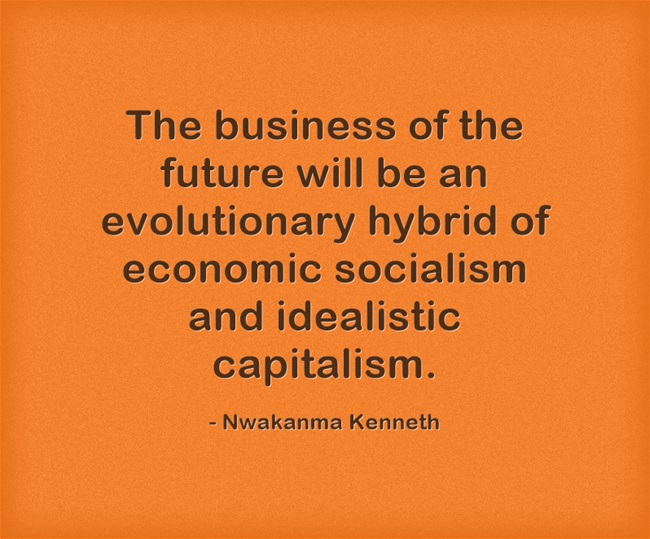
It will be an evolutionary hybrid of economic socialism and idealistic capitalism.

The business of the future will combine new technologies with humanness and spirituality, almost making it look like a sacred pursuit, which actually it is.This is already happening. 

I’m just bringing some bit of attention to the aspiring innovator and entrepreneur and also to the government of the day to help them redesign their strategies and policies.

From time immemorial, work has always been the major defining factor of a man’s sense of worth and wellbeing. Where else do people seek and  find self-esteem, self value, regard, sense of fulfillment except in their work?

How else are people’s values measured except by what they do?

As we advance into a higher universal consciousness fired by individual awakening and the advent and deepening of innovations in communication and transportation technology, coupled with knowledge-economy, changes in how we do business are sweeping across the world and affecting most areas of human life, including our concept of social culture and governance.
Africa cannot risk being left behind.

Nations are beginning to look less like geographical entities and more like apps that are upgrade-able and if they refuse to upgrade, one day they might stop working!

Same for businesses too!

Below are a few of my thoughts about the future of business and the business of the future:

  1. The business of the future will not see workforce as employees but as strategic partners.
  2. It will not see market as customers but as community.
  3. It will not see other businesses as competitors but as strategic co-creators and coaches in the journey to business success and innovation.
  4. The business of the future will seek to empower partners and communities not through salaries and corporate social responsibilities but through sharing and collaborations.

The Sharing economy will come into a balance with a new Caring economy and people will corporately and professionally seek the objective good of their local, immediate, and larger partnerships and communities, not just to provide market platforms for the sharing economy.

Let us just say we might begin to see an objective combination of Sharing economy and Caring economy in businesses to give us what we might coin as a SCharing Economy!

Already the new technologies such as artificial intelligence, cloud computing, block chain technology, cyber security, quantum computing, internet of things, nano-factories, etc are giving possibilities to a world that seemed impossible until now.

The concept of financial prosperity has been shifting with every radical innovation that comes on the scene. We have seen company growth trajectory drastically reducing in time due to these technological innovations and innovations in social and business practices.

The growth level that usually took companies 10 to 20 years to arrive at in the past is now taking less than five years to happen.

Well, on the downside, the failure speed also increased!

We are coming to the end of the concept of scarcity and poverty with each new discovery and innovation.

Cryptocurrency might not have fully matured yet, but the possibilities inherent in the innovation can single handedly change the idea of creating money as a means of exchange by lifting it out of the hands of the governments and cartels of this world, into the hands of every individual!

We might be returning to the future day of everyone being his own goldsmith!

Innovators such as Alex Machinksy, CEO Celsius Network, one of the developers of VOIP (Voice Over Internet Protocol) technology have already begun daunting projects of using cryptocurrency to disrupt the conservative and sartorial banking industry and open the way for technology (not government) to bridge the gap between the rich and the poor. 

He plans to achieve this by harnessing the  decentralization feature of the blockchain technology in cryptocurrencies to free up capital and get monetary power out of the hands of those at the ‘top’.

We are in the age of possibilities raised to the power of infinity with technology and mind-power as the only limiting factors!

Government cannot afford to remain stolid, stuck in the old model and continue with how they run, especially the governments of Africa.

Each waking day more people have interactions in their virtual internet communities than with their immediate and geographical environment.

From business to social activities, software is taking over territories in the minds of people and we know the power of mental psychology with regard to this cyber warfare.

These are strange concepts whose time might seem unripe for many in African countries but they are worth paying serious attention to.

The fact is that the world is entering or has entered a new phase of human consciousness. That phase is such that the intrinsic human qualities such as care, empathy, intuition, sense of limitlessness, sense of brotherhood, value for life, etc are heightened and are seeking expressions in the daily lives of people.

People desire that their individuality be recognized. They no longer want to be identified with the nondescript crowd. Rather they want to be felt, regarded, treated as an individual and given a bit of autonomy to perform and be appraised.

The workplace organizational system is agitating for a change from hierarchical to relational-functional structures. Structures that will give much room for exponential productivity and win-win reward systems.

While resistance from the old and established circle is strong, change is the only constant thing in the world of man.

The age has shifted.

It is an age of rich and diverse creativity in human activities including entrepreneurship, investment, ownership and interaction.

Cost of education is getting far cheaper everyday with many MOOC (massive open online course) platforms springing up daily, billions of downloads go on nearly each day of free information.

Business designed only to get people to pay for just a service rendered are fast losing their competitive advantage. People are asking communities that give them social value first.

With many innovators, creators, producers and entrepreneurs giving away for free their informational products and services, the model for business revenue and profit is being revisited.

With companies such as Xiaomi,  the Chinese smartphone maker, making product innovations  possible through crowdsourcing by leveraging its community of about 100 million fans, the game of business is decidedly transformed as we write.

What many aspiring creators should be doing is to be playing catch-ups.If you must survive it, you have to flow with it.Learn to think sharing, caring, connecting and collaborating from new perspectives as the radical business concepts that might help you in the coming economy.

In summary, the future of business and the business of the future is being shaped by new technologies and techniques on one side, and a new level of awakened human consciousness signified by heightened sense of self worthiness, and connectedness with others and the global environment.

Therefore governments, policy makers and entrepreneurs especially in Nigeria and Africa should borrow a lesson from the dinosaur which went extinct because it refused to change.

Things will never remain the same for all times.

The last word is: go-with-the-flow or go extinct!

The future is here and now.


Factors Affecting Productivity and Professionalism of Nigerian Civil Servants

0

There are so many negative comments about Nigerian civil servants that, as one of them, I felt I should make some contributions. I’ve heard that a lot of civil servants are lazy, corrupt, unprofessional and unproductive. I’m not debating these. In fact, to a large extent, these assertions are true. But I don’t think there’s anybody became a government paid worker so he could be unproductive – at least to the best of my knowledge. Please, I’m not here to make excuses for civil servants, I just want to relay what I have observed and felt is wrong with the system so proper adjustments could be made by the government and the workers.

I joined the Nigerian Civil Service after hustling for more than ten years in the private sector. I came in with the same spirit as seen in the private sector and was frustrated with the slow motion in the public sector (even though things are considered fast in the academic sector). It took me time to understand and adjust to the system (though I’m still adjusting). So, I’ll list some of the problems I observed – both as an outsider and as an insider.

a. Low Salary: An average Nigerian civil servant cannot afford good housing, good meal, good education for the children, good means of transportation, and so on. No matter how we look at it, the truth is that it hurts when you, with all your certificates and expertise, cannot afford to live in a decent neighbourhood, rent a good apartment, or even build your own house(despite the National Housing Fund monthly deductions). It hurts when you are going to work in the morning and you have to struggle for keke (commercial tricycle) or bus, while your counterparts in the private sector move around in their cars. It hurts that before your salary comes, it has finished (those in the system will understand). I know that some people in the private sector earn the same thing civil servants do (or even less) and they still work hard and are very productive. Maybe when we look at other factors we will understand better. By the way, civil servants are prohibited from having side hustles. The reason isn’t clear to me because I was just told not to do it (that’s part of the problems we have – information underload).

b. Promotion Scheme: While in the private sector, I realized that promotions and assignment of special duties and positions are based on values added to the company – people are promoted based on their performances and portfolios are assigned based on who can deliver. In Nigerian civil service scheme, people are due for promotion after spending a certain number of years in one level – usually three or four years. Though promotion exam is given (publications and academic qualifications are considered in some), output and impact of workers are not really tested. So, most civil servants are not ready to go the extra mile when they know that it won’t count in their appraisals. So what most do is to relax and wait for when they will get to the top so they can create an impact. What they don’t know is that by the time they continue with the bad habit of not being productive, that habit will not be easy to break when they get there. So, the old story continues.

c. Victimization: This is a part of the civil service no one hears of until they find themselves inside. Generally, civil servants are afraid of doing what may lead to stepping on the toes that belong to the feet of someone that may kick their behind sooner or later. It doesn’t matter who the toe belongs to – whether junior or senior colleague – once the owner has the right “connection” … well, so many things could go wrong. Ways of victimizing people in the civil service range from a missing file (which could deny the worker a lot of things, including promotions), transfer to remote and unsafe area, denial of training, and so many other things. And, unlike in private sector where the victimizer could leave the job voluntarily or involuntarily, the victimizer in civil service will continue this wicked act until retirement or when the victimized was able to get a godfather that could rescue him. Now you understand why some civil servants will tell you, “Please leave me to be collecting my salary. Let them continue. Only God will judge them.”

d. Bottlenecks: The bottleneck in the civil service is the major reason things don’t move fast in the system. Something that would take the private sector an hour to treat will take the public service one month or more to handle. Flow of information isn’t fast in the civil service. You can’t send a document to the top without passing through several offices (even complaints and petitions against junior and senior colleagues). And when the matter has been treated by the director, the document will start crawling back down till it reaches the last office that may have to raise a memo regarding your document. When this memo has finally been raised, it will start crawling around the offices until it finally gets to you. If perchance, the person where the document got to is not available, everything about that matter will be put on hold until the person in charge comes back to attend to it (unless there are formal instructions that someone else should handle it). Hope this also explains why documents sent to MDAs are hard to trace.

e. Undermining Staff Opinions: In private sector, everybody has a voice. Nobody’s opinion is undermined. This is not so in the public sector. In fact, during staff meetings or briefings, unless a junior staff was called upon to explain something, he dare not talk (if not he will be considered not respectful). Even if he gives his suggestions, it will not be considered. Like some will say, “You can’t do that in the civil service. That’s not the way we do it here”. Only the opinions of the management team are important. Now think of the sayings about using the same unworkable solutions to solve the same problems.

Ok, so we have seen a little bit of what Nigerian civil service is like. But the system shouldn’t continue like this, if you ask me. Changes need to be made. I have been toying with some ideas for some time now, I don’t know if they are applicable. Here they are:

a. Nobody should be employed into the civil service unless they have worked in the private sector for a minimum of five years. This is because they will come in with the spirit of the private sector.

b. Promotion of officers should be the same way it is done in the private sector – performance based, not duration based. This method will bring a radical change in the civil service. The civil servants will find different ways of being professionals in their fields. This method is already in use in the academic and health sector but there is still need for improvement.

c. All MDAs should have a working website and the staff members, emails. This way, dissemination of information will be easy. Besides, this will encourage civil servants to be computer literate.

d. Platforms should be created, where civil servants can freely air their views, ideas and opinions towards the system. Presently, civil servants don’t have a voice except when agitating for salary increase (lol).

e. Civil servants should be encouraged to have side hustles so long as it does not affect their primary job. The government should release a list of secondary jobs civil servants should not engage in, which it believes might compromise their main job. If civil servants are allowed to have side hustles, they will create jobs, think like entrepreneurs and will not constantly agitate for salary increase.

There is hope for Nigerian Civil Service if necessary adjustments are made.

Why Do I do What I do?

0

Take a pause today and ask yourself why do you do what you do. Why do you share some values you share. You don’t eat pork because your religion or tradition prohibits the eating of pork, you don’t eat fish because it’s a taboo according to your tradition to eat fish or your religious beliefs frown against it.

It’s high time we question the rationale behind those religious and traditional beliefs, we dwell on the circle of ‘we are told that that’s how it’s done or on the circle of we were born to see it being done that way, or we met our elders doing it so we joined, and we are going to pass it on to our children.

When we question the rationality behind some certain things; religious, traditional or societal values we share, you will be amazed that most of them started as a joke and some are out rightly stupid. I’m not here to criticize your religious beliefs or traditional values but I’m here to throw a question at you of why do you do it.

There is a stream in one certain village, the stream is the only source of water for the villagers. One certain day, a lady who happened to be on her menstrual flow went to the stream and her blood flew into the stream and messed up the stream. That day’s occurrence made the village heads to pronounce that any lady on her menstruation who visits the stream will not conceive again. That pronouncement was passed on generations and generations later, women of the village don’t go to the stream on the fear that they will not conceive again, if they do go without knowing why, and when that pronouncement was made.

Some of these values, laws, ethics and whatnot we share were made to carter for the societal needs and solve the societal problems at that particular time, and becomes obsolete once that need that has been solved. If you dig dip and ask why its is a taboo not to eat in your village you would be amazed that the pronouncement was made some generations ago so to preserve the fishes in your village stream from fishermen, in order for the fish to not go extinct. And you grew up not eating fish because your parents taught you it’s a taboo to eat fish according to your tradition and you don’t border to ask why.

Think about it, most of the things you do in the name of tradition or religious beliefs appear stupid both to common sense and to every sense of reason, but you just have to do it in order not to incur the wrath of your god(s) or commit sacrilege, so you think.

An old and mind bugging story goes; ten monkeys were kept in a room, and a bunch of bananas was tied at the stage of the room, all the monkeys started struggling for the banana, whenever any monkey reaches the banana, water was sprinkled on all the monkeys. When the monkeys discovered that the reason water is being sprinkled on them was for them to stay away from the banana. In order to avoid water been sprinkled on them, they all decided to avoid the banana. One of the monkeys wanted to give it a last try and reached for the Banana and water was sprinkled on all the monkeys again; all the monkeys got angry and pounced on the monkey that went for the banana and made water to be sprinkled on them this time and beat the hell out of the monkey.

One monkey was taken out of the room and replaced with a new monkey that have not been to the room, when the new monkey saw the banana he wondered why the rest monkey decided not to get it, so the new monkey decided to go get the banana, all the other monkeys pounced on him and beat the hell out of him. This time water wasn’t sprinkled on the monkeys, the new monkey was confused and doesn’t know why he got beaten and he decided to stay calm. 

Another monkey was brought and replaced with an old monkey in the room, immediately he got into the room, he went for the banana and all the monkeys jumped on him and beat the hell out of him including the other monkey that was beaten. The previous monkey joined in beating this new monkey without knowing the reason why he was beaten and why other monkeys are beating the new one but he joined the bandwagon.

All the old monkeys were gradually replaced with new monkeys and whenever any of the new monkeys reached for the banana they all jumped on that monkey and beat the hell out of him. None of the new monkeys in the room now could explain the reason of beating any monkey that goes for the banana.

The justification of the new monkeys will be ‘that’s the tradition that any monkey that goes for the banana gets beaten’ without knowing the reason behind the beating.

That’s what traditions and religious ethics has done to so many of us. We do irrational things without knowing why we do them, all the reason we have is that ‘that’s how I see them doing it, that’s what I’m told by those before me, that’s how I met them doing it’.

Traditions have made us all monkeys ready to beat any new monkey that goes for the banana without asking ourselves why?

Think about it; ask yourself the reason you do what you do.