
DD
MM
YYYY

PAGES

DD
MM
YYYY

spot_img

PAGES

Home Blog Page 6785

The Billionaires Bible

6

It is not everyone’s goal to become a billionaire, and it’s fine. We all have our different goals in life. Whatever makes you happy and satisfies you should be the number one thing to pay attention to. However, I am quite aware that there are people like myself who really want to become billionaires, and believe you me, it is very possible to have that strong mindset or optimism and achieve it. After taking so much study on billionaires, I discovered that they have a different approach towards building their wealth. So, I will be sharing some basic facts that hold true in which you can position yourself on such path.

Skills Cannot Make You A Billionaire: The honest truth is that there is a clear behavioural traits between those who have skills or talents and those who eventually become billionaires. I have heard of people speak out of excitement that they want to become billionaires, and all I see is that they just have a skill or talent. Here’s the reality of things, when you have a skill or talent, you can only earn when you put in the work, and you do not earn when you do not put in the work. Now, I’m not saying people with skills cannot become billionaires; I am saying that with skills alone, there will be restrictions on the flexibility of your earning ability.

Just like the clear distinction I made in an article between a freelancer and an entrepreneur; a freelancer is someone who gets the job done and gets paid for it while an entrepreneur earns even when not working. Yes, once he doesn’t get a job done, there’s no payment for a freelancer. For an entrepreneur,  he has structures in place for his skills to be running even when he’s not working. This means an entrepreneur can go on vacation, and still be earning while a freelancer will not because he has not worked to earn money.

Your skills must work for you: You must get to a point where your skills work for you, and not you with your skills. This is a billionaire game; it means your skill must have a high valuation. I am not writing this out of assumptions or from a particular book. Pay attention; J K Rowling made a billion dollar from the sale of her book Harry Potter. Writing of the book Harry Potter is a skill but that’s not the first book that anyone in the world has ever written. Did they all get to that point? So what’s the setback? Should I rather say there’s a secret to it. It’s still depending on the law of compounding.. The first lesson to bite is that your skill must have high valuation. I have said this earlier. What I mean is that your skill must be able to convert to huge money when you work with it.

If it does not have high value when you work with it, then it cannot work for you. It grows exponentially because of the value it already has. The book Harry Potter is an epic book. The book by itself should be worth some billions of dollars if it was published under normal circumstances. Just an ordinary book cannot be worth some billions of dollars just like that. This means that her writing skill is not of this world. Her skill is firstly of high valuation before the skill can work for her. The same thing applies to having money; your money must be able to work for you. So, in order to chase the billionaire dream, your skill must be able to permeate different corners and places while you’re also working with the skill. This itself is rare anyway.

Understanding Numbers: This itself is a very difficult one. Not everyone really finds numbers interesting, so, not everyone can be a billionaire. Matter of fact, I really find numbers very boring but I try my best to keep studying it. Not all entrepreneurs understand numbers as well. Being a billionaire is never by mistake. You can be a millionaire by mistake but can never be a billionaire by mistake. All billionaires who built businesses understand numbers.

This is how numbers work, and it still works based on the law of compounding. It states by my own definition; 1 million dollar and 1 million dollar car are not the same except both can yield the same interest. Unfortunately, both cannot in every case. The law of numbers has to do with understanding money. Money spent to buy physical items is no longer money and has lesser value than money. Let’s talk about Beyonce and the money she was given from Coachella sometimes back; rather than use it to get something of instant gratification, she pushed it into compound interest where the money can work for itself. Warren Buffet is a king of that. This is what I was referring to in the last point that money needs to work for you at some point.

Jay Z didn’t become a billionaire through music alone but by making music work for him. He followed the law of numbers; “if I invest a million dollars into this young talent, how much will it fetch me or if I get a house worth a million dollars, how much will it fetch me”. That’s numbers!

Most times, businesses themselves cannot make a billionaire if the entrepreneur doesn’t push the business to the point that it both runs on itself and at the same time makes money multiply itself. We can call it understanding investment. But understanding investment is just beyond putting a dollar in the bank. How does the money in the bank work for you?

This is not a path for everyone. However, for those on the path like myself, this is part of the things you should know.

#BelieveInAfrica

1

Enough of the stereotypes. Not all Africans are murderers, dubious or thieves.

It’s disheartening to see how our media present Africans out there. Of course, every country has problems, but it makes no sense when all we read on papers, hear on the radio and see on television is the bad side of Africa.

I spoke with an American guy who said that the only thing he knows about Nigeria is scams. I was gutted.
Why would you assume or conclude like that?
We see American action movies and read their books, does that make Americans murderer?
We read American books and hear the news about the country, does that change anything about them?

Other countries will never come out to tarnish their own image. Only Africans would do that. Africans are always the first to wash their dirty underwear in public. It makes me wonder what we stand to gain from doing that.
Perhaps, Africans love to appear like victims. No wonder leaving the country is the dream of every African youth. They’d say they are in search of greener pastures.

I am not against anyone leaving if they see a brighter picture elsewhere, but do it respectfully. Don’t make it look like you were dying here. I spoke with a Nigerian lady in Dublin, Ireland, she told me she would never come back to Nigeria again. Her only reason was because of rats, cockroaches and lizards in the African surroundings.
I couldn’t stop laughing. Africans are the problem of Africa.

Let me ask some questions from all Africans reading this:

  • Since we’ve been badmouthing our own Africa, what changes has it brought?
  • Has it made the visa processing easy for us?
  • Has it given us bigger opportunities out there?

Break out from the poor thinking and victim mentality. You’ll always remain a second or third citizen in another man’s country. Let’s grow our own Africa.

As Africans, we need to do more. Enough of the stereotype caused by us. We made everyone sees Africa as a delicate place to visit. The news on the radio and television is appalling. You can barely hear anything positive about Africa. They are either attacking the Buhari administration or religious conflicts.

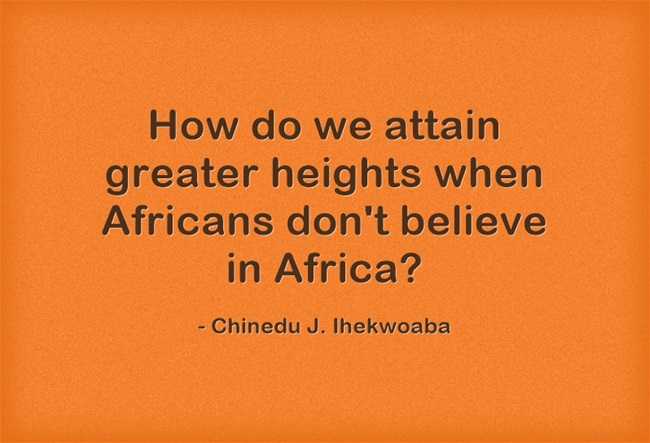
How do we attain greater heights when Africans don’t believe in Africa?
Recently, Samuel L. Jackson, an American actor, traced his origins back to Africa and obtained his Gabonese passport. Even Anthony Joshua, a British boxer still claims Nigeria.
It makes you see how people outside the country see our own Africa.

The human race is one. We Africans need to start seeing ourselves as one. No White man will come to your rescue. We are our own Messiah. Let’s stand up and fight corruption, inequality and killings in Africa.

Africa must be great again.

Analysis of Criticism

0

You may be familiar with the dictionary definition of criticism; it is something like this – “The expression of disapproval of someone or something on the basis of perceived faults or mistakes.”  I love this particular definition for no specific reason, or maybe because in it are a few words that stand out from the sentence making it a bit easier to be analyzed. So for the sake of this analogy, let me highlight the words that stand out for me.

  • Disapproval
  • Perception
  • Fault or Mistake

Also one can decide to categorize criticism based on intent. Then it is either Constructive or Destructive.

Imagine that someone is being severely criticized, and it is getting increasingly difficult to say if those criticisms are fair; we have to consider the following questions in this order of increasing importance.

  • Intent
  • Factuality
  • Implication

Intent

Let’s assume for a second that something unpleasant is being said about a leader; is the intention of the critique really important?  Even if it was, is it really possible to figure out what the critic’s intentions are if they are not clearly stated by the person?  It will be extremely difficult to do so. As long as we lack the ability to read minds, this task will always be impossible. If someone calls you a bad leader for instance, there could be infinite number of reasons to do so which might include but not limited to the fact that he doesn’t like you as an individual. So, if there are infinite number of reasons for doing that,  and you single out just one possible reason probably based on personal perceptions, the mathematical equation of probability will look like this P(I)= 1/(~)  where (~) represents infinity and P(I) represents the probability of Intention.

In Maths, this is equal to (0) and in literary theory it could be a sort of Fallacy of intention (the fallacy of basing an assessment of a work on the author’s intention rather than on one’s response to the actual work). Indeed, it is almost impossible to actually say what the intentions of any criticism are.

Factuality

Since we aren’t so perfect when it comes to reading intentions, one may be left with the option of verifying the factuality of a particular criticism. In order words, is it true?

What if for instance someone in a security organization who is known for his hatred for a particular boss criticizes, or accuses his boss of transferring confidential security information to a third party that has got some links with criminals, should the case be dismissed because it is coming from a known ‘enemy’? Or should it be investigated to figure out how factual the criticism is?

Any organization interested in survival, efficiency or progress should scrutinize information with the intention of finding out how factual it is and not based on source.

Implication

Criticism has got implications . It doesn’t matter if they are right or wrong. From the mere fact that those criticisms exist, it points to the fact that there is dissatisfaction, whatever the cause maybe. As the criticism increases, it signals that something is wrong. Now this doesn’t necessarily mean that the wrong is coming from the leader. It only highlights that there is problem in the system. If a house is on fire, does it matter if it was set ablaze by the landlord or by the tenants more than it matters to put out the fire?  If a company is in crisis, does it matter whether the crisis was caused by the manager or a worker more than it matters to get the firm out of trouble? Unless in this case identifying and removing the mole eliminates the problem.

So, in the scenario above where someone is criticized for leaking confidential information into the wrong hands, the question to be asked should be – Could the safety and future of the organization be jeopardized if this is true?  What can be done to prevent failure as a result of this? What can we do to prevent any valuable information from leaking out to unknown sources in the future?  This should be the way to dissect criticism.

Summary

Though some criticisms are directed at tarnishing the image of those being criticized, it should not be spared from thorough analysis. The reasons people criticize could be just about perception and not based on concrete evidence or reality. Still it points to the fact that a fragment of the whole is in a state of dissatisfaction, throwing light to the fact that if perfection or increased efficiency is to be the target, due consideration should be given to those acts of criticism.

Nigeria’s GONA, A Payment Startup, Raises Multi-million Dollar Investment

0

According to MasterCard and The Fletcher School, “of the $301 billion of funds flows from consumers to businesses in Nigeria, 98 percent is still based on cash.” Fintech will not merely have to move those $295 billion-worth cash transactions online/digital; it must create new value in the process. GONA, a payment startup in Lagos, is tapping into that; it just raised millions of dollars from some Chinese investors.

GONA is a mobile payments platform with primary operations in Lagos. The startup recently announced the completion of a multi-million dollar Pre-A round of financing.

According to news website, c.m.163.com the Chinese-led investment came from Crystal Stream Capital, UnityVC and Shaka VC.

Liu Xiaojun, founder and CEO of GONA says the round of financing will be used for team building and product technology upgrades.

[..]

GONA, which among other things, is enabling cashless payments on ‘informal transit’ public buses in Lagos, is working to solve the pains of inconvenience in the local travel market. This it is doing by using technical means to improve operational efficiency.

Fintech startups and specifically payment ones have huge market opportunities ahead as most of the consumer transactions remain cash-based. Moving them into the digital space will need more investment capital. That is why fintech is hot – the frictions are largely unmoved and waiting to be fixed.

Complacency Poses More Risks Than Competition to Companies

1
MVQ

Ever since I delivered a keynote on “The Malignancy of Complacency” in a religious gathering at Federal Polytechnic, Nekede, Owerri, Imo State, Nigeria, I’m always watchful of the disease of complacency. 

Complacency is the I have arrived attitude. It is “a feeling of being satisfied with how things are, and not wanting to try to make them better: self-satisfaction especially when accompanied by unawareness of actual dangers or deficiencies.”

I’ve made it, what else? What do you think you can teach me? Do you know how many degrees I have in my name? Do you know how long I have been in business? This is how we use to do it here; what new ideas do you want to introduce? You that started school yesterday, what do you think you know? 

To be complacent means to feel satisfied with the current state and to be declined to try to make things better.

The greatest enemy of success is success itself. And the major reason some companies won’t succeed tomorrow is because they have succeeded today. Many businesses in the 21st century have more to fear from complacency than their competitors.

Great business leaders are always on the move. They are always improving. They value yesterday’s success but they know that yesterday ended last night. They are always in pursuit of something—of excellence, of elegance, of better value, of what’s next, of what if, of result, of innovation, of knowledge, of something bigger than them. Every day of their life is an opportunity to improve on their skills, trade, products and services. They make each day a masterpiece.

Success leaves clues. And to be successful in any business endeavor, one must study the life and dispositions of successful business leaders. What’s their success recipe? What do they do in the secret and in the open? How do they spend their time?

The good news is, success is learnable. In other words, if you do what successful people do, if you think the way successful people think, and if you have the same mindset as they do, you sure would have the results that they have. 

It is amazing how many businesses are at the verge of collapsing and declaring bankruptcy and the owner is busy wasting precious time watching television in his/her office. Customers are no longer buying from you as they used to and you think it is spiritual. No, it is not spiritual, you’ve only failed in one of the principles of business—continuous and never ending improvement. 

“Being good enough, is not good enough.” You must give customers a reason to remain faithful. You must move customers from satisfaction to loyalty by focusing on retention and loyalty. And the best way to do this is to keep improving on a daily basis. This is important because if you don’t give your customers some good reasons to keep buying from you, your competitors will give them a reason to buy from them..

The common denominator that unites all successful business leaders is READING. They are avid readers. Warren Buffet (one of the world’s richest men) reads many pages a day. Is he busy with work just as you’re? May be even more. Bill Gates reads 50 books a year. Mark Zuckerberg reads two books a month. Elon Musk credits his business success to voracious reading. My question for you is, what are you reading? What are you doing each passing day to improve? Maybe the answer is nothing, or maybe you feel you already know everything that needs to be known. Maybe you have arrived!

Do you wonder why Toyota releases new models of their cars every year? Do wonder why Toyota Camry 2019 is different from Toyota Camry 2018? It is because of KAIZEN. Kaizen is a Japanese business philosophy of continuous improvement. Kaizen is the resolve that you know only one thing; and that thing is that you know nothing.  And as such, you’re open to continuous learning and application of new things. You want to develop and build on what you already know. 

Kaizen is the secret behind the outstanding business success of Toyota Automobile Company. And today, this philosophy is singularly THE TOYOTA WAY. They are improving every day. They are not sleeping on duty. Their ideas are not lying dormant to collect dust. They are busy around the clock. Improvement! Improvement! Improvement! is the watchword. No matter how little. It could be a little modification, a little alteration, a little adjustment. The fact is, Toyota Camry 2019 is not the same as Toyota Camry 2018.

Knowledge today is as perishable as fresh tomatoes. And unless you commit yourself to a continuous and never ending improvement strategy, you would become obsolete in no distant time.

The figures might be high, but let there be no room for complacency. “You cannot be the same, think the same, and act the same if you hope to be successful in a world that does not remain the same.”