DD
MM
YYYY

PAGES

DD
MM
YYYY

spot_img

PAGES

Home Blog Page 6839

Nigerians In Search of Transparency, Legal Rights for Rape and Ruga

0

By Mutiu Iyanda

In the last few days, rape and Ruga have been trending in Nigeria. They remain two issues that have polarized Nigerians along ethnicity and religion lines. At the same time unite Nigerians who believe that the two issues are threats to the female citizens and security across the country. Rape is not a strange crime in Nigeria. The country has been repeatedly ranked as one of the countries with the highest number of rape cases. It has also been ranked as one of the countries with the high level of insecurity due to the incessant terrorist attacks, and herdsmen and farmers crisis.

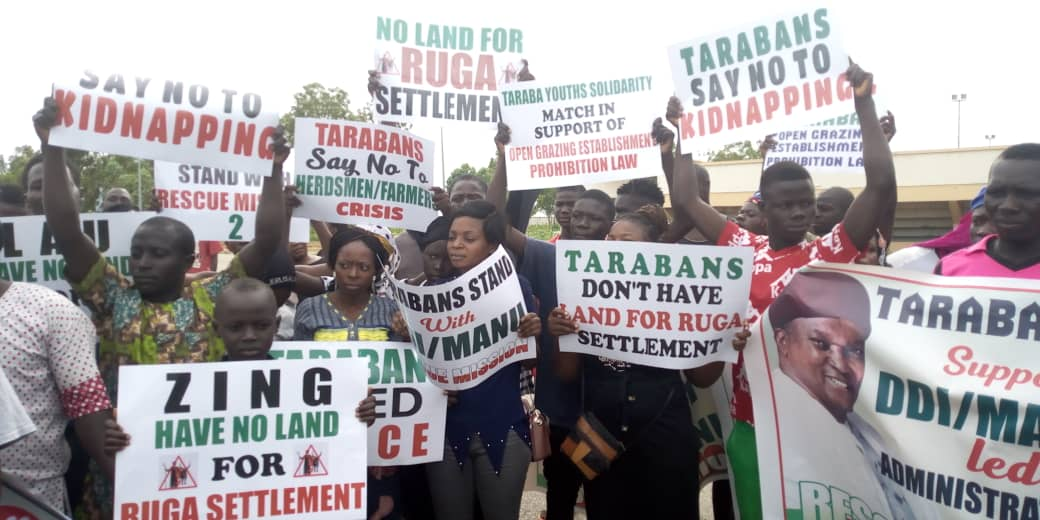
The idea of Ruga, planned annexation of land in states for cattle colonies, is to end the crisis between herdsmen and farmers, according to the Federal Government. From the southern region to the western region, it has appeared that the government’s position is not tenable, especially in states where the crisis has resulted in loss of lives and property. Groups in the two regions have alleged that the government is shopping for lands on behalf of the herdsmen, which could further heighten the insecurity in the country.

On the two issues, Nigerians are expressing their feelings and accusing the key actors. The Presidency and state governors in the southern and western regions have been under severe criticism, while Pastor Biodun Fatoyinbo and Bukola Dakolo have not been spared from various lashes. As the criticism continues, analysis indicates that Nigerians are making sense of the issues through the Internet with a view of receiving information capable of reevaluating their previous knowledge towards informed discussions.

Making Sense of Ruga and Rape

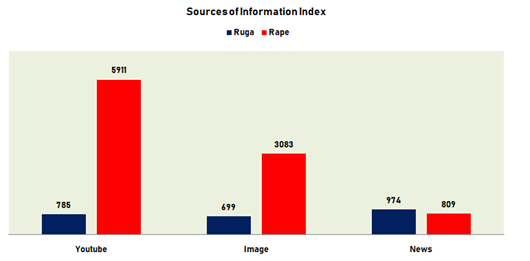
On Sunday 30th June 2019, analysis shows that Nigerians sought information about the two issues using YouTube, image and news sections on the Google Search Engine. Within 24 hours, rape was searched most using the two sections than Ruga. From the result, it is obvious that Nigerians did not have much interest in Ruga. They deployed their resources towards understanding issues around the alleged rape case. This could be linked to the protests which were held in Lagos and Abuja. The more they used YouTube, image and news sections on Google Search Engine, the less they employed the sections for understanding the proposed Ruga settlements across the country, analysis reveals. One percent of using the three sections diminished the use of the sections for Ruga by 62.4%.
Source: Google Trends, Infoprations Analysis, 2019

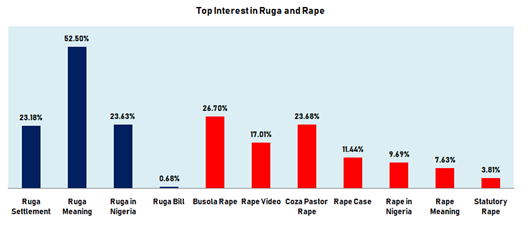
Throughout the hours, Nigerians developed interest about Bukola rape, Coza Pastor rape among other top searches than Ruga’s top searches such as Ruga meaning and Ruga in Nigeria. The top searches for the rape issues were mostly from Rivers, Delta, Ogun, Oyo, Edo, Lagos states and Abuja. For the Ruga, people in these states and FCT in addition to Abia, Benue, Akwa Ibom, Anambra, Enugu and Imo states had an interest in the top searches. It is understandable that people in these locations sought information about the two issues.  These states have recorded a significant number of rape cases. They also have been experiencing a series of herdsmen attacks since 2016. In 2016, Lagos state recorded 162 rape cases. Four years before, report indicates that more than 1,200 girls were allegedly raped in Rivers State. Three years later, governmental official said “not less than 10” girls are raped everyday in the state.

What is missing?

The two issues revolve on transparency and legal rights. From the public criticism trailing the proposed Ruga settlements, it is clear that governments and people of the southern and western regions expect transparency in the programme. As long as cattle rearing are peculiar to the northern region, annexation of lands should also be restricted to the region. To the protesters and public activists, the rape victims must get justice. However, Nigeria’s poor ranking for transparency of government policymaking in the last 4 years is likely to prevent the transparency in the proposed Ruga settlements some groups and states are craving for.  According to the Global Competitiveness Index, a yearly publication of the World Economic Forum, between 2015 and 2018, Nigeria’s average rank was 116.5 for the transparency of government policymaking, while a legal right was 32.75.

When these were analysed along with the top searches for rape and Ruga, the results indicate that the Ruga’s top searches connected with transparency of government policymaking by 70%. This confirms the earlier position that people and groups want the Federal government to be fair to every region on the Ruga settlements.  Analysis further reinforces the position with one percent interest in Ruga’s top searches decreases transparency of government policymaking by 56%. This suggests that the Federal Government cannot avoid fairness principle, while addressing the issues on the programme. The story is quite different from the rape issue. The first analysis establishes that rape’s top searches and legal rights connected negatively (-83.9%), signifying a higher interest in the searches than the legal rights.  However, there is hope for the victims as the second analysis reveals that one percent interest in rape top searches increases legal rights by 51.1%. This suggests that as the public continues expressing their feelings on rape cases, it is likely to lead to prosecution of the offenders.
Source: Google Trends, Infoprations Analysis, 2019

The Breakout Season Is Coming for African Startups

0

By  Ajayi Joel

There has never been a time in the history of Africa that Africans seem more concerned about their continent. Perhaps, not since I was born.

Here’s what I mean; if you’re a keen observer of trends and economy and all, you would discover that Africa is at the point of a break out.

Break out from what? Before I answer that question I asked myself, I would first like to make some points.

The first point I would love to make is that things are quite very tough at this moment on Africa. I did not say “things are tough for people”, I said for Africa. What this means to me is that something is actually pulling the roots of Africa for an upgrade.

One thing I have been hearing from people over the last one year is that Africa is a tough place to do business. Well, if anyone disputes that fact, such person is blind.

But that’s not the end of the story, I will also say Africa is the best place to start a business or think about starting a business. Foreign investors are rushing down; foreign companies are seeking where to pitch their tents.

Back to my point and I really want you to take this serious if you’re really considering starting a company, Africa is at the point of discovering itself!

How do I know? We have lots of different sectors emerging, and the good news is that on a major problem you think you might face along the way, another startup is solving it as its  major problem, for all.

I see a phase where there’s a linking in the whole industries of Africa, and to crown it all, we now have the internet!

Wait, did I just mention the internet? Yes! The internet has been in existence for a long time; fine, and its relevance is becoming more evident. Now look at this closely. Perhaps you will see what I’m seeing.

The internet as useful as it is still has huge setback. But guess what, I’m aware that lots of start-ups scattered around Africa are working towards a better internet.

Now who’s going to fund them? Wait a minute – there are lots of venture capitalists also coming up, from both home and outside who are seeing reasons to push their money into Africa.

I’m not saying we’ve gotten it all right but there’s a pull here and there. The major problems you feel you’d face, some others are solving them. It is a virtuoso cycle.

So what exactly is Africa breaking out from?

Well, Africa is breaking out from its shell and it’s getting ready to be ripe. Get yourself positioned for the future; someone had predicted 2022. Do not lose this new boat ride. Listen to the video and get insights on how this redesign will happen.

Building Nigeria: Two Funds Needed to Accelerate Growth

4

By David Alade

Nigeria has over 35 million unemployed or underemployed labour force. That number may not ring a bell until you know that it represents over 40% of the labour force. Addressing this is both the responsibility of the government and that of private sectors; it is too big to leave to the hand of just a part of the economy.

Policies have been made to help reduce this alarming number by the federal government. One is supporting entrepreneurship.

Recently, we read that the CBN has concluded on a scheme to grant loans to NYSC members repayable over 7 years, this is after it had run a scheme of loan for the same group of individuals’ payable over a maximum of 3 years from 2016.

These efforts are commendable and may be helpful. We do not have data regarding the effect of this initiative over the last 3 years, hence, we cannot reliably assert the effectiveness of the scheme on any metric (loan repayment, business survival, employment of at least 3 individuals, etc.). However, we can infer from the rising unemployment statistics that the overall goal of the scheme is probably failing; the unemployment rate has been on the rise ever since.

These then require that we ask questions about policy effectiveness and whether we are getting it right regarding policy alignment with popular needs. Are the youth interested in the entrepreneurship that the government is encouraging or do they just see the loan scheme as an avenue to eat from the ‘national cake’? Are they entrepreneurial or they just see the avenue as a way to not stay home doing nothing? Would they have chosen the entrepreneurial part if they had a job instead? These questions really need to be answered, and the answer is supposed to drive policy statements.

As opined earlier, public data regarding the effectiveness of the CBN loan scheme is not available to the public hence, we cannot conclusively say a thing about policy effectiveness.

This article is anchored on a simple hypothesis: the youths in question are not largely interested in entrepreneurship as we are made to believe, they want a job, a well-paying one. In fact, fulfil this condition and the majority of those treading the entrepreneurial part will quickly fade out of sight.

If this is the case, how can we reduce unemployment and speed up growth in our country Nigeria? I propose the establishment of two types of funds:

  1. Investment fund
  2. Innovation fund

Investment Fund – huge capital for the savvy entrepreneurs

Following from the hypothesis that job is what the majority wants not entrepreneurship, the investment fund proposed here will be a fund set out for large-scale investment in a labour intensive business line. Sangu Delle of Golden Palm Investments Corporation practised this in his investment fund in Botswana. Instead of the fund being distributed to small scale ventures, it was aggregated and invested in one promising venture capable of creating a value chain that will employ what the sum of the small funds would be capable of. The result proved great. According to him, Sangu,

“Consider these two alternative scenarios. One: You loan 200 dollars to each of 500 banana farmers allowing them to dry their surplus bananas and fetch 15 per cent more revenue at the local market. Or two: You give 100,000 dollars to one savvy entrepreneur and help her set up a factory that yields 40 per cent additional income to all 500 banana farmers and creates 50 additional jobs. We invested in the second scenario and backed 26-year-old Kenyan entrepreneur Eric Muthomi to set up an agro-processing factory called Stawi to produce gluten-free banana-based flour and baby food. Stawi is leveraging economies of scale and using modern manufacturing processes to create value for not only its owners but its workers, who have an ownership in the business. Our dream is to take an Eric Muthomi and try to help him become a Mo Ibrahim, which requires skill, financing, local and global partnerships, and extraordinary perseverance.”

We need this thought process in Nigeria; we need the likes of Dangote, to employ more.

The investment fund is to create large-scale companies capable of employing more labour and whose success will be more than the sum of what individual small funds could have achieved.

Innovation fund – resilient fund for the real entrepreneurs

The investment fund will separate the folks who primarily want employment from those who can be regarded as the real entrepreneurs. Innovation fund will be the anchor of experimentation, iteration and possible success of the entrepreneurial venture.

The innovation fund will have characteristics different from the investment fund, below are characteristics that I will consider imperative:

  1. The fund should have a life span similar to the current NYSC fund of 7 years
  2. Allowance should be given to a right off if the entrepreneur can reasonably account for the business failure that ate up all the fund
  3. The fund should be resilient enough to allow for ‘entrepreneurship failure’
  4. The fund should have an advisory board, the board will weigh ideas and allocate fund like venture capital (Series A, B, C…)
  5. The fund should have a part that allows for R & D spending either to the entrepreneur or another independent venture outfit.
  6. The fund should be opened to ‘all’ as long as the advisory board has certified the idea.

Nation building is a strategic and long-term effort, my propositions here are to help in bringing strategic context to different funds being set aside by various government level in the drive to encourage entrepreneurship. I hope someone finds this relatable and relay the message to another and another who will help our government to think objectively on this.

Congrats Mr. President – Here is the Strategy Sheet on North Korea

0

Mr. President,

Great trip in North Korea! We executed. This is our strategy sheet and what the government should do now the cameras have gone.

  • There is no military option in North Korea because South Korea is America’s 52nd state after Canada. Any attempt, North Korea’s Kim Jong-un will make South Korea ocean of blood before even defending his people.
  • Because of the Iraqi hangover where Saddam Hussein gave out his weapons only for us to topple him, Kim Jong-un will never disarm.
  • This is our proposition: normalize relations with North Korea and formalize it as a nuclear power, and quickly unbundle the U.S. sanctions.
  • Nothing will happen: We are living with Pakistan and North Korea understands that it has responsibilities as a nuclear power.
  • When do we book a national broadcast to tell the American people that threat from North Korea is finally over?

Thank you Mr. President. This looks great for 2020.

Livestock247 Provides Digital Platforms To Modernize Cattle Business in Nigeria

2

By Nnamdi Odumody

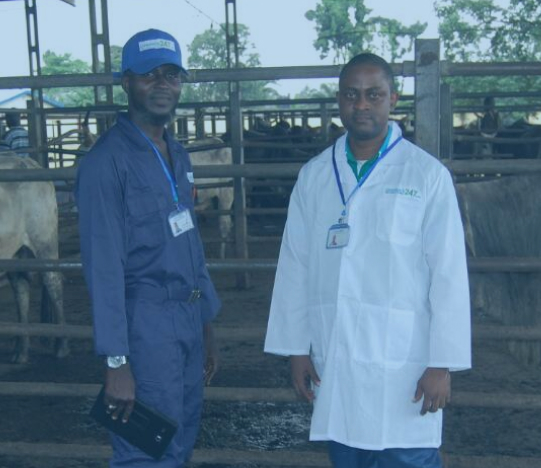
Ibrahim Maigari Ahmadu cofounded Livestock247 as a means to fix the friction in the cattle herding ecosystem which has seen Fulani herdsmen being forced to migrate to other regions in Nigeria. This movement has been necessitated as a result of lack of water and pasture in the northern part of the country. Most experts attribute the paralysis to climate change.

Livestock247.com is an online livestock market and listing platform. We are based in Africa, Nigeria. We work together to create and produce good food that we are proud of for people and organizations.

Livestock247.com is a platform for cattle sellers and buyers to transact business. It is also trying to solve the Fulani herdsmen and farmers crisis by making the herdsmen stay in their locales through the provision of pasture, water, funding and access to market thus preventing nomadic migration which has led to serious casualties across the nation. It is also an aggregator for livestock producers, consumers, and financial service providers to mitigate the spread of cattle disease.

It established a partnership with telecommunication giant MTN to develop a cattle tracking system to identify sick cattle in real time and ensure they are treated before their conditions deteriorate. Doing this prevents the spread of diseases which could lead to harmful beef for human consumption.

According to Ahmadu, the livestock business is a multi-billion naira market as a popular livestock market in Jigawa State called Maigatari Market does over 500 million naira in weekly sales, attracting buyers from different parts of Africa, who come there to buy cattle. The entrepreneur wants to onboard the livestock sellers there on his platform to enable them run 24-hour operations.

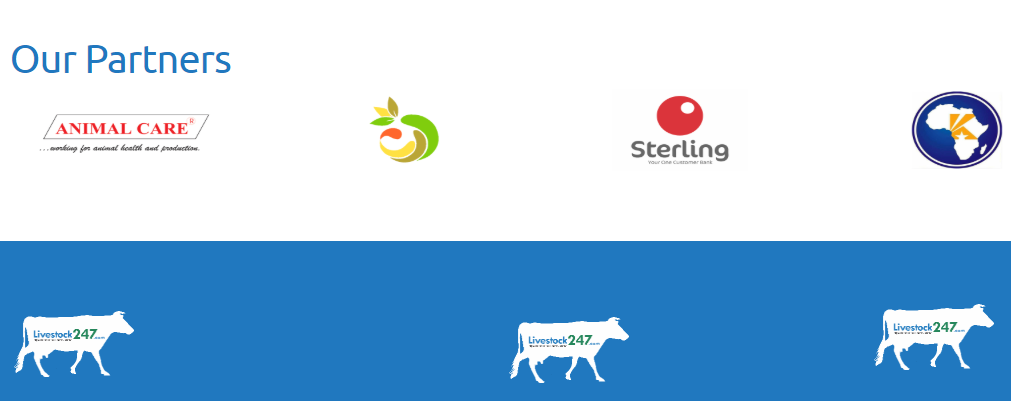
Another partnership with Sterling Bank is aimed at bringing financial inclusion to the cattle herdsmen.

Livestock 247.com aims through its solutions to make cattle herders smile to the bank irrespective of their locations in the country, while ensuring that only healthy cattle is sold through its platform to consumers. Most importantly, it will prevent the migration patterns of the herdsmen as a survival strategy for their cattle.

Kobo360 is one of the partners, handling the logistics for this startup.