DD
MM
YYYY

PAGES

DD
MM
YYYY

spot_img

PAGES

Home Blog Page 6841

Making Agribusiness Work For Smallholders

2

By Nicholas Alifa

It’s no news that over 80% of the foods we eat in Africa are produced by smallholders in rural villages. These farmers are highly disadvantaged economically, as well as in formal education.

On the other hand, the food and agricultural experts from African Universities are trained to serve the large commercial farms, who are, in most cases, very few.  The smallholders that constitute the majority of food producers can neither afford the services of the trained experts nor make a good business sense to do so. As a result, we are faced with the two-fold challenges of experts who do not have enough market for their services, and an existing market of smallholders who do not have trained experts to serve them.

They’ve got to be a way to make agribusiness sustainable and profitable in Africa, and especially for the smallholders. This is the center focus of the “Making Agribusiness Work” course organized by ICRA at the International Institute For Tropical Agriculture(IITA), Ibadan.

I was privileged to be part of this two-week, down-to-earth, practical and real-life oriented course as an Orange Knowledge Program (OKP) scholar. The course equips me with the necessary skills with which to build trust among the actors along the agribusiness value chain that can lead to a win-win situation for everyone.

One of the profound lessons that stood out for me in this course is the Agribusiness Cluster (ABC) approach, as against the conventional farmers corporation or producers association approaches. This model, according to our facilitator, is based on the ”eat, let’s eat” model. The model is built on the foundation that the pie can always be made large enough for everyone to take a bite if we can strike a balance between coordination and competition among the major stakeholders along the value chain.

From this course, I am better equipped not only to communicate, facilitate trust and negotiate a win-win situation for Agribusiness Clusters, but to also make agribusiness work for both smallholders and every other actor along the value chain.

I will love to appreciate the Orange Knowledge Programme (OKP) of the Netherlands for granting me the scholarship to be part of this course.

An Effective Way of Getting Graduates Employed in Nigeria

3
happy african male university graduate with classmates

By Adeshina Fadeyibi, PhD

The dream of every parent is to see their children secure a paid job after completing a course of study in the higher institution of learning. However, only very few are fortunate to secure the job of their dreams. Many take jobs without personal conviction, while others may never get the jobs. This last category of graduates is the one to eventually constitutes problems for our society.

Interesting, the fact that people do not easily get jobs has not stop our universities from turning up graduates every year. Thus, the number of young people looking for jobs is increasing  with the future providing little or no hope. The best to offer is the National Youth Service which can only last one year.

Federal government social investment schemes such as the Npower have helped, but the schemes cannot provide ready jobs for everyone, and they are not sustainable. There is therefore the need for the government to think deeply on better, effective and sustainable ways of addressing this problem before it is too late.

This writer has an idea that can help address the growing unemployment in Nigeria. The broad idea is simple! Create Federal Farm in each state of the federation, and unemployment will reduce by 80%.

The highlights are worth sharing, and the writer has the following to say:

  1. Nigeria has over 60% of its total land mass uncultivated, and that is an opportunity
  2. Only a fraction of this is required by government to establish farm in every state.
  3. Farming is robust! This means it encompasses all works of life. Hence, graduates of all disciplines can be engaged to earn a living from farming.
  4. From cultivation of land to crop harvesting and processing, and from rearing of animals including birds or poultry to their processing, a lot could be done.
  5. The processing of the raw materials will also be done right on the farms. This will involve equipment design, maintenance and management. Service of experts in these disciplines (Agric Engineer, Mechanical Engr, Electrical Engr etc) can be sought.
  6. You will need the economists and the accountants to handle the area of budgeting viz a viz the income from the proceeds of farms.
  7. Services of experts in Law will be required to give legal advice.
  8. There are people who are into hide and skin business. Their services could be sought too.
  9. Whether skilled (graduate of higher institution) and unskilled (those with little or no training or formal education), everyone is important here.
  10. Here again, there is no need sweating for oil money to pay workers. There will be enough to feed the nation and to export. Government itself will make enough from the sale of the farm proceeds abroad.
  11. The list is endless!

You can imagine if government can establish this in every state! This writer is confident it will help address unemployment among our dear graduates.

Nigeria’s State Residents and Outsourcing Common Needs to Private Contractors

3
Nigerian roads are very bad

By Kalu Ndukwe

Should the indigenes of states have option to contract private experts to manage their common resources and needs or to allow their state government to continue to do the job? Our constitution is very silent on this. But, current realities make case for such a right.

There have been, in recent times, a recurring trend in Nigeria, characterized by persistent decline in the willingness of state leaders to exercise good initiatives and foresights in the duties owed the citizens. This is further exacerbated by disturbing administrative inefficiency, profligate and outrageous sharp practices in public ministries, in the state and local government levels. (The case of the central government is beyond the scope of this work).

The other side of the above observed trend is the fact that private individuals and firms, in turn, have increasingly come up with means to privately do tasks owed citizens by government. These tasks include but not limited to provision and maintenance of infrastructure, education, health care, water, and security as a result of which the only time one feels the presence of government (or rather government officials), in some states, is during election when politicians seeking reelection and their challengers come out to say things, promise things and do some fancy shows like rice sharing, money sharing, eating roasted corn on the road, moving heavy equipments to construction sites. Do they usually give specific order that the work must proceed as slow as possible, and be abandoned after election is over? That’s just what happens.

One may not be surprised if the younger generation knows nothing about the duties of government, in some states, beyond the things that they are taught in their schools about government. As such, little children may know the names of their states and local leaders, have book knowledge of what they do (or should be doing), which are in fact the formulated knowledge of yesteryears, based on what government represent, at that time.

But finding it hard to reconcile what the teacher says in school about governance and what is seen every day, these kids painfully live day by day in the reality that security is provided by family and the vigilante of the community, that parents provide water and light, that, if there were no private schools, he/she would prefer to stay at home, and be taught by family members, than go and waste talent in public schools.

No one should be surprised if children in such states know of government existence, only when it is mentioned in parents’ radio or TV sets. No one should be surprised when a young fellow is confused after they hear that government has completed this or that road project awarded with alarming sums, and the child and his/her parent had to pay N50, for some footmen to carry them on the back, and cross the road during heavy downpour, which rendered the muddy road, that has been completed on radio, over-flooded and impassable.  As it is with roads, so it is with other projects initiated by such state governments. The result of these states government’s alarming inefficiency, heart rending mismanagement of state resources and show of lack of vision, incapability in doing the job, has led citizens into the daily struggle of developing capacity to cope with both the shock of government’s inefficiencies and also the personal duty of meeting self daily need and challenges.

The nightmare associated with living daily to contain these two-faced problems, is the reason it is argued” why not give citizens the option to choose whether to still let government do the job or to use their common resources to contract experts to do the various jobs for them? These days, anything may be outsourced.

 A case for reducing inefficiency (Outsourcing)

The confusion is straight. What is seen today, in state governance, is not the sort of thing we were told by the fathers and forefathers. Their stories tell us that government started because the people felt that they should form a body to manage their common needs, in order for them to enjoy efficient, excellent results. They formed this institution and empowered it with their tax and the right to exploit the resources of the land to achieve its mandate. That’s an instance of outsourcing. Outsourcing happens when an individual, or group of individuals, contract an expert, for a fee, to do a job or part of a job they had been doing themselves, when they feel that, better results will be achieved by giving out the task to the expert to do for them (this is not a technical definition). Monumental strides exist in history to show that the step taken by the forefathers, by forming government is a fantastic move. But, there are instances calling for a reexamination of how states citizens go about meeting common needs.

When individual citizens drill their own water, build roads (as it’s been witnessed in some states in Nigeria), provide own power supply, take up the task of securing their lives and properties, as well as proffering solutions to other social welfare problems that affect them, of which government is paid tax to do, (because citizens feel doing it collectively, rather than individually, will yield better outcome), that means that government is clandestinely outsourcing the job to the citizens, at a greater cost to citizens.  In other words, government failure causes unofficial outsourcing of some sort. This secret, outsourcing of government jobs back to citizens is causing heavy friction and unimaginable burden on citizens, business and commerce, in the sense that, citizens pay tax to government to do these job so that they (citizens) will enjoy economic of scale, government fails to do it, or do it poorly, which makes citizens to bear the triple burden of:

  • (1) doing some of these jobs themselves (for which they paid tax),
  • (2) paying taxes to government, and
  • (3) Losing the enjoyment of economic of scale, which would have been gained, had government done the job well, and doing government’s job without being paid.

The chief reason for outsourcing is to enjoy better economic benefits. These economic benefits cannot be achieved if citizens go about meeting common social needs, individually, which is why government became necessary. Are the failures of government to meet these common needs of citizens satisfactorily and the unofficial relegation of the tasks back to citizens indication that government can no longer do the job well?

 All Together

Citizens should not continue to suffer so much avoidable losses. If the government can no longer do the job well, the constitution should be immediately updated to that regard. It should give room for privatization of all public services and recognize that citizens have options of either paying local authorities tax to render public services or to pay experts to manage the various social needs for them. Constitution should not continue to support state governments to ill-use citizens and get away with it, through its limited choices provisions. If our lawmakers feel the system is not yet ripe for such a complex arrangements suggested, the constitution should be immediately reframed in such a way that no state administration will wreck the havoc being witnessed in some of our states and get away with it.

How Businesses, Scholars Can Help Nigeria Achieve 41% of 2030 SDGs

0

By Mutiu Iyanda

In 2000, the global leaders came together and collectively devised a plan that would help reduce various socioeconomic and political problems by 2015. Despite the good intention and efforts put into the attainment of poverty reduction and other time-bound targets, many countries, including Nigeria lagged behind due to lack of political will, bureaucracy, poor resource, insecurity among other reasons. Since a great number of countries, especially those in developing continents, missed the MDGs targets, world leaders converged again in 2015 and came up with the Sustainable Development Goals with the agreement to start the implementation by January 2016 and end in 2030.

If Nigeria does not want to fail again, the country needs to develop realistic plans and sector-specific strategies to achieve the set goals. The last goal of the SDGs is a partnership, which is expected to be driven by the Public Private Partnership Models. Businesses, scholars and others need to select the right models that would help the country in realising the goals by 2030, particularly Goal 6, 7, 8, 12, 13, 14 and 15. These goals are directly connected with various environmental and social issues across the country.

From the north to the east, and south to the west region, people need clean water and better sanitation facilities. Power supply from the national grid remains unsustainable in the last two decades, which has resulted in the use of harmful sources of energy at the rural and semi-urban areas. The unemployment rate is increasing every quarter and year, making decent work and sustained economic growth unattainable. Consumables and non-consumables are being produced and used in the last few years through the means capable of endangering human and aquatic life. From domestic to industrial places, toxic chemicals are being released every second into the atmosphere, causing significant impacts on the climate with the incessant flooding and other results on the environment. No doubt, lives under water and on the land need attention of the businesses, schools and governments.

These insights and others led to the analysis of the place of accounting scholars (as one of the partners) in the realisation of Goal 6, 7, 8, 12, 13, 14 and 15 expected to be driven by governments and businesses with the respect to the environmental and social accounting practices. From 2015 to 2018, various keywords and phrases were used to locate articles published by the Nigerian scholars in different search engines and analyse the research trends and practices within the period. The search reveals a total of 46 publications with the domination of environmental accounting studies followed by social accounting studies. Over 39% of the articles were published in 2018 and 2017 (26.08%).

This indicates that scholars shifted attention to environmental and social accounting researches two years after the world agreed on the new goals for another 15 years. In the same 2018, Nigerians scholars focused on environmental issues more than social issues. Over 34% of the 26 environmental issues articles were published during the year, while 30.76% were published in 2017. Only 4 articles were found for social accounting issues. Out of this number, 2 articles were published in 2018. The available data also indicate that 10 articles with the specific focus on environmental and social accounting were published in 2018.

Out of the 46 articles discovered by the search engines, 20 articles had specific industries. Eight of the articles had oil and gas industry as the setting. This is closely followed by manufacturing industry with 7 articles, while banking had 5 articles. The main practices among the businesses as discovered by the scholars include investment and disclosure. Companies studied by the scholars invested in environmental and social accounting issues and disclosed the expenditure in their annual reports. Despite the investment and disclosure, the understanding of the ESA principles was low among the preparers of the sustainability reports. Does the public interest match with the scholars and businesses’ efforts during the period? Answers were sought for this question with the further analysis of the articles along with the real time data.

Public Interest and Expectations

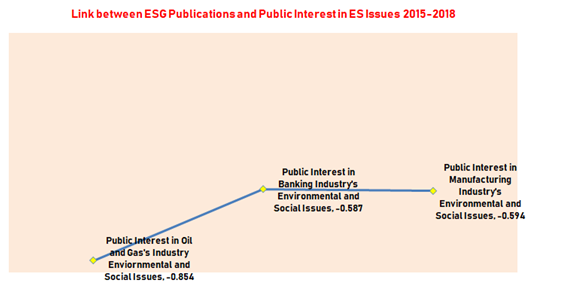
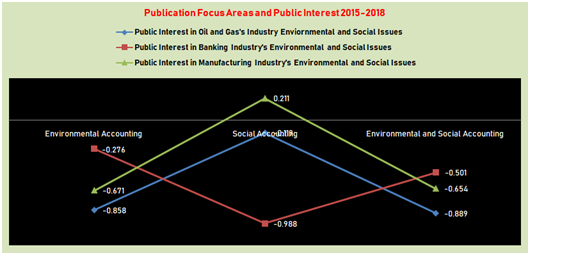
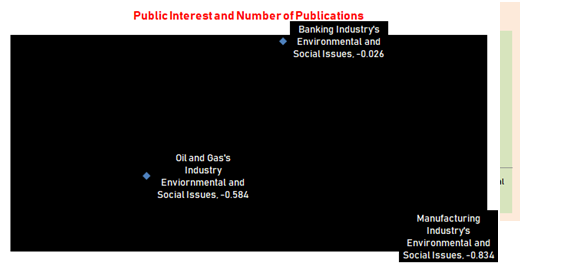
For the 4 years examined, environmental and social issues from the activities of the oil and gas companies occupied public minds than those generated in banking and manufacturing industries. Analysis shows that the higher the public interest in environmental and social issues, the lower the publications by the scholars. This suggests that publications were not resonating with the public need. However, analysis suggests that there was a low positive connection between the public interest in the manufacturing industry’s environmental and social issues and publications by the scholars within social accounting.


Source: Google Trends, Journal Articles and Infoprations, 2019


Source: Google Trends, Journal Articles and Infoprations Analysis, 2019


Source: Google Trends, Journal Articles and Infoprations Analysis, 2019

Looking Ahead

Academia need to intensify researches within environmental accounting in addition to social accounting researches, especially for the oil and gas, and banking industries. These two industries are critical to the country’s attainment of 7 out of the 17 SDGs. Businesses must also deem it fit to comply with the necessary guidelines on the preparation of sustainability reports.

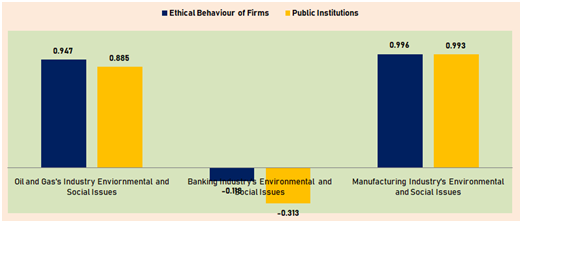
In this regard, adherence to the corporate ethics must be prioritised because analysis suggests that the current global ranking for the country within the ethical behaviour of firms’ indicator resonated with the public interest in environmental and social issues, especially in the oil and gas, and manufacturing industries than the banking industry.

The negative link between the public interest in environmental and social issues signifies the possibility of the players in the banking sector non-adherence to the corporate ethics during the period under review. To ensure adequate compliance, government needs to strengthen institutional framework and processes being used for corporate governance and sustainability practice. This is essential as the public interest in ESA aligned with the country’s poor ranking on public institutions’ indicator.

Source: World Economic Forum, 2018; Google Trends, Infoprations Analysis 2019


Anything is Nothing When Starting a Business

4

By Jude Odika

Three weeks ago, I had a brief chat with an acquaintance who recently started a small agri-business. In the course of our discussion, I was curious about how the person came about the business idea, and what prompted the person to go into business as against going the conventional route of seeking and taking up employment right after college. So, I asked. The response I got was that the person had applied to several jobs and after interviewing with two different companies and got no positive result, the person resorted to entrepreneurship. In the person’s opinion, instead of striving so hard to get an employment and ‘slave’ for another person, it is better to strive hard knowing that you are working for yourself. And this really got me thinking.

Now, I was not so concerned about personal capabilities here, because I think this person is intelligent and smart. But I am very concerned about the thought process that led to the person’s decision to go into business. I think that this person, just like many others out there, have misconstrued the concept of entrepreneurship and what it takes to achieve success in that space. And unless this level of thinking is upgraded very quickly, there might not be a business before long.

In part one of this two-part series, I wrote about being intentional about your career path. It was basically for those that are about to begin their career and those seeking to make progress in theirs. In this sequel, I would like to address individuals who want to, or have already started up ‘anything’ in the form of a business, all in the name of being referred to as an entrepreneur or simply being their own boss, and not having to answer to anyone. I hope to help these individuals understand why ‘anything’, in the context of starting a business without a solid mission, ultimately amounts to nothing as well.

I believe that, if you are going to start any business primarily because you could not secure a job, then your chances of achieving entrepreneurial success are almost next to none, especially if you do not have any prior experience of running a business. If you think that because securing a job is very hard then you would have better luck with entrepreneurship, you just might be in for a big surprise. This is not to say that everyone who starts a business right out of college would not succeed. No, it goes to say that those who do it just for the sake of the status, without an evolving sense of mission overtime, typically don’t succeed. Join me as I share my thoughts on why jumping right into starting a business for two categories of individuals is a poor strategy, and might ultimately be a bad idea.

Those in the first category are fresh college graduates. You see, there is this present rave about being an entrepreneur, so much that both those who are and those who think they are almost wear it like a badge of honour. And now, almost every graduate wants to be an entrepreneur right out of school. They want to do their own ‘thing’ and get access to the big bucks (especially investor funds) as quickly as possible. What I find interesting is that these people typically draw their inspirations from absorbing contents around the successes of the likes of Mark Zuckerberg, Jeff Bezos, Steve Jobs, etc. But they do little to absorb contents around, and possibly get inspiration from, the processes that equipped these people with the capabilities that have now allowed them to attain great entrepreneurial success. The keyword here is capability!

Capability enables you to execute on any business idea backed by a great sense of mission. In order words, no matter how great your business idea might be, if you do not have the capability to execute properly, you will get minimal or no success. In fact, an average idea backed by excellent execution will always do better than an excellent idea backed by average execution. So, dear fresh college graduates, before you engage in your lofty dreams of being the next Steve Jobs or Jeff Bezos, be certain that you have what it takes to execute; because if you don’t, you will not be able to attract quality investors for your venture. I’ll tell you that for free as someone who has been there, done that. Invest in yourself first, and acquire as much knowledge and skills as possible before you begin your entrepreneurial journey. Read books, volunteer, take up a job. But not just any volunteer opportunity or any job, be deliberate about it; seek out the ones that will help you acquire the skills you need faster. Doing that comes with a double advantage: you learn what you need to drive your mission, and while at it, you earn what you need to take care of your bills.

Those in the second category are those who are already in paid employment, but want to start their own business because they are frustrated at their jobs. The first thing that comes to my mind whenever I encounter people like this is: show me a job or endeavour that does not come with some level of frustration, and I will show you a job or endeavour that does not exist. Now, I am not advocating that you should stay in a toxic work environment where there is no regard for the dignity of work and the humans that put in the work. My point here is, try to focus on the learning opportunities rather than allowing the frustrations get to you. And when you have reached the height of the learning curve, then it is time to exit to the next venture. Approaching job frustrations from this perspective will help you build resilience – a core skill you must have as an entrepreneur anyways. But if there are no specific learning opportunities for you there, then you shouldn’t be there in the first place, frustrations or no frustrations. And when you have acquired the skills and capabilities that you will need to succeed in that business venture you have been thinking about, then you can launch. But not before. It is true that Nigeria and Africa in general need more businesses that are solving real life problems, but these businesses have to be sustainable and even scalable for them to effectively address the present challenges plaguing the continent. And one of the key components of a sustainable and scalable business is excellent execution, and that you can achieve by acquiring relevant capabilities.

In conclusion, I submit that until we upgrade our thought process to approach entrepreneurship and business in general from the perspective of giving rather than getting, our businesses will continue to struggle in many ways. If we focus on giving value, then we would naturally get rewarded by getting value in return. This does not mean that running the business will be very smooth and there will be no challenges; no, there will be challenges and this is where the core skill of resilience comes into play. The fastest way I know to build your ability to give value, is to constantly give value where ever and when ever is possible to do so. No matter how little or insignificant you think it might be, do it consistently and you will get better at it. And while you are it, always keep in mind that you cannot give what you don’t have. So, the more you acquire capabilities, the more you are able to give value, and the more you get value. However, in all you acquire, give, and get, find and stay true to your purpose!